Urdu Row Erupts in Srinagar: Identity Meets Policy
By: Javid Amin | 28 April 2026
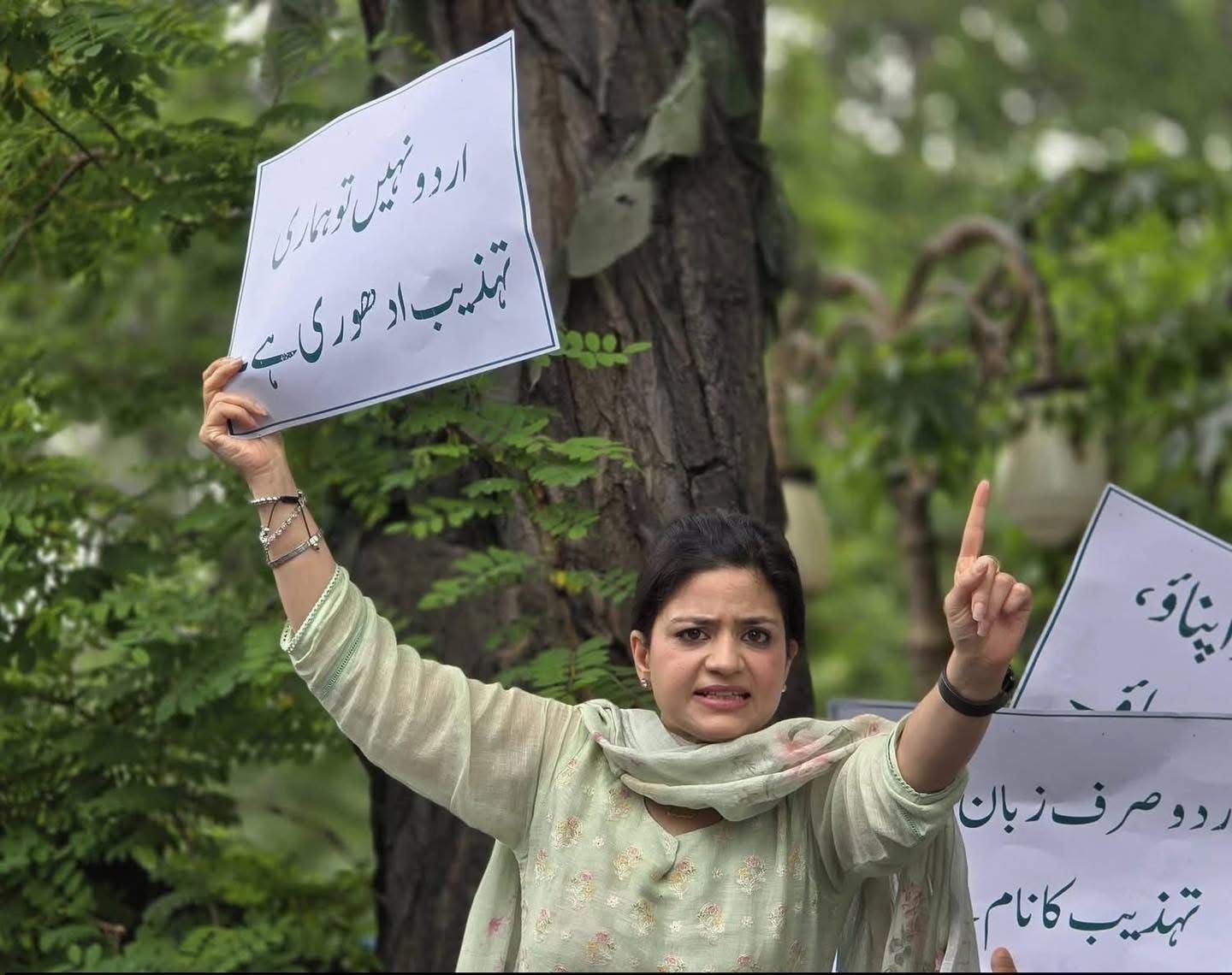
Fresh political tensions have gripped Srinagar after the People’s Democratic Party (PDP) staged protests against a proposed change in recruitment rules that drops Urdu as a mandatory qualification for key revenue posts.
Led by Iltija Mufti, demonstrators called the move an “attack on Kashmir’s identity,” transforming what appears to be an administrative tweak into a full-blown cultural and political flashpoint.
What Triggered the Controversy?
The issue stems from a recruitment-related decision by the
Jammu and Kashmir Services Selection Board (JKSSB).
Key Change
- Urdu proficiency removed as mandatory for posts like:
- Naib Tehsildar
- Patwari
Instead, candidates proficient in any of J&K’s official languages may now be eligible.
Legal Backdrop: Tribunal Intervention
The shift did not emerge in isolation—it follows a ruling by the
Central Administrative Tribunal (CAT).
What CAT Said
- Stayed parts of the 2009 recruitment rules mandating Urdu
- Directed authorities to broaden eligibility
- Emphasized inclusion of all official languages of J&K
Legally, the move aligns with post-2020 language policy—but politically, it has triggered backlash.
PDP’s Stand: “Attack on Identity”
For the People’s Democratic Party, the issue is existential—not procedural.
Core Arguments
- Urdu is a linguistic bridge across communities
- Central to administration and land records
- Dropping it weakens cultural continuity
Iltija Mufti demanded an immediate rollback, framing the move as:
A deliberate attempt to erase Urdu from governance
Government & NC Response: “Draft, Not Final”
Officials linked to the National Conference government have adopted a more measured tone.
Key Clarifications
- The notification is only a draft
- Public objections and feedback are invited
- Urdu remains important in syllabus and records
This suggests a policy in flux, not a final decision—though politically, the damage may already be done.
Timeline: Urdu’s 137-Year Role in J&K Governance
Historical Evolution
| Year | Event | Significance |
|---|---|---|
| Pre-1846 | Persian as court language | Administrative legacy under earlier regimes |
| 1889 | Urdu replaces Persian under Maharaja Pratap Singh | Beginning of Urdu’s official dominance |
| 1947 | Urdu retained post-accession | Became symbol of unity |
| 1960s | English gains prominence | Administrative shift begins |
| 2009 | Urdu mandatory for revenue jobs | Ensures continuity in records |
| 2020 | Jammu and Kashmir Official Languages Act | Adds Hindi, Kashmiri, Dogri, English |
| 2025–26 | CAT ruling + rule change debate | Sparks current protests |
Why Urdu Still Matters
Administrative Backbone
- Land and revenue records historically maintained in Urdu
- Essential for interpreting legacy documentation
Cultural Identity
- Not a native tongue for most—but a shared administrative language
- Bridges Kashmiri, Dogri, Gojri, and Pahari speakers
Literary Heritage
- Deep roots in poetry, literature, and public discourse
Urdu’s role is functional + symbolic, making policy changes highly sensitive.
The Core Debate: Inclusion vs Heritage
| Issue | PDP View | Govt/Tribunal View |
|---|---|---|
| Language Policy | Urdu central to identity | Multiple languages ensure inclusion |
| Governance | Removal disrupts administration | Transition manageable |
| Politics | Cultural erosion | Administrative modernization |
This is not just a policy shift—it’s a philosophical clash over identity vs accessibility.
Political Fallout: A New Flashpoint
PDP vs NC
- PDP accuses National Conference of compromising on identity
- आरोप of indirect alignment with BJP’s broader policies
Broader Narrative
- Language becomes a proxy for autonomy debate
- Reinforces perception of cultural dilution post-2019
Ground Reality: The Practical Challenge
Even if rules change, one hard constraint remains:
Most land records are still in Urdu
This creates a functional dilemma:
- New recruits without Urdu skills may struggle
- प्रशासन may need translation systems or retraining
Policy change without administrative transition could create operational inefficiencies.
What Happens Next?
Short-Term
- Public objections to draft rules
- Continued protests and political mobilization
Medium-Term
- Possible policy revision or partial rollback
- Legal scrutiny if challenged
Long-Term
- Gradual shift toward multilingual administration
- Or reassertion of Urdu’s central role
Bottom Line
The Urdu row in Jammu & Kashmir is not merely about recruitment criteria—it is about identity, history, and political trust.
For the People’s Democratic Party, it is a fight to preserve cultural continuity.
For the administration, it is an attempt to balance inclusivity with practicality.
The unresolved question remains:
Can J&K modernize its language policy without diluting its historical identity?
In Kashmir, language is never just language—it is politics, memory, and power combined.


