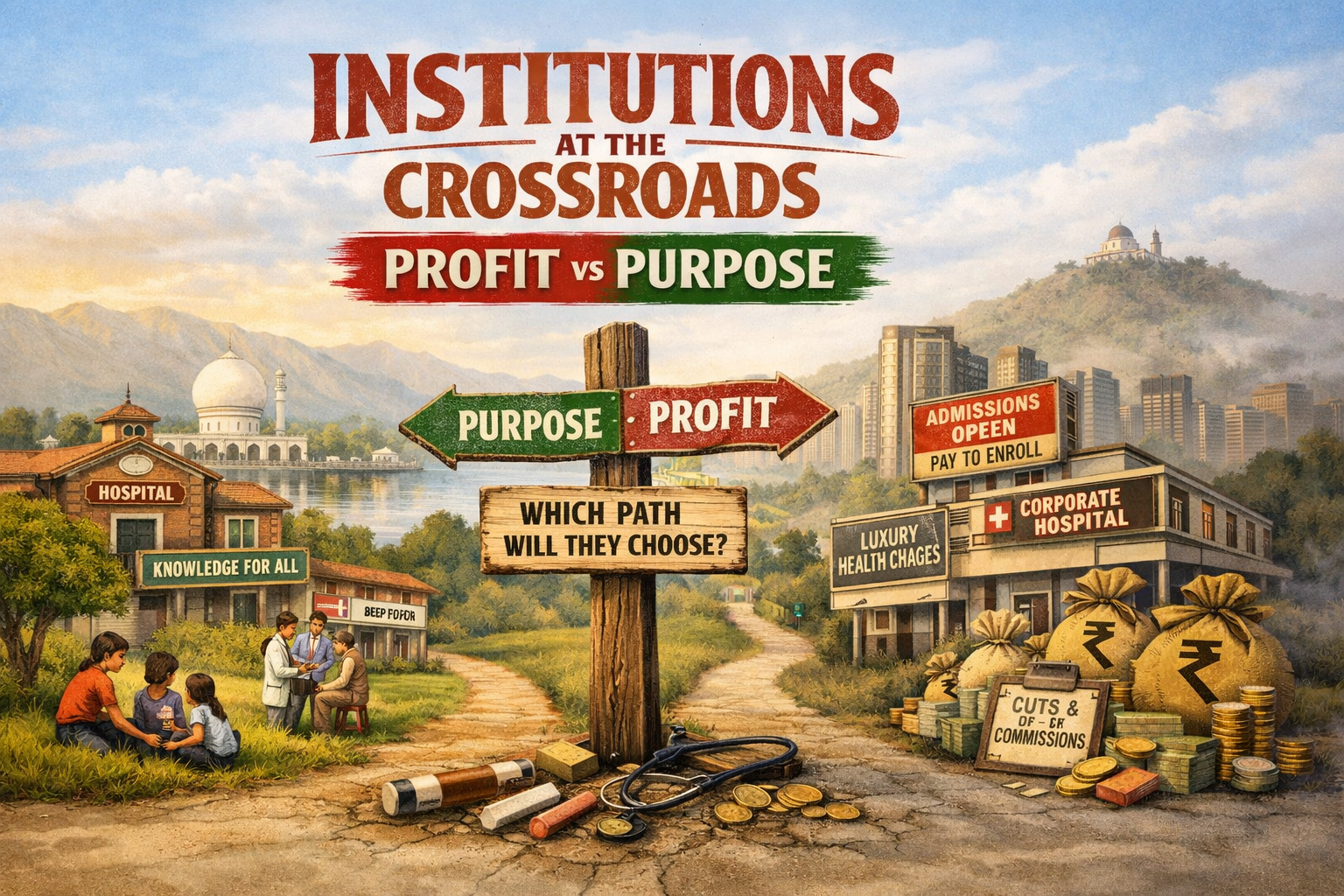
When Noble Professions Lose Their Soul | Education & Healthcare Commercialization in India
By: Javid Amin | 03 May 2026
The Day the Torch Went Out
There is a story that teachers in ancient India told their students before anything else — “Acharya Devo Bhava.” The teacher is God. And in the same breath, healers were considered extensions of Dhanvantari, the divine physician. These were not just professions. They were callings. They were the invisible architecture holding civilization together.
That architecture is cracking.
Today, in cities and towns across India — and across much of the world — the very mention of “school admission season” fills parents with dread, not hope. And a visit to a private hospital can drain a family’s savings faster than a medical emergency itself. Something has gone profoundly wrong. The people we once called gurus and vaidyas — those who lit minds and mended bodies — now operate in systems that prioritize profit margins over purpose.
This isn’t a story about a few bad apples. This is about orchards that have been quietly, systematically replaced by something else entirely.
The Classroom Has Become a Marketplace
Learning for Sale — How Education Turned Commercial
Education, at its core, is a relationship — between a curious mind and a patient guide. That relationship has been steadily monetized, packaged, and sold back to the very families it was supposed to serve for free.
The commercialization of education refers to the growing trend of educational institutions — particularly private ones — prioritizing revenue generation over the primary goal of providing quality and accessible education. It includes practices like high tuition fees, aggressive marketing, exam-focused coaching, and curriculum decisions driven by market demand rather than holistic learning. This shift transforms education from a public service into a business venture — one where students are increasingly treated as revenue sources.
The numbers tell a stark story. India currently invests around 4.3 percent of its GDP in education, lower than the 6 percent recommended by the Kothari Commission. As public investment stagnates, private institutions have rushed in — not always with noble intent.
The Rise of the ₹50,000-Crore Shadow Education Industry
Walk into any middle-class neighborhood in India, and you’ll find more coaching centers than libraries. This isn’t a coincidence — it’s a crisis hiding in plain sight.
India’s private coaching sector was valued at $6.50 billion in 2024 and is projected to grow to $17.40 billion by 2033 — a massive industry that expanded without a robust regulatory framework. To put that in perspective: this is not a supplement to education anymore. It has become a parallel education system — one that families pay for twice, after already paying school fees.
Private coaching incidence has risen sharply — from 19.8% overall in 2017–18 to 27.0% in 2025 — signalling an alarming increase in dependence on supplementary coaching. In urban areas, the number is even more sobering: nearly 1 in 3 school students now attends private tuition classes, according to government data.
When families divert precious household income toward tuition centers and coaching classes, they’re signaling one thing: schools aren’t delivering the ROI parents expect. This is a systemic vote of no confidence in formal schooling — and the system, rather than fixing itself, has simply built another expensive lane around the problem.
The Capitation Fee Scandal — Paying to Study
Of all the ugly faces of education commercialization, the capitation fee is perhaps the most brazen.
In the context of Indian law, a capitation fee refers to the collection of payment by educational bodies not included in the prospectus of the institution — usually in exchange for admission. While education is not meant to be a commercial practice, corruption in educational institutions has made a noble endeavor into a “notorious business” that has been repeatedly raided by governmental authorities, resulting in identification and seizure of unaccounted wealth.
The Supreme Court has noted that educational institutions cannot charge capitation fees or make education a business. However, regulating commercialization while encouraging private investment remains a challenge.
The damage runs deeper than money. The capitation fee has been considered one of the reasons for the exorbitant hike in healthcare costs and deteriorating medical standards — because those who complete their course by paying capitation fees are looking for a “return on investment.” Such attempts to recover investment fuel unethical practices.
Think about that for a moment. A student who paid ₹1 crore in capitation fees to get into a medical college doesn’t graduate with a calling to heal — they graduate with a debt to recover. The rot begins before the stethoscope is even worn.
Kota and the Cost of Ambition — When Pressure Kills
The city of Kota, Rajasthan, has become a symbol of everything that has gone wrong with India’s education culture. Tens of thousands of students pour into its coaching factories every year, chasing seats in IITs and medical colleges. The coaching centers grow richer. The children grow hollower.
Intense academic pressure, especially in coaching hubs like Kota, has been linked to a rising number of student suicides. In 2023, Kota reported 26 student suicides, prompting urgent calls for reform. These were not failures of individual children. They were failures of a system that commodified their dreams and crushed their spirits in the process.
Many coaching centers charged excessive fees, promised guaranteed ranks, and had unclear refund policies — financially and psychologically burdening students and parents. The Ministry of Education introduced “Guidelines for Regulation of Coaching Centers 2024” to establish a legal framework, but the cultural machine grinds on.
Branding Over Learning — The Instagram University
Here’s a test: visit the website of any major private university or school in India today. Count the number of times you see the words “learning,” “curiosity,” or “wisdom.” Then count how many times you see “placement,” “ranking,” “campus life,” or “industry-ready.”
The language has shifted. And language always follows culture.
When profit becomes the primary motive, some institutions prioritize enrollment targets over academic rigor. They may hire underqualified staff, inflate grades to maintain attractive pass rates, or focus resources on marketing rather than curriculum quality.
Private schools, coaching centers, and international universities cater to the elite, creating parallel education systems that exacerbate inequality. Meanwhile, public schools — underfunded and deprioritized — serve those who cannot afford private alternatives. The result is a two-tier system where quality education is determined not by merit but by the financial capacity of a student’s family.
Education has stopped being a ladder. For millions, it has become a wall.
The Hospital Has Become a Business Hotel
When Care Became Calculation
In the healing arts, there is a principle older than any hospital: Primum non nocere — “First, do no harm.” Today, one might add a modern addendum that many institutions seem to live by instead: First, do no loss.
The focus shifted toward declaring dividends to shareholders and from patient care to generating profits. Unlike other sectors, technology and infrastructure investment in medical services resulted in increasing prices, while competition entailed a “race to the bottom” with the “kickback” culture taking root.
India’s healthcare system, for all its brilliance — world-class doctors, cutting-edge hospitals, affordable medical tourism — has a deeply troubling underbelly.
The Kickback Economy — India’s Open Secret
Ask any general practitioner, any patient who has navigated a referral chain, any pharmacist in a busy city — they will tell you what the textbooks won’t.
The rampant spread of kickbacks and cut-practice by doctors — from pharmacy shops, diagnostic centers, and hospitals in return for unnecessary referrals — has attracted much media attention. The increasing trend toward prescribing a battery of tests, irrational medication, or unnecessary procedures and surgeries are all facets of the process of commodification of healthcare.
India’s healthcare system has become a vast network of unregulated private sector hospitals. This lack of regulation, coupled with intense competition, encourages doctors — who are often under substantial financial pressure — to prescribe expensive investigations and perform operations which a patient might not need, in order to increase their profit margins.
According to a WHO-Eurohealth publication, health sector corruption in India includes not only collusion, bribes, and kickbacks in procurement, but also doctors’ willingness to accept payments in exchange for special privileges, and distortions in medical professionals’ prescribing practices.
This is not corruption hiding in the shadows. It is corruption wearing a white coat.
The Medical College Scandal — Buying the Right to Heal
The rot doesn’t begin in hospitals. It begins in the medical colleges that produce the doctors.
India’s Central Bureau of Investigation has alleged widespread bribery and collusion between government officials and private medical colleges, raising urgent concerns about the integrity of medical education and the future quality of healthcare in the country.
According to the CBI, large-scale bungling took place in the implementation of NRHM. The modus operandi for siphoning off state wealth included overpricing, fake supply of medicines and hospital equipment by fictitious firms, as well as huge kickbacks in construction activity to improve health services in government-run primary health centers in rural areas.
When the system of producing doctors is itself compromised — when admission is sold, when degrees are purchased — what kind of healer walks out at the end? What does a patient receive when they place their life in those hands?
The Prescription Trap — Tests You Don’t Need
Here is a scenario millions of Indian patients know well. You visit a doctor with a simple complaint — a persistent cough, a mild fever, a backache. You leave with a prescription for three different tests at a specific diagnostic center, two specialist referrals, and a list of branded medicines from a pharmacy next door.
Every link in that chain pays a commission. The diagnostic center pays the doctor a referral cut. The pharmacy pays on branded prescriptions. The specialist pays a “introduction fee.” The patient pays for all of it — twice: once in money, once in unnecessary anxiety.
Doctors have been known to take bribes from other healthcare entities in return for patient referrals, or to accept kickbacks from pharmaceutical companies disguised as “professional fees” in order to outcompete other private hospitals.
Corruption in healthcare includes bribes paid to procure government contracts, to manipulate and falsify records, to speed up permission procedures, and to influence legal outcomes to avoid punishment for wrongdoing.
The patient — already sick, already frightened — has no way to know what is medically necessary and what is financially motivated.
How Did We Get Here? — The Anatomy of a Collapse
The System Was Set Up to Fail
To be fair to individual teachers and doctors — many of whom enter their professions with genuine idealism — the system around them has been designed, whether by accident or design, to reward the wrong things.
A corrupt education system feeds into a corrupt governance system, creating a vicious cycle that hampers the nation’s growth and social equity.
In medicine, because healthcare in India is inexpensive by Western standards, private health insurance is relatively rare, and a sizeable majority of total health expenditures are made out-of-pocket. With little regulation and without meaningful price negotiation by either the government or private insurance companies, India’s healthcare system has become a vast network of unregulated private sector hospitals.
Doctors — especially those who have paid enormous capitation fees to get their degrees — enter practice already behind financially. They work in an unregulated market where the incentives are aligned not with healing but with billing. The individual doctor’s moral choices happen inside a system that punishes virtue and rewards extraction.
The same is true for teachers. A school teacher in a government school earns far less than a coaching center star-faculty. The market has made its values clear. Knowledge is valued only when it can be packaged and sold.
The Global Problem With an Indian Face
This crisis is not uniquely Indian — but India’s scale, population pressure, and regulatory gaps make it uniquely acute here.
Only 18% of countries are meeting the internationally agreed minimum benchmarks for public education expenditure, according to a 2024 UNESCO report. As public investment stagnates, private institutions fill the gap — but at a cost that systematically excludes the poor. This directly undermines UN Sustainable Development Goal 4, which calls for inclusive and equitable quality education for all.
When governments abdicate their responsibility in education and healthcare, the private sector fills the vacuum — but the private sector follows money, not mission. The result is a system that serves those who can pay and abandons those who cannot.
The Human Cost — Who Really Pays?
The Student Who Lost More Than an Exam
Behind every statistic is a human story. The child from a small town in Uttarakhand whose parents mortgaged their land to pay for a coaching center that promised a medical seat. The girl from a middle-class family in Chennai who spent three years in Kota, failed NEET twice, and came home a stranger to herself. The first-generation learner who took an education loan from a private college only to find the degree wasn’t worth the paper it was printed on.
These are not edge cases. These are the faces of a system that decided profit mattered more than people.
The Patient Who Trusted and Lost
And then there is the patient. The elderly woman in a village who traveled four hours to see a specialist, only to be sent back with a bag of unnecessary medicines. The family that spent their entire savings on a surgery that may not have been needed. The young father who died because the doctor chasing insurance claims prescribed the wrong drug.
Trust — once the foundation of the doctor-patient relationship — has become a liability in the new economy of healthcare.
Reclaiming the Soul — What Can Actually Be Done
The Path Back Is Not Nostalgia — It’s Accountability
Romanticizing the past won’t fix the present. What is needed is not a return to some imagined golden age — it is a structural reset of incentives, accountability, and governance.
In Education:
- Regulate coaching centers ruthlessly. The government’s 2024 guidelines are a start, but enforcement must follow words. The Centre has suggested that coaching centers be penalized up to ₹1 lakh or have their registration cancelled for charging exorbitant fees that cause undue stress. This needs to be implemented without fear or favor.
- Increase public investment. India must move toward the Kothari Commission’s recommended 6% of GDP for education. Quality public schools are the only real counter to exploitative private ones.
- Reform entrance examinations. The NEET and JEE ecosystem feeds the coaching industry. A Centre-appointed committee, headed by Secretary Vineet Joshi, is currently considering holding entrance exams in Class 11 or aligning their difficulty with the grade’s curriculum to reform exams and lessen the dependency on coaching. This reform, if implemented faithfully, could break the coaching cartel’s stranglehold.
- Reward teachers for outcomes, not optics. Teacher salaries in public schools must be competitive. A profession that is underpaid will be undervalued — and will lose its best people to commercial alternatives.
In Healthcare:
- Create a transparent fee disclosure system. Patients have a right to know what tests cost, what commissions are embedded in referrals, and what alternative treatments exist.
- Strengthen the National Medical Commission. For the purpose of regulating physician practice along ethical norms and ensuring the quality of medical education, robust regulatory systems must be enforced — not just exist on paper.
- Expand public health infrastructure. AIIMS-type institutions in every state, district hospitals that are actually functional, and primary health centers with dignity — these are the antidotes to corporate hospital dominance.
- Protect whistleblowers. Doctors who refuse to participate in kickback cultures often pay a professional price. A system that protects ethical practitioners is one that has a chance of producing more of them.
The Role of Civil Society — Us
Systemic change requires political will, but it is sparked by social pressure. Patients who share their experiences. Parents who refuse to pay capitation fees even when pressured. Teachers who choose classrooms over coaching centers. Doctors who prescribe only what is needed, and name the system that makes ethical practice so hard.
Every honest transaction in education and healthcare is an act of resistance. Every parent who asks “why is this test necessary?” is pushing back. Every student who chooses a public school over a debt trap is voting for a different future.
Conclusion: The Torch Must Be Reclaimed
There is still a teacher somewhere in India who stays after class to explain a difficult concept to a struggling student — not for extra fees, but because that is what a teacher does. There is still a doctor who listens to a patient for more than three minutes, who prescribes the cheapest effective drug, who tells a family the hard truth that surgery is not needed.
They exist. But the system makes their lives harder every year.
The crisis of commercialization in education and healthcare is not just an economic problem. It is a moral emergency. When the people entrusted with the most intimate human needs — the formation of young minds and the healing of sick bodies — are incentivized to exploit rather than serve, civilization itself is diminished.
Education must return to enlightenment — not just enrollment. Medicine must return to healing — not just billing. And accountability must replace the apathy that has allowed this rot to spread for decades.
The torch of humanity that teachers and healers once carried has not been extinguished. It has been sold. It is time to buy it back — at whatever cost that takes.
This article is independently researched and written. All statistics cited are from verified public sources including government surveys, peer-reviewed journals, and established research institutions. If you are a student, patient, parent, teacher, or medical professional with a story to share, the conversation must continue.

