BJP Protests Against Liquor Sales in Kashmir, Marches Towards Omar Abdullah Residence Over Policy Row
By: Javid Amin | 15 May 2026
“Will Not Allow Liquor Stores on This Land”: BJP Warns of ‘Lockdown’ Over Kashmir Liquor Policy
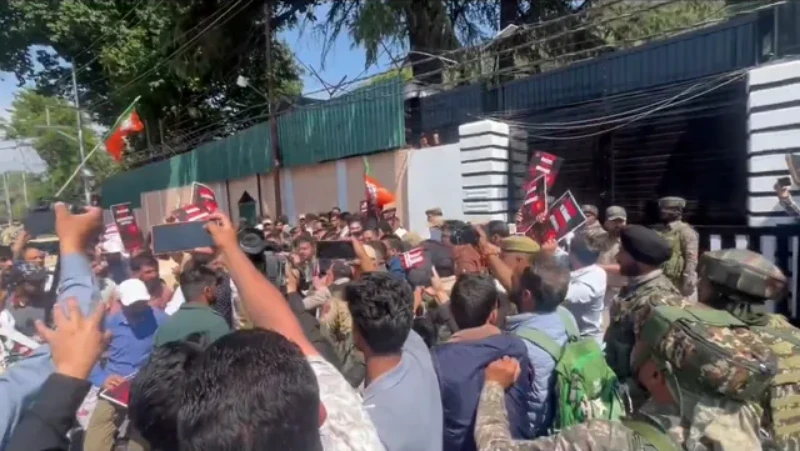
Political temperatures in Jammu & Kashmir have risen sharply after the Kashmir unit of the Bharatiya Janata Party staged protests against the alleged expansion of liquor sales in the Valley, marching towards the residence of Chief Minister Omar Abdullah and issuing a strong warning against opening new liquor outlets.
The protest has reignited one of Kashmir’s most emotionally charged political debates — the clash between cultural identity and economic modernization.
BJP leaders declared they would “not allow liquor stores to open on this land,” accusing the administration of disregarding religious sensitivities and promoting what they described as “moral decay” in the Valley.
The demonstration, though political in nature, reflects a much deeper and decades-old conflict in Kashmir’s public discourse: whether tourism-driven economic reforms should override conservative social sentiment.
Why Liquor Policy Becomes a Flashpoint in Kashmir Politics
Unlike many other Indian regions where alcohol policy is largely debated through taxation and public health lenses, liquor sales in Kashmir carry powerful cultural, religious, and political symbolism.
In the Kashmir Valley, alcohol consumption has historically remained socially discouraged due to the region’s overwhelmingly Muslim demographic and conservative social fabric.
As a result, every government attempt to regulate, expand, or normalize liquor sales has triggered protests — regardless of which party was in power.
The latest BJP protest is therefore not merely about licensing policy. It is about identity, symbolism, and political positioning.
BJP’s Protest: What Happened?
March Towards CM Omar Abdullah’s Residence
BJP workers and activists marched in protest towards Omar Abdullah’s residence, demanding immediate rollback of any move perceived as encouraging liquor sales in Kashmir.
The protest was framed as a defense of Kashmiri culture and religious values.
Party leaders accused the government of prioritizing revenue generation and tourism optics over public sentiment.
The BJP’s Kashmir unit also warned of a “lockdown-style agitation” if liquor outlets were opened or expanded in the Valley.
The language used during the protest indicated the party’s attempt to tap into conservative social anxieties while positioning itself as a protector of Kashmiri cultural identity.
Government’s Argument: Regulation Over Illegal Trade
While opposition groups have intensified criticism, successive administrations in Jammu & Kashmir have defended regulated liquor licensing using economic and administrative arguments.
Government officials and policy advocates generally argue that:
- Controlled liquor sales help reduce illegal alcohol trade
- Tourist destinations require regulated hospitality infrastructure
- Licensing generates revenue for administration
- Regulation is preferable to underground supply networks
Tourism-dependent areas such as Gulmarg and Pahalgam have historically seen limited licensed liquor operations catering primarily to visitors.
Supporters of regulation argue that tourism economies across India rely heavily on hospitality ecosystems that include controlled alcohol access.
However, in Kashmir, even limited expansion often triggers intense public backlash.
Liquor Policy in J&K: A Political Timeline
1980s: Limited Licensing Era
During the 1980s, liquor outlets were mostly concentrated in Jammu, while the Kashmir Valley remained informally “dry” due to strong social opposition.
Alcohol sales existed but remained limited and discreet.
1990s: Insurgency and Social Conservatism
The rise of militancy in the 1990s dramatically altered public space in Kashmir.
Most liquor outlets in the Valley shut down during this period, either because of security concerns or militant pressure.
Alcohol increasingly became associated with Western influence, moral decline, and anti-cultural narratives.
The issue evolved from a commercial debate into an identity-driven political symbol.
2002: Mufti Mohammad Sayeed Government
The government led by Mufti Mohammad Sayeed cautiously permitted limited reintroduction of liquor services in tourism-focused destinations such as Gulmarg and Pahalgam.
The move immediately sparked protests from religious groups and opposition parties.
Critics argued that tourism should not come at the expense of local cultural values.
2010: Omar Abdullah Government Faces Backlash
During Omar Abdullah’s earlier tenure as Chief Minister, attempts to expand licensed liquor operations triggered demonstrations across several areas.
Interestingly, opposition came from ideologically different groups — including BJP voices and separatist organizations — both of whom accused the government of ignoring Kashmiri traditions.
The controversy demonstrated how liquor policy could unite otherwise opposing political camps under cultural rhetoric.
2015: Mehbooba Mufti Era
Under the government led by Mehbooba Mufti, discussions around additional outlets once again generated protests.
Religious leaders and conservative organizations organized demonstrations demanding rollback of proposed expansions.
The administration ultimately faced intense pressure to move cautiously on the issue.
Post-2019 Reorganization: New Administrative Dynamics
Following the 2019 reorganization of Jammu & Kashmir into a Union Territory, licensing systems increasingly aligned with broader national administrative frameworks.
This period saw renewed debates around liquor regulation, tourism infrastructure, and modernization.
Political parties across ideological lines began using the issue to mobilize public sentiment.
Ironically, parties that supported liberalized economic policies nationally sometimes adopted culturally conservative positions within Kashmir — reflecting the region’s unique political sensitivities.
2026: BJP’s Current Protest
The latest BJP protest marks the newest chapter in this recurring political cycle.
The party’s warning of a “lockdown” if liquor stores are opened has intensified political polarization and reignited debates around governance priorities in the Valley.
At the same time, critics accuse political parties of selective positioning — opposing liquor expansion in Kashmir while supporting similar policies elsewhere in the country.
This has triggered fresh accusations of symbolic politics rather than consistent policymaking.
Why Cultural Issues Dominate Regional Politics in Kashmir
Symbolic Politics and Identity Assertion
In Jammu & Kashmir, cultural issues frequently become tools of political mobilization.
Topics such as:
- Liquor sales
- Religious practices
- Dress codes
- Land rights
- Cultural preservation
often carry political weight far beyond their immediate policy implications.
Political parties use these issues to project ideological authenticity and connect emotionally with local voters.
Liquor policy, in particular, has become shorthand for a broader debate about preserving Kashmiri identity amid rapid political and administrative change.
Economic Modernization vs Cultural Conservatism
The controversy also reflects a larger governance challenge facing every administration in Jammu & Kashmir.
The Economic Argument
Supporters of regulated liquor sales argue that:
- Tourism competitiveness requires hospitality flexibility
- Revenue generation is crucial for economic sustainability
- Illegal alcohol networks flourish without regulation
- Controlled licensing is administratively more effective
With tourism becoming a major pillar of Kashmir’s economy, many business stakeholders privately support pragmatic regulation.
The Cultural Argument
Opponents counter that Kashmir’s social identity cannot be reduced to tourism economics.
Religious organizations, conservative groups, and many local residents argue that:
- Liquor sales contradict local cultural values
- Commercialization risks social erosion
- Tourism should adapt to Kashmir’s traditions — not the other way around
This emotional framing makes the issue politically explosive.
Political Implications of the BJP Protest
1. Rising Political Polarization
The protests deepen tensions between ruling and opposition parties while adding another emotionally charged issue to Kashmir’s political landscape.
2. BJP’s Regional Positioning
The BJP’s Kashmir unit appears to be attempting a calibrated political strategy — aligning itself with conservative public sentiment in the Valley despite the party’s broader national economic positioning.
This reflects how regional politics often reshape party messaging.
3. Pressure on Omar Abdullah Government
The Omar Abdullah administration now faces a delicate balancing act:
- Avoid alienating conservative voters
- Protect tourism-related economic interests
- Prevent the controversy from escalating into wider unrest
Any perceived policy misstep could quickly become politically costly.
4. Youth and Public Sentiment
Public opinion remains divided.
Many residents support restrictions on liquor sales due to cultural and religious beliefs.
Others — particularly business groups and sections of urban youth — argue Kashmir cannot isolate itself economically while simultaneously promoting global tourism.
This generational divide may become increasingly important in future elections.
The Larger Pattern: Every Government Faces the Same Dilemma
One striking feature of Jammu & Kashmir’s liquor policy debate is its consistency across decades and governments.
From Mufti Mohammad Sayeed to Omar Abdullah to Mehbooba Mufti and post-2019 administrations, every leadership structure has encountered the same political dilemma:
Modernize the economy or preserve traditional social expectations?
No government has fully resolved that contradiction.
And because the issue touches identity, religion, governance, and economics simultaneously, liquor policy continues to resurface during politically sensitive moments.
Conclusion
The BJP’s protest against liquor sales in Kashmir is not simply a dispute over commercial licensing. It is part of a much broader political struggle over identity, governance, and the future direction of Jammu & Kashmir.
For the BJP, the agitation offers an opportunity to connect with conservative cultural sentiment in the Valley.
For Omar Abdullah’s government, it presents a difficult governance challenge involving tourism, regulation, and public sensitivity.
And for Kashmir itself, the controversy once again highlights the region’s enduring tension between modernization and tradition — a debate that has shaped its politics for decades and is unlikely to fade anytime soon.