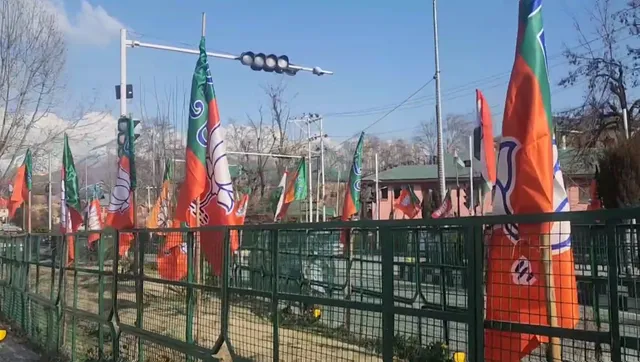
BJP Kashmir Unit to March Towards Omar Abdullah’s Residence Over Liquor Sales Row in Kashmir
By: Javid Amin | 14 May 2026
Liquor Policy Turns Into Fresh Political Flashpoint in Jammu and Kashmir
The Bharatiya Janata Party’s Kashmir unit has announced a protest march towards the residence of Chief Minister Omar Abdullah, escalating the political battle over liquor sales in the Kashmir Valley.
The BJP says the protest is aimed at opposing what it describes as the “expansion” and “normalization” of liquor sales in Jammu and Kashmir, accusing the government of ignoring public sentiment, cultural sensitivities, and religious values associated with the region.
The development has once again brought one of Kashmir’s most emotionally charged political issues back into public debate — the clash between cultural identity and economic governance.
What may appear to be an administrative issue involving licensed liquor outlets has evolved into a broader political confrontation involving religion, tourism, modernization, governance, and regional identity.
Why the BJP Is Protesting
The BJP’s Kashmir leadership has framed the protest as a defense of Kashmiri social and cultural values.
Party leaders allege that the government’s handling of liquor policy is encouraging alcohol consumption in a region where large sections of society remain socially and religiously opposed to it.
The march towards Omar Abdullah’s residence is intended to pressure the Chief Minister into reconsidering policies related to alcohol distribution and licensed sales in the Valley.
According to BJP leaders, expanding liquor availability in Kashmir contradicts local traditions and risks damaging the Valley’s social fabric.
The party has attempted to position itself as speaking for public sentiment, particularly in conservative areas where opposition to liquor sales remains strong.
The issue has also become politically significant because it allows opposition parties to challenge the ruling establishment on questions of identity and governance rather than purely administrative matters.
Liquor Sales in Kashmir: Why the Issue Is So Sensitive
Unlike many other parts of India, liquor policy in Kashmir has always carried deep cultural and political implications.
In the Valley, alcohol is not viewed merely as a commercial product. For many residents, especially in conservative and religious circles, it is linked to questions of morality, tradition, and collective identity.
That is why even small policy shifts related to liquor licensing often trigger intense political reactions.
The controversy reflects a larger debate that has existed in Kashmir for decades:
Should governance prioritize modernization, tourism, and revenue generation, or should public policy align more closely with local cultural and religious sensitivities?
This unresolved tension continues to shape political discourse across the region.
Omar Abdullah Government Under Political Pressure
The protest announcement places Chief Minister Omar Abdullah’s government under renewed pressure from opposition parties.
While the administration has not publicly announced any dramatic expansion of liquor sales, opposition groups claim that the regulatory environment has become more permissive under the current setup.
Government circles, however, argue that regulated liquor sales are necessary for multiple reasons:
- Revenue generation
- Tourism infrastructure
- Prevention of illegal black-market trade
- Regulation and monitoring of consumption
Officials and policy defenders often argue that banning regulated sales entirely could strengthen underground alcohol networks and unlicensed distribution channels.
However, critics insist that economic reasoning cannot override cultural realities in Kashmir.
The BJP’s decision to directly target the Chief Minister’s residence indicates that the party wants to transform the issue into a major political narrative rather than a routine policy disagreement.
A Long and Contentious History of Liquor Politics in Kashmir
The current controversy is part of a much longer political history.
Early Opposition in the 1980s
Religious organizations and conservative social groups began publicly opposing liquor sales in Kashmir during the 1980s, framing alcohol as incompatible with Kashmiri social and religious values.
1990s Insurgency Period
During the peak of militancy in the 1990s, most liquor outlets in the Valley shut down entirely due to militant threats, social pressure, and security concerns.
The issue became deeply intertwined with identity politics and resistance narratives.
Controlled Reintroduction in the 2000s
As tourism gradually revived, successive governments cautiously allowed regulated liquor sales in select tourist destinations such as Gulmarg and Pahalgam.
Authorities argued that controlled licensing would support tourism and reduce illegal alcohol trade.
Yet protests resurfaced repeatedly whenever new outlets were proposed.
Omar Abdullah and Liquor Controversies: A Recurring Political Theme
This is not the first time liquor policy has become politically linked to Omar Abdullah’s leadership.
During Omar Abdullah’s earlier tenure as Chief Minister around 2010, opposition parties and religious groups strongly criticized moves related to licensed alcohol sales and hospitality-linked liquor permissions.
At that time, critics accused the government of disregarding local sentiment in favor of tourism-driven policies.
The current protest revives many of those earlier political narratives.
The BJP is now attempting to portray the present government as disconnected from the Valley’s cultural sensitivities.
The Larger Political Strategy Behind the Protest
Political observers believe the BJP’s protest serves multiple strategic purposes.
Mobilizing Public Sentiment
Liquor policy remains an emotionally resonant issue capable of mobilizing sections of society beyond traditional party lines.
Challenging the Government’s Cultural Positioning
By framing the issue around Kashmiri identity and values, the BJP seeks to politically corner the ruling alliance.
Building Opposition Narrative
The protest allows the BJP to position itself as an aggressive opposition force inside Jammu and Kashmir’s evolving political landscape.
Linking Governance to Morality
The issue also enables parties to shift political discourse from technical administration toward moral and cultural debates, which often attract stronger public reactions.
Public Opinion Remains Deeply Divided
Public sentiment over liquor sales in Kashmir remains far from uniform.
Opposition to Liquor Expansion
Many residents, especially in conservative and rural areas, oppose liquor outlets entirely and see them as socially harmful.
Religious leaders and civil society groups frequently argue that alcohol undermines social stability and local traditions.
Support for Regulated Sales
Others — particularly sections connected to tourism, hospitality, and urban business sectors — argue that regulated liquor sales are part of a modern tourism economy.
Supporters also claim that legal regulation is preferable to unregulated black-market activity.
This divide reflects the broader transformation debate unfolding in Kashmir: how to balance economic modernization with preservation of local identity.
Security Concerns Around the Proposed March
The BJP’s decision to march towards the Chief Minister’s residence could create law-and-order challenges for authorities.
Political marches targeting high-security government zones often require significant deployment of police and security personnel to prevent escalation or confrontation.
Past protests around liquor policy in Kashmir have occasionally witnessed tensions between demonstrators and law enforcement agencies.
Authorities are therefore expected to closely monitor the situation and regulate movement around sensitive locations if the protest proceeds as announced.
Why Liquor Policy Continues to Trigger Political Flashpoints
The persistence of liquor-related controversies across decades highlights how deeply symbolic the issue remains in Kashmir.
Every attempt to expand or regulate liquor sales has historically triggered three overlapping debates:
| Debate | Government Argument | Opposition Argument |
|---|---|---|
| Economic | Tourism and revenue generation | Culture cannot be commercialized |
| Administrative | Regulation prevents illegal trade | Regulation encourages normalization |
| Social | Controlled access is manageable | Alcohol harms social fabric |
Because these debates involve identity and values, they rarely remain confined to policy discussions alone.
Instead, they often evolve into emotionally charged political movements.
A Symbolic Battle Beyond Alcohol
The BJP’s planned march is ultimately about more than liquor outlets.
It reflects a larger struggle over:
- Cultural identity
- Political legitimacy
- Governance priorities
- Public morality
- The direction of social change in Kashmir
For the ruling government, the challenge lies in balancing economic governance with public sensitivities.
For opposition parties, the issue offers a powerful political platform capable of mobilizing emotional and cultural sentiment.
As tensions build ahead of the proposed march, the liquor debate has once again become one of the Valley’s most potent political flashpoints — where policy, identity, and politics intersect in deeply consequential ways.


