Dal Lake Pollution & Restoration 2026 — Srinagar’s Ecological Crisis Explained
By: Javid Amin | 05 July 2026
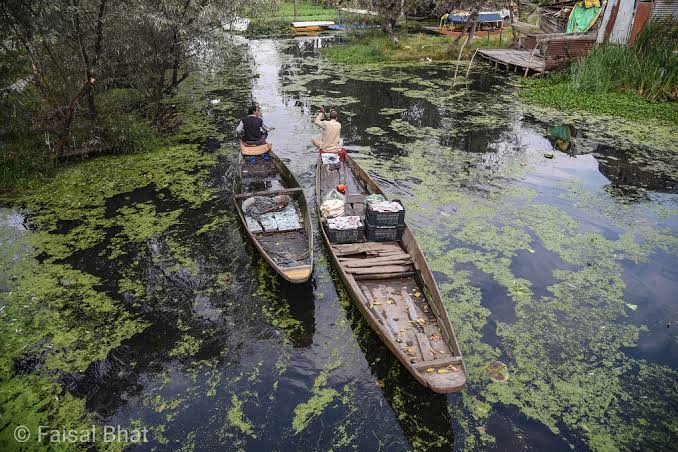
Every morning, narrow wooden shikaras glide across Dal Lake in a scene that looks lifted straight from a postcard — snow-capped Himalayan peaks in the backdrop, lotus gardens in the foreground. But beneath that timeless beauty lies an alarming reality. The water that those boatmen dip their oars into smells foul. Workers who clean the lake’s weeds wear gloves to avoid skin allergies. And the native snow trout — a fish that has called these waters home for centuries — is now on the brink of extinction.
Dal Lake, the beating heart of Srinagar and one of Asia’s most iconic freshwater bodies, is in crisis. Despite massive restoration investments worth over ₹500 crore and years of government intervention, the lake continues to shrink, choke under algae, and absorb millions of litres of untreated sewage every single day. This is the ground reality of Kashmir’s most precious ecological and cultural treasure in 2026.
How Bad Is It? The Shrinking Numbers Tell a Stark Story
Dal Lake, which once spanned over 22 square kilometres in the heart of Srinagar, has now shrunk to a mere 18 square kilometres — a loss of nearly a fifth of its original size. That shrinkage is not just a statistic; it represents lost livelihoods, fading biodiversity, and a cultural wound that has been decades in the making.
The National Green Tribunal (NGT), which has been monitoring the lake’s health closely, painted a grim picture. The court noted that Dal Lake and its two backflow channels — Nayadar and Jogilankar — are almost anaerobic and carry an extremely high organic load, going up to 23.5 milligrams per litre. Anaerobic conditions mean the lake is running dangerously low on dissolved oxygen — a death sentence for aquatic life.
A peer-reviewed study published in January 2025 in the journal Water confirmed the trend. The ecosystem of Dal Lake has been rapidly degraded in recent decades due to intensified eutrophication, with heightened algal blooms bringing significant water quality deterioration, a reduction in indigenous fish populations, and a general disturbance of the ecological balance.
The Root Causes: What Is Killing Dal Lake?
Untreated Sewage — The Biggest Villain
The single largest driver of the lake’s decline is raw sewage. According to data from the Jammu & Kashmir Pollution Control Committee (JKPCC), over 70% of the sewage generated in Srinagar flows untreated into Dal Lake, including domestic waste, human excreta, and harmful chemicals that seep into the water body daily.
The numbers are staggering. Tens of millions of litres of untreated wastewater pour into the lake every day from surrounding settlements, hotels, and the iconic houseboats that have long defined the Dal Lake experience. Sewage drains flow directly into the lake, and water streams coming from the mountains bring waste such as diapers and other garbage, according to Ghulam Rasool, a weed cleaner employed by the local government who described the situation in stark terms.
Algal Blooms and Eutrophication: A Chemical Trap
Where sewage goes, algae follow. Excess nitrogen and phosphorus from sewage and fertilisers cause algal blooms and macrophyte overgrowth, choking open water and reducing dissolved oxygen for fish. Proliferation of weeds like Eichhornia (water hyacinth) reduces water spread and impedes navigation and recreation.
The toxic spiral does not stop there. The blooms, predominantly cyanobacteria, release toxins that harm aquatic species and pose health risks to humans. As one independent scientist put it, the water condition is so bad that effluent conductivity and microbial load can be sensed by the pungent smell and turbidity of the water.
A 2022 study by Sher-e-Kashmir University of Agricultural Sciences and Technology (SKAUST-K) documented how far things have deteriorated: the concentration of total phosphorous had increased from 0.1 to 0.4 mg/l in 1997 to about 6 mg/l in 2017 — a roughly fifteen-fold increase in two decades.
Siltation: The Lake Is Slowly Filling Up
Nearly 80,000 tonnes of silt flow into Dal Lake every year. Deforestation, grazing, and agriculture in the catchment increase silt and nutrient inflow, shrinking effective water area and altering lake morphology. Land use change in the Zabarwan foothills has increased runoff and sedimentation — a process that is essentially accelerating the natural ageing of the lake at an unnatural speed.
Encroachment: When the Lake Loses Ground
The pressure is not just from above the water’s surface — it comes from the shoreline too. Expansion of settlements, houseboats, and floating gardens (locally called raad) leads to encroachment and solid waste generation, converting water areas into marshy land. Illegal construction, unchecked urban growth, and the absence of enforced buffer zones have steadily eaten into Dal Lake’s ecological boundaries.
The Restoration Effort: What Has Been Done So Far
A ₹500 Crore Push With Mixed Results
The government’s response has been significant in scale, if not yet sufficient in impact. The Government of Jammu and Kashmir has launched a comprehensive program for the conservation and restoration of Srinagar’s historic water bodies, including Dal Lake, Nigeen Lake, Anchar, Brari-Nambal, Gilsar, Khushalsar, and Echnambal.
A detailed project report costing ₹273 crore has been approved under the Prime Minister’s Development Plan to cover rehabilitation of Dal dwellers, catchment management, mitigation of silt load, and ecological restoration of the lake ecosystem over five years. This is in addition to existing operational budgets and separate projects, taking the total restoration outlay well past ₹500 crore.
Weed Removal: Expanding Open Water
One of the most visible wins has been in weed removal. The Lake Conservation and Management Authority (LCMA) — a government body set up in 1997 that includes civil engineers, scientists, forest officials, and local police — has been at the forefront of this effort. Over 6.5 square kilometres of aquatic weeds have been cleared, expanding the lake’s open water area to 20.3 square kilometres. Twenty navigation channels have been restored, easing movement across the lake.
The wet biomass collected from weeds is not being wasted either. It is being converted into compost in collaboration with the National Agricultural Cooperative Marketing Federation of India (NAFED), addressing unscientific disposal while generating revenue.
Sewage Treatment Plants: Building Capacity
Five Sewage Treatment Plants (STPs) with a combined capacity of 36.73 million litres per day (MLD) are now operational. A new 30 MLD plant at Guptganga is under construction at a project cost of ₹306 crore — which, once complete, will significantly enhance the city’s ability to treat wastewater before it reaches the lake.
Sewerage networks for 573 houseboats in Dal Lake and 148 houseboats in Nigeen Lake have been connected to treatment plants, ensuring safe disposal of wastewater. In addition, approximately 10–12 MLD of sewage is treated through natural oxidation and detention ponds constructed along the lake peripheries, and land-based bio-digesters have been piloted in Tailbal to scientifically manage household sewage.
While more than 75% of Srinagar’s population is currently connected to sewage treatment systems, sewage from unconnected houses remains a major contributor to lake pollution.
Dredging: Reclaiming Depth
Nearly 200,000 cubic metres of silt have been dredged from the lake floor, helping restore the depth that decades of sediment accumulation had eroded. Combined with 20 restored navigation channels, this has improved the lake’s hydrology and made boating significantly more practical.
Community Relocation: Reducing Human Pressure
Around 3,108 families residing inside Dal Lake have been relocated to various housing colonies to reduce human pressure on the lake ecosystem. This has been one of the most politically sensitive aspects of the restoration program, given how deeply intertwined the lake community’s livelihoods are with the water body itself.
However, a major policy shift occurred in early 2026. The Jammu and Kashmir government decided to shelve the earlier ₹416.72-crore restoration plan — originally approved in 2009 — that sought large-scale relocation of nearly 9,000 families, opting instead for an in-situ conservation model that allows residents to continue living within the lake. The rationale was to balance ecological goals with the social realities of thousands of families whose livelihoods — fishing, vegetable cultivation, houseboat services — depend entirely on Dal Lake.
Surveillance and Catchment Management
To prevent encroachments and illegal construction, lake boundaries have been demarcated using GPS and satellite imagery, and 29 ANPR/PTZ cameras have been installed around the lake periphery, with 35 more cameras under installation from Habak to Dalgate via NIT Srinagar. Violations are being addressed under the JK Control of Building Operations Act and the JK Development Act.
In the catchment areas upstream, around two lakh trees have been planted, and check dams and anti-erosion structures have been constructed to slow silt inflow into the lake.
The Biodiversity Tragedy: A Lake Without Its Own Fish
Perhaps the most heartbreaking consequence of Dal Lake’s decline is the near-extinction of its native fish. The unchecked dumping of human waste has already put the native schizothorax fish — locally known as Kashir Gaad or snow trout — on the verge of extinction. The current study of fish diversity in Dal Lake reveals that the overall catch from the lake is now dominated by exotic Cyprinus carpio, while the native Schizothoracids are represented by just 0.3% of the total catch, restricted to only one site in the lake, near Nishat.
A lake that once nourished a thriving fish community is now largely inhabited by invasive species. The oxygen-depleted, toxin-loaded water has made it impossible for native species to survive and reproduce.
The Human Cost: Livelihoods and Tourism at Stake
Dal Lake serves as the nucleus of Kashmir’s tourism, but scientists, environmentalists, and local communities are now increasingly worried about its deteriorating health. The algal blooms, foul odour, and visible pollution have already begun affecting tourist footfall — and for Kashmir, tourism is not a luxury; it is an economic pillar.
For the thousands who live on and around the lake — boatmen, fishermen, vegetable growers on floating gardens — the lake’s health is inseparable from their own. A combination of climate-driven changes, pollution, and unplanned development is accelerating a decline in Indian lakes, with consequences rippling across multiple communities and livelihoods.
Workers tasked with cleaning the lake describe the daily reality bluntly. “We are afraid to touch the water with bare hands. Whenever we need to clean something by hand, we wear gloves, because without them our hands quickly develop allergies,” said Ghulam Rasool, a weed cleaner employed by the local government. He added that sometimes it feels impossible to keep the lake clean.
The Climate Dimension: A Crisis Within a Crisis
Dal Lake’s problems do not exist in isolation. Climate change is making everything harder. Climate change has been devastating for Kashmir, impacting every sector of the economy — from hydropower-generating capacity and tourism to highly valued apple and saffron farms, all of which have been hit by erratic, extreme weather in recent years, according to Irfan Rashid, an environmental scientist at the University of Kashmir.
Warmer temperatures accelerate algal growth. Erratic rainfall increases silt inflow during flash floods and reduces the lake’s natural flushing during dry spells. The melting of Himalayan glaciers that feed the lake’s freshwater supply introduces its own unpredictability. Climate change, in short, is amplifying every vulnerability that pollution and encroachment have already created.
What Needs to Happen Now: The Road Ahead
The path forward for Dal Lake is clear in theory, even if it remains challenging in practice. Experts and ground reports point to several non-negotiable priorities:
Plugging Every Sewage Leak. The Guptganga STP, once complete, will add significant treatment capacity. But infrastructure alone is not enough — enforcement of connections for the remaining unlinked households and commercial establishments must be treated as urgent.
Completing the Surveillance Net. The additional 35 cameras being installed along the lake periphery need to be part of a genuinely proactive anti-dumping and anti-encroachment enforcement regime, not just a deterrent on paper.
Sustaining the In-Situ Model. The shift to an in-situ conservation approach is a pragmatic acknowledgment of social realities. But it will only succeed if decentralised sewage treatment and solid waste management are resourced and monitored rigorously.
Protecting the Catchment. Two lakh trees have been planted, but the catchment area needs continuous attention. Every tree that survives and every erosion check dam that holds reduces the silt burden on the lake.
Biodiversity Recovery. Native fish species like the snow trout need active habitat restoration — better oxygen levels, reduced toxin loads, and dedicated breeding and reintroduction programs backed by scientific monitoring.
Snapshot: Dal Lake Restoration at a Glance (2026)
| Factor | Current Status | Impact |
|---|---|---|
| Lake Area | Shrunk from 22 to 18 sq km | Loss of water body and biodiversity |
| Sewage Inflow | Over 70% of city sewage untreated | Algal blooms, eutrophication |
| STPs Operational | 5 plants (36.73 MLD) + Guptganga (30 MLD) under construction | Improved but incomplete coverage |
| Weed Removal | 6.5 sq km cleared | Open water restored to 20.3 sq km |
| Dredging | 200,000 m³ silt removed | Improved depth and navigation |
| Houseboat Sewerage | 573 Dal + 148 Nigeen houseboats connected | Reduced direct discharge |
| Family Relocation | 3,108 families relocated | Partial reduction in human pressure |
| Surveillance | 29 CCTV cameras (35 more under installation) | Monitoring encroachment and dumping |
| Trees Planted | 2 lakh in catchment areas | Reduced erosion and silt inflow |
| Native Fish (Snow Trout) | 0.3% of total catch — near-extinction | Severe biodiversity loss |
Conclusion: Time Is Running Out for Dal Lake
Dal Lake is not just a body of water. It is a civilisation’s mirror — a place where Kashmiri culture, economy, history, and identity converge. Its shikaras have ferried poets and emperors. Its floating gardens have fed generations. Its houseboat communities have charmed millions of visitors from across the world.
But that mirror is cracking. Despite a $275 million investment by the Indian government, the iconic water body continues to deteriorate due to rampant sewage dumping, incomplete conservation projects, and systemic mismanagement.
The restoration projects underway are real, the progress measurable, and the intent genuine. But the gap between what has been done and what needs to be done remains dangerously wide. Dal Lake’s degradation reflects broader urbanisation pressures in Srinagar — and the challenge lies in designing infrastructure that reduces environmental stress without displacing communities.
The lake’s survival will ultimately depend on whether India treats this as a national ecological emergency — one that demands not just crores of rupees, but political will, institutional coordination, community partnership, and an unflinching commitment to enforcement. The shikaras are still gliding each morning. But for how much longer is a question that can no longer wait for an answer.
This article is based on verified ground reports, peer-reviewed research, NGT proceedings, official government data, and independent scientific assessments. All figures cited are from the most recently available authoritative sources as of July 2026.


