Mirwaiz Umar Farooq Says Kashmir’s History Did Not Begin in 2019, Calls for Renewed Dialogue to Achieve Lasting Peace
By: Javid Amin | 07 July 2026
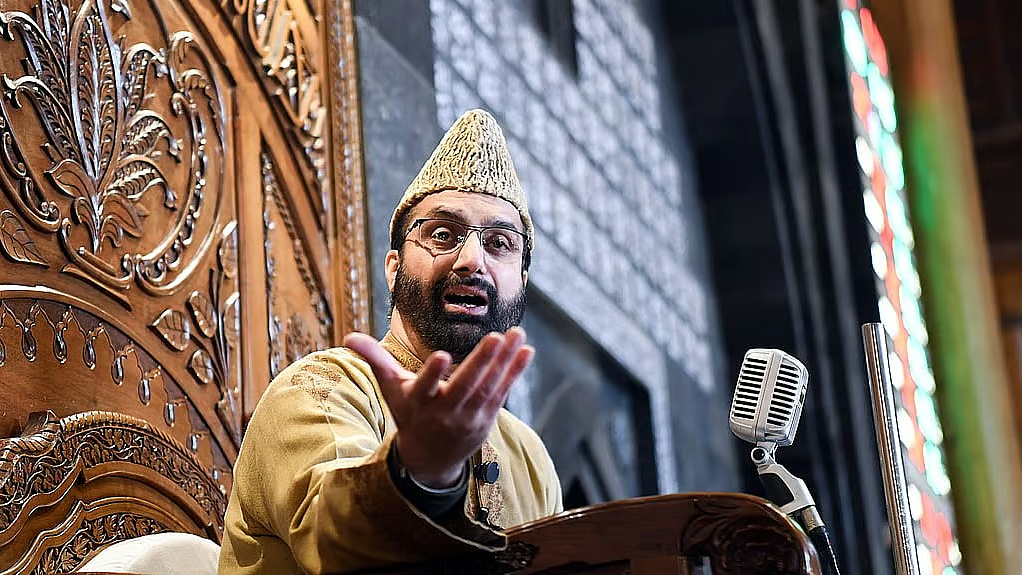
Hurriyat Conference chairman Mirwaiz Umar Farooq has renewed his appeal for dialogue as the only sustainable path toward lasting peace in Jammu and Kashmir, asserting that the region’s history and political identity cannot be viewed solely through the lens of the constitutional changes introduced in 2019.
Speaking against the backdrop of renewed debate over India–Pakistan engagement and Jammu and Kashmir’s political future, Mirwaiz said Kashmir’s story stretches back centuries and cannot be reduced to a single political event. He argued that durable peace requires political engagement, mutual trust and the inclusion of all relevant stakeholders rather than unilateral decisions.
His remarks come amid increasing discussions on restoring political dialogue in the region, with several mainstream leaders and civil society groups also advocating renewed engagement between India and Pakistan.
‘Kashmir’s History Did Not Begin in 2019’
Mirwaiz emphasized that Kashmir possesses a long and complex historical, cultural and political legacy that predates recent constitutional developments.
According to him, understanding Kashmir’s present requires acknowledging its historical evolution rather than defining the region exclusively by the events of August 2019.
His remarks appear to challenge narratives that portray the constitutional changes of 2019 as the sole defining moment in Jammu and Kashmir’s modern political history. Instead, he argued that the region’s identity has been shaped by decades of political developments, social change and historical experiences.
For many observers, the statement reflects a broader argument that any discussion on Kashmir’s future should take into account its layered history and diverse perspectives.
Dialogue, Not Confrontation, Is the Way Forward
Reiterating his long-held position, Mirwaiz said confrontation has repeatedly failed to produce lasting peace and has instead deepened mistrust among communities.
He argued that sustained dialogue between India and Pakistan, alongside engagement with representatives from Jammu and Kashmir, remains the most practical route toward reducing tensions and creating conditions for long-term stability.
According to Mirwaiz, peace cannot be achieved solely through administrative or security measures. He maintained that political engagement, confidence-building and open communication are essential components of any meaningful resolution.
His comments align with repeated calls from several political leaders and sections of civil society who believe that dialogue should complement security efforts rather than be viewed as an alternative to them.
An Implicit Critique of the 2019 Constitutional Changes
Although Mirwaiz did not explicitly mention the abrogation of Article 370 or the reorganization of the erstwhile state in August 2019, his remarks suggested that unilateral political decisions have not resolved the underlying issues facing the region.
He implied that lasting solutions require consultation, consensus and participation rather than measures implemented without broad political engagement.
The observations are likely to generate political debate, particularly because opinions on the 2019 changes remain sharply divided across the political spectrum.
Supporters of the constitutional changes argue they have strengthened national integration, improved governance and accelerated development in Jammu and Kashmir. Critics, however, maintain that political dialogue and restoration of democratic processes remain essential for addressing long-term concerns.
Recalling the Vajpayee–Musharraf Peace Process
Mirwaiz urged political leaders to revisit the spirit of earlier peace initiatives, particularly the engagement between former Indian Prime Minister Atal Bihari Vajpayee and former Pakistani President Pervez Musharraf.
That period witnessed several confidence-building measures, including cross-Line of Control travel, expanded people-to-people contact and sustained diplomatic engagement aimed at reducing tensions.
While those initiatives ultimately did not produce a final settlement, they are often cited by advocates of dialogue as examples of how continuous engagement can create opportunities for cooperation even during periods of political disagreement.
By referring to that phase, Mirwaiz underscored his belief that diplomacy remains an indispensable instrument for conflict management.
The Broader Political Context
Mirwaiz’s remarks come at a time when Jammu and Kashmir is witnessing renewed political activity.
Recent weeks have seen:
- The National Conference intensify its campaign for the restoration of statehood.
- Fresh calls from several political leaders for renewed India–Pakistan dialogue.
- Civil society groups advocating greater political engagement and confidence-building.
- Continuing debates over governance, democratic representation and constitutional issues.
Against this backdrop, Mirwaiz’s intervention adds another dimension to the evolving political discourse by focusing on reconciliation and historical continuity rather than immediate political contestation.
Growing Calls for Engagement
The appeal for dialogue is no longer limited to separatist voices.
In recent weeks, leaders from the National Conference, the People’s Democratic Party (PDP) and several eminent citizens from both India and Pakistan have also advocated reopening channels of communication between New Delhi and Islamabad.
These calls, however, continue to face opposition from the Bharatiya Janata Party (BJP), which maintains that meaningful dialogue cannot resume until Pakistan takes credible and irreversible action against cross-border terrorism.
The contrasting positions reflect two competing approaches to regional peace—one emphasizing political engagement and the other prioritizing security concerns before diplomatic negotiations.
Political and Regional Implications
Reinforcing Kashmir’s Historical Identity
Mirwaiz’s statement seeks to place Kashmir’s present-day politics within a broader historical framework, arguing that understanding the region requires acknowledging its centuries-old political and cultural evolution.
Renewed Focus on Dialogue
By reiterating the importance of engagement, the statement adds momentum to ongoing discussions about whether diplomatic and political dialogue should play a greater role in reducing regional tensions.
Continued Political Debate
His remarks are expected to trigger differing political responses. While supporters of dialogue view engagement as essential for lasting peace, critics argue that security challenges must be addressed before broader political initiatives can succeed.
Political Snapshot
| Aspect | Details | Potential Impact |
|---|---|---|
| Historical Narrative | Kashmir’s history predates 2019 | Reinforces the region’s long political and cultural identity |
| Core Message | Dialogue over confrontation | Encourages renewed political engagement |
| View on Unilateral Measures | Suggests they have not resolved underlying issues | Likely to fuel political debate |
| Reference Point | Vajpayee–Musharraf peace initiatives | Highlights diplomacy as a model for confidence-building |
| Regional Objective | Inclusive and sustained engagement | Aims to reduce mistrust and promote long-term stability |
Outlook
Mirwaiz Umar Farooq’s latest remarks come at a time when Jammu and Kashmir’s political discourse is increasingly shaped by debates over statehood, governance and India–Pakistan relations. By stressing that Kashmir’s history extends far beyond the events of 2019, he has called for a broader understanding of the region’s complexities and renewed emphasis on dialogue.
Whether such appeals translate into any policy shift remains uncertain. The Union government continues to maintain that national security remains its foremost priority, while opposition parties and several civil society groups argue that sustained political engagement is essential for durable peace.
As discussions over Jammu and Kashmir’s future continue, the balance between security, constitutional governance and dialogue is likely to remain at the heart of the region’s evolving political landscape.