US Launches Fresh Strikes on Iran as Missile Alerts Sound in Bahrain and Qatar, Raising Fears of Wider Gulf War
By: News Desk | 09 July 2026
A New Phase in the Gulf Conflict
The United States has launched another round of airstrikes against Iranian military targets, while missile alerts and air raid sirens were activated across Bahrain and Qatar, signaling one of the most dangerous moments in the Gulf since the latest ceasefire unraveled. U.S. officials said the operation targeted military infrastructure linked to Iran’s ability to threaten commercial shipping through the Strait of Hormuz, including missile batteries, drone facilities and air defence systems.
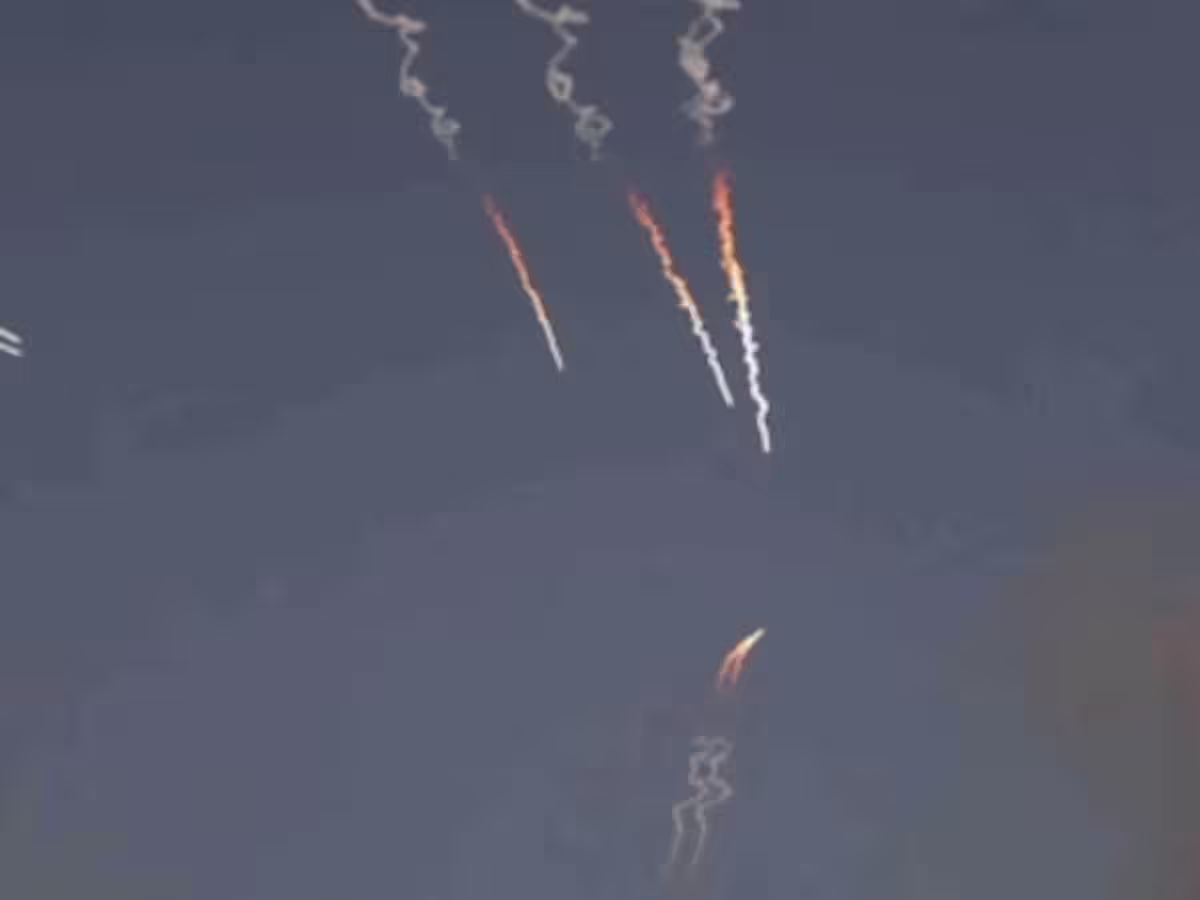
Within hours of the strikes, authorities in Bahrain and Qatar activated emergency warning systems after reports of incoming missiles and drones. Air defence units intercepted the reported threats, and officials said there were no immediate reports of large-scale casualties or significant damage. The alerts nevertheless sent residents rushing indoors and highlighted the growing vulnerability of Gulf states that host major U.S. military facilities.
Iran’s Islamic Revolutionary Guard Corps (IRGC) claimed responsibility for retaliatory missile and drone attacks targeting U.S. military positions across the Gulf, including facilities in Bahrain, Kuwait and Qatar. The claims form part of a rapidly evolving military exchange, while U.S. and regional authorities continue assessing the full extent of the attacks.
US Says Operation Aimed at Protecting Global Shipping
According to U.S. Central Command, the latest military operation focused on degrading Iran’s capacity to threaten commercial vessels navigating the Strait of Hormuz.
Officials said the strikes targeted:
- Coastal air defence systems.
- Ground-to-air missile batteries.
- Anti-ship cruise missile launch sites.
- Drone launch and storage facilities.
- Military surveillance and command infrastructure.
Washington described the operation as a defensive response following recent attacks on commercial shipping, arguing that freedom of navigation through the Strait of Hormuz is essential for global trade and energy security. U.S. officials also stated that the objective was to reduce future threats rather than broaden the conflict.
Missile Alerts Trigger Anxiety Across the Gulf
The activation of missile alerts in Bahrain and Qatar underscored how quickly the confrontation has spread beyond Iranian territory.
In Bahrain, warning sirens sounded across several areas as authorities advised residents to seek shelter while air defence systems engaged incoming threats. Similar alerts were issued in Qatar, where officials monitored the situation closely because of the presence of major U.S. military installations. Both governments later indicated that defensive measures had intercepted the reported projectiles.
Although the physical damage appears limited, the psychological impact has been significant. Schools, businesses and transport operators reviewed contingency plans, while residents described scenes of uncertainty as emergency notifications spread across mobile phones and public warning systems.
The Strait of Hormuz Once Again at the Center of Global Tensions
The renewed exchange has placed the Strait of Hormuz back at the heart of international security concerns.
The narrow maritime corridor carries roughly one-fifth of the world’s seaborne oil trade, making any military activity in the area a matter of global economic importance. Even short-lived disruptions can increase shipping costs, raise insurance premiums and unsettle financial markets.
Energy traders responded cautiously to the latest escalation, with oil prices moving higher amid fears that prolonged hostilities could threaten maritime traffic. Analysts say the market’s next move will depend on whether military exchanges remain limited or expand into sustained attacks on shipping or regional energy infrastructure.
A Conflict Entering a More Dangerous Stage
Unlike earlier exchanges that were largely confined to isolated military targets, the latest developments have drawn multiple Gulf states into a heightened security posture.
The combination of U.S. airstrikes, Iranian retaliation, missile alerts and continued threats to commercial shipping suggests the confrontation is evolving into a broader regional security crisis. At the same time, officials from several countries continue to call for restraint, warning that further escalation could undermine diplomatic efforts and increase the risk of a wider conflict across the Middle East.
Why Bandar Abbas and Bushehr Are Critical to Iran’s Military Strategy
The latest U.S. strikes focused on areas around Bandar Abbas and Bushehr, two locations that are central to Iran’s military posture along the Persian Gulf.
Bandar Abbas is Iran’s principal naval hub overlooking the Strait of Hormuz. It hosts key Islamic Revolutionary Guard Corps (IRGC) naval facilities, coastal missile units, logistics centers and surveillance infrastructure that monitor maritime traffic through the narrow waterway. Military analysts have long regarded the city as the backbone of Iran’s strategy to project power in the Gulf.
Bushehr, meanwhile, is strategically significant because of its military installations and proximity to Iran’s only operational nuclear power plant. While there has been no indication that the civilian nuclear facility itself was targeted, military sites in the surrounding region are considered vital to Iran’s coastal defence network. Reports indicate the latest strikes focused on missile, drone and military infrastructure rather than civilian facilities.
Iran’s Military Options: How Tehran Could Respond
Despite sustaining repeated U.S. strikes, Iran retains a range of military and asymmetric options.
Security experts believe Tehran is unlikely to seek an immediate full-scale conventional war. Instead, it may continue calibrated retaliation designed to impose costs on Washington while avoiding an uncontrollable regional conflict.
Possible responses include:
- Additional missile and drone attacks on U.S. military installations across the Gulf.
- Increased threats to commercial shipping in the Strait of Hormuz.
- Expanded cyber operations targeting military and critical infrastructure.
- Greater use of naval assets, including fast attack craft, in strategic waterways.
- Renewed diplomatic pressure through regional mediators while maintaining military leverage.
Iran has repeatedly stated that any attack on its territory will be met with what it calls a “proportionate response,” while continuing to accuse Washington of violating regional stability.
Gulf States Find Themselves on the Front Line
The latest exchange has once again exposed the vulnerability of Gulf nations that host American military installations.
Missile alerts in Bahrain and Qatar, along with heightened security measures in Kuwait, reflect growing concern that these countries could increasingly become theatres of confrontation despite not being direct parties to the conflict. Air-defence systems were activated after reports of incoming missiles and drones, and authorities urged residents to follow official safety instructions.
For Gulf governments, the challenge is balancing long-standing security cooperation with the United States while preventing their territories from becoming launchpads—or targets—in a wider regional war.
The Strait of Hormuz: Why the World Is Watching
The Strait of Hormuz remains the most strategically sensitive maritime corridor in global energy trade.
An estimated 20% of the world’s seaborne oil and significant volumes of liquefied natural gas pass through this narrow waterway each day. Even limited military activity can disrupt shipping schedules, increase insurance premiums and drive volatility across international energy markets.
Recent attacks on commercial vessels have prompted shipping companies to reassess routes and operational risks, while naval forces from multiple countries have increased patrols to reassure commercial operators. U.S. Central Command says it has escorted hundreds of merchant vessels through the strait in recent months to maintain freedom of navigation.
Oil Markets React as Investors Price in Geopolitical Risk
Financial markets have responded cautiously to the renewed escalation.
Brent crude prices moved higher as traders assessed the potential impact of further military action on Gulf exports. Although fears of supply disruption have intensified, analysts note that markets remain highly sensitive to developments in the Strait of Hormuz, where even short-term interruptions can have global consequences.
If attacks on commercial shipping continue or critical energy infrastructure is damaged, economists warn that oil prices could rise further, increasing inflationary pressures for energy-importing countries.
What Does This Mean for India?
India is among the world’s largest importers of crude oil, with a substantial share sourced from Gulf producers.
Any prolonged instability in the Strait of Hormuz could:
- Increase India’s crude import bill.
- Put upward pressure on petrol and diesel prices.
- Raise transportation and manufacturing costs.
- Complicate supply-chain planning for refiners.
- Add to inflationary pressures across the broader economy.
Beyond energy security, India has important strategic relationships with the United States, Iran and Gulf Cooperation Council countries. That makes regional stability a major foreign policy priority, as New Delhi continues to support dialogue, freedom of navigation and peaceful resolution of disputes.
Can Diplomacy Prevent a Wider War?
Despite the latest military escalation, diplomatic channels have not been completely severed.
Regional mediators continue to encourage dialogue, even as Washington and Tehran exchange increasingly sharp warnings. Public statements from both sides suggest they remain prepared to respond militarily to further attacks, but neither has formally ruled out future negotiations.
The coming days are likely to determine whether the crisis remains a cycle of limited retaliation or evolves into a broader regional conflict involving additional Gulf states.
Outlook
The latest U.S. strikes and Iran’s retaliatory threats underscore how quickly the Gulf security environment can deteriorate.
With commercial shipping under pressure, missile alerts spreading across neighbouring countries and diplomatic efforts under strain, the Strait of Hormuz has once again become the focal point of global geopolitical risk.
Whether this confrontation escalates further or returns to the negotiating table will depend on the decisions made in Washington, Tehran and regional capitals over the days ahead. For now, governments, energy markets and military planners around the world remain on high alert.
Global Reactions: Calls for Restraint as World Powers Watch Gulf Crisis Intensify
The renewed military confrontation has triggered urgent diplomatic activity across major world capitals.
The United Nations has appealed for immediate restraint, warning that continued military escalation around the Strait of Hormuz could threaten regional peace and disrupt global economic stability. Diplomats have urged both Washington and Tehran to restore communication channels before the conflict expands further.
European governments, while reaffirming the importance of protecting international shipping, have also emphasized that military action alone cannot resolve the crisis. Several countries have called for renewed negotiations aimed at preventing further attacks on commercial vessels and reducing tensions in the Gulf.
Across Asia, governments are closely monitoring developments because of their heavy dependence on energy imports from the Middle East. Japan, South Korea, China and India all have significant economic interests tied to uninterrupted maritime trade through the Strait of Hormuz.
Military Experts Warn Against a Cycle of Escalation
Defence analysts believe the current confrontation reflects a classic “deterrence versus retaliation” strategy.
The United States has sought to weaken Iran’s ability to threaten shipping by targeting military infrastructure, while Iran has attempted to demonstrate that American military pressure will be met with reciprocal action.
Experts caution that this pattern carries significant risks.
Even if neither side seeks a full-scale war, repeated missile launches, drone attacks and military strikes increase the possibility of miscalculation. A single strike causing large-scale casualties or damage to critical infrastructure could rapidly transform a limited confrontation into a broader regional conflict.
Military planners also warn that the increasing use of drones, precision-guided missiles and cyber capabilities makes modern conflicts more unpredictable, allowing escalation to occur within hours rather than days.
Possible Scenarios: What Could Happen Next?
Scenario 1: Diplomatic De-escalation
The most optimistic outcome would involve renewed negotiations through regional or international mediators.
If both sides agree to suspend military operations and restore communication, tensions could gradually ease, allowing commercial shipping to resume under enhanced security arrangements.
Likelihood: Moderate, but dependent on political willingness in Washington and Tehran.
Scenario 2: Limited Military Exchanges Continue
Under this scenario, both countries continue retaliatory strikes while avoiding attacks likely to trigger an all-out war.
Commercial shipping would remain vulnerable, insurance costs would stay elevated and Gulf states would continue operating under heightened military readiness.
Many analysts currently view this as the most likely short-term outcome.
Scenario 3: Regional Conflict Expands
The most dangerous possibility is a broader regional conflict involving additional countries or armed groups.
Further attacks on U.S. military installations, Gulf energy infrastructure or major commercial shipping routes could draw more regional actors into the crisis.
Such a development would have far-reaching consequences for global energy markets, international trade and regional security.
What It Means for Global Energy Markets
The Strait of Hormuz remains one of the world’s most strategically important maritime corridors.
Every escalation in the region affects not only oil-exporting nations but also importing economies across Asia, Europe and beyond.
If shipping disruptions persist:
- Oil prices could remain volatile.
- Shipping insurance costs may continue rising.
- Freight charges could increase.
- Inflationary pressures may intensify.
- Supply chains dependent on Gulf energy could face renewed uncertainty.
For countries already dealing with economic pressures, prolonged instability in the Gulf would add another layer of risk to global growth.
Frequently Asked Questions (FAQs)
Why is the Strait of Hormuz so important?
The Strait of Hormuz is the main maritime route connecting Gulf oil producers with global markets. Around one-fifth of the world’s seaborne oil trade passes through this narrow waterway.
Why did the United States carry out the latest strikes?
According to U.S. officials, the strikes were aimed at degrading Iranian military capabilities following attacks on commercial shipping and protecting freedom of navigation in the Gulf.
How has Iran responded?
Iran has condemned the strikes as an act of aggression and has claimed retaliatory missile and drone operations targeting U.S.-linked military positions in the Gulf, while warning of further consequences if attacks continue.
Are Gulf countries directly involved in the conflict?
Countries such as Bahrain, Qatar and Kuwait host U.S. military facilities and have strengthened security measures. While they are not direct participants in the conflict, they are increasingly affected by its regional spillover.
How could this affect India?
India relies heavily on energy imports from the Gulf. Any prolonged disruption in the Strait of Hormuz could increase oil import costs, affect fuel prices and place additional pressure on the Indian economy.
Conclusion: A Defining Moment for Gulf Security
The latest exchange of U.S. airstrikes, Iranian retaliation and missile alerts across the Gulf marks another critical chapter in an increasingly volatile regional confrontation.
While both Washington and Tehran continue to defend their actions as necessary for national security, the consequences extend far beyond the battlefield. Every military exchange raises the stakes for global energy security, commercial shipping and diplomatic stability in one of the world’s most strategically important regions.
The coming days will be decisive.
If diplomacy regains momentum, the Gulf may avoid a wider conflict that would carry profound political and economic consequences. If military escalation continues, however, the Strait of Hormuz could remain the epicentre of a prolonged crisis with global repercussions.
For now, governments, energy markets and security analysts around the world are watching closely, aware that developments in this narrow stretch of water have the potential to reshape the geopolitical landscape far beyond the Middle East.