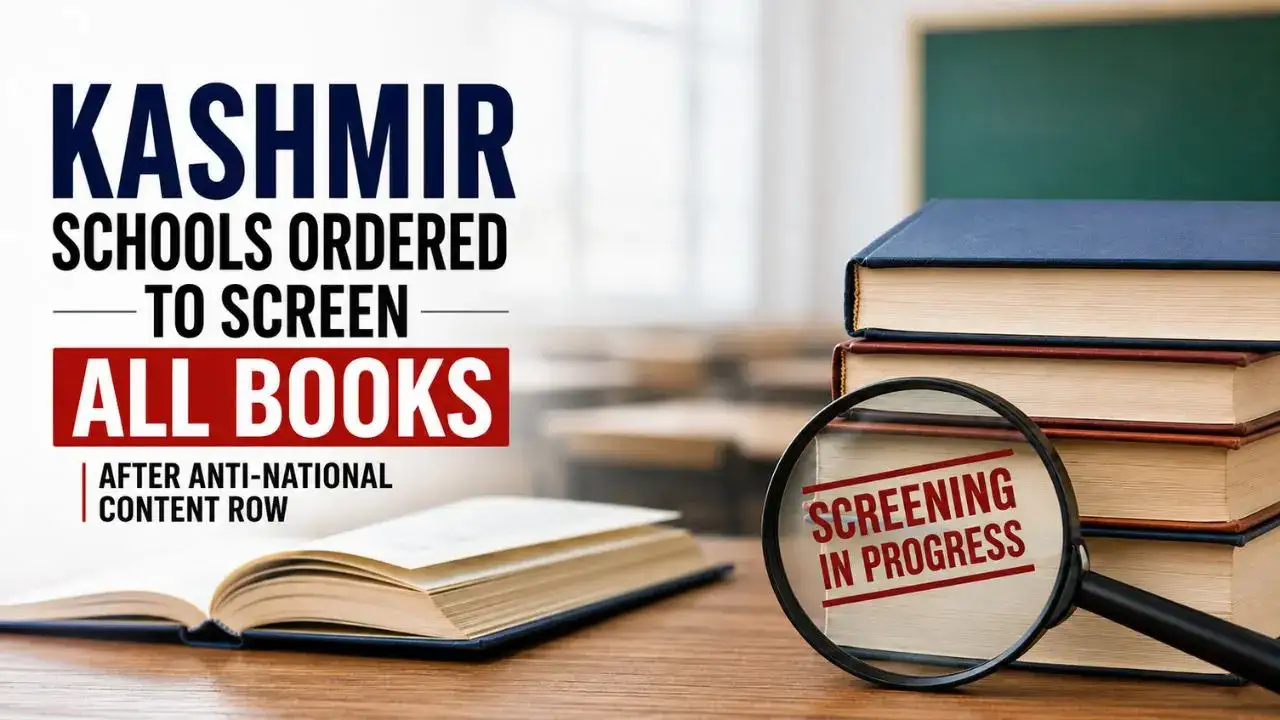
J&K Govt Orders Screening of School Books Across Kashmir for Objectionable Content
By: News Desk | 09 July 2026
J&K Govt Orders Comprehensive Screening of School Textbooks Across Kashmir
The Jammu and Kashmir Government has launched a comprehensive review of school textbooks used across the Kashmir Valley, directing education authorities to identify and examine any material considered objectionable, factually inaccurate or inconsistent with prescribed educational standards.
The directive follows recent controversies surrounding content found in certain privately published textbooks, prompting the administration to tighten oversight of learning material used in schools. Officials say the objective is to ensure that classroom resources are educationally sound, age-appropriate and aligned with the curriculum prescribed by the Jammu and Kashmir Board of School Education (JKBOSE).
The move represents one of the most significant curriculum review exercises undertaken by the School Education Department in recent years and is expected to affect government as well as private educational institutions using supplementary textbooks.
Why Has the Government Ordered the Review?
The decision comes in the wake of action taken by the School Education Department after controversial material was reportedly found in some privately published books being used in schools.
Following the controversy, the government suspended several education officials over alleged lapses in the approval process and initiated action against certain publishers and authors. The latest order seeks to strengthen quality control mechanisms and prevent similar incidents in the future.
Officials have stated that the review is intended to safeguard the academic environment by ensuring that educational material reflects constitutional values, factual accuracy and appropriate educational standards.
District-Level Screening Committees to Review Textbooks
Under the new directive, district-level committees will be constituted to examine textbooks currently being used in schools.
The committees are expected to scrutinize books across different subjects and classes to determine whether any content requires correction, revision or removal.
The review will cover textbooks prescribed or recommended by schools, particularly those published by private publishers in addition to JKBOSE-approved material.
Education officials are expected to submit their findings to higher authorities for further action wherever necessary.
What Will the Committees Examine?
According to the government’s directions, the review will focus on several key areas, including:
Accuracy of Information
Officials will verify whether textbooks contain factual errors, misleading information or content that does not conform to accepted academic standards.
Constitutional Values
The screening process will assess whether educational material is consistent with the principles and values enshrined in the Constitution of India.
Moral and Cultural Appropriateness
Authorities will also examine whether the content is suitable for students’ age groups and is sensitive to the region’s cultural and social context.
Compliance with JKBOSE Curriculum
Books will be checked to ensure they complement rather than contradict the curriculum and academic framework prescribed by JKBOSE.
Fresh Approval Process Before the Next Academic Session
The government has directed that textbooks proposed for future use should undergo proper scrutiny before being introduced in classrooms.
Schools using privately published books may be required to obtain approval from the competent authorities to ensure compliance with prescribed academic guidelines.
Officials say this process is intended to establish a more transparent and accountable mechanism for textbook selection across educational institutions.
What Does This Mean for Schools?
Schools are expected to:
- Submit textbooks used in classrooms for review where required.
- Ensure that learning material complies with JKBOSE guidelines.
- Avoid using unapproved or unauthorized supplementary books.
- Cooperate with district-level screening committees during inspections.
School managements may also need to reassess existing book lists before the next academic session to ensure compliance with the government’s directions.
Impact on Publishers
Private publishers are likely to face greater regulatory scrutiny under the revised oversight mechanism.
They may be required to:
- Align content with JKBOSE curriculum standards.
- Ensure factual accuracy through editorial review.
- Remove or revise any material flagged during the screening process.
- Obtain necessary approvals before distributing textbooks to schools.
The directive is expected to encourage publishers to strengthen quality assurance procedures during content development.
What It Means for Students and Parents
For students, the government says the initiative is aimed at ensuring access to reliable, standardized and academically appropriate learning material.
Parents, many of whom had expressed concern following recent textbook-related controversies, may see the review as an effort to improve accountability within the education system.
Officials believe a uniform review mechanism could help reduce inconsistencies between schools and improve confidence in classroom resources.
Broader Significance of the Move
Strengthening Academic Oversight
The initiative reflects the administration’s effort to exercise closer supervision over educational content used in schools across Jammu and Kashmir.
Restoring Public Confidence
Following recent controversies, the government appears focused on reassuring parents, educators and students that learning materials will undergo stricter quality checks before reaching classrooms.
Standardizing Educational Content
By emphasizing compliance with JKBOSE guidelines, the administration aims to reduce disparities in the use of supplementary textbooks and promote greater uniformity in school education.
Balancing Oversight and Academic Freedom
While the government has described the initiative as a quality-control measure, curriculum reviews involving concepts such as “objectionable” or “politically sensitive” content can attract differing perspectives. Supporters argue that oversight helps ensure accuracy, age-appropriateness and constitutional compliance, while critics often stress the importance of transparent review processes and academic independence. How the screening committees apply the guidelines in practice is therefore likely to receive close public attention.
The Road Ahead
The textbook screening initiative marks a significant step in the Jammu and Kashmir Government’s efforts to strengthen oversight of school education. As district-level committees begin reviewing books in circulation, schools, publishers and education officials will need to ensure that classroom material meets prescribed academic and regulatory standards.
The effectiveness of the exercise will depend on the transparency, consistency and fairness of the review process. If implemented with clear criteria and due process, the initiative could improve confidence in school curricula while ensuring that educational content remains accurate, age-appropriate and aligned with JKBOSE guidelines and constitutional values.


