Himalayas Extreme Weather 2025: How Climate Change and Human Activity Are Making Mountain Disasters More Dangerous
By: Javid Amin | 13 Aug 2026
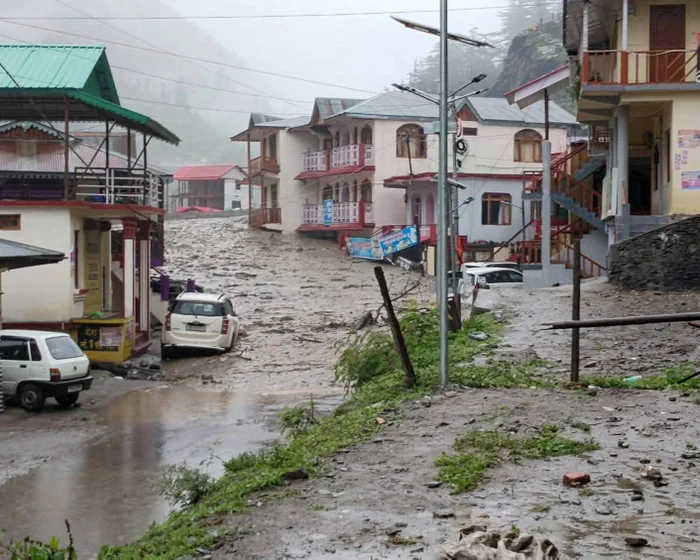
From cloudbursts and flash floods to landslides, debris flows and collapsing mountain roads, the Himalayas endured a succession of destructive weather events in 2025. Scientists say a warming climate is changing the region’s hydrological and cryospheric systems, while poorly planned development is increasing the number of people and assets exposed to these hazards.
The Himalayas have always been a landscape of extremes.
Heavy rain, avalanches, landslides and floods are part of the mountain system’s natural behaviour. But what is changing is the combination of climate stress, extreme precipitation, rapid infrastructure development and growing human exposure.
That combination can turn a naturally occurring hazard into a major disaster.
The evidence from 2025 provides a stark illustration.
A recent peer-reviewed assessment of the 2025 extreme monsoon in the northwestern Himalayas documented a sequence of high-intensity rainfall events from late June through mid-September. The study examined destructive events in Uttarakhand, Himachal Pradesh and Jammu & Kashmir, including debris flows, cloudbursts, flash floods and landslides.
At the wider Hindu Kush Himalaya scale, ICIMOD’s analysis found that four of the region’s eight countries experienced more than 10 major disasters in 2025.
The warning is becoming harder to ignore: the mountains are not simply facing more hazards. They are facing more complicated interactions between hazards, infrastructure and human settlements.
A Season of Extreme Weather Across the Himalayas
The period from spring through the 2025 monsoon brought repeated examples of how quickly Himalayan weather can shift from routine rainfall to disaster.
Among the most damaging hazards were:
- Cloudbursts
- Flash floods
- Landslides and debris flows
- Rockfalls and shooting stones
- Intense thunderstorms and hailstorms
- Strong winds
- Flooding linked to rapid runoff and snow or ice melt
The events did not occur in one isolated location.
The northwestern Himalayan region, including parts of Uttarakhand, Himachal Pradesh and Jammu & Kashmir, experienced a particularly destructive sequence during the 2025 monsoon. A scientific assessment published in Landslides documented major rainfall-triggered disasters across the region.
Dharali, Kullu, Mandi and Kishtwar Showed the Scale of the Risk
The 2025 disasters demonstrated how different hazards can connect.
In Uttarakhand, rainfall and meltwater contributed to a destructive debris-flow event in Dharali.
In Himachal Pradesh, Mandi and Kullu experienced a succession of cloudbursts and flash floods affecting steep, narrow catchments.
In Jammu & Kashmir, cloudburst-triggered debris flows devastated areas including Chasoti in Kishtwar.
These events illustrate a critical feature of Himalayan disasters: one extreme weather event can trigger a chain reaction.
Heavy rainfall can saturate slopes. Saturated slopes can fail. Landslides can block streams. Blocked streams can suddenly release water and debris. Roads can then be cut off, bridges damaged and communities isolated.
The result is a hazard cascade rather than a single event.
Climate Change Is Altering the Background Conditions
The relationship between climate change and Himalayan disasters needs to be explained carefully.
It would be scientifically inaccurate to say that climate change directly caused every cloudburst or landslide in 2025.
Cloudbursts are part of Himalayan meteorology, and landslides can have many triggers.
But climate change is changing the conditions in which these hazards occur.
A major ICIMOD analysis published in February 2025 found that flood frequency in High Mountain Asia has increased since 2000 and identified rising temperatures as a key driver. The research also found that floods are becoming less predictable, including a rise in events occurring outside the traditional monsoon period.
That is a significant shift.
A Warmer Atmosphere Can Hold More Moisture
As air warms, its capacity to hold water vapour increases.
When moisture-rich air is lifted over steep Himalayan terrain, it can produce intense precipitation.
That does not mean every heavy shower is caused by climate change. Rather, warming can increase the amount of moisture available to extreme precipitation systems, potentially raising the intensity of some rainfall events.
This matters enormously in steep mountain catchments.
A few hours of exceptionally intense rainfall can generate runoff far faster than soils, streams and drainage systems can absorb or carry it.
Glacier Melt Is Adding Another Layer of Complexity
The Himalayan climate story is also a cryosphere story.
The Hindu Kush Himalaya contains thousands of glaciers that feed major river systems across Asia.
ICIMOD’s 2026 glacier assessment found that glaciers across the Hindu Kush Himalaya are losing ice at an accelerating rate, with the rate of ice loss having doubled since 2000. The organisation reported that the region has lost up to 27 metres of ice thickness since 1975.
The implications extend far beyond melting ice.
Changes in glaciers, snow cover, meltwater and high-altitude lakes can alter downstream water availability and contribute to changing flood hazards.
Glacier Melt Does Not Automatically Mean More Floods Everywhere
This distinction is important.
Glacier retreat does not mean every Himalayan flood is caused by melting glaciers.
Flood risk depends on multiple factors, including:
- Rainfall intensity
- Snowmelt
- Glacier melt
- Lake conditions
- Catchment characteristics
- Slope stability
- River morphology
- Land use
- Infrastructure
In some locations, glacier retreat can initially increase runoff. Over longer periods, declining glacier volume can reduce meltwater contributions.
The key concern is therefore changing hydrological behaviour and greater uncertainty, rather than a simplistic assumption that more melting always means more flooding.
Human Activity Is Increasing Exposure
Climate change is only part of the story.
The other part is what humans are building—and where they are building it.
Across the Himalayas, roads, tunnels, hydropower facilities, hotels, bridges, airports and urban settlements are expanding into increasingly complex mountain terrain.
Development itself is not necessarily the problem.
The critical question is whether development respects the geological and ecological limits of the landscape.
Roads Can Become Part of the Hazard Chain
Mountain roads often require cutting into steep slopes.
When excavation changes slope geometry or drainage, it can affect stability. Poorly designed drainage can allow water to infiltrate slopes, increasing pore-water pressure and weakening already-fractured rock or soil.
During intense rainfall, those weaknesses can become failure points.
The result may be:
Rainfall → slope saturation → landslide → road blockage → isolation → delayed rescue and supply disruption.
This is why building more roads does not automatically make a mountain region more resilient.
The engineering standard matters.
Forest Loss and Land-Use Change Can Remove Natural Buffers
Mountain forests play an important role in stabilising slopes, regulating runoff and supporting soil structure.
Deforestation does not independently cause every landslide, but vegetation removal can increase vulnerability in susceptible terrain.
The problem becomes particularly serious when forest clearance is combined with:
- Road widening
- Quarrying
- Construction
- Poor drainage
- Slope cutting
- Intense rainfall
A landscape already stressed by extreme precipitation has less room for additional disturbance.
Tourism Is Growing Faster Than Mountain Capacity in Some Places
Tourism is one of the economic lifelines of the Himalayan states.
It provides employment for drivers, guides, hotel workers, shopkeepers, restaurant owners, artisans and countless small businesses.
But rapid tourism growth can create environmental pressure when infrastructure expands faster than local carrying capacity.
Popular destinations such as Manali, Leh and Srinagar have experienced substantial development and increasing visitor demand.
The challenge is not tourism itself.
The challenge is unplanned tourism.
Construction on flood-prone land, excessive groundwater extraction, inadequate sewage treatment, waste accumulation and road expansion can increase environmental stress.
When extreme weather arrives, these weaknesses become liabilities.
Hydropower: Essential Energy, Complex Mountain Risk
Hydropower is another issue that requires nuance.
The Himalayas offer enormous hydropower potential, and renewable electricity is important for reducing dependence on fossil fuels.
But large infrastructure projects in active and fragile mountain terrain require rigorous geological and environmental assessment.
Tunnelling, blasting, slope modification, reservoir creation and road construction can alter local geological and hydrological conditions.
That does not mean hydropower projects automatically cause earthquakes, floods or landslides.
The real concern is whether project design and cumulative development adequately account for:
- Seismic hazards
- Slope stability
- Sediment movement
- Extreme rainfall
- Glacial hazards
- River ecology
- Downstream flood risk
- Cumulative impacts from multiple projects
The lesson is straightforward: renewable energy does not automatically mean low environmental risk at the project site.
Why a Cloudburst Can Become a Catastrophe
A cloudburst is a highly localised extreme rainfall event.
In the mountains, the consequences can be amplified by topography.
Imagine a steep valley receiving an extraordinary amount of rain within a short period.
Water races downhill.
It picks up soil, boulders, trees and loose material.
A small stream becomes a torrent.
A road becomes a channel.
A bridge becomes an obstruction.
A settlement located beside the river suddenly finds itself in the path of a debris flow.
This is why Himalayan disasters can unfold within minutes.
Reuters noted during the 2025 monsoon that cloudbursts in India and Pakistan were producing devastating flash floods and landslides, while scientists pointed to warming as one factor that can increase atmospheric moisture available to intense storms.
Infrastructure Is Often the First Major Casualty
Roads and bridges are lifelines in mountain communities.
When they fail, the consequences spread quickly.
A damaged road can mean:
- Food cannot reach villages
- Ambulances cannot move
- Tourists become stranded
- Rescue teams face delays
- Electricity restoration becomes harder
- Construction and local businesses stop functioning
The economic damage can continue long after floodwaters disappear.
A road rebuilt in the same vulnerable location without addressing drainage and slope stability can simply become a recurring repair bill.
The Human Cost Goes Beyond Deaths
Official disaster statistics often focus on fatalities and physical damage.
But the true cost is broader.
A family whose farmland is buried under debris may lose income for years.
A shop destroyed by a flood can wipe out decades of savings.
A damaged road can cut a remote community off from healthcare and education.
Tourism workers may lose an entire season.
Farmers may lose crops just before harvest.
This makes climate adaptation a livelihood issue, not merely an environmental issue.
The Economic Cost Is Growing
The wider Hindu Kush Himalaya region already faces significant disaster-related economic losses.
ICIMOD’s analysis of EM-DAT data found that HKH countries suffered more than US$6 billion in economic losses in 2024, with floods, landslides and storms accounting for much of the damage.
That number demonstrates why prevention can be cheaper than repeated reconstruction.
Every destroyed bridge rebuilt in the same flood-prone location represents an opportunity to ask whether the replacement should be designed differently.
Every landslide that repeatedly blocks the same highway is evidence that the underlying slope and drainage problem may require a long-term engineering solution.
The Ecological Cost Is Harder to Measure
Infrastructure can be rebuilt.
Ecosystems are different.
A major debris flow can strip vegetation, alter stream channels, bury habitats and change sediment movement.
Repeated disturbance can make ecological recovery more difficult.
High-altitude ecosystems are particularly sensitive because growing seasons are short and environmental conditions are harsh.
Climate change adds another layer of stress by shifting temperature, precipitation and snow patterns.
The result is a landscape facing multiple simultaneous pressures.
Early Warning Systems Can Save Lives
One of the most practical responses is better early warning.
The Himalayas are difficult to monitor because terrain creates major gaps in weather observations.
Dense networks of:
- Automatic weather stations
- Rain gauges
- Weather radar
- River-level sensors
- Satellite monitoring
- Landslide monitoring systems
- Glacial-lake surveillance
can improve warnings.
But technology alone is not enough.
A warning is useful only when people receive it, understand it and have a safe place to go.
That means community-level evacuation plans are just as important as sophisticated forecasting systems.
Communities Must Be Part of Disaster Preparedness
People living in mountain villages often possess detailed knowledge of local terrain.
They know which streams rise quickly, which slopes have moved before and which roads become dangerous during heavy rain.
That knowledge should be incorporated into formal disaster planning.
Community-based preparedness can include:
- Local emergency teams
- Evacuation routes
- Designated shelters
- Village-level communication systems
- Emergency supply storage
- Training in first aid and rescue
- School disaster drills
- Mapping of vulnerable households
The best disaster-management system is one that works before government rescue teams arrive.
The Himalayas Need Risk-Sensitive Development
The choice facing Himalayan states is not simply development versus environment.
That is a false binary.
The real choice is between:
short-term development that increases vulnerability
and
long-term development designed around mountain realities.
That means roads that account for slope stability.
Bridges designed around future flood levels.
Buildings constructed to seismic standards.
Tourism planned according to local carrying capacity.
Hydropower projects subjected to rigorous cumulative risk assessment.
And settlements kept away from the most dangerous flood channels and unstable slopes.
What a Climate-Resilient Himalayas Could Look Like
A resilient Himalayan development model would combine several priorities.
1. Climate-Smart Infrastructure
Infrastructure should be designed around future climate conditions rather than historical averages alone.
2. Better Land-Use Planning
Hazard maps should influence where roads, hotels, homes and public facilities are built.
3. Stronger Environmental Regulation
Environmental clearances must be followed by meaningful monitoring and enforcement.
4. Ecosystem Restoration
Forests, wetlands, riparian zones and natural drainage corridors should be treated as protective infrastructure.
5. Improved Disaster Forecasting
Investment in high-resolution weather, hydrological and geological monitoring should continue.
6. Community Preparedness
Residents should receive practical warnings and evacuation training, not merely alerts on a phone.
7. Responsible Tourism
Tourism growth should be linked to water availability, waste-management capacity, road capacity and ecological limits.
The Science Is Moving Toward a More Complex Risk Picture
The strongest evidence does not support a simple headline such as “climate change causes Himalayan disasters.”
The reality is more complicated—and more important.
Climate change can alter rainfall, temperature, snow and glacier conditions.
Human activity can alter slopes, drainage, forests and river systems.
Urbanisation can put more people and infrastructure in hazardous locations.
These factors can interact.
That creates what scientists increasingly describe as compound or cascading risks.
A warming atmosphere may contribute to more intense precipitation.
Extreme rainfall saturates a slope.
The slope fails.
The landslide blocks a river.
The river overtops its channel.
A road collapses.
A community becomes isolated.
One hazard has become five.
The Himalayas Are Sending a Clear Warning
The extreme weather of 2025 should not be remembered simply as a collection of tragic events.
It should be studied as a warning about the future of mountain development.
Scientific evidence already shows that flood behaviour in High Mountain Asia is changing and becoming less predictable.
Glaciers are losing ice faster.
Major disasters continue to affect communities across the Hindu Kush Himalaya.
And new research into the 2025 northwestern Himalayan monsoon has documented how intense rainfall can trigger interconnected disasters across steep mountain catchments.
The lesson is not that the Himalayas are becoming uninhabitable.
It is that the old assumptions about what is safe are becoming less reliable.
Conclusion: The Himalayas Need a New Development Equation
The Himalayas cannot be protected by stopping every road, dam, hotel or tourism project.
Nor can the region safely continue with development that treats mountains as ordinary construction sites.
The answer lies between those extremes.
Climate science must inform infrastructure.
Geology must inform construction.
Ecology must inform tourism.
Hazard mapping must inform settlement planning.
And local communities must have a central role in deciding how risk is managed.
The Himalayas will continue to experience cloudbursts, floods, landslides and storms because these are natural features of a young and dynamic mountain system.
But disaster is not inevitable simply because a hazard is natural.
The scale of the loss depends heavily on where people build, how they build and how well they prepare.
The defining challenge for the Himalayas in the coming decades will therefore not be to eliminate extreme weather.
It will be to build a region capable of absorbing shocks without sacrificing lives, livelihoods and ecosystems.
That is the real meaning of Himalayan climate resilience.


