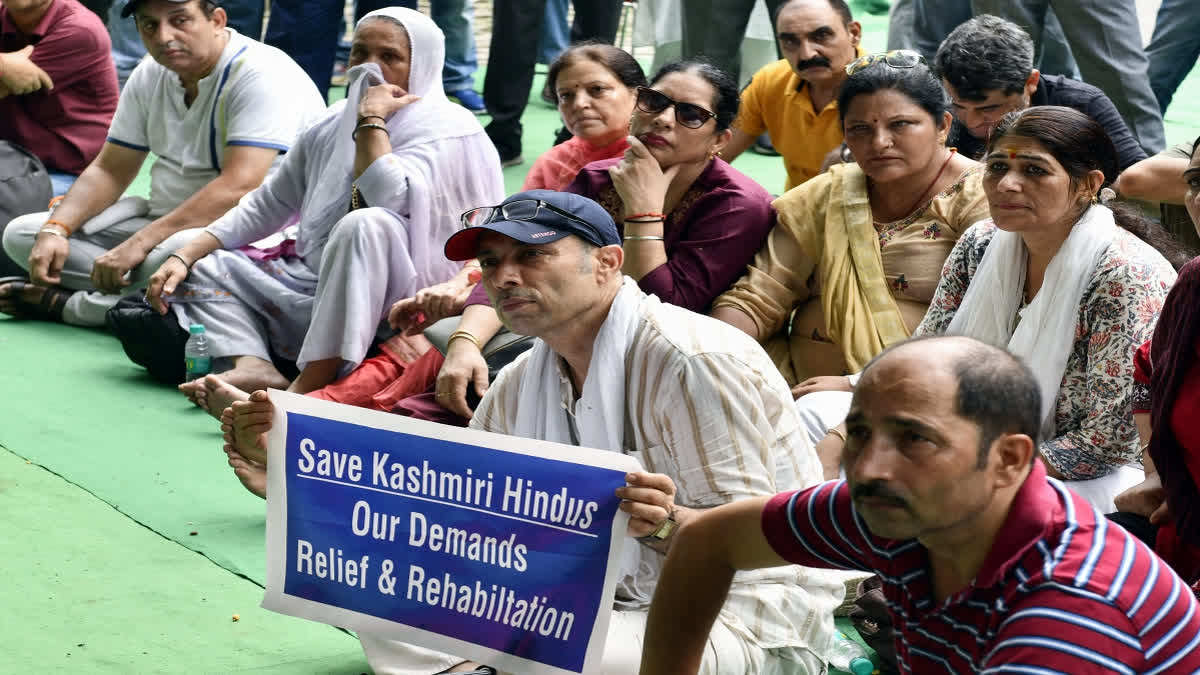
37 Years in Exile: Kashmiri Pandit Body Demands Time-Bound Roadmap for Return to Valley
By: News Desk | 14 September 2026
Jammu / Srinagar: Thirty-seven years after the mass displacement of Kashmiri Pandits from the Valley, a prominent community organisation has renewed the demand for a time-bound, comprehensive roadmap for return, rehabilitation and restitution, arguing that decades of assurances have failed to provide the certainty needed for a dignified return.
The demand comes at a particularly sensitive moment. While successive governments have introduced employment packages, housing schemes and security measures aimed at facilitating the community’s return, fresh threats against Kashmiri Pandit employees working in the Valley have once again exposed the gap between rehabilitation policy and the lived experience of security.
The Kashmir Policy & Strategy Group, chaired by senior advocate Ashok Bhan, made the latest demand during a web meeting held on September 14, on the eve of Kashmiri Pandit Balidan Divas. The group said that “37 years of exile is too long” and called for the community’s return to be transformed from a recurring political promise into a measurable policy programme.
The timing could hardly be more significant.
Only days earlier, Kashmiri Pandit employees recruited under the government’s rehabilitation/employment programme had written to Union Home Minister Amit Shah over renewed threats, seeking stronger security, investigation of threatening communications and a comprehensive security audit.
The two developments together underline the central dilemma surrounding the return of Kashmiri Pandits:
A return cannot be meaningful unless people believe they can live, work, own property and raise families in the Valley without fear.
37 Years of Exile and a Demand for Something More Concrete
The Kashmir Policy & Strategy Group has called for a formal Return, Rehabilitation and Restitution Roadmap, developed in consultation with representative Kashmiri Pandit organisations.
Its demands go well beyond employment.
The proposed framework would have to address:
- security and protection;
- voluntary and dignified return;
- housing;
- employment and livelihoods;
- property restitution;
- protection of temples and cultural heritage;
- and meaningful participation of returning families in Kashmir’s social and economic life.
The group has also called for measurable targets, designated institutional responsibility and periodic public review.
That is an important shift in emphasis.
For years, the political conversation has frequently revolved around packages, announcements and numbers of jobs or houses sanctioned. The latest demand is essentially asking a more difficult question:
What is the actual roadmap from displacement to permanent, dignified rehabilitation?
The group argues that the answer cannot remain open-ended after nearly four decades.
The History Behind the Demand
The mass migration of Kashmiri Pandits occurred against the backdrop of the violent insurgency that erupted in Jammu & Kashmir around the end of the 1980s and beginning of the 1990s.
Militant threats, targeted killings and an atmosphere of fear contributed to the departure of large numbers of Kashmiri Pandit families from the Valley.
The Indian government’s current official records describe approximately 62,000 registered Kashmiri migrant families across the country, with around 40,000 in Jammu, 20,000 in Delhi-NCR and roughly 2,000 elsewhere. The Ministry of Home Affairs says the broad policy framework has been that those who migrated would eventually return to the Valley.
That number is important because it demonstrates the scale of the challenge.
This is not simply a question of relocating a few thousand employees.
It involves families that have spent decades building new lives elsewhere while retaining social, cultural, religious and property links with Kashmir.
For many, return is therefore both a practical and emotional question.
Government Packages Have Created a Framework—but Not a Final Solution
Successive governments have attempted to facilitate rehabilitation through financial assistance, employment and housing.
The Prime Minister’s Development Package included government jobs and transit accommodation for Kashmiri migrant families.
In a 2019 government statement, the Centre said it had approved an additional 3,000 government jobs and 6,000 transit accommodation units, in addition to earlier measures.
By July 2022, the government said 5,502 Kashmiri migrants had been provided government jobs under the package and that 6,000 transit accommodation units had been approved.
Earlier government data also showed the scale of the employment initiative: of 6,000 posts announced under the package, nearly 3,800 migrants had been rehabilitated through government employment at the time of the 2021 parliamentary reply.
These measures represent substantial government intervention.
But they also reveal the limits of an employment-centric rehabilitation model.
A job in Kashmir does not automatically mean permanent rehabilitation in Kashmir.
For a family considering a permanent return, questions of housing, schooling, healthcare, community safety, property rights, social acceptance and long-term security are equally important.
That is precisely where the latest demand for a comprehensive roadmap comes in.
The Fresh Threats Have Changed the Conversation
The most immediate obstacle remains security.
In August and September 2026, Kashmiri Pandit employees working in the Valley reported renewed threats circulated through social media and purported threat letters.
One reported threat communication included personal details of employees, including names, phone numbers and residential information. The All PM Package Employees Forum subsequently sought enhanced protection and a review of security arrangements around workplaces, residences and transit routes.
In September, another purported threat letter surfaced after Kashmiri Pandit employees protested over their security and accommodation arrangements. The letter reportedly targeted employees who had participated in the demonstration.
And on September 12, employees working under the PM package wrote to Home Minister Amit Shah, asking for investigation into the threats, punishment of those responsible, strengthened security and a comprehensive security audit of employees and their settlements.
These reports are particularly troubling because the employees involved were part of a policy intended, in part, to facilitate the community’s return and reintegration.
Instead, some employees now say that the threat environment is making that process extremely difficult.
“Returned With Hope”—But Now Living With Uncertainty
The language used by the employees in their communication to the Home Minister captures the problem.
They said there was a perception within the community that complete social rehabilitation and acceptance had not progressed as hoped, while the continuing atmosphere of uncertainty was making rebuilding their lives difficult.
This is an important distinction.
Security is not merely about whether an attack has taken place.
It is also about whether people believe the state can protect them if a threat emerges.
If employees have to repeatedly ask for security audits after personal details are circulated publicly, confidence in long-term rehabilitation inevitably suffers.
And if families considering return believe that government employees already living and working in the Valley remain vulnerable, persuading displaced families to permanently relocate becomes considerably harder.
The Difference Between Return and Rehabilitation
This distinction is often lost in political discussions.
Return means physically coming back.
Rehabilitation means being able to rebuild a sustainable life.
The latter is much harder.
A genuinely successful rehabilitation policy would have to answer several questions:
Where will returning families live?
What happens to disputed or occupied properties?
Who will protect religious sites and temples?
What employment opportunities will exist beyond government jobs?
How will children returning after generations outside Kashmir be integrated into schools?
What healthcare and civic infrastructure will be available?
How will local communities participate in the process?
And, perhaps most importantly, what happens when security conditions deteriorate?
Without credible answers to those questions, return risks becoming a symbolic exercise rather than a durable social process.
Property Restitution Could Become One of the Hardest Questions
The latest roadmap proposal specifically includes property restitution.
This could become one of the most complicated elements of any long-term rehabilitation programme.
After nearly four decades, property situations can be extraordinarily complex.
Some properties may have changed hands. Others may have deteriorated. Some may be subject to legal disputes, while others may have been sold, abandoned or encroached upon.
A return policy therefore cannot simply promise houses.
It must also establish transparent mechanisms through which legitimate property claims can be examined and resolved under law.
Interestingly, this issue was also raised in the recent letter by PM package employees to the Home Minister, who sought transparent and legally sound mechanisms concerning legitimate property rights and grievances.
That suggests that property restitution is not a peripheral issue.
It is becoming part of the wider debate about whether rehabilitation can actually become permanent.
Security Cannot Be Reduced to Transit Colonies
The government’s strategy has included transit accommodation for employees returning to the Valley.
The rationale is understandable: providing dedicated housing can make employment-based rehabilitation more practical.
But the latest controversy also raises a larger question.
Can separate settlements become a permanent model for return?
Some community representatives view secure accommodation as essential because of continuing security concerns. Others have long argued that permanent rehabilitation should ultimately mean integration into ordinary social and economic life rather than indefinite residence in segregated settlements.
The Kashmir Policy & Strategy Group has specifically called for returning families to have a meaningful stake in the social and economic life of Kashmir, indicating that rehabilitation should not simply mean placing families inside protected housing clusters.
The challenge, therefore, is to combine security with integration.
Too little security creates fear.
Too much segregation can prevent genuine social rehabilitation.
Finding the balance will be one of the most difficult tasks for policymakers.
What Does “Safe Return” Actually Mean?
A credible return policy would have to establish measurable security benchmarks.
That could include:
- regular security assessments;
- protection of vulnerable employees and families;
- rapid investigation of threats;
- secure transport in vulnerable areas where necessary;
- emergency response mechanisms;
- protection of religious and cultural sites;
- and periodic public reporting on security conditions.
The recent demand for a security audit from PM package employees demonstrates why such mechanisms matter.
The employees have not simply asked for political assurances. They have asked the government to examine their workplaces, residences and broader security environment.
That is a more concrete demand than a general promise of protection.
Return Must Be Voluntary and Dignified
Another important element in the latest proposal is the emphasis on voluntary return.
That matters because the objective should not be to force families back to Kashmir simply to meet a numerical target.
A successful rehabilitation programme must create conditions in which people choose to return because they believe the Valley is secure and economically and socially viable.
That means return figures should not be the only measure of success.
A family returning and subsequently leaving because of fear would represent a policy failure even if the initial rehabilitation statistics looked impressive.
The real measure is permanence.
Kashmir’s Composite Heritage Is Part of the Debate
The Pandit organisations are also framing the issue in cultural terms.
The Kashmir Policy & Strategy Group argued that the community’s temples, traditions, scholarship, language, literature and cultural memory are inseparable from Kashmir’s wider civilisation. It described the return as a question of historical justice, dignity, identity and restoration, rather than merely resettlement.
That argument gives the rehabilitation debate a dimension beyond government employment schemes.
Kashmiri Pandits are an integral part of Kashmir’s historical and cultural landscape, and their prolonged absence has had consequences for the Valley’s social fabric.
At the same time, any long-term reconciliation effort will need to recognise that Kashmir’s composite heritage includes communities with different experiences of the conflict and displacement.
A durable return cannot be built solely through government orders.
It requires rebuilding trust at the community level as well.
The Government Faces a Difficult Test
For New Delhi and the J&K administration, the latest demands present a difficult policy challenge.
The government can point to jobs, housing, financial assistance and security measures already provided.
Official figures demonstrate that significant resources have been committed over the years.
But the community’s response is equally clear:
Measures are not the same as a completed rehabilitation process.
If employees still fear threats, if families remain uncertain about returning, and if property and cultural questions remain unresolved, the government cannot reasonably claim that the rehabilitation question has been fully settled.
That is why the demand for a time-bound roadmap is politically significant.
It asks the government to move from scheme-based rehabilitation to outcome-based rehabilitation.
Why “37 Years Is Too Long” Has Resonance
The phrase is powerful because it captures the extraordinary duration of the displacement.
A child who left Kashmir in 1990 could now be approaching middle age.
A second generation has grown up largely outside the Valley.
For many younger Kashmiri Pandits, Kashmir may be an ancestral homeland known through family stories, photographs, religious traditions and memories rather than everyday experience.
Every additional year makes permanent return more difficult.
The challenge is therefore becoming generational.
A policy that worked for a displaced family in 1995 cannot necessarily be applied unchanged to a family in 2026.
The government has to address the realities of a community whose relationship with the Valley has been transformed by decades of displacement.
The Political Cost of Endless Promises
The latest demand also carries a clear political message.
Kashmiri Pandit organisations are increasingly asking governments to move beyond commemorations, announcements and broad statements of intent.
They want:
deadlines, responsible institutions, measurable targets and public accountability.
That is a fundamentally different way of evaluating rehabilitation.
Instead of asking how much money has been announced, the question becomes:
How many families have permanently returned, how many properties have been resolved, how many homes are ready, how many security concerns have been addressed, and what mechanisms exist to ensure that return remains sustainable?
Those are measurable questions.
And measurable questions are much harder for governments to avoid.
What a Credible Return Roadmap Could Look Like
A genuinely comprehensive roadmap could be built around several interconnected pillars.
1. Security
A permanent security framework for vulnerable families and employees, backed by periodic threat assessments and rapid investigation of intimidation.
2. Housing
A transparent housing programme that moves beyond temporary accommodation towards permanent, dignified homes.
3. Employment
Government employment should remain available where necessary, but rehabilitation should also facilitate private-sector opportunities, entrepreneurship and professional reintegration.
4. Property Rights
A dedicated mechanism for resolving property disputes, encroachment allegations and legitimate ownership claims through transparent legal processes.
5. Cultural Restoration
Protection and restoration of temples, shrines, cremation grounds and other cultural assets associated with the community.
6. Education and Healthcare
Returning families need functioning schools, hospitals and civic infrastructure—not simply accommodation.
7. Social Integration
Return must eventually mean participation in ordinary community life rather than permanent isolation.
8. Accountability
A designated authority should publish periodic progress reports with clearly defined targets and timelines.
That would turn the idea of rehabilitation from a political slogan into a policy programme that can actually be evaluated.
The Larger Question: Can Kashmir See a Sustainable Return?
The demand for a return roadmap comes at a time when the government continues to project an improving security environment in J&K, while fresh threats against Pandit employees demonstrate that perceptions of vulnerability have not disappeared.
Both realities can exist simultaneously.
The security situation may have improved considerably from the worst years of militancy while a section of the displaced population continues to feel unsafe about permanent return.
Recognising that distinction is essential.
A return policy cannot be judged solely by broad security statistics.
It has to be judged by whether a family considering its ancestral home believes that its children will be safe there tomorrow, next year and decades from now.
That is a much higher threshold.
A Return Cannot Be Measured in Announcements
Thirty-seven years after the mass displacement of Kashmiri Pandits, the question has moved beyond whether governments support their return.
Official policy already says that eventual return is the objective. The government has invested in employment, accommodation and financial assistance, and thousands of migrants have been brought into government service in the Valley.
The unresolved issue is how to turn that policy objective into a durable reality.
The latest demand from the Kashmir Policy & Strategy Group comes with a simple proposition: after nearly four decades, the community should not have to wait indefinitely for another package, another announcement or another assurance.
A credible return would require security strong enough to inspire confidence, property mechanisms strong enough to resolve old disputes, housing and jobs strong enough to support families, and social conditions strong enough to make the return permanent.
The fresh threats reported by Pandit employees show why the issue remains deeply sensitive.
Ultimately, the test of rehabilitation will not be the number of schemes announced in Delhi or Srinagar.
It will be whether a Kashmiri Pandit family can once again regard the Valley not simply as the place its ancestors came from, but as a secure place where it can build its future.
After 37 years, that is the standard by which the next phase of rehabilitation will inevitably be judged.


