Kashmir’s Seismic Risk Is Real — But Is the Valley Ready for a Major Earthquake?
By: News Desk | 14 September 2026
The earthquake that Kashmir cannot schedule
Earthquakes are different from most disasters Jammu and Kashmir prepares for.
Floods can often be preceded by rainfall warnings. Landslides may follow prolonged rain. Heavy snowfall can be forecast several days in advance.
A major earthquake offers no comparable luxury.
It can strike in the middle of the night, during school hours, in winter, during tourist season or while traffic is at its peak.
For Kashmir, that uncertainty is particularly serious.
Large parts of the Kashmir Valley lie in Seismic Zone V, India’s highest seismic-hazard category, while significant parts of Jammu and Kashmir, including much of the Jammu region, fall in Zone IV. The official J&K hazard profile identifies most of the Kashmir Valley, along with Doda, Ramban and Kishtwar, as Zone V areas with very high damage risk.
The question, therefore, is not whether Kashmir has earthquake risk.
It unquestionably does.
The harder question is whether the Valley’s buildings, roads, hospitals, emergency services and communities are prepared for a major earthquake occurring without warning.
The answer is uncomfortable:
Kashmir has earthquake-resistant building rules and disaster-management institutions, but its existing urban fabric remains substantially vulnerable.
Kashmir’s seismic geography is not new
Kashmir’s earthquake threat is rooted in its Himalayan geology.
The Valley lies within a tectonically active mountain system shaped by the continuing collision of the Indian and Eurasian plates.
Historical earthquakes have repeatedly demonstrated the consequences.
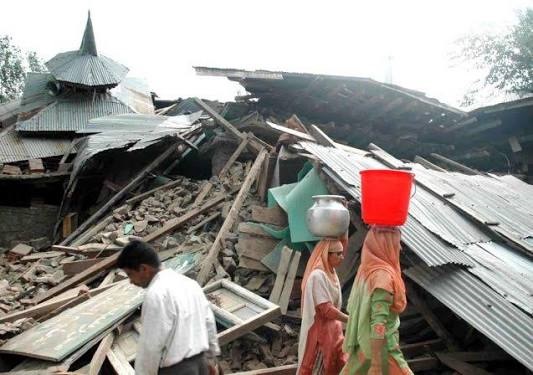
The October 8, 2005 Kashmir earthquake, centred near Muzaffarabad, caused catastrophic destruction across the Kashmir region on both sides of the Line of Control.
For people in J&K, the disaster remains one of the clearest reminders that seismic risk is not an abstract scientific calculation.
It is a threat capable of destroying homes, roads, bridges and public infrastructure within minutes.
The region has also experienced numerous smaller earthquakes and tremors.
Most cause little or no structural damage.
But frequent low-intensity tremors should not be interpreted as evidence that a major earthquake is imminent — nor as evidence that the danger has disappeared.
Earthquake science cannot currently provide Kashmir with a reliable date and time for the next major event.
Preparedness therefore has to assume that the next damaging earthquake could happen without notice.
Srinagar presents the most difficult urban challenge
The seismic problem becomes particularly complicated when natural hazard meets dense urban development.
A detailed 2023 scientific assessment of Srinagar examined the vulnerability of the city’s built environment using GIS-based analysis of building density, height, construction type, geometry, road networks and the potential for neighbouring buildings to strike each other during strong shaking.
The findings should command serious attention.
The study identified 23 of Srinagar’s 69 municipal wards as having high or very high structural vulnerability. Nine wards were placed in the very-high category and 14 in the high category. Together, the high and very-high zones covered roughly 7% of the city’s area.
The most vulnerable areas were concentrated particularly around the densely built-up city centre.
Why?
Because earthquakes do not damage buildings in isolation.
They interact with the entire urban environment.
Dense buildings.
Narrow roads.
Limited open spaces.
Older masonry structures.
Irregular construction.
Insufficient separation between buildings.
And difficulties in getting emergency vehicles through congested neighbourhoods.
When these factors combine, a moderate structural failure can become a major rescue problem.
The building itself may be the first line of failure
One of the most significant findings of the Srinagar assessment concerns construction type.
Researchers mapped approximately 250,000 buildings in the city. Around 98% were classified as masonry structures, while about 65% had a high possibility of pounding against neighbouring buildings on at least one side under strong shaking because adequate separation distances were not maintained.
This does not mean that 98% of Srinagar’s buildings will collapse during an earthquake.
That would be an unjustified interpretation.
It means that masonry construction and building-to-building interaction are important vulnerability factors that require attention.
The same study found that dense downtown areas were particularly exposed because of their narrow roads and tightly packed structures.
That is where the real concern lies.
Even if many individual buildings survive, blocked roads and collapsed structures could prevent ambulances, fire engines, rescue teams and heavy equipment from reaching the injured.
An earthquake response can fail because of access, not merely because of structural collapse.
The disappearance of traditional construction carries an unexpected lesson
Kashmir’s traditional building heritage also contains a lesson in earthquake resilience.
The 2023 Srinagar study noted that traditional Dhajji-Dewari construction can perform comparatively well during earthquakes because timber framing and masonry infill provide a degree of flexibility and energy dissipation.
But much of Kashmir’s newer construction has shifted toward contemporary masonry and concrete forms.
Researchers warn that many residential structures are built by local semi-skilled workers without sufficient technical expertise in seismic-resistant construction.
This does not mean modern concrete construction is inherently unsafe.
Properly designed and detailed reinforced-concrete buildings can be highly earthquake resistant.
The danger arises when structural design, materials, workmanship and construction supervision do not meet the relevant seismic standards.
In other words:
The problem is not modernity. It is non-engineered construction.
Kashmir already has earthquake-resistant building rules
This is where the story becomes more complicated than simply saying that authorities have failed to create regulations.
They have.
J&K’s building framework requires structural safety measures against earthquakes and references relevant Bureau of Indian Standards codes, including IS 1893, IS 4326, IS 13920, IS 13827 and IS 13828. The building-permission framework requires structural documentation and certification by qualified professionals.
The Srinagar Master Plan 2035 also incorporates earthquake-resistant design and construction standards into its development code.
The government has additionally been modernising the building-permission system.
J&K’s Housing and Urban Development Department operates an online Auto Scrutiny Based Online Building Permission System, designed to subject applications to applicable building bye-laws and provide scrutiny reports.
In February 2026, the administration also notified amendments to the Unified Building Bye-Laws 2021.
So the issue cannot accurately be described as a complete absence of building regulation.
The more difficult question is:
How effectively are seismic requirements enforced in the buildings that already exist — and during actual construction on the ground?
New buildings are only half the problem
Building codes are most effective when applied before construction.
But Kashmir already has an enormous building stock.
Many structures were built decades ago.
Others were constructed incrementally, with additional floors, extensions or alterations.
Some may predate modern seismic standards.
This creates the central earthquake-preparedness challenge:
What happens to buildings that cannot simply be rebuilt?
The answer is retrofitting.
Retrofitting can involve strengthening walls, improving connections, reinforcing structural elements, correcting weaknesses and improving the overall seismic behaviour of a building.
It is especially important for buildings where failure would have consequences beyond the occupants themselves.
That includes:
- hospitals;
- schools;
- colleges;
- fire stations;
- police facilities;
- emergency-operation centres;
- bridges;
- communication facilities;
- water infrastructure;
- and major government buildings.
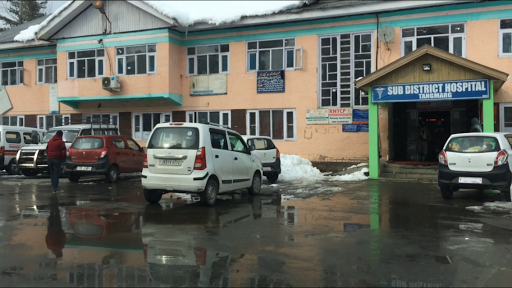
A hospital that becomes unusable after an earthquake is more than a damaged building.
It removes a critical component of the emergency-response system precisely when demand for medical care is greatest.
Srinagar’s vulnerable areas need more than a building code
The 2023 vulnerability study offers an important warning about this.
Researchers concluded that high- and very-high-vulnerability areas need strict compliance with building regulations, retrofitting and rehabilitation, while densely built areas require greater provision of open spaces and emergency services.
That means earthquake resilience cannot be reduced to structural engineering alone.
Urban planning matters.
Where buildings are permitted matters.
How closely they are packed matters.
Whether roads remain accessible matters.
Whether there are open spaces for evacuation matters.
Whether fire and rescue vehicles can enter a neighbourhood matters.
And whether people know where to assemble after an earthquake matters.
The narrow-road problem could become a rescue problem
One of Srinagar’s defining characteristics is also one of its seismic vulnerabilities.
Older neighbourhoods contain dense clusters of buildings connected by narrow lanes.
In ordinary times, this is an urban mobility problem.
During an earthquake, it could become a life-and-death issue.
A collapsed building can block a narrow road.
Falling walls can create debris piles.
Damaged electricity and gas infrastructure can create secondary hazards.
Vehicles abandoned by fleeing residents can further obstruct access.
And thousands of people moving simultaneously toward open spaces can create additional congestion.
The result could be a paradox:
The areas with the greatest concentration of people may also be the areas where emergency responders have the greatest difficulty reaching them.
The liquefaction question cannot be ignored
Srinagar’s geology creates another concern.
The city is situated largely on relatively young alluvial deposits and Karewa formations, and scientific research has identified areas with high to very-high seismic and liquefaction potential.
Liquefaction occurs when strong earthquake shaking causes water-saturated loose sediments to temporarily lose much of their strength.
Buildings can tilt or settle.
Roads can deform.
Underground infrastructure can be damaged.
The precise risk varies by soil conditions and location, so it would be wrong to claim that all of Srinagar faces the same liquefaction threat.
But it is another reason why site-specific seismic assessment matters.
A city cannot be treated as if every neighbourhood sits on identical ground.
Schools should be treated as emergency infrastructure
If a major earthquake strikes during school hours, thousands of children could immediately become part of the emergency response.
That makes school preparedness particularly important.
Every school should ideally have:
- earthquake evacuation plans;
- clearly identified assembly areas;
- marked emergency exits;
- basic search-and-rescue equipment;
- first-aid capability;
- trained teachers;
- emergency communication procedures;
- and regular drills.
Children can also become powerful messengers.
A child who learns how to Drop, Cover and Hold On can take that knowledge home.
School-level preparedness therefore protects not only students but entire households.
Hospitals need a different preparedness standard
Hospitals face a particularly difficult scenario.
After a major earthquake, demand for medical care can surge while the hospital itself may be damaged.
This is why structural safety and operational continuity have to be considered together.
A hospital’s preparedness plan should address:
the building, electricity, water, oxygen, medical supplies, communications, emergency access and patient evacuation.
The question should not simply be whether a hospital building will remain standing.
It should be:
Can the hospital continue functioning immediately after the earthquake?
That distinction is central to modern disaster resilience.
Disaster management capacity has improved — but resilience is broader than equipment
J&K is not starting from zero.
The government has been strengthening disaster-management infrastructure, including emergency-operation centres and district-level response mechanisms. The 2026-27 Budget, for example, provides for a Disaster Risk Mitigation Fund and refers to state-of-the-art Emergency Operations Centres and District EOCs across the UT.
These are important investments.
But disaster response capacity cannot be measured simply by the number of rescue vehicles, boats, communication devices or emergency personnel available.
An earthquake creates a different operational environment.
Roads may be blocked.
Mobile networks may fail.
Electricity may be disrupted.
Hospitals may be overwhelmed.
Water systems may be damaged.
Fuel supplies may become difficult to move.
And rescuers themselves may be affected.
A resilient disaster-management system therefore needs redundancy.
If one communication network fails, another must work.
If one road is blocked, another route must exist.
If a hospital is damaged, alternative treatment capacity must be available.
If power fails, critical facilities need backup systems.
The first rescuers will usually be neighbours
In a large earthquake, professional rescuers cannot reach every building immediately.
The first response often comes from neighbours, family members, shopkeepers, teachers, security guards and local volunteers.
That makes community preparedness one of the cheapest and most powerful forms of disaster resilience.
Residents should know:
- where to take shelter during shaking;
- how to switch off electricity and gas where appropriate;
- how to treat basic injuries;
- how to identify unsafe structures;
- how to avoid elevators;
- how to move away from damaged buildings;
- where community assembly points are located;
- and how to communicate when mobile networks are congested.
Prepared communities reduce pressure on professional responders.
Unprepared communities increase it.
Mock drills cannot be ceremonial events
A drill that happens once a year, produces photographs and ends there does little to build genuine resilience.
Effective drills should expose weaknesses.
Can the alarm system actually be heard?
Can children evacuate safely?
Can people with disabilities reach assembly areas?
Can emergency vehicles access the building?
Can hospitals activate their emergency plans?
Can authorities communicate with residents if mobile networks fail?
Can search-and-rescue teams reach dense neighbourhoods?
The purpose of a drill is not to demonstrate that everything works.
It is to discover what does not.
The tourism economy is also exposed
Earthquake preparedness is particularly important for a tourism-dependent region.
Srinagar, Gulmarg, Pahalgam, Sonamarg and other destinations accommodate large numbers of visitors during different seasons.
Tourists are less familiar with local geography.
They may not know evacuation routes.
They may not speak the local language.
They may be staying in older hotels or structures whose seismic characteristics they cannot assess.
Tourism preparedness should therefore include hotel-level emergency plans, visible evacuation information, trained staff and regular structural safety inspections.
The objective is not to frighten visitors.
It is to ensure that Kashmir’s tourism infrastructure is resilient enough to protect them.
The 2005 lesson should not be allowed to fade
The 2005 earthquake remains an important historical reference point precisely because disasters tend to disappear from public attention once immediate reconstruction ends.
The danger is that preparedness follows the same cycle.
A major disaster occurs.
Awareness rises.
Funds are released.
Drills increase.
New committees are created.
Then public attention declines.
Buildings continue to age.
New construction expands.
Urban density increases.
And the underlying vulnerability gradually returns to the background.
Earthquake preparedness must break that cycle.
What Kashmir needs now
1. Complete a building-level seismic vulnerability inventory
Authorities need a systematic inventory of existing buildings, beginning with critical infrastructure and high-density neighbourhoods.
The objective should be to identify which structures need:
- inspection;
- repair;
- retrofitting;
- restricted occupancy;
- or replacement.
2. Prioritise hospitals and schools
Critical facilities should be assessed before less consequential buildings.
The strongest earthquake response system is useless if the buildings housing its essential services fail.
3. Enforce seismic standards during construction
The existing building-permission system should be backed by field inspections, material-quality checks and accountability for structural professionals and builders.
Paper certification cannot substitute for physical compliance.
4. Establish a serious retrofitting programme
Older vulnerable buildings need technical and financial pathways for strengthening.
This is particularly important in dense urban neighbourhoods where demolition and reconstruction may be impractical.
5. Protect emergency access corridors
Srinagar needs clearly identified routes that remain usable for fire, ambulance and rescue operations after a major earthquake.
6. Create neighbourhood-level assembly spaces
Open spaces should be protected from encroachment and incorporated into emergency planning.
7. Institutionalise school earthquake drills
Preparedness should become part of school safety culture rather than an occasional awareness event.
8. Expand community first-responder training
Residents should be trained in basic first aid, light search-and-rescue techniques, emergency communication and safe evacuation.
9. Strengthen seismic monitoring and public communication
Scientific institutions and authorities should ensure that earthquake information is rapidly communicated to the public without creating unnecessary panic.
10. Conduct regular multi-agency exercises
Police, fire services, health authorities, civil administration, SDRF/NDRF, municipalities, utility providers and community organisations need to practise together.
The objective should be interoperability.
Cross-LoC cooperation is complicated — but science should remain connected
The Kashmir earthquake hazard does not stop at the Line of Control.
The same Himalayan tectonic system extends across the wider Kashmir region.
Scientific cooperation across politically divided regions can therefore have value for seismic research, hazard mapping and understanding regional earthquake behaviour.
However, operational disaster-response cooperation across the Line of Control involves substantial political, security and diplomatic constraints.
The immediate priority for J&K is therefore to strengthen its own monitoring, modelling, emergency communication and response systems, while supporting scientific exchange wherever formally possible.
Preparedness cannot depend on a political breakthrough.
The real question is not whether Kashmir will shake
Kashmir will continue to experience earthquakes.
The scientific question is when, where, how strongly and with what consequences.
Those questions cannot all be answered in advance.
But the consequences can be reduced.
A well-engineered building is less likely to collapse.
A retrofitted hospital is more likely to remain operational.
A trained teacher can evacuate children more safely.
A prepared neighbourhood can rescue trapped residents before professional teams arrive.
A clear emergency route can save precious minutes.
And a functioning communication system can prevent panic.
That is what earthquake resilience means.
Kashmir’s greatest seismic vulnerability may be complacency
The Valley has the regulations.
It has scientific expertise.
It has disaster-management institutions.
It has building-permission systems.
It has experienced devastating earthquakes before.
What remains difficult is converting all of that knowledge into consistent physical resilience on the ground.
The 2023 Srinagar vulnerability assessment provides a particularly powerful warning: the city’s most densely built areas, with high building density, masonry construction, narrow roads and limited separation between structures, remain among its most vulnerable urban environments.
That warning should not be interpreted as a prediction that Srinagar will suffer catastrophic destruction in the next earthquake.
It is a warning about exposure.
And exposure is something governments can reduce before disaster strikes.
Kashmir does not need another earthquake to remind it of its vulnerability.
It already has the science.
It has the history.
It has the building codes.
It has the vulnerability maps.
The challenge now is to act on them.
Because when the ground finally begins to move, there will be no time to start discussing preparedness.
The buildings, roads, hospitals, emergency teams and communities will either already be ready — or they will not.