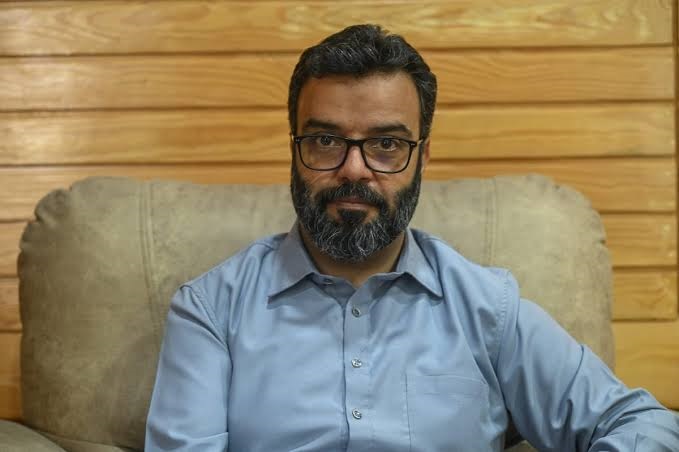
Aga Ruhullah Attacks NC Dynasty, Questions Omar Abdullah’s Leadership
By: Javid Amin | 13 September 2026
Srinagar: The long-running ideological confrontation between National Conference MP Aga Syed Ruhullah Mehdi and his party leadership has entered a sharper and more personal phase, with the Srinagar MP now questioning not only the NC’s position on Article 370 and statehood but also its decision to retain the Abdullah family at the centre of power.
Ruhullah has accused the National Conference of having an opportunity after the 2024 Assembly elections to choose a Chief Minister from outside the Abdullah family but failing to take it.
His pointed assessment was blunt: the Chief Minister’s post was a temptation the party could not resist.
The remarks add a new dimension to an increasingly public dispute that has, until now, largely revolved around Article 370, statehood and whether the NC has diluted its electoral commitments.
Ruhullah is now challenging the party on a deeper question:
Can the National Conference claim to represent a broad Kashmiri political movement while continuing to revolve around one political family?
Ruhullah’s Attack Goes Beyond Omar Abdullah
Ruhullah’s criticism is not simply an attack on Omar Abdullah’s performance as Chief Minister.
It is an attack on the political choice that placed him in the post.
According to reports from his September 12 interaction with reporters in Ganderbal, Ruhullah argued that after the election, the party could have chosen somebody outside the Abdullah family to lead the government. Instead, he suggested, it chose continuity because it could not resist the attraction of the Chief Minister’s position.
That distinction is important.
Criticism of an individual Chief Minister can be dismissed as a disagreement over policy or administration. Criticism of the family-based leadership structure goes directly to the identity and internal organisation of the National Conference.
For a party whose history is inseparable from Sheikh Abdullah, Farooq Abdullah and Omar Abdullah, that is a much more fundamental challenge.
The Abdullah Family and the National Conference Are Almost Impossible to Separate
The relationship between the Abdullah family and the NC is not merely one of conventional party leadership.
Sheikh Abdullah remains the central historical figure associated with the party’s emergence and Kashmir’s post-1947 political history. Farooq Abdullah subsequently became one of the most recognisable faces of the NC, while Omar Abdullah eventually emerged as the next generation of the family in electoral politics.
Omar served as Chief Minister earlier and returned to the post after the NC emerged as the largest force in the 2024 Assembly election.
That history gives the Abdullah family enormous political brand value.
But it also provides critics with an obvious line of attack.
Ruhullah’s argument is essentially that historical legitimacy should not automatically translate into permanent political entitlement.
His latest remarks bring that criticism into the open.
The Bigger Fight Is About What the NC Promised
The dynasty argument cannot be separated from Ruhullah’s much broader disagreement with the party.
For more than a year, the Srinagar MP has repeatedly argued that the NC’s electoral mandate was not simply about restoration of statehood.
He has maintained that the party sought votes on the promise of fighting for the restoration of constitutional safeguards associated with Article 370.
In April, Ruhullah said voters had not voted merely for statehood and argued that the NC had promised to fight for constitutional rights, including Article 370.
In July, he went further, accusing the party of moving away from its campaign commitments and arguing that concentrating only on statehood risked normalising the post-August 5, 2019 political framework.
And in August, he directly wrote to NC president Farooq Abdullah, questioning why the party’s 2024 manifesto had promised restoration of Article 370 if the leadership was now effectively treating statehood as the principal achievable objective.
The latest attack on the Abdullah family’s leadership therefore fits into a much larger pattern.
For Ruhullah, the problem is not simply who is Chief Minister.
It is whether the party’s leadership still embodies the political commitments on which it sought votes.
Article 370 Versus Statehood: The Central Fault Line
The fundamental disagreement inside the NC can be reduced to two competing approaches.
Ruhullah’s approach
Ruhullah argues that the party’s mandate extends beyond restoration of statehood.
His position is that Article 370 and the constitutional safeguards associated with it remain the central political demand, and that settling for statehood could effectively legitimise the post-2019 arrangement.
In July, ahead of the NC’s Delhi protest, he accused the party of shifting the political conversation away from constitutional guarantees towards a demand that he described as insufficient.
NC leadership’s approach
The leadership under Omar Abdullah has instead placed considerable emphasis on restoration of statehood as an immediate and achievable political objective.
The argument from the pragmatic camp is that statehood is a concrete demand that can be pursued through political engagement with New Delhi, whereas restoration of Article 370 faces an entirely different constitutional and political reality.
This is where the disagreement becomes strategic rather than merely ideological.
Ruhullah asks:
Why should the party abandon a promise simply because it is difficult?
The leadership’s implied response is:
Should a government sacrifice achievable political gains by insisting on objectives that currently have little prospect of implementation?
That is the unresolved argument at the heart of the NC.
Why the “Abdullah Family” Remark Matters
The most politically damaging element of Ruhullah’s latest intervention may ultimately be the dynasty argument rather than the Article 370 argument.
The Article 370 debate has existed for years and is already well established within Kashmiri politics.
The question of family control is different.
The NC has historically benefited from the Abdullah name. It provides continuity, recognition and a political identity that few regional parties can replicate.
But the same legacy can become a vulnerability when younger leaders or competing political groups argue that the party has become overly dependent on one family.
Ruhullah’s latest remarks attempt to turn that historical strength into a political liability.
His argument is effectively:
If the party had genuinely wanted to demonstrate renewal, it could have used the 2024 mandate to elevate a leader from outside the Abdullah family.
Instead, he says, the party chose the familiar path.
Is This Really About Dynastic Politics?
There is an important complication.
Calling the NC simply a “dynastic party” risks oversimplifying its political history.
The Abdullah family has not survived solely through inheritance. Farooq Abdullah and Omar Abdullah have both contested elections and maintained significant electoral constituencies.
The NC itself remains a large organisation with leaders from different regions and communities.
Moreover, voters ultimately determine electoral legitimacy.
The more precise criticism is therefore not that the Abdullahs have never faced electoral scrutiny, but that the party’s political identity remains unusually concentrated around the family.
Ruhullah is challenging whether that concentration is still compatible with the kind of political renewal demanded by a post-2019 J&K.
Ruhullah’s Growing Independence Is No Longer in Doubt
The latest remarks also demonstrate how far Ruhullah has moved from the conventional discipline expected of a ruling-party MP.
His disagreements with the NC leadership have become increasingly public.
He opposed the party’s emphasis on the Delhi statehood protest, accused the leadership of deviating from the 2024 manifesto and directly addressed Farooq Abdullah over the party’s position on Article 370.
In August, The Indian Express described his communication to Farooq Abdullah as his first direct communication to the party president amid the prolonged dispute.
By September, he was openly talking about freeing himself from what he described as “chains” and leaving his political future open.
On September 12, he indicated that November 3 would be a point when he would “break those chains” and “free” himself, while leaving open the possibility of a new political platform. He said any decision about forming a party would be taken collectively with the people and particularly the youth of J&K.
That makes his latest attack much more consequential than an ordinary expression of dissent.
Could Ruhullah Leave the NC?
This is now one of the biggest unanswered questions in J&K politics.
Ruhullah has not definitively announced that he is forming a new political party.
What he has done is leave the possibility open.
That distinction matters.
Creating a new political platform in Jammu & Kashmir would require much more than personal popularity. It would require organisational infrastructure, candidates, resources, a coherent programme and support across regions and communities.
Ruhullah himself has reportedly said that the decision on whether to form a party would be collective and would involve consultation with the people and youth of J&K.
For now, therefore, a new party remains a possibility, not an established political fact.
But even the possibility changes the calculations inside the NC.
Could His Politics Attract the Disenchanted?
Ruhullah’s appeal comes from a specific political proposition.
He presents himself as a politician unwilling to abandon issues that he believes formed the basis of the NC’s 2024 electoral mandate.
That gives him a potentially distinctive constituency among voters who believe the post-2019 political settlement should be challenged more forcefully.
His emphasis on Article 370 also separates him from the more pragmatic statehood-first approach of the current government.
But there is another side.
A large section of the electorate may be more concerned about jobs, development, healthcare, investment, infrastructure and administrative stability than about reopening constitutional questions whose restoration faces formidable legal and political barriers.
That is the central electoral test for Ruhullah.
Can ideological consistency be converted into a broad political coalition?
The Supreme Court Factor Cannot Be Ignored
Any discussion about Article 370 also has to acknowledge the constitutional reality.
In December 2023, the Supreme Court upheld the Union government’s constitutional changes concerning Article 370 and directed that Assembly elections be held in Jammu & Kashmir, while also saying statehood should be restored at the earliest.
That legal position fundamentally shapes the political environment in which the NC operates.
Ruhullah’s demand for restoration of Article 370 is therefore a political position rather than a straightforward administrative policy that the J&K government can implement on its own.
This is one reason the NC leadership has focused so heavily on statehood.
The dispute between Ruhullah and the leadership is consequently not simply about what the party wants.
It is about what the party believes it can realistically achieve—and what it believes it is morally and politically obligated to continue demanding.
The NC’s Two Faces
The emerging internal divide has produced two distinct images of the National Conference.
On one side is the governing NC—led by Omar Abdullah, focused on administration, development, jobs, statehood and engagement with New Delhi.
On the other is the movement-oriented NC represented increasingly by Ruhullah—focused on Article 370, constitutional guarantees, political dignity and resistance to what he sees as normalisation of the post-2019 order.
Both claim the NC’s legacy.
Both claim to represent the electorate.
And both believe their approach is necessary for the party’s future.
That is what makes the dispute so difficult to resolve.
What Happens to the Abdullah Legacy?
The most important question may ultimately concern the future of the NC itself.
The Abdullah family remains its most recognisable political brand. Removing that family from the centre of leadership would not automatically make the party more democratic or more representative.
But Ruhullah’s intervention forces the NC to confront an uncomfortable question:
Can a party founded around a powerful political personality successfully reinvent itself without loosening the family’s grip on its leadership?
There is no easy answer.
The Abdullah legacy is simultaneously an asset and a vulnerability.
It gives the NC historical continuity, but it also allows rivals to portray it as a family-centred organisation.
The Youth Question Could Decide the Next Phase
Ruhullah’s reference to youth in discussing a possible future political platform is particularly important.
Jammu & Kashmir’s younger voters have grown up amid an entirely different political environment from the one that shaped the original NC.
For them, questions of employment, education, technology, private-sector opportunities and political representation compete with the traditional debates around autonomy and constitutional status.
A successful political challenge to the NC would therefore need to combine identity politics with an economic programme.
Article 370 alone may not be enough.
Nor would statehood alone necessarily be enough.
The political movement capable of connecting constitutional aspirations with employment and everyday governance could potentially occupy a much larger space.
A New Battle for the NC’s Political Soul
Ruhullah’s latest comments expose a deeper struggle than a personal disagreement between an MP and a Chief Minister.
It is a battle over the political soul of the National Conference.
Should the party remain primarily the vehicle of the Abdullah political legacy?
Should it broaden its leadership and allow a new generation to emerge?
Should it prioritise achievable statehood or continue making Article 370 restoration the centrepiece of its political identity?
And can it reconcile government responsibility with the oppositional politics on which much of its historical legitimacy was built?
These questions are becoming harder to avoid.
Ruhullah’s accusation that the NC “could have” chosen a Chief Minister outside the Abdullah family—and simply “couldn’t resist the temptation”—has therefore struck at one of the party’s most sensitive points.
Whether the remark remains an internal challenge or becomes the foundation of a new political formation could have consequences well beyond the National Conference.
For J&K politics, the emerging contest is no longer simply NC versus BJP, or NC versus PDP.
It is increasingly becoming a contest over what the NC itself should represent in the post-2019 era:
a pragmatic governing party seeking what can be achieved, or a political movement willing to keep fighting for what it believes was promised.
And at the centre of that increasingly public debate stands Aga Syed Ruhullah Mehdi.


