Kashmir Moon-Venus Conjunction: Valley’s Night Sky Shines as 2026 Celestial Calendar Unfolds
By: News Desk | 14 September 2026
From a delicate crescent beside brilliant Venus to meteor showers, eclipses and planetary encounters, Kashmir’s mountains and dark-sky landscapes offer a spectacular backdrop for watching the heavens in 2026.
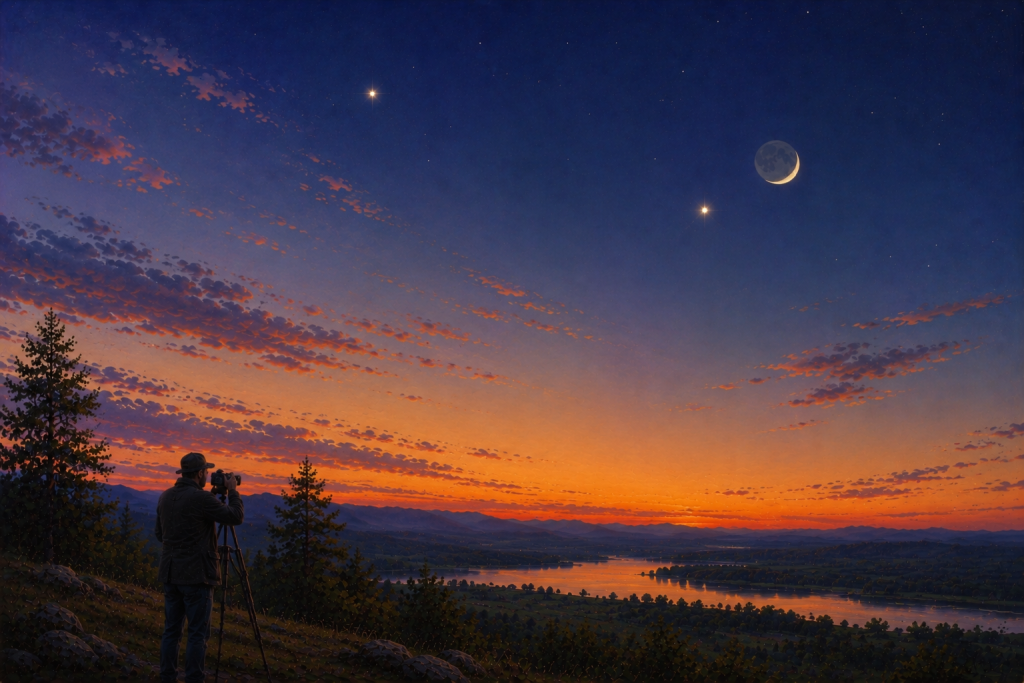
SRINAGAR — For a few precious moments after sunset, the Kashmir sky offered the kind of spectacle that needs neither a telescope nor a special observatory.
A slim crescent Moon hung above the western horizon while brilliant Venus appeared nearby, creating one of those deceptively simple astronomical scenes that can stop people in their tracks.
The event was a reminder that some of the most beautiful sights in the night sky are also among the easiest to observe.
There was no need for sophisticated equipment. No complicated calculations. No observatory dome.
Just a clear horizon, a fading sunset and two of the brightest objects visible from Earth.
And for Kashmir, where mountains, lakes and meadows naturally frame the horizon, the visual effect can be particularly striking.
But the Moon-Venus encounter is more than a pretty photograph.
It offers an accessible introduction to astronomy — and comes as the Valley moves through a year packed with eclipses, meteor showers, planetary appearances and seasonal celestial milestones.
What people actually saw in Kashmir
The phenomenon is commonly described as a Moon-Venus conjunction.
In astronomy, a conjunction does not mean that two celestial bodies have physically come close to each other.
It simply means that, from our perspective on Earth, two objects appear close together in the sky.
The Moon and Venus remain separated by enormous distances.
Their apparent proximity is a consequence of the geometry of their orbits and our viewing position from Earth.
That distinction is important because spectacular sky events can create the illusion of cosmic neighbours when, in reality, the objects are nowhere near each other.
On September 14, Venus was particularly well placed for evening observation in northern India. Astronomical calculations show Venus setting shortly after sunset, while the Moon appeared as a waxing crescent.
That narrow window is part of what makes such displays memorable.
The sky changes quickly after sunset.
The blue fades.
The brightest stars begin to emerge.
Venus appears almost unnaturally bright.
And the Moon, carrying only a thin illuminated portion of its surface, adds another layer to the scene.
Why Venus looks so bright
Venus is often called the Evening Star when it appears after sunset, although it is not a star at all.
It is a planet.
Its brilliance comes primarily from its highly reflective cloud-covered atmosphere and its relative proximity to Earth compared with the distant stars.
Venus can become so bright that it is easily visible in twilight, when many stars remain invisible.
That makes it an especially effective companion for the Moon.
The contrast is striking:
a razor-thin lunar crescent on one side and an intensely bright point of light nearby.
For casual skywatchers, it is also one of the easiest ways to identify a planet without any equipment.
A conjunction is an illusion of perspective — but a beautiful one
Imagine looking down a long road.
Two buildings may appear almost side by side in the distance even though one is several kilometres behind the other.
The celestial sphere works in a similar visual way.
The Moon is Earth’s natural satellite and circles our planet roughly 384,000 kilometres away on average.
Venus, meanwhile, is a planet orbiting the Sun.
When their positions line up favourably from Earth, they can appear remarkably close.
The physical distances remain enormous.
The visual alignment is what matters.
And that alignment is precisely what gives conjunctions their photographic appeal.
Why Kashmir is such a compelling place to watch the sky
Kashmir’s appeal for astronomy is not simply poetic.
Large portions of the Valley and surrounding mountains offer darker skies than densely illuminated urban centres.
Higher-altitude locations can also provide broader horizons, although altitude alone does not guarantee good astronomical visibility.
The biggest factors remain:
- cloud cover;
- atmospheric transparency;
- light pollution;
- horizon visibility;
- moonlight;
- and the position of the astronomical target.
For a low western object such as Venus shortly after sunset, an unobstructed western horizon can matter more than altitude.
That is why a good viewpoint overlooking an open valley can sometimes be better than a heavily built-up high-altitude location.
From Srinagar to Gulmarg: the Valley has an astronomical advantage
The Kashmir landscape provides a remarkable range of settings for skywatching.
Gulmarg
Gulmarg’s elevation and open landscapes can provide excellent opportunities for observing meteor showers and bright planetary objects when skies are clear.
Its broad mountain horizons also create dramatic foregrounds for astrophotography.
Pahalgam
Pahalgam offers wide valley views and a natural setting away from some of the brighter urban areas.
It can be particularly attractive for photographers who want mountains or forests in the foreground.
Sonamarg
With darker surroundings and expansive mountain scenery, Sonamarg can offer compelling conditions for night-sky photography, although weather and accessibility remain decisive.
Yusmarg
Yusmarg’s meadows and relatively quiet surroundings make it appealing for people seeking a slower, camping-style stargazing experience.
Dal Lake
Dal Lake is perhaps the most visually distinctive option.
The sky itself may not necessarily be darker than at remote mountain locations, but reflections of the Moon, Venus and stars on the water can produce extraordinary photographs.
For travellers interested in combining astronomy with Kashmir’s landscapes, this is where the experience becomes something more than conventional stargazing.
2026 is a busy year for skywatchers
The Moon-Venus display is only one event in a much larger astronomical calendar.
Several notable events have already occurred or are still ahead in 2026.
However, some of the dates and visibility descriptions circulating online require clarification.
March 3 lunar eclipse: spectacular globally, but not fully visible from India
The March 3 event was a total lunar eclipse globally.
But that does not mean the entire total phase was visible from every location.
In New Delhi, for example, the Moon rose while the eclipse was already underway. The total phase occurred below the horizon, and observers saw only the later partial phase.
So the commonly repeated claim that the total lunar eclipse was “fully visible across India” is too broad.
The exact experience depended on location.
This is a useful lesson for anyone planning astronomical travel:
An eclipse’s global classification and its local visibility are not the same thing.
August 12 solar eclipse: spectacular, but not an Indian viewing event
Another correction concerns the August 12 total solar eclipse.
The eclipse itself was a major global astronomical event.
But the Indian subcontinent was not in the path of visibility.
The Indian Meteorological Department’s Rashtriya Panchanga specifically lists the August 12, 2026 total solar eclipse and states that it was not visible in India.
For Indian skywatchers, therefore, this was an international astronomical event rather than a Kashmir viewing opportunity.
That distinction matters for travel articles because “visible globally” does not mean “visible locally.”
Meteor showers remain the easiest deep-sky spectacle
Unlike eclipses, meteor showers do not require precise equipment.
On a sufficiently dark night, observers can simply lie back and watch.
Meteor showers occur when Earth passes through streams of dust and debris left behind by comets or asteroids.
When tiny particles enter Earth’s atmosphere at high speed, they heat the surrounding air and produce the streaks commonly called shooting stars.
The particles themselves are generally tiny.
The visual streak can nevertheless be spectacular.
For Kashmir, the combination of dark surroundings and dramatic mountain silhouettes can make meteor showers especially photogenic.
Lyrids, Eta Aquariids and the summer meteor season
The Lyrid meteor shower around April 22–23 remains one of the year’s familiar spring skywatching events.
The Eta Aquariids, associated with debris from Halley’s Comet, peak in early May.
Later in the summer, the Delta Aquariids become active around late July.
These events vary considerably in viewing quality from one year to another because moonlight can wash out fainter meteors.
That means a meteor shower’s published peak date is only part of the story.
For photographers, the better question is:
What will the Moon be doing when the meteors peak?
Dark skies can make a modest meteor shower appear much more impressive.
And then comes the Leonid season
The Leonids, traditionally active in November, are among the best-known meteor showers because their parent comet is 55P/Tempel-Tuttle.
They have produced spectacular meteor storms in the past.
But it is important not to promise a meteor storm every year.
The Leonids are periodic, but ordinary annual activity can be much more modest.
For Kashmir observers, November’s colder nights can actually provide excellent atmospheric clarity when skies cooperate — although warmth becomes essential for anyone spending several hours outdoors.
Equinoxes and solstices: the astronomical rhythm of the year
Not every important astronomical event involves a dramatic object in the sky.
The equinoxes and solstices are equally fundamental.
They mark key points in Earth’s annual journey around the Sun and the changing relationship between sunlight and the planet’s hemispheres.
For Kashmir, these transitions are particularly visible in everyday life.
Spring brings longer days and changing mountain landscapes.
Summer stretches daylight hours.
Autumn rapidly transforms the Valley’s colours.
Winter compresses daylight and brings long, dark nights.
Astronomy is therefore not separate from Kashmir’s seasonal identity.
It helps explain it.
Kashmir’s celestial calendar is also a tourism opportunity
There is an emerging opportunity here for Kashmir’s tourism sector.
The Valley is already marketed for mountains, lakes, snow, adventure and photography.
Stargazing adds another dimension.
A traveller who spends a day exploring Srinagar can move toward a quieter mountain destination in the evening and experience a completely different side of the landscape.
A tourism itinerary could combine:
sunset → local cuisine → mountain viewpoint → night-sky observation → astrophotography → sunrise.
That is a tourism experience rather than simply a sightseeing stop.
Explore Kashmir journeys with JKL Travels
For visitors looking to combine Srinagar, Gulmarg, Pahalgam and other Valley destinations, local itinerary planning can also make it easier to select locations based on weather, accessibility and the timing of celestial events.
See Kashmir travel options from Kashmir Travels
Why dark-sky tourism could become valuable for Kashmir
Globally, astronomy tourism is becoming increasingly attractive.
People travel to see auroras.
They travel to remote deserts for meteor showers.
They travel to mountain regions for eclipses.
Kashmir has an obvious advantage in this market:
the landscape is already a destination.
The challenge is ensuring that tourism development does not destroy the very darkness that makes astronomical tourism attractive.
That means avoiding unnecessary light pollution around potential viewing locations.
Downward-facing lights.
Warmer, lower-intensity illumination where practical.
Shielded fixtures.
Better lighting design.
And keeping unnecessary lights away from open viewing areas.
Dark-sky tourism and responsible tourism can therefore reinforce each other.
How to photograph the Moon and Venus
You do not need a professional camera to capture a conjunction.
A modern smartphone can produce surprisingly good results.
The most important ingredient is usually composition, not expensive equipment.
Place the Moon and Venus against something recognisably Kashmiri:
- a mountain ridge;
- a lake;
- a houseboat;
- a chinar silhouette;
- a mosque skyline;
- or a quiet meadow.
The celestial objects then become part of a larger landscape photograph.
For cameras with manual controls, a tripod is extremely useful.
A short exposure can preserve the shape of the crescent and the brightness of Venus while keeping the landscape visible.
Longer exposures can brighten the foreground but may make the Moon appear overexposed.
This is why astrophotography is often an exercise in compromise.
Binoculars are enough for many beginners
People sometimes assume that astronomy requires an expensive telescope.
It does not.
For basic skywatching, the naked eye is enough for:
- the Moon;
- Venus;
- Jupiter;
- Saturn;
- brighter stars;
- and many meteors.
Binoculars can reveal additional lunar detail and make some star clusters much easier to observe.
A telescope becomes useful when the observer wants to explore planetary details, lunar craters or fainter deep-sky targets.
For a Moon-Venus conjunction, however, no telescope is necessary.
In fact, a telescope may make the event less visually satisfying because the two objects may not fit comfortably into the same field of view at higher magnification.
The most important rule: check the horizon
For conjunctions involving Venus shortly after sunset, the western horizon matters.
Buildings, trees and mountains can hide the objects before they become visible.
Skywatchers should ideally reach the viewing location before sunset.
That gives them time to:
- identify the western horizon;
- set up equipment;
- watch the sunset;
- allow twilight to fade;
- locate Venus;
- then identify the crescent Moon.
Astronomical events can be short-lived.
Arriving after the show begins can mean missing the best view.
Weather remains Kashmir’s wildcard
Astronomy ultimately depends on something humans cannot control:
clouds.
A perfectly positioned Moon and Venus are useless to an observer beneath thick cloud.
The same applies to meteor showers.
A forecast that says “clear skies” does not necessarily guarantee perfect transparency, particularly in mountainous terrain where local weather can change quickly.
This makes flexibility important.
If the sky is cloudy in Srinagar, a traveller may have better conditions elsewhere.
But mountain travel should never be undertaken solely on the assumption that another location will definitely be clear.
Weather forecasts and local conditions should be checked before travelling.
Stargazing should also be responsible tourism
There is another side to the growing interest in night-sky tourism.
Remote locations can become crowded when a major astronomical event attracts photographers and tourists.
That creates risks:
- litter;
- vehicle congestion;
- disturbance to local communities;
- excessive lighting;
- unsafe roadside parking;
- and damage to fragile natural areas.
The answer is not to keep people away.
It is to develop responsible stargazing practices.
Visitors should carry their waste back.
Avoid bright lights when possible.
Respect local communities.
Do not trespass.
Avoid blocking mountain roads.
And never assume that an isolated location is automatically a safe location.
A simple Kashmir stargazing itinerary
For travellers who want to turn the celestial calendar into part of a Kashmir holiday, a simple format could look like this:
Day 1 — Srinagar
Explore the city’s heritage, Dal Lake and local markets.
Day 2 — Srinagar to Gulmarg
Enjoy the mountain landscape and remain overnight where skies permit.
Day 3 — Night-sky experience
Choose an appropriate viewing location based on the astronomical event and weather.
Day 4 — Pahalgam
Combine valley landscapes with evening skywatching.
Day 5 — Return to Srinagar
Use the final evening for lakeside photography and a relaxed city experience.
The itinerary should remain flexible because astronomical visibility cannot be guaranteed in advance.
Plan a customised Kashmir itinerary with JKL Travels
And for travellers specifically interested in Kashmir stays, sightseeing and customised packages, Kashmir Travels provides another local planning option.
Plan your Kashmir holiday with Kashmir Travels
2026 Kashmir Stargazing Calendar
| Period | Event | Kashmir viewing outlook |
|---|---|---|
| January 4 | Quadrantid meteor shower | Pre-dawn viewing; dark skies preferred |
| March 3 | Total lunar eclipse globally | Partial phase visible from parts of India; totality not fully visible from many Indian locations |
| April 22–23 | Lyrid meteor shower | Best after midnight/pre-dawn, subject to moonlight and weather |
| May 5–6 | Eta Aquariid meteor shower | Pre-dawn viewing; southern sky favoured |
| Late July | Delta Aquariid activity | Best under dark, moonless conditions |
| August 12 | Total solar eclipse | Not visible from India |
| September | Moon/planet encounters and autumn skywatching | Increasingly attractive as nights lengthen |
| November 17–18 | Leonid meteor shower | Pre-dawn viewing recommended |
| December | Winter skywatching | Long nights offer extended observing opportunities |
The exact quality of any event depends on local horizon conditions, cloud cover, moonlight and the object’s altitude at the time of observation.
The Moon, Venus and the poetry of Kashmir
There is something fitting about the Moon and Venus appearing together over Kashmir.
The Valley has long been associated with poetry, water, mountains and changing light.
The same landscape that inspires people during the day becomes something entirely different after sunset.
Dal Lake becomes a dark mirror.
Mountain silhouettes disappear into the night.
The last light fades from the western sky.
And suddenly, a thin crescent and a brilliant planet become the focal point.
Science explains exactly why the event happens.
But science does not make the experience less beautiful.
If anything, understanding the mechanics makes it more extraordinary.
The Moon is moving.
Venus is moving.
Earth is moving.
The entire scene is part of a constantly changing celestial geometry — and yet, for a few minutes, from a particular point in Kashmir, they appear to pause together in the sky.
That is the real attraction of astronomy.
The universe is always putting on a show. We simply have to look up.