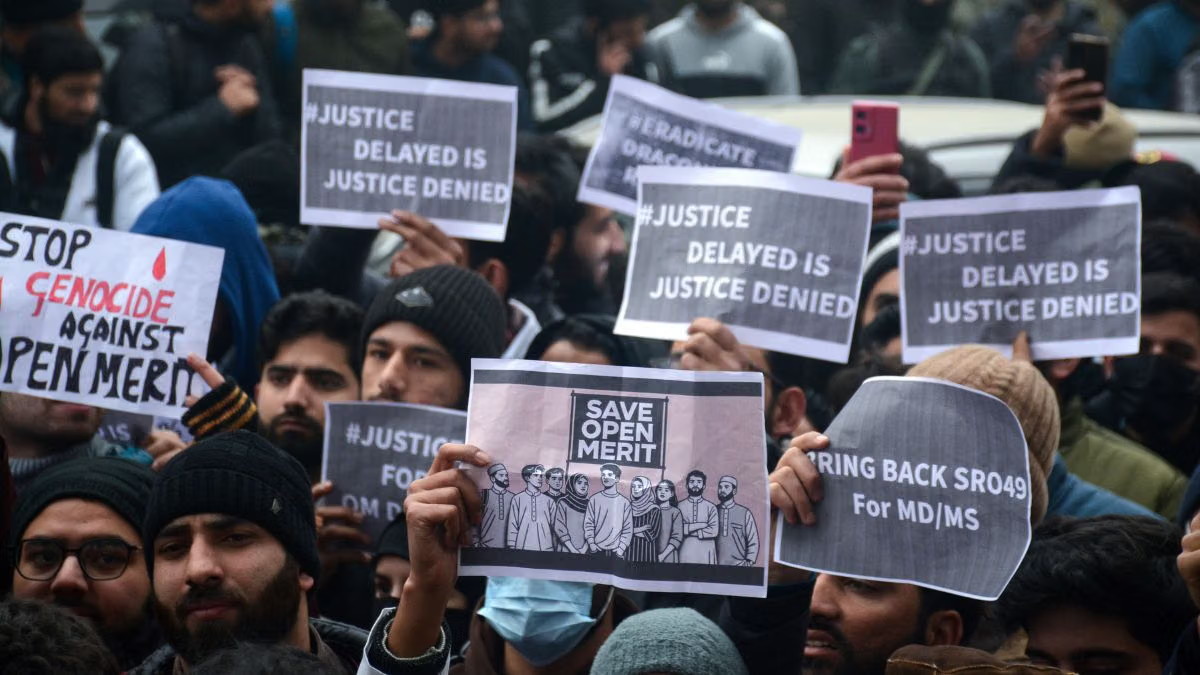
J&K Reservation Row: What Does an Open-Merit Student Actually Get?
By: Javid Amin | 24 September 2026
Srinagar: For a young person preparing for a government job or a professional college entrance examination in Jammu and Kashmir, the reservation debate is not an abstract argument about percentages.
It is much more personal.
It comes down to a simple question:
If I am an Open Merit candidate, how many seats are actually available to me?
That question has once again moved to the centre of the Jammu and Kashmir Assembly session, with opposition parties pressing the government to discuss the reservation framework and disclose the status of the Cabinet Sub-Committee constituted to examine and rationalise it.
The government has confirmed that the committee completed its work and submitted its recommendations, but the report is still awaiting a final decision by the competent authority. Until that happens, the existing framework continues to operate.
For students and job aspirants, however, the wait has become part of the problem.
They are applying for examinations under one set of rules while knowing that the government itself is considering changing those rules.
And this is where the numbers matter.
First, what is the current reservation structure?
The J&K Government amended the Reservation Rules in March 2024.
The official Gazette shows the following vertical reservation structure for direct recruitment:
| Category | Reservation |
|---|---|
| Scheduled Castes (SC) | 8% |
| Scheduled Tribes (ST-I + ST-II) | 20% |
| Other Backward Classes (OBC) | 8% |
| Residents of Backward Areas (RBA) | 10% |
| ALC/International Border | 4% |
| Economically Weaker Sections (EWS) | 10% |
| Total vertical reservation | 60% |
| Balance/Open Merit | 40% |
The March 15, 2024 Gazette formally records 8% SC, 20% ST, 8% OBC, 4% ALC/IB, 10% RBA and 10% EWS under the direct-recruitment framework.
There are also horizontal reservations for certain groups, including persons with disabilities and ex-servicemen. These operate differently from vertical reservation and should not simply be added to the 60% figure as though they were another block of seats.
That distinction is important because much of the public debate has become confused by adding every percentage together.
So, does an Open Merit student get 40%?
For direct recruitment, the simplest answer under the current structure is:
40% of the posts are allocated to Open Merit.
But there is an important catch.
“Open Merit” does not mean that only candidates who have no reservation category can compete for those 40%.
A candidate belonging to SC, ST, OBC, RBA or another reserved category can also qualify on merit against an Open Merit position.
This is a long-standing principle of the reservation system.
The Jammu and Kashmir High Court has explained that a reserved-category candidate selected on merit against an Open Merit seat is counted against the Open Merit quota rather than consuming the reserved seat.
So an Open Merit candidate does not have a guaranteed 40% of the jobs to himself or herself.
Rather, the candidate competes in the open pool, while candidates from reserved categories are also eligible to compete in that pool if their merit is high enough.
That is why the actual experience of an unreserved candidate can feel very different from simply looking at the percentage printed in a recruitment advertisement.
Take a real example: 1,815 J&K Police posts
The clearest way to understand the issue is to leave the political speeches aside and look at an actual recruitment notification.
The J&K Services Selection Board advertised 1,815 Constable (Executive Police) posts in December 2025.
There were:
- 934 posts in Jammu Division
- 881 posts in Kashmir Division
- 1,815 posts overall
Of these, 728 posts were earmarked for Open Merit.
That works out to exactly 40.11% of the total.
The remaining posts were distributed among SC, ST-I, ST-II, RBA, OBC, ALC/IB and EWS categories.
This is what the reservation debate looks like from the perspective of a young person filling out an application.
Out of 100 similar posts, roughly 40 are initially marked Open Merit.
The other roughly 60 are assigned to reserved categories.
But even within those 40 open posts, reserved-category candidates who qualify on merit can be selected.
That is the part often missing from social-media explanations.
Then why are people talking about 30% Open Merit?
This is where the controversy becomes complicated.
Some political statements and reports have described the current structure as leaving only 30% for Open Merit, because they are looking at the overall reservation framework and roster implications rather than simply adding the vertical percentages in Rule 4.
The official March 2024 Gazette, however, clearly sets out 60% vertical reservation in direct recruitment, leaving the mathematical balance at 40%.
That does not mean the 30% figure should simply be dismissed.
It means the terminology needs to be precise.
There is a difference between:
the Open Merit percentage specified in the reservation table,
and
the number of posts a particular unreserved applicant ultimately experiences as available to candidates outside reserved categories after the roster, horizontal reservations and merit movement are applied.
Those are not necessarily identical.
That distinction should be made every time this issue is discussed.
Otherwise, students are left arguing over two different calculations without realising it.
What happened to the 50% figure?
There is another source of confusion.
The same March 2024 Gazette contains a separate table under Rule 15, concerning professional-course admissions.
That table explicitly lists 50% Open Merit, followed by reserved categories.
This is different from the direct-recruitment provision.
So a student asking about a government job and a student asking about admission to a professional course cannot necessarily be given the same one-line answer.
For direct recruitment, the current Rule 4 structure leaves 40% as the balance after vertical reservations.
For professional-course admissions, Rule 15 contains a 50% Open Merit entry, alongside specified reserved categories.
That is one reason the public debate needs to stop using a single “reservation percentage” as though it applies identically to every recruitment and admission exercise.
The EWS question adds another layer
Economically Weaker Sections are also part of the current J&K structure.
The March 2024 rules provide 10% EWS reservation.
For an economically weaker candidate who otherwise falls within the eligibility criteria, this creates an additional category of competition.
But EWS should not be confused with Open Merit.
An EWS candidate is a reserved-category candidate for the purposes of the reservation framework, even though EWS is based on economic criteria rather than caste or tribe.
That distinction matters when people describe every candidate outside SC/ST/OBC/RBA as “general category”.
The legal and administrative categories are more complicated than that.
And what exactly is “general category”?
This is probably the biggest misunderstanding in the public conversation.
In everyday language, people often say:
General category.
Government recruitment rules more commonly use:
Open Merit.
They are not perfectly interchangeable concepts.
Open Merit is essentially the unreserved competition pool.
A candidate from a reserved category can enter that pool through merit.
So imagine 100 vacancies.
If 40 are Open Merit, all eligible candidates compete for those 40.
Now suppose a candidate who belongs to an ST category scores high enough to finish within those 40.
That candidate is selected against Open Merit.
The ST reserved seat remains available for another eligible ST candidate.
This is why simply looking at the caste or category of selected candidates and adding them together can produce a misleading picture.
What does an ordinary unreserved student actually face?
Now consider a hypothetical student from an unreserved category who does not qualify for EWS or any other reserved category.
For that student, the situation is straightforward but competitive.
There is no separate SC seat.
There is no ST seat.
There is no RBA seat.
There is no OBC seat.
There is no ALC/IB seat.
There is no EWS seat.
The student’s direct-recruitment route is primarily the Open Merit pool.
Under the present direct-recruitment structure, that means competing for the roughly 40% Open Merit share.
But that 40% is not reserved exclusively for unreserved-category students.
Reserved-category candidates who make the Open Merit list can also take those positions.
This is why an Open Merit candidate may feel that the practical competition is much larger than “40 seats for 40 general candidates”.
It is.
The open pool is open.
The 1,815 police posts show the numbers clearly
The police recruitment provides a useful real-world snapshot.
| Category | Posts |
|---|---|
| Open Merit | 728 |
| SC | 145 |
| ST-I | 181 |
| ST-II | 181 |
| RBA | 181 |
| OBC | 147 |
| ALC/IB | 72 |
| EWS | 180 |
| Total | 1,815 |
The figures reported from the recruitment notification add up to the full 1,815 posts.
The headline figure for an Open Merit aspirant is therefore 728 posts.
But the final number of unreserved-category candidates selected cannot automatically be assumed to be 728 because reserved-category candidates who qualify on Open Merit can occupy positions in the open list.
That is the crucial difference between Open Merit vacancies and Open Merit-only beneficiaries.
The same issue appeared in Medical Officer recruitment
The reservation debate is not limited to police recruitment.
In December 2025, the Health and Medical Education Department referred 480 Medical Officer posts for direct recruitment.
According to contemporary reporting, 192 posts were earmarked for Open Merit, again amounting to 40%.
The remaining positions were distributed across reserved categories.
For a medical graduate preparing for a government job, this is not an ideological debate.
It is a calculation of how many vacancies they can realistically compete for.
That is why the issue has become particularly sensitive among students and professional graduates.
Why Open Merit groups are angry
Open Merit student groups argue that the reservation structure has become too large relative to the share of the population they believe falls outside reserved categories.
They point to recruitment notifications in which only 40% of posts are marked Open Merit and argue that reserved-category candidates can also enter that open pool on merit.
Their concern is therefore not simply the existence of reservation.
It is the cumulative effect of multiple reservations, roster rules, category benefits and limited government vacancies.
The J&K Open Merit Students Association has repeatedly raised this issue, including during the controversy over the 1,815 police posts.
There is also a wider political argument over whether the present system adequately reflects the population composition and whether reservation has expanded beyond what its original social-justice objective required.
Those are political and policy judgments, however, not matters that can be settled merely by looking at one recruitment notice.
Why reserved communities defend the system
The other side of the argument is equally important.
Reservations were not created simply to distribute government jobs.
They are intended to address historical social and educational disadvantage and improve representation in institutions and public employment.
The J&K reservation framework covers Scheduled Castes, Scheduled Tribes and several socially and educationally backward groups, alongside EWS and other provisions. The government continues to defend the need to provide representation and opportunities to communities covered by these categories.
The 2024 amendment also increased the ST reservation to 20%, following the inclusion of the Pahari ethnic group and other communities in the Scheduled Tribe framework.
That change is one of the major reasons the current controversy exists.
The question is no longer simply whether reservation should exist.
It is about how much reservation is appropriate, how categories should be identified, whether the distribution reflects present-day disadvantage, and how Open Merit opportunities should be protected.
Why the Pahari ST decision changed the arithmetic
The 2024 changes are central to understanding today’s dispute.
Before the changes, the reservation structure was substantially different.
The March 2024 notification divided the 20% ST reservation into two 10% blocks.
One covered the existing Scheduled Tribes.
The other covered the newly added communities, including the Pahari ethnic group, Gadda Brahmin, Koli and Paddari Tribe following their inclusion under the relevant constitutional amendment.
That additional ST reservation changed the balance between reserved and open categories.
It also transformed reservation into a major political issue because the new arrangement affected both Jammu and Kashmir regions and multiple communities.
The Cabinet Sub-Committee was supposed to find a middle ground
After the political controversy intensified, the Omar Abdullah government constituted a three-member Cabinet Sub-Committee in December 2024 to examine and rationalise the reservation policy.
The committee was expected to look at the competing concerns.
On one side:
open-merit students and job aspirants.
On the other:
communities benefiting from reservation.
The government has now acknowledged that the committee completed its report.
But the recommendations have not become the law.
The latest government response, reported on September 24, says the report has completed its prescribed process and is awaiting a final decision by the competent authority.
That is why the Assembly debate has returned to the same unresolved question.
What did the committee recommend?
There has been no final change yet
This point is particularly important for students.
The government has not announced that the existing reservation structure has been replaced.
Until a competent authority approves and formally implements any new arrangement, recruitment agencies continue operating under the existing rules applicable to the relevant notification.
The JKSSB continues to issue recruitment advertisements in 2026, and its own FAQ says reservation is governed by the rules, regulations and government orders applicable to the particular notification.
So a student should not assume that a political statement about “40%” or “50%” automatically changes the vacancy structure of the next examination.
The advertisement is what matters.
There is another complication: reservations are not always simply stacked
This is where reservation mathematics becomes difficult for ordinary applicants.
Suppose a recruitment has 100 posts.
You cannot always simply say:
“60 reserved plus 40 open equals exactly 60 people who are barred from open competition.”
Why?
Because some reservations are horizontal, meaning they cut across the main categories.
Persons with disabilities, for example, can receive horizontal reservation within the broader category structure.
The March 2024 Gazette specifies 4% horizontal reservation for persons with disabilities under Rule 4 and 6% for ex-servicemen.
The practical allocation therefore involves a roster.
That is why the final selection list can look different from a simple percentage calculation.
What about the candidate who scores the highest?
This is where Open Merit becomes particularly important.
Suppose an ST candidate obtains one of the highest scores in an examination.
If that candidate qualifies in the Open Merit list, the candidate can be selected against an Open Merit seat.
The reserved ST vacancy does not disappear.
It can subsequently be filled by another eligible ST candidate.
The High Court has recognised this principle in its interpretation of the J&K reservation rules.
From the perspective of an unreserved candidate, this means that the Open Merit pool is genuinely competitive.
From the perspective of a reserved-category candidate, it means achieving high merit does not necessarily mean giving up the benefit of the reserved category for subsequent allocation purposes.
That is one reason the system is more complicated than the phrase “40% general quota” suggests.
What does the average student want?
Away from political speeches, the concern among young people is remarkably practical.
They want to know:
How many seats?
How many applicants?
What is the cutoff?
What category will I be considered under?
Will the rules change before my examination?
If the government is reviewing the system, why are recruitments continuing under the old framework?
Those are legitimate questions.
At the same time, reserved-category students have an equally practical concern:
Will any change reduce protections that were created to address genuine social and educational disadvantage?
That question cannot be ignored either.
The challenge for policymakers is therefore to find a framework that is transparent enough that neither side feels the numbers are being changed behind closed doors.
The biggest problem may be uncertainty
For many aspirants, uncertainty is becoming almost as frustrating as the percentage itself.
A Cabinet Sub-Committee has submitted recommendations.
The Council of Ministers has considered them.
The report has moved through the administrative process.
Yet the final decision remains pending.
Meanwhile, recruitment continues.
That creates an obvious problem for students who spend months or years preparing for examinations.
Should they prepare under the existing rules?
Should they expect a change?
Will a new policy apply prospectively?
Will ongoing recruitment remain under the old rules?
Will professional admissions follow the same structure as government recruitment?
These questions need clear answers.
What should the government publish?
The current controversy could be made considerably easier to understand if the government published the full reservation position in a simple format.
For every recruitment and admission stream, it could show:
Total seats/posts
Open Merit seats
SC
ST-I
ST-II
RBA
OBC
ALC/IB
EWS
Horizontal reservations
Roster methodology
Treatment of reserved candidates selected on Open Merit
Rules applicable to vacancies already advertised
That would remove much of the confusion.
A student should not need to become a constitutional lawyer to understand how many seats he or she can compete for.
The government also needs better data
There is another important issue beneath the political arguments.
How effective are the existing reservations?
How many candidates from each category enter professional colleges?
How many obtain government jobs?
How many positions remain vacant because eligible candidates are unavailable?
What is the socioeconomic profile of each reserved category today?
How does representation compare with population?
How has reservation affected educational attainment?
How many Open Merit candidates are actually selected against open seats?
And how many reserved-category candidates enter the Open Merit list on merit?
Without this information, the debate risks becoming a battle of competing claims.
A rationalisation exercise should be built on data rather than political pressure from either side.
What is the situation right now?
As of September 25, 2026, the practical position is this:
The existing reservation framework remains in force.
The Cabinet Sub-Committee has submitted its recommendations, but the government says the report is still awaiting final approval.
For direct government recruitment, the March 2024 Reservation Rules provide a structure in which 60% of posts are covered by vertical reservations and the balance is 40% Open Merit.
Recent recruitment provides a real-world illustration: 728 of 1,815 J&K Police Constable posts were advertised as Open Merit, while the remaining 1,087 were distributed among reserved categories.
But an Open Merit seat is not reserved exclusively for candidates who have no category certificate.
Reserved-category candidates can also qualify against Open Merit through their merit.
That is the point every student should understand before interpreting the numbers.
And what does the “common general-category kid” actually get?
In plain language:
If a student is from an unreserved category and does not qualify for EWS or another reserved category, the student’s principal competition is for the Open Merit pool.
For direct recruitment under the current structure, that pool is 40% of the posts.
But those 40% are open to everyone who meets the eligibility conditions.
A reserved-category student who scores high enough can also take an Open Merit position.
The unreserved student cannot claim the reserved 60% simply because he or she has scored well.
That is the practical reality.
And it explains why an Open Merit candidate can legitimately say:
“I am competing for the open seats, but I am competing against everyone.”
That is a much more accurate description than saying that a “general candidate gets only 40%” or that “general candidates get 30%”.
The exact number depends on the recruitment, the applicable rule, the roster and the final selection process.
The real political question is no longer whether reservation should exist
Jammu and Kashmir has moved beyond that simplistic debate.
The serious questions now are:
How much reservation is justified?
Which communities should qualify?
What evidence should determine that?
How often should categories be reviewed?
How should economic disadvantage be measured?
How should Open Merit opportunities be protected?
How should horizontal reservations operate?
How should professional admissions differ from government recruitment?
And perhaps most importantly:
Can the government publish a system that an ordinary student can understand without needing a lawyer or political spokesperson to explain it?
That is where the current Assembly debate becomes more than another political confrontation.
It is about whether thousands of young people can look at a recruitment advertisement and immediately understand where they stand.
The unresolved question is now sitting with the government
The reservation controversy has been running for nearly two years since the major 2024 changes.
The government formed a committee to rationalise the system.
The committee submitted its report.
The report moved through the administrative process.
Yet the final decision remains pending.
For students who have already spent years preparing for competitive examinations, that delay has a real cost.
They cannot pause their careers indefinitely while policymakers debate percentages.
At the same time, a hurried change could affect communities whose reservation claims are protected by law and constitutional provisions.
That is why the eventual decision needs more than a new percentage.
It needs a clear explanation.
It needs data.
It needs transparent implementation.
And it needs a transition plan so students who have already entered a recruitment or admission process know exactly which rules apply to them.
In the end, the number is only the beginning
The easiest headline in the reservation debate is:
40% versus 60%.
But the reality is more complicated.
For direct recruitment, the current rules produce a 40% Open Merit balance after the listed vertical reservations.
For a real recruitment such as the 1,815 police posts, that translated into 728 Open Merit vacancies.
But Open Merit is an open competition pool, not a reserved block exclusively for unreserved-category candidates.
Reserved candidates can also enter that pool through merit.
That is why the debate over “what a general student gets” cannot be answered by one percentage alone.
The young person preparing for a government job does not need another political slogan.
He or she needs a transparent answer to three questions:
How many seats are open?
Who can compete for them?
What rules will apply when the final selection is made?
Until the Cabinet Sub-Committee’s recommendations receive a final decision and are formally implemented, those questions remain tied to the existing framework.
For Kashmir’s students and job aspirants, the demand is ultimately a simple one.
Tell them the rules. Show them the numbers. And give them a fair chance to compete under a system they can actually understand.


