Kashmir’s ‘Berlin Wall’ on NH-44: Waheed Para Flags Daily Highway Stoppages, Raises Questions Over Security and Civilian Freedom
By: News Desk | 22 September 2026
Srinagar: A familiar problem on the Srinagar-Jammu National Highway has acquired a new political phrase in the Jammu and Kashmir Assembly: “Berlin Wall.”
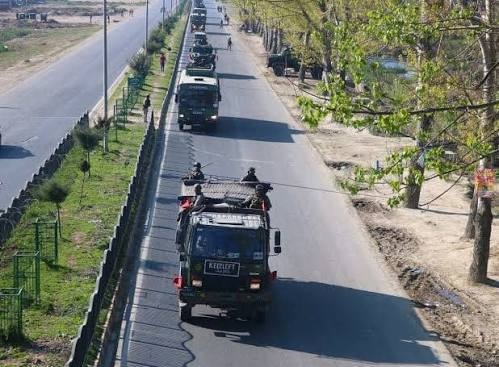
PDP MLA Waheed Ur Rehman Para, speaking during Zero Hour on September 22, questioned the repeated stopping of civilian traffic on the highway in South Kashmir, saying commuters are frequently made to wait while security convoys, the Amarnath Yatra and other protected movements pass through.
Para said people living along the highway, including those whose land was acquired for its construction, are repeatedly stopped for around 10 to 15 minutes. He argued that while security arrangements are necessary, they should not leave ordinary residents feeling that they are being treated differently on a road they depend on every day.
The intervention found support from National Conference MLA Abdul Majeed Larmi, who said the Assembly could send a recommendation or resolution to the Centre seeking a review of the restrictions. Larmi specifically pointed to difficulties faced by students, patients and travellers between Qazigund and Srinagar, saying delays can have consequences far beyond inconvenience.
The exchange has reopened an old and difficult question in Kashmir: where should the line be drawn between legitimate security requirements and the everyday freedom of civilians to move along one of the Valley’s most important roads?
‘Berlin Wall’: What Waheed Para actually meant
Para’s comparison was deliberately provocative.
He described the repeated restrictions as creating an “us-versus-them” feeling and likened the experience to a Berlin Wall. According to reports of his Assembly remarks, he questioned why ordinary Kashmiris should continue to experience restrictions while travelling on a highway connecting the Valley with the rest of the country.
The reference to the Berlin Wall is, of course, a political metaphor rather than a literal comparison.
The original Berlin Wall divided East and West Berlin from 1961 until 1989 and became a global symbol of physical separation and restricted movement. Para used that historical image to describe what he sees as a psychological and administrative divide: civilians on one side and security priorities on the other.
His argument was not that security personnel should abandon convoy protection.
Rather, he said security and civilian dignity have to coexist.
That distinction is important because NH-44 through South Kashmir is not an ordinary urban road. It is a strategic transportation corridor, carries security convoys, serves the Amarnath pilgrimage route and handles large volumes of tourist and local traffic.
The challenge is therefore not simply whether restrictions should exist.
It is how, when and for how long they should be imposed.
Why NH-44 is so important to Kashmir
The Srinagar-Jammu highway, now part of NH-44, is the Valley’s principal road connection with Jammu and the rest of India.
For residents of South Kashmir, however, its importance is even more immediate.
The highway connects towns and villages with Srinagar and provides access to hospitals, educational institutions, government offices, markets, railway stations and the airport. People travelling from areas around Qazigund, Anantnag, Pulwama and neighbouring districts routinely depend on it.
That means a 10-minute stoppage is not necessarily just a 10-minute inconvenience.
A commuter travelling for a medical appointment may have a scheduled hospital visit. A student may have an examination. A passenger heading towards Srinagar may have a train or flight to catch.
Larmi highlighted precisely these concerns in the Assembly, saying students could miss examinations and travellers could miss flights because of repeated stoppages.
These are claims made by the legislator, rather than independently documented statistics on missed exams or flights. But they illustrate why the issue resonates differently with people who use the road every day.
Security restrictions have a very different logic
The security establishment’s perspective is fundamentally different.
NH-44 is used by security forces and protected convoys moving through a region that has experienced militant attacks and remains subject to heightened security requirements.
Convoy movement requires route sanitisation, traffic control and the ability to prevent potentially dangerous vehicles or individuals from approaching protected movements.
During major events such as the Amarnath Yatra, Independence Day-related security arrangements and periods of heightened threat perception, restrictions can become more stringent.
A temporary traffic halt can therefore have an operational purpose.
The existence of inconvenience does not automatically mean that a security restriction is unnecessary.
At the same time, security requirements do not automatically answer the question of whether every stoppage is proportionate, whether alternatives exist or whether civilian traffic can be managed more efficiently.
That is the policy gap Para and Larmi are asking the government to examine.
The controversy is not about security versus no security
This is perhaps the most important point emerging from the Assembly debate.
Neither Para nor Larmi argued that security convoys should be allowed to move without protection.
Para explicitly acknowledged the importance of security arrangements and instead called for a review of the way restrictions affect ordinary commuters. The New Indian Express also reported his emphasis on maintaining necessary security arrangements while addressing residents’ concerns about dignity and equal treatment.
Larmi similarly acknowledged that the matter falls largely within the domain of the Union Home Ministry and security agencies. His proposal was for the elected Assembly to formally communicate the civilian concerns to the Centre rather than attempt to directly override operational security decisions.
That makes the debate more nuanced than the headline might suggest.
The question is not:
Security or civilian movement?
It is:
Can security be maintained while reducing unnecessary disruption to civilian movement?
‘10 to 15 minutes’ — a small delay that can become a daily burden
Para’s claim that commuters are routinely stopped for 10 to 15 minutes has been independently echoed across multiple reports of his Assembly remarks.
But there is an important limitation.
There does not appear to be publicly available official data establishing how many stoppages occur each day, their average duration, the number of vehicles affected, or how much cumulative travel time is lost.
That missing data matters.
A 10-minute stoppage occurring once during an unusual security operation is one thing.
A 10-minute stoppage occurring repeatedly over several points of the route, every day during certain periods, is something else entirely.
For a highway carrying thousands of vehicles, even small delays can accumulate into significant disruption.
That is why the government could potentially make the debate more evidence-based by publishing traffic-management data and explaining the circumstances under which restrictions are imposed.
Patients, students and ordinary commuters are at the centre of the argument
The political significance of the controversy lies in its effect on people who have little control over the security situation.
A patient travelling to Srinagar cannot reschedule an emergency.
A student may have only one examination sitting.
A family travelling to an airport has a fixed departure time.
A worker commuting between districts may lose wages if a journey is repeatedly delayed.
Larmi specifically brought students, patients and travellers into the Assembly discussion, arguing that the restrictions have consequences beyond ordinary traffic inconvenience.
This is why the demand for a review has found support beyond party lines.
The issue was raised by a PDP legislator and supported by an NC legislator from the treasury benches.
That cross-party intervention is significant because the highway question is not easily confined to the usual government-versus-opposition political divide.
The land question adds another layer
Para also invoked the history of the highway’s construction.
His argument was that residents who surrendered or contributed land for the highway should not subsequently feel like outsiders on that same road.
That is a powerful political point because infrastructure projects are often presented as serving the public.
When residents living beside such infrastructure repeatedly encounter restrictions while using it, the psychological effect can be very different from the official purpose of the road.
However, the land-acquisition history varies along different stretches of NH-44, and Para’s broader statement should not be interpreted as meaning that every current commuter personally contributed land.
The larger argument is about ownership and belonging:
If a road is public infrastructure, how should the people living alongside it experience that publicness during periods of heightened security?
That is the question Para’s “Berlin Wall” metaphor brings into focus.
The Pulwama attack remains part of the background
The current argument also reflects the security legacy of the 2019 Pulwama attack, in which a suicide bomber targeted a CRPF convoy on the Jammu-Srinagar highway, killing 40 personnel.
Security arrangements on the highway were subsequently subjected to intense scrutiny.
Para argued in the Assembly that a security incident should not result in ordinary civilians being subjected indefinitely to a sense of humiliation or discrimination. Reports of his remarks carried the argument that one incident cannot become a permanent justification for restrictions affecting the wider civilian population.
Larmi also referred to the restrictions that followed the Pulwama incident and argued that their continued impact on civilians deserved review.
But the security context has not disappeared simply because time has passed.
The challenge for authorities is therefore to distinguish between temporary restrictions justified by a specific threat and routine restrictions that may have become embedded in traffic-management practice.
That distinction requires evidence.
Who actually controls the highway security restrictions?
This is another area where the Assembly debate offers an important clarification.
The elected J&K government does not have unilateral control over every security decision concerning the highway.
Security arrangements involving central armed police forces, protected convoys and broader counter-terrorism operations involve the Union government and security agencies.
Larmi acknowledged this directly, saying the issue was not entirely within the elected government’s jurisdiction but arguing that the Assembly could nevertheless send a formal recommendation to the Centre.
Para called for the government to engage with the Unified Command, the Centre and security agencies, including the CRPF, to find a workable arrangement.
This potentially gives the controversy a practical direction.
Instead of treating the Assembly intervention as a demand to abolish security restrictions, it can be viewed as a request for coordination between the elected administration and agencies responsible for security operations.
Could technology reduce the friction?
The debate also raises a broader policy question: whether modern traffic management can reduce the need for blanket stoppages.
Possible measures could include:
- advance notification of major convoy movements where operationally safe;
- dynamic traffic management;
- designated holding points rather than repeated stoppages;
- emergency corridors for ambulances;
- special protocols for patients and critical medical transport;
- better coordination during pilgrimage movements;
- real-time traffic information for commuters;
- time-window planning for predictable convoy movements; and
- periodic review of restrictions according to the current threat assessment.
None of these measures can replace operational security decisions.
But they could potentially reduce the conflict between civilian traffic and protected movement.
The key phrase is risk-based traffic management, rather than blanket restrictions.
A sensitive road needs a sensitive policy
The Srinagar-Jammu highway is simultaneously several things.
It is a strategic security corridor.
It is a tourism route.
It is a pilgrimage route.
It is an economic lifeline.
And for thousands of residents of South Kashmir, it is simply the road they use to get to work, school, hospitals and homes.
That is why every traffic restriction on NH-44 carries a larger political meaning than an ordinary highway closure.
A security convoy may see the road as a controlled operational corridor.
A commuter sees it as public infrastructure.
Both perspectives are legitimate.
The difficulty begins when one perspective completely overwhelms the other.
The road ahead: review the restrictions, but don’t weaken security
The Assembly intervention by Waheed Para and Abdul Majeed Larmi has placed an old grievance back into the political spotlight.
Para’s “Berlin Wall” phrase is likely to dominate the political conversation because it captures the emotional dimension of the issue. But the more important question lies beneath the rhetoric.
Are the current restrictions still calibrated to the present security threat, and can civilian disruption be reduced without compromising operational requirements?
That question cannot be answered through political speeches alone.
It requires the government, security agencies and the Centre to examine traffic data, convoy schedules, threat assessments, emergency access arrangements and the actual frequency and duration of stoppages.
If restrictions are necessary, authorities can explain why.
If some have become unnecessarily broad, they can be modified.
And if certain safeguards cannot be relaxed, the public deserves a clearer explanation of the security rationale.
That would turn the “Berlin Wall” controversy from a political metaphor into a serious policy conversation.
For Kashmir’s commuters, the demand is ultimately quite ordinary: a highway that remains secure without making the people who use it every day feel like they are standing on the wrong side of a barrier.


