Erdogan Raises Kashmir at UNGA Again: Why Türkiye’s Latest Remark Matters for India-Pakistan Diplomacy
By: Javid Amin | 22 September 2026
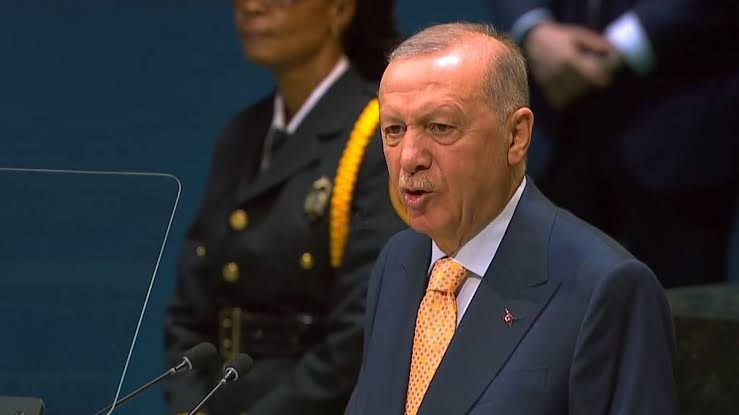
United Nations: Turkish President Recep Tayyip Erdogan has once again brought Jammu and Kashmir into the spotlight at the United Nations General Assembly, calling for disputes in South Asia, including Kashmir, to be addressed through dialogue under the UN Charter and relevant resolutions.
Speaking at the 81st UN General Assembly in New York on September 22, Erdogan said: “In South Asia, it is important that all disputes, including the Kashmir issue, be addressed through dialogue within the framework of the United Nations Charter and of relevant resolutions.”
The statement is significant not simply because Kashmir was mentioned again, but because it comes against a backdrop of increasingly close defence cooperation between Türkiye, Pakistan and Saudi Arabia. The three countries signed the Makkah Joint Defence Agreement on August 7, 2026, creating a new strategic layer in Ankara-Islamabad relations.
There is, however, an important correction to the timing circulating in some reports: the agreement was signed about six weeks before Erdogan’s UNGA address, not merely “days” earlier. The proximity is still diplomatically notable, but the wording matters when assessing the sequence of events.
The episode also revives a familiar diplomatic divide. Ankara continues to frame Kashmir as an issue requiring dialogue and reference to the UN framework, while New Delhi maintains that Jammu and Kashmir is an integral part of India and rejects any third-party role in matters concerning the region.
Erdogan raises Kashmir at the UN again
The 81st UN General Assembly’s high-level general debate began on September 22 and is scheduled to continue through September 26 before concluding on September 28. The UN lists the theme of the session as “Restoring Trust, Managing Transformation: A United Nations That Delivers for All.”
It was against this wider multilateral backdrop that Erdogan inserted Kashmir into his remarks on South Asia.
His wording was notable for being framed around dialogue, the UN Charter and relevant resolutions, rather than presenting a detailed new Turkish initiative or announcing a mediation effort.
That distinction is important.
A statement at the UN General Assembly does not by itself create a negotiating mechanism between India and Pakistan. Nor does it establish a new international process for Kashmir. It is principally a declaration of a country’s diplomatic position before the wider membership of the United Nations.
Nevertheless, repeated interventions by a major regional power can carry political significance, particularly when they come from a country with growing defence and strategic links with Pakistan.
Why the timing is drawing attention
The latest Erdogan remarks come after a major development in Türkiye-Pakistan-Saudi Arabia defence relations.
On August 7, Saudi Crown Prince Mohammed bin Salman, Turkish President Erdogan and Pakistan Prime Minister Shehbaz Sharif met in Makkah and signed the Makkah Joint Defence Agreement.
According to the Saudi government’s official account, the agreement is designed to strengthen collective deterrence and states that an armed attack against any one of the three countries will be regarded as an attack against all three. It also provides for expanded defence cooperation.
That does not establish that the defence pact caused Erdogan’s Kashmir remarks. There is no evidence in the available reporting that the agreement contains a Kashmir-related clause or that the two issues were formally linked.
But the strategic context is difficult to ignore.
Türkiye already has a substantial defence relationship with Pakistan, while Ankara has also expanded security cooperation with Riyadh. Reuters reported this month that Türkiye has expressed readiness to support Saudi Arabia militarily under the new defence arrangement amid escalating attacks by Yemen’s Houthi movement.
The Makkah agreement therefore represents a broader regional security development rather than simply another bilateral Türkiye-Pakistan arrangement.
For New Delhi, that wider strategic picture provides additional context whenever Ankara speaks on an issue as sensitive as Kashmir.
India’s position remains fundamentally different
India’s position on Kashmir has remained consistent: New Delhi considers Jammu and Kashmir an integral part of India and rejects attempts by third countries to intervene or mediate in India-Pakistan bilateral matters.
India has also repeatedly referred to the 1972 Shimla Agreement, under which India and Pakistan committed themselves to resolving differences through peaceful means and bilateral negotiations.
New Delhi’s position has also been that dialogue cannot be separated from the issue of cross-border terrorism.
This puts the Indian and Turkish diplomatic formulations on noticeably different tracks.
Türkiye speaks of dialogue within the UN framework and references relevant UN resolutions. India, meanwhile, stresses bilateral mechanisms, sovereignty and territorial integrity.
The disagreement is therefore not simply about whether dialogue is desirable. It is also about who has a legitimate role in that dialogue and which diplomatic framework should govern it.
Erdogan’s Kashmir position did not begin in 2026
The latest UNGA intervention is part of a pattern rather than an isolated statement.
Erdogan’s strongest interventions came after India’s August 2019 decision to revoke Jammu and Kashmir’s special constitutional status under Article 370.
At the 74th UN General Assembly in September 2019, he spoke about Kashmir in unusually direct terms, arguing that the international community had not paid sufficient attention to the dispute. His comments generated a sharp response from New Delhi.
He continued to raise the issue in subsequent years.
In 2021, Erdogan again referred to Kashmir at the UN and called for a resolution reflecting what he described as the aspirations of Kashmiris. India objected, arguing that his remarks demonstrated a lack of understanding of India’s position and the history surrounding the issue.
There was a notable change in 2024, when Kashmir did not feature in Erdogan’s UNGA address.
But the issue returned to his international rhetoric in 2025.
February 2025: Erdogan raised Kashmir during Pakistan visit
Erdogan’s position became particularly visible during his February 2025 visit to Pakistan.
During his visit to Islamabad, he said the Kashmir issue should be addressed through dialogue between India and Pakistan, in accordance with UN resolutions and while taking into account the aspirations of the people of Kashmir.
India responded strongly.
The Ministry of External Affairs rejected the remarks and said Jammu and Kashmir was an integral part of India. New Delhi also said that there was no need for third-party mediation in bilateral issues between India and Pakistan and conveyed its protest to the Turkish ambassador.
The episode demonstrated a recurring pattern: Erdogan frames his position around dialogue and international principles, while India sees such public interventions as an unwarranted intrusion into a matter it regards as internal and bilateral.
The 2025 UNGA episode added another layer
Erdogan again referred to Kashmir at the 80th UN General Assembly in September 2025, following a period of heightened India-Pakistan tensions.
He welcomed a ceasefire and called for the Kashmir issue to be resolved on the basis of UN resolutions through dialogue. India again rejected the intervention and reiterated its established position.
The sequence is significant because it shows that Ankara’s Kashmir messaging has survived changes in the immediate India-Pakistan security environment.
In other words, the latest statement cannot easily be understood as a one-off reaction to one particular crisis. It is part of a longer-running Turkish diplomatic position.
What exactly does the UN Charter reference mean?
The phrase “within the framework of the UN Charter” can sound more consequential than it necessarily is.
The UN Charter provides the basic legal and institutional framework for international relations, including principles concerning sovereign equality, peaceful settlement of disputes and the prohibition on the use of force.
Erdogan’s formulation therefore places Kashmir within a broader argument for diplomatic dispute resolution.
However, invoking the UN Charter does not automatically determine how the Kashmir dispute should be settled.
The history of Kashmir at the United Nations stretches back to the late 1940s, while the diplomatic landscape has subsequently been shaped by agreements between India and Pakistan, particularly the 1972 Shimla Agreement and the 1999 Lahore Declaration.
That is why India places considerably greater emphasis on bilateral mechanisms than Türkiye does in its public statements.
Türkiye-Pakistan ties make the Kashmir remarks more sensitive
There is a longstanding strategic relationship between Ankara and Islamabad.
Pakistan has been an important defence partner for Türkiye, while cooperation has expanded into areas including military technology, naval platforms and defence production.
The relationship also has a political dimension. Erdogan has repeatedly described Pakistan as a close partner, and successive Turkish governments have maintained strong diplomatic engagement with Islamabad.
The new Makkah defence arrangement takes this relationship into a wider trilateral framework with Saudi Arabia.
The agreement’s collective-defence language is particularly important. According to the Saudi government’s official statement, an armed attack on one member is to be treated as an attack on all three.
Reuters has reported that Türkiye is prepared to help meet Saudi military requirements under the agreement, although the pact’s practical implementation and the precise circumstances in which its commitments would be activated remain important questions.
This means Ankara’s relationship with Islamabad now sits inside a more complicated Middle Eastern security architecture.
Kashmir was only one part of Erdogan’s UNGA message
It would be misleading to view Erdogan’s entire UN address through Kashmir alone.
The Turkish president devoted substantial attention to the war in Gaza and the Palestinian question. He criticised Israel’s military campaign and called for stronger international action.
He also called for wider recognition of Palestinian statehood and argued that the United Nations Security Council needs structural reform. Reuters reported that Erdogan criticised the concentration of decision-making power among the five permanent Security Council members and argued that the existing system has undermined confidence in the UN.
The Turkish Cypriot issue also remains part of Ankara’s wider UN diplomacy.
Seen in that context, Kashmir fits into a broader Erdogan foreign-policy narrative: disputes that Ankara believes require international attention, diplomacy and a stronger multilateral role.
That does not remove the bilateral significance of his Kashmir remarks for India, but it provides important context for understanding why the issue continues to appear in his major international addresses.
What changes after the latest statement?
In immediate practical terms, probably very little.
Erdogan’s remarks do not establish negotiations between India and Pakistan. They do not alter India’s territorial position. They do not create a new UN mechanism. And they do not, by themselves, change the existing diplomatic status of the Kashmir dispute.
Their significance lies elsewhere: diplomatic signalling.
For Pakistan, Turkish support for a dialogue-oriented international framing of Kashmir remains politically valuable.
For India, repeated Turkish references reinforce concerns about Ankara’s willingness to publicly engage with an issue New Delhi considers outside the legitimate role of third countries.
For Türkiye, Kashmir policy is also part of a wider foreign-policy strategy in which Ankara seeks a visible role across South Asia, the Middle East and the broader Muslim world.
The bigger India-Türkiye relationship
The Kashmir disagreement exists alongside substantial areas of India-Türkiye engagement.
The two countries have economic, commercial and people-to-people links, and Türkiye remains an important country for India’s wider engagement with Europe, West Asia and the Mediterranean.
That creates an interesting diplomatic contradiction.
New Delhi and Ankara can cooperate in areas of mutual interest while sharply disagreeing over Kashmir.
The latest UNGA intervention therefore does not necessarily mean that India-Türkiye relations are headed toward a complete rupture. Diplomatic relationships routinely contain competing interests.
But Kashmir has repeatedly emerged as a particularly sensitive fault line.
Why Ankara’s language matters in New Delhi
There is another reason the latest statement will attract attention in India.
The United Nations General Assembly remains one of the most visible diplomatic stages in the world. A statement delivered from the UN podium receives substantially more attention than a similar comment made during a bilateral press conference.
Erdogan’s words also come at a time when the global diplomatic system itself is under strain.
The 81st UNGA is explicitly centred on restoring trust and managing global transformation.
Against that backdrop, Erdogan is using the same multilateral platform to argue for dialogue over Kashmir, stronger UN institutions and a greater international response to conflicts such as Gaza.
India’s counter-position is equally clear: international institutions should not be used to create an external mediation role in what New Delhi considers a bilateral issue.
That fundamental disagreement is unlikely to disappear because of one UN speech.
A recurring diplomatic fault line, not a new Kashmir process
Erdogan’s latest intervention is best understood as another chapter in an established diplomatic pattern.
Türkiye has again put Kashmir into its UNGA narrative. Pakistan continues to welcome international attention to the issue. India continues to reject third-party involvement and maintains its position on sovereignty, bilateralism and terrorism.
The Makkah Joint Defence Agreement adds a new strategic backdrop to the episode, particularly because it has strengthened the formal security relationship between Türkiye, Pakistan and Saudi Arabia. But the available evidence does not establish that the defence agreement and Erdogan’s Kashmir statement were formally connected.
What is clearer is that Ankara’s Kashmir position has remained remarkably durable across several years.
The question now is less whether Erdogan will mention Kashmir again — history suggests that remains possible — and more how New Delhi manages the disagreement while preserving areas of cooperation with Ankara.
For India, Pakistan and Türkiye, Kashmir remains a diplomatic issue with very different meanings. At the UN, those competing narratives have once again occupied the same stage.


