Netanyahu UN Speech: Delegates Walk Out as Israel Defends Iran Strike
By: Javid Amin | 24 September 2026
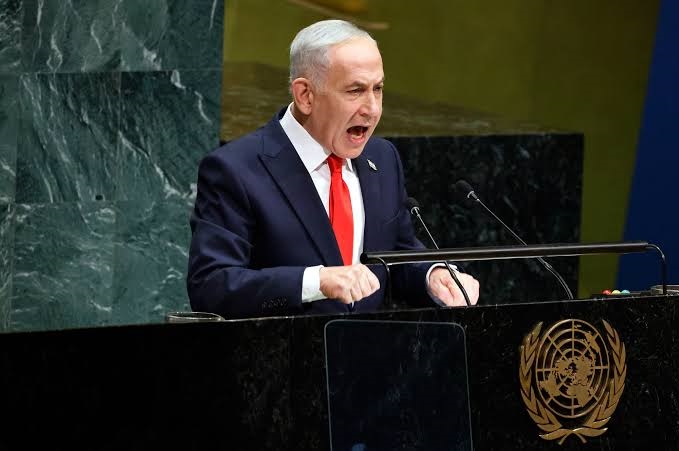
United Nations, New York: A dramatic walkout by scores of delegates, a defiant defence of Israel’s war against Iran and a fierce rejection of allegations over Gaza turned Israeli Prime Minister Benjamin Netanyahu’s address to the United Nations General Assembly into one of the most politically charged moments of this year’s high-level session.
As Netanyahu approached the podium on Thursday, delegates from numerous countries began leaving the chamber. The protest followed an appeal from the Palestinian Mission to the United Nations asking member states to organise a collective walkout when the Israeli prime minister began speaking.
The symbolism was difficult to miss. Netanyahu continued his address as large sections of the chamber emptied, eventually accusing those who had left of being “moral cowards.” He then told any remaining critics that they could leave as well.
But the walkout was only the most visible part of a much broader diplomatic confrontation.
Netanyahu used the UN podium to defend Israel’s military campaign against Iran, insist that Israel had acted in self-defence and reject allegations that its conduct in Gaza amounted to genocide. Palestinian President Mahmoud Abbas, speaking by prerecorded video after being denied a US visa for the second consecutive year, delivered a sharply different message, calling for greater international action to protect Palestinians and reiterating support for a two-state solution.
Meanwhile, the future of Gaza remains caught between political disagreements over Hamas’s disarmament, Israeli military withdrawal, governance and the enormous financial requirements of reconstruction.
The result was a UNGA session that laid bare just how deeply divided the international community remains over Israel, Iran and the future of Gaza.
The walkout: A coordinated diplomatic protest
The departure of delegates was not an entirely spontaneous reaction inside the General Assembly hall.
The Palestinian Mission had circulated a message to UN member states calling on them to bring staff into the chamber and collectively walk out once Netanyahu was announced. The stated purpose was to signal opposition to what the Palestinian side described as Israel’s genocide, war crimes and occupation.
When Netanyahu reached the podium, the chamber saw a mixture of applause, boos and departing delegations.
General Assembly President Khalilur Rahman repeatedly called for order.
The visual effect was striking: an Israeli prime minister addressing an international audience while a significant number of representatives were leaving the room.
That does not mean the entire UN membership rejected Netanyahu’s position. Delegations that remained in the chamber heard his full argument, while supporters in the visitors’ gallery applauded portions of the speech.
The scene therefore reflected polarisation rather than a single unified international position.
Netanyahu: Striking Iran Was “One of the Easiest Decisions”
The central foreign-policy argument in Netanyahu’s address was Iran.
He defended Israel’s decision to launch military action against Iranian nuclear facilities, describing it as a necessary response to what Israel considers an existential threat.
Netanyahu said attacking Iran’s nuclear infrastructure “was one of the easiest decisions I’ve ever had to make” as prime minister, arguing that without the operation, Israel and others would face an even greater danger.
He went further, claiming that Israel’s military campaign against Iran was not merely protecting Israel.
According to Netanyahu, Israel was also protecting other countries whose representatives had walked out.
He claimed that some foreign leaders had privately thanked Israel for attacking Iran’s nuclear capabilities. That was a claim made by Netanyahu in his speech; the public account of the address does not establish which leaders he was referring to or independently verify the alleged private conversations.
This distinction matters because the Iran issue has become the centre of an increasingly complicated regional confrontation.
Why Iran dominated Netanyahu’s UN speech
Israel’s confrontation with Iran has moved far beyond the traditional shadow war that characterised much of the previous decade.
The 2026 conflict has involved direct military action, attacks on strategic infrastructure and a much greater risk of regional escalation.
US President Donald Trump also used his UN address earlier in the week to defend America’s decision to enter the war with Iran and warned that the United States could inflict even greater destruction if Tehran did not agree to a peace arrangement.
Netanyahu’s UN speech therefore came only days after Washington had itself placed Iran at the centre of its General Assembly diplomacy.
For Israel, the argument is fundamentally about national survival and preventing Iran from developing or retaining capabilities that Israeli leaders consider an existential danger.
For Iran, the conflict is viewed through an entirely different lens, with Tehran portraying American and Israeli military action as aggression and asserting its right to resist.
The competing narratives are now deeply entrenched.
Netanyahu’s message to the countries that walked out
The Israeli prime minister did not ignore the walkout.
He confronted it directly.
Calling those who departed “moral cowards,” Netanyahu argued that the very countries protesting Israel were benefiting from Israeli military action against Iran.
That argument is part of a broader Israeli diplomatic narrative: that Iran represents a threat extending beyond Israel and that Israel is acting as a forward line of defence for other countries in the region.
Critics reject that framing and argue that Israel’s actions in Gaza and its wider military campaign cannot be separated from questions of international law, civilian casualties and Palestinian self-determination.
The General Assembly scene therefore exposed two competing interpretations of Israel’s role:
Israel’s position: military action is necessary self-defence against existential threats.
Its critics’ position: military force has produced unacceptable civilian suffering and cannot substitute for a political settlement.
Those arguments remain fundamentally unresolved.
Netanyahu rejects Gaza genocide allegations
The second major pillar of the speech was Gaza.
Netanyahu dismissed allegations that Israel had committed genocide in the Gaza Strip as “the biggest lie of the century.”
He continued to describe Israel’s military campaign as self-defence following the Hamas-led attack of October 7, 2023.
The Israeli government rejects allegations of genocide and war crimes.
At the same time, international scrutiny of the humanitarian situation in Gaza remains intense. The scale of destruction, civilian deaths, displacement and restrictions affecting humanitarian operations have generated sustained criticism from UN officials, governments and humanitarian organisations.
The disagreement over terminology is not merely semantic.
It reflects a much deeper legal and political dispute over Israel’s conduct of the war and the responsibilities of the Israeli state under international humanitarian law.
International courts and UN bodies have been dealing with separate legal and political questions surrounding the conflict, while Israel continues to reject allegations that its military campaign constitutes genocide.
The competing claims remain highly contested.
Netanyahu’s visual message: The pager on the UN podium
Netanyahu also used a visual prop during the address, holding up a pager while referring to Israel’s September 2024 operation against Hezbollah.
The device was used to remind delegates of the remotely detonated pagers distributed among members of the Iran-backed Lebanese group.
The 2024 operation killed and wounded people across Lebanon and became one of the most dramatic examples of Israel’s technological penetration of Hezbollah’s communications network.
By displaying the pager at the UN, Netanyahu was effectively connecting three theatres of the wider conflict:
Iran.
Hezbollah.
Israel.
The message was that Israel’s confrontation with Iran does not begin and end inside Iranian territory. From the Israeli perspective, Tehran’s regional network of armed partners forms part of the same security challenge.
Mahmoud Abbas speaks — but not from the UN chamber
The contrast between Netanyahu’s appearance and Mahmoud Abbas’s was striking.
The Palestinian president did not physically appear at the General Assembly.
Instead, Abbas delivered prerecorded remarks from Ramallah after the United States denied visas to him and other senior Palestinian officials for the second consecutive year.
The UN General Assembly had previously voted overwhelmingly to permit Abbas to address the gathering remotely after the visa denial.
His message focused on Palestinian statehood, the humanitarian situation and the need for international action.
“We will not leave our homeland. We will not accept displacement. And we will not allow anyone to decide our future on our behalf,” Abbas said in his recorded address, according to the Associated Press.
He also called for international pressure over the supply of weapons to Israel and argued that Gaza, the West Bank and East Jerusalem could not be treated as separate political entities.
Abbas pushes the two-state argument
Abbas’s intervention came at a difficult moment for the Palestinian Authority.
The PA remains internationally recognised as the Palestinian governing authority, but its political influence among Palestinians has weakened significantly over the years.
The Gaza war has further complicated its position.
Hamas controls the political and armed infrastructure that has dominated Gaza during the conflict, while the Palestinian Authority has been largely sidelined from negotiations over the territory’s immediate post-war arrangements.
Abbas nevertheless argued that Gaza cannot have a separate political future from the West Bank.
He called for the Palestinian territories to ultimately operate under “one state, one government, one law and one legitimate entity authorised to bear arms.”
That position directly intersects with one of the most difficult questions in the emerging Gaza framework:
Who governs Gaza after the war?
Hamas signals readiness for the next Gaza phase
Hamas spokesman Hazem Qassem said the group was ready to implement the roadmap proposed for Gaza’s future reconstruction and governance.
Hamas has expressed support for moving toward the next stage of the framework, including the involvement of Palestinian technocratic administrators and international forces.
But one of the central disputes remains unresolved:
Hamas’s weapons.
The European-led Global Alliance for the Implementation of the Two-State Solution called for the disarmament of Hamas and other armed groups and for a verified Israeli withdrawal as part of the broader transition.
Hamas, however, has not publicly accepted all of those conditions in the same form.
Its latest statement focused on implementing the roadmap and facilitating the entry of the technocratic committee into Gaza.
The group has also accused Israel of failing to fulfil its own obligations under the ceasefire framework.
That leaves reconstruction caught between political conditions that have yet to be fully resolved.
Gaza reconstruction: The money is nowhere near enough
One of the biggest challenges facing Gaza is financial.
A six-month, $2.45 billion recovery and reconstruction proposal was unveiled by the US-led Board of Peace during the UN General Assembly.
The plan contains 66 projects covering areas including infrastructure, education, healthcare, housing and food security.
But the proposed amount is only an initial recovery programme.
The broader reconstruction requirement is vastly larger.
An assessment cited by DW puts the medium-term reconstruction requirement at roughly $35.2 billion, while other international estimates have placed the overall cost considerably higher depending on the period and categories included.
The gap between an initial recovery package and the cost of rebuilding an almost entirely devastated urban environment is therefore enormous.
And money is only one problem.
Access is another.
Security is another.
Governance is another.
And the political status of Hamas remains perhaps the most difficult question of all.
Europe has pledged money — but implementation remains the challenge
It would be inaccurate to say that Europe has provided virtually nothing for Gaza reconstruction.
The European Union launched the Team Gaza Initiative in July with an initial amount of about €883.6 million for early recovery projects.
On September 23, the EU announced its first flagship projects, worth €43 million, aimed at restoring water and solid-waste services, with UNICEF and UNDP involved in implementation.
But the broader humanitarian funding picture remains severely inadequate.
The UN-related European External Action Service assessment said that, as of September 15, only about $1.61 billion of the $4.06 billion requested for the 2026 humanitarian response in the occupied Palestinian territory had been disbursed — roughly 39.7% of the requirement.
That is humanitarian funding, not the complete reconstruction bill.
The distinction is critical.
A territory requiring tens of billions of dollars for reconstruction cannot be rebuilt through humanitarian funding alone.
The physical scale of Gaza’s destruction complicates everything
The reconstruction challenge is not simply about replacing damaged buildings.
Gaza’s water systems, sewage networks, electricity infrastructure, roads, hospitals, schools and housing have suffered enormous damage.
Recent reporting has highlighted how dangerous damaged buildings remain, with thousands of structures considered at risk of collapse.
The Associated Press reported that more than 320,000 homes have been damaged in the conflict, citing World Bank and UN assessments, while more than 2,000 buildings were identified by Gaza’s Health Ministry as at risk of collapse.
That means reconstruction requires an enormous logistical operation before conventional rebuilding can even begin.
Rubble has to be cleared.
Explosive remnants have to be removed.
Water and electricity systems have to be restored.
Construction materials have to enter.
Governance structures have to function.
And security has to be sufficient for international organisations and contractors to operate.
The UN says Gaza’s recovery cannot wait indefinitely
At a high-level UNGA roundtable on Gaza early recovery on September 23, Acting UN Special Coordinator Ramiz Alakbarov warned that the region was entering a decisive phase.
He argued that early recovery could help restore essential services, rebuild confidence and create conditions for functioning governance and broader political arrangements.
That argument reflects an important shift in thinking.
Reconstruction is no longer being treated simply as a humanitarian exercise.
It is increasingly being viewed as part of the political settlement itself.
If civilians cannot see improvements in their daily lives, political arrangements may struggle to gain legitimacy.
If governance cannot function, reconstruction money cannot be deployed effectively.
And if security remains unstable, international donors may be unwilling to commit the enormous sums required.
The three problems are therefore inseparable.
The central dispute: Disarmament versus reconstruction
The Gaza roadmap now faces a difficult sequence.
Israel has insisted that Hamas must disarm.
International proposals envisage some form of transitional Palestinian administration and international security presence.
Hamas has signalled readiness to move ahead with the roadmap but has not publicly embraced every element of the proposed disarmament framework.
European and international officials meanwhile continue to press for Israeli withdrawal, humanitarian access and a credible political transition.
This produces a classic diplomatic dilemma.
Israel argues that security must come before reconstruction.
Palestinians and many international actors argue that reconstruction and political recovery are themselves essential to long-term security.
Neither side has fully resolved how the two processes can be carried out simultaneously.
The wider Middle East picture is becoming even more complicated
Netanyahu’s speech cannot be separated from the broader regional confrontation.
Iran remains at the centre of the security crisis.
The United States remains deeply involved.
Saudi Arabia is dealing with direct security threats while trying to protect its economic transformation.
Yemen remains a major pressure point.
The Strait of Hormuz remains strategically sensitive.
And Gaza remains unresolved.
The conflicts are interconnected.
Iran’s confrontation with Israel affects Lebanon and the Gulf.
The Gaza conflict affects Arab public opinion and regional diplomacy.
Houthi attacks affect Saudi security and international shipping.
American military decisions influence calculations in Tehran and Riyadh.
That is why the UNGA this year has effectively become a diplomatic mirror of the wider Middle Eastern crisis.
What Netanyahu’s UN appearance actually demonstrated
The dramatic walkout created the day’s most memorable image, but its deeper significance lies in what happened around it.
The UNGA exposed several competing realities simultaneously.
Israel continues to insist that its military actions are fundamentally defensive.
Palestinian leaders argue that Israel’s conduct has produced unacceptable destruction and displacement.
Hamas is signalling willingness to participate in a post-war framework while resisting or qualifying key demands surrounding disarmament.
Western governments are attempting to balance Israel’s security with pressure for Palestinian political rights and humanitarian access.
And international organisations are warning that the window for meaningful recovery is narrowing.
There is therefore no single international consensus on the path forward.
There is, however, growing agreement that Gaza cannot remain indefinitely in its current state.
A UN divided by war — and a Middle East still searching for an exit
Netanyahu’s address was never likely to bridge the divisions surrounding Gaza or Iran.
Instead, it exposed them.
The walkout demonstrated the depth of opposition to Israel’s policies among numerous UN delegations.
Netanyahu’s response showed that the Israeli government remains determined to present its military actions as necessary self-defence, regardless of international criticism.
Abbas’s remote appearance underscored the political dispute surrounding Palestinian representation and US policy toward the Palestinian Authority.
Hamas’s latest position demonstrated that the next stage of the Gaza framework remains negotiable rather than settled.
And the reconstruction figures revealed perhaps the most difficult reality of all: even if the political obstacles were suddenly removed, rebuilding Gaza would still be an enormous financial and logistical undertaking.
The UN General Assembly can provide a stage for these competing narratives.
It cannot, by itself, solve them.
The real test will come after the speeches — in negotiations over disarmament, Israeli withdrawal, Palestinian governance, humanitarian access, international security arrangements and the billions of dollars required to rebuild.
Until those questions are answered, the empty seats behind Netanyahu will remain more than a striking television image.
They will be a symbol of just how far apart the major sides of the Middle East conflict remain.