J&K LPG Cylinder Row: Six Free Refills Trigger Assembly Storm as BJP Targets NC Promise, Deputy CM Hits Back on Statehood
By: News Desk | 24 September 2026
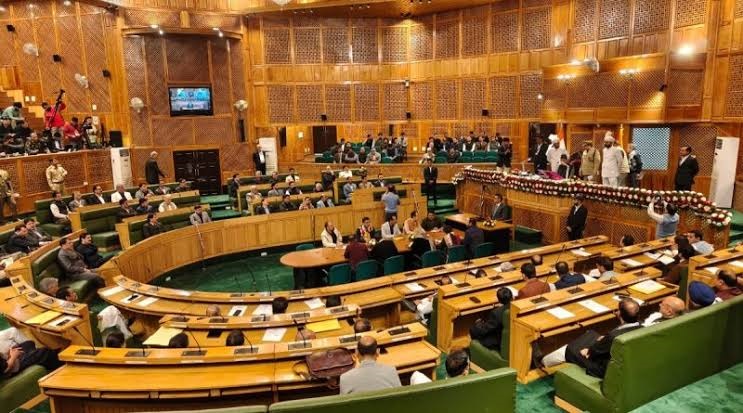
Srinagar: What was announced as a welfare measure for Jammu and Kashmir’s poorest households quickly turned into another political confrontation inside the Legislative Assembly.
The Omar Abdullah government has approved six free LPG cylinder refills a year for families covered under the Antyodaya Anna Yojana (AAY), a scheme aimed at providing direct financial relief to households classified among the poorest under the public distribution system.
But within minutes of the announcement, the Assembly floor became a political battleground.
The Opposition BJP accused the National Conference-led government of cutting down an election promise of 12 free LPG cylinders and questioned what had happened to other major commitments, including 200 units of free electricity and one lakh jobs.
Leader of Opposition Sunil Sharma called the announcement a “mockery” and accused the government of misleading voters.
The ruling benches pushed back.
And Deputy Chief Minister Surinder Choudhary turned the argument around, asking the BJP why it was questioning the implementation of an NC manifesto commitment while Jammu and Kashmir’s own demand for restoration of statehood remained unresolved.
The exchange was more than another noisy Assembly confrontation.
It exposed a larger political contest taking shape in J&K: the battle over election promises, the delivery of welfare benefits, and the continuing dispute over the Union Territory’s incomplete political status.
Six free LPG cylinders: What has actually been approved?
Food, Civil Supplies and Consumer Affairs Minister Satish Sharma informed the Assembly on September 24 that the government had received approval from the competent authority to provide six free LPG cooking-gas cylinders annually to AAY families across Jammu and Kashmir.
He said the necessary implementation order would be issued shortly.
This is an important distinction.
The announcement does not mean that every household in Jammu and Kashmir will receive six free cylinders.
The benefit is specifically targeted at Antyodaya Anna Yojana households, a category intended for the poorest families under the food-security system.
The J&K Food, Civil Supplies and Consumer Affairs Department’s data shows that AAY households form a distinct category within the Union Territory’s public distribution system. The department lists AAY entitlement at 35 kg of foodgrains per family, reflecting the programme’s focus on the poorest households.
Earlier in September, the government had told the Assembly that the LPG proposal was still under examination and that the implementation modalities were being worked out. The plan involved reimbursement of the cost of six LPG refills a year through Aadhaar-enabled Direct Benefit Transfer (DBT).
The September 24 announcement therefore marked an important step forward: approval had been obtained and the government said formal implementation orders would follow.
The precise operational details—including how and when beneficiaries receive the reimbursement—remain important because the political dispute has already shifted from “Will there be a scheme?” to “How will it actually reach families?”
Why six cylinders became a political flashpoint
The controversy comes directly from the National Conference’s 2024 Assembly-election commitments.
The party had promised 12 free LPG cylinders annually for economically weaker households as part of its welfare programme. Contemporary reporting on the election manifesto recorded the 12-cylinder commitment alongside other relief measures.
The BJP is now using that promise as the benchmark against which it is judging the government’s latest announcement.
Sunil Sharma’s argument is straightforward:
If the promise was 12, why has the government announced six?
The BJP also questioned why the benefit is now specifically limited to AAY households when the political debate around the original promise was broader.
During the Assembly confrontation, BJP members accused the government of reneging on its commitments and raised slogans against the ruling benches. Sharma also questioned the status of the government’s promises concerning 200 units of free electricity and one lakh jobs.
The government’s response, however, rests on a different interpretation.
NC leaders have argued that their manifesto commitments are to be implemented during the government’s five-year tenure rather than all at once. Deputy Chief Minister Surinder Choudhary made precisely this point while responding to the BJP’s criticism.
That turns the LPG dispute into a question of political accountability:
Should an election promise be judged against its eventual five-year implementation, or against the exact form and scale in which voters were originally promised it?
The parties clearly have different answers.
BJP’s “mockery” charge: what Sunil Sharma is arguing
For the BJP, the issue is not simply the number of cylinders.
It is the credibility of the government’s promises.
Sunil Sharma argued that after nearly two years in office, the NC government had reduced a promise of 12 cylinders to six and restricted the benefit to AAY families.
He also questioned the status of the 200-unit free electricity commitment and the promise of one lakh jobs.
The BJP’s political strategy is therefore to connect several welfare and employment promises into one broader argument:
The NC made expansive commitments during the 2024 election campaign, but implementation has been slower or narrower than promised.
That is an opposition claim, rather than an independent assessment of the government’s overall performance.
The distinction matters because some manifesto commitments may require legislative approval, administrative changes, budgetary allocation or coordination with institutions beyond the elected government’s immediate control.
But politically, voters are likely to focus on a much simpler question:
What was promised, and what has actually reached them?
The government’s defence: targeted relief rather than universal subsidy
The NC’s defence rests on the targeted nature of the scheme.
AAY families represent the most economically vulnerable section of the public distribution system. Providing six LPG refills to these households allows the government to concentrate limited public resources on families considered most in need.
The administration has described the measure in terms of social security, clean cooking fuel and financial relief.
That argument also has an economic logic.
LPG prices and household energy expenses can have a disproportionate impact on low-income families. A targeted refill subsidy can reduce the immediate cash burden of cooking fuel without requiring the government to subsidise every consumer.
But targeting also creates a political problem.
Families outside the AAY category may ask why they are excluded if the original political promise was understood more broadly.
That is where the difference between a manifesto promise and a targeted welfare scheme becomes politically significant.
The LPG row is really about trust
The most important word in the Assembly debate may not be “cylinder.”
It is trust.
Election promises create an implicit contract between political parties and voters. Governments inevitably face fiscal and administrative constraints after taking office, and not every commitment can be implemented immediately.
But when the final policy differs from the original promise, governments must explain the change clearly.
In the present case, there are at least three separate questions:
- Why has the benefit been fixed at six cylinders rather than 12?
- Why is it restricted to AAY households?
- When exactly will beneficiaries start receiving the financial assistance?
The government can answer these questions through policy documents and implementation orders.
The opposition can then challenge those explanations politically.
That is how a welfare announcement becomes an accountability issue.
The statehood counterattack changes the political equation
The BJP’s criticism might have remained confined to welfare promises had Deputy Chief Minister Surinder Choudhary not turned the discussion toward statehood.
His response was essentially a political counter-question:
If the BJP is demanding that the NC honour its promises, what about the BJP’s commitment to restore statehood to Jammu and Kashmir?
Choudhary pointed out that the BJP had made commitments regarding statehood in Parliament and before the Supreme Court, arguing that more than two years had passed without restoration.
This is a particularly potent issue in J&K because statehood is not merely another election promise.
The Union Territory was created after the reorganisation of the former state in 2019, and restoration of statehood has remained a central political demand of the region’s mainstream parties.
The National Conference government has repeatedly placed statehood near the top of its political agenda.
The BJP, meanwhile, has maintained that statehood will be restored at an appropriate time, while its leaders have linked the process to circumstances and security considerations.
The Assembly confrontation therefore brought two different kinds of promises into collision:
NC’s welfare promises versus BJP’s statehood commitment.
The political symmetry of the Assembly clash
There was an unmistakable symmetry in the argument.
The BJP told the NC:
You promised 12 cylinders. You are giving six.
The NC effectively responded:
You promised statehood. Where is it?
Neither argument automatically resolves the underlying issue.
A welfare promise can be measured through government orders, beneficiary lists and expenditure.
Statehood is a constitutional and political process involving the Union government and Parliament.
But politically, both sides are using the other’s unfulfilled commitments to question credibility.
That is why the exchange became bigger than LPG.
200 units of free electricity returns to the spotlight
The BJP’s reference to 200 units of free electricity also deserves attention because the issue has been repeatedly raised since the 2024 campaign.
The commitment was part of the NC’s broader welfare agenda.
But electricity policy is more complicated than simply announcing a free-power threshold.
Jammu and Kashmir faces structural challenges involving power procurement, distribution losses, infrastructure, seasonal demand and the financial condition of electricity distribution utilities.
A universal or broad free-power scheme therefore carries a significant fiscal implication.
The government’s challenge is to explain whether the commitment will be implemented in its original form, modified, phased or replaced by another form of relief.
For consumers, however, the political distinction can be much simpler.
They want to know what appears on the electricity bill.
And then there is the one-lakh-jobs promise
Employment remains perhaps the most politically sensitive of all the commitments raised in the Assembly.
Government employment has historically carried enormous importance in Jammu and Kashmir, where private-sector job creation has struggled to absorb the large number of educated young people entering the labour market.
The NC’s election programme included a commitment relating to one lakh jobs, along with measures intended to improve youth employment.
The BJP is now using that promise to argue that the government needs to explain what progress has been made.
The government, for its part, has pointed to recruitment processes, administrative reforms and the broader timeline of its five-year mandate.
But jobs cannot be assessed purely through political speeches.
The more useful measure is the actual number of vacancies identified, recruitment examinations conducted, appointment orders issued and posts filled.
That is where employment data will eventually matter more than slogans.
A welfare announcement becomes a test of implementation
The six-cylinder scheme now moves into its most important phase: implementation.
Approval is one stage.
Delivery is another.
The government has indicated that the benefit will be connected to AAY households and that DBT mechanisms are being considered or used for reimbursement.
For the scheme to work smoothly, several practical questions need clear answers:
- How many AAY families are eligible?
- Will beneficiaries receive the money before or after purchasing the refill?
- What is the maximum reimbursement per cylinder?
- How will beneficiaries without Aadhaar-linked bank accounts be assisted?
- Will the benefit cover the full refill cost or a fixed subsidy?
- What happens if LPG prices rise?
- When will the first payment be credited?
- Will the six refills be available throughout the financial year or under a defined schedule?
These details could determine whether the announcement becomes a meaningful welfare intervention or remains primarily a political headline.
The fiscal question cannot be ignored
Any free-cylinder scheme ultimately has to be paid for from public resources.
The government will therefore have to balance the welfare benefit against Jammu and Kashmir’s broader fiscal commitments.
That does not mean the scheme is inherently unaffordable.
It means its sustainability depends on the number of beneficiaries, the reimbursement rate and the annual budgetary allocation.
A targeted AAY-only scheme could be substantially less expensive than providing 12 cylinders to every household.
That distinction may partly explain the government’s approach.
But if the political promise was broader, the administration still faces a communication problem: it must explain why the policy has been narrowed and whether the change represents a temporary phase, a fiscal prioritisation or a final departure from the original commitment.
Why the BJP-NC confrontation matters beyond the Assembly
The latest clash is part of a broader pattern in the current J&K Assembly.
The autumn session has already seen sharp disagreements over reservation, statehood, governance, recruitment, security restrictions and welfare commitments.
The Assembly has effectively become the principal political arena where the competing narratives of the Union Territory’s first elected government since 2018 are being tested.
The BJP is seeking to portray the NC government as falling short of its electoral promises.
The NC is attempting to shift attention toward the commitments it says remain pending at the Centre, particularly statehood.
Both narratives resonate because they address genuine public concerns, but they operate at different levels of government.
That distinction is important for voters assessing responsibility.
A Union Territory administration cannot unilaterally restore statehood.
Similarly, the Union government cannot directly implement every welfare promise contained in an elected J&K party’s manifesto.
The political debate becomes more useful when those responsibilities are separated.
What happens next?
The immediate test is whether the six-cylinder scheme moves quickly from announcement to actual beneficiary payments.
The government has said the necessary orders will follow.
If AAY households begin receiving the promised assistance, the NC will have a concrete welfare achievement to point to.
If implementation is delayed, the BJP’s criticism is likely to intensify.
The larger political question will be what happens to the original 12-cylinder promise.
Will the government eventually expand the benefit?
Will it maintain six cylinders specifically for AAY families?
Will the promise be considered fulfilled in modified form?
And what happens to the other commitments—200 units of electricity, one lakh jobs and other welfare measures?
Those questions are unlikely to disappear simply because the government has approved the six-cylinder scheme.
J&K’s politics is increasingly becoming a politics of promises
The latest Assembly confrontation offers a useful snapshot of Jammu and Kashmir’s post-election politics.
The NC came to power with a substantial welfare and governance agenda.
The BJP now occupies the opposition benches and is using those promises as a political yardstick.
Meanwhile, the NC is countering by pointing to the unresolved issue of statehood.
This creates a cycle in which every promise becomes ammunition for the other side.
The LPG controversy is therefore unlikely to remain about cooking gas.
It is becoming a proxy for a much broader argument:
Can the elected government deliver the economic and welfare changes it promised, and can the Union government deliver the political restoration that J&K’s mainstream parties continue to demand?
For ordinary families, the answer will ultimately be judged not in Assembly speeches but through tangible outcomes—whether a cylinder becomes cheaper, whether an electricity bill falls, whether a young person gets a government appointment, and whether the region regains the political status promised by its national political leadership.
That is where the real test of credibility lies.