Congress leader calls the five-day judicial custody of CJP activists an “act of cowardice”, reigniting debate over protest rights, police powers and Delhi’s decision to remove Jantar Mantar from its list of designated protest venues
By: Javid Amin | 14 October 2026
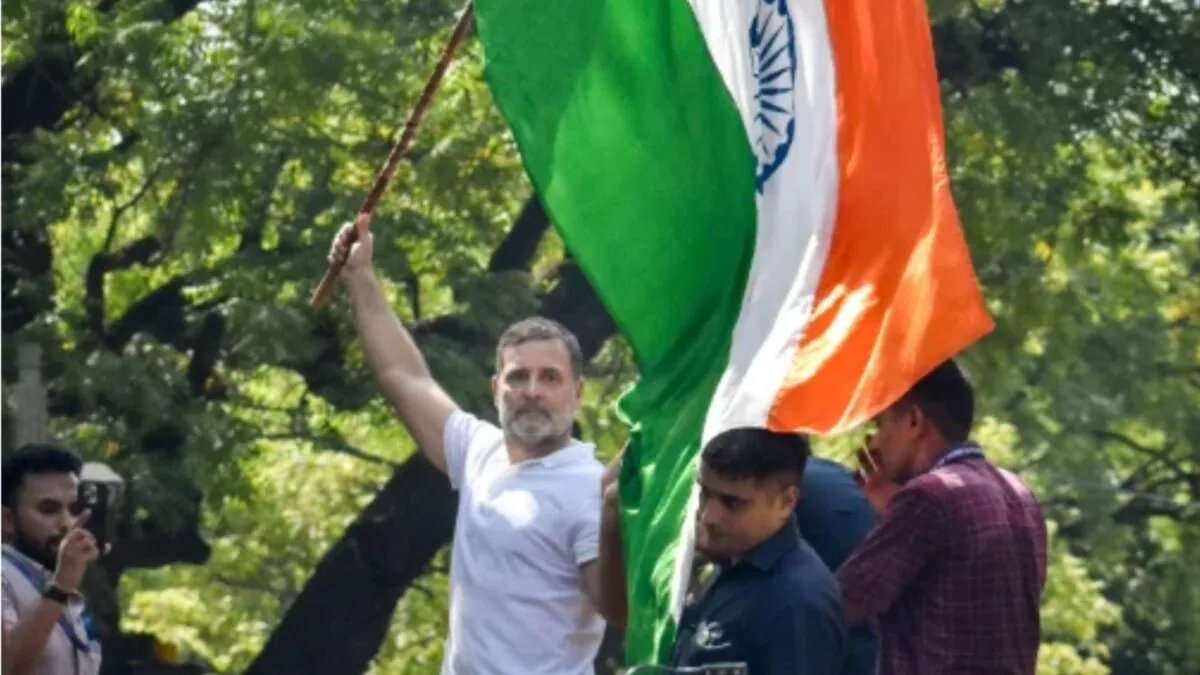
New Delhi: Congress leader and Leader of the Opposition in the Lok Sabha Rahul Gandhi has publicly backed the Cockroach Janta Party (CJP), condemning the five-day judicial custody of its leaders Saurav Das and Ashutosh Ranka after they entered Jantar Mantar carrying the national flag. Gandhi said peaceful flag-waving during a protest should not be treated as a crime and described the jailing of young activists as an “act of cowardice”.
In a statement posted on X on Wednesday, Gandhi wrote: “Waving the Tricolour at Jantar Mantar in a peaceful protest is not a crime. Jailing youth for it is an act of cowardice.”
He also declared that Jantar Mantar belongs to the people of India and said, “We will reclaim it.”
The remarks represent a significant show of support from a senior Congress leader for CJP’s campaign against the restrictions imposed on demonstrations at the historic Delhi protest site. The intervention has brought renewed political attention to the detention of the activists and the wider controversy surrounding the Special Intensive Revision (SIR) of electoral rolls.
The police, however, have maintained that the action against Das and Ranka relates to alleged unauthorised entry, violations of prohibitory orders, breach of previously executed peace bonds and obstruction of public servants—not simply the act of carrying the national flag.
The dispute has therefore developed into a wider argument over the limits of police powers, the right to peaceful assembly and whether relocating demonstrations away from central Delhi could weaken the visibility of political dissent.
Rahul Gandhi’s Message: ‘Jantar Mantar Belongs to the People of India’
Gandhi’s intervention came after a Delhi court remanded Das and Ranka to five days of judicial custody on Wednesday, following their detention during a protest at Jantar Mantar on Tuesday.
The Congress leader’s statement placed the national flag at the centre of the debate. By emphasising peaceful flag-waving, Gandhi argued that carrying the Tricolour during a political demonstration should not itself be treated as a criminal act.
His remarks also linked the immediate case to a broader principle: the right of citizens to assemble and express disagreement with public institutions.
The statement that Jantar Mantar “belongs to the people of India” directly challenges the decision to remove the site from Delhi’s list of designated protest venues. Gandhi’s promise that it would be reclaimed signals support for continued opposition to the revised arrangements.
The political significance of the statement lies in the fact that the controversy is no longer confined to CJP and Delhi Police. It has attracted the attention of a senior national opposition leader and could widen the debate over the regulation of public demonstrations.
However, Gandhi’s political argument and the legal grounds for the detentions are separate questions. Whether the police action was lawful depends on the relevant orders, the circumstances of the incident and the legal proceedings—not on the presence of the Tricolour alone.
Why Saurav Das and Ashutosh Ranka Were Sent to Judicial Custody
Das and Ranka were detained on Tuesday after CJP activists entered the Jantar Mantar premises by climbing over gates and barricades. The group carried the national flag and raised slogans demanding the resignation of Chief Election Commissioner Gyanesh Kumar.
The action was intended to challenge the recent removal of Jantar Mantar from the list of designated protest locations. CJP leaders have argued that changing the venue cannot eliminate their right to protest against alleged irregularities in electoral-roll revisions.
Delhi Police registered a case citing alleged trespass, violation of prohibitory orders, breach of a peace bond and obstruction of a public servant in the discharge of official duties.
Police officials also cited the fact that Das and Ranka had signed bonds to maintain peace following their earlier detention during a protest on October 10. Authorities alleged that their subsequent conduct breached the conditions associated with those bonds.
The two leaders were produced before a Special Executive Magistrate at Mandir Marg on Wednesday and remanded to five days of judicial custody in Tihar Jail.
Another CJP activist, Ajinkya Shinde, was released after furnishing a fresh bond, according to media reports.
The distinction between the police allegations and the activists’ account is central to the case. CJP representatives maintain that the activists were demonstrating with the national flag and patriotic slogans. Police, meanwhile, have cited the alleged breach of restrictions and other conduct as the basis for their action.
A remand order does not, by itself, establish guilt. The allegations remain subject to the applicable legal process.
The National Flag at the Centre of a Larger Constitutional Debate
The Tricolour has powerful symbolic significance in India. It represents the Republic, national sovereignty and the shared civic identity of its citizens. Carrying or displaying the flag during a peaceful demonstration is not, in itself, generally a criminal offence.
But the legality of a demonstration cannot be determined solely by the presence of the national flag.
A protest can involve constitutionally protected expression while also raising separate legal questions about access to a location, compliance with a valid prohibitory order or obstruction of public officials. Those issues must be assessed independently.
This distinction is particularly important in the Jantar Mantar case. CJP argues that its activists were expressing dissent peacefully, while police have cited alleged violations beyond the act of waving the Tricolour.
The central legal questions include whether the relevant restrictions were validly imposed, whether the activists’ conduct violated those restrictions, whether the peace-bond conditions were breached and whether the resulting detention and remand complied with the law.
These are matters for legal scrutiny and cannot be settled simply by political statements from either side.
At the same time, the case highlights a broader democratic concern: peaceful protest must remain a meaningful avenue for citizens to question government decisions and public institutions. Restrictions on gatherings must be legally justified and proportionate, rather than used arbitrarily to silence criticism.
Why Jantar Mantar Has Become a Flashpoint
Jantar Mantar has served for decades as one of Delhi’s best-known venues for public demonstrations. Farmers, students, workers, civil society organisations, retired military personnel and political groups have gathered there to press demands and draw attention to grievances.
Its central location has given protests a degree of visibility that is difficult to replicate at more distant venues. Demonstrations at Jantar Mantar have frequently attracted national media coverage and placed campaigners within reach of the institutions they sought to influence.
Delhi Police recently removed the site from the list of designated protest venues and identified Ramlila Ground, Burari Ground and CBD Ground as alternative locations.
Authorities can regulate demonstrations to protect public safety, manage crowds and prevent disruption. Yet the choice of venue also affects the practical ability of protesters to reach the public and make their demands visible.
Critics of the relocation argue that moving demonstrations away from the political centre can diminish their impact. Supporters of designated alternatives may point to the need for crowd management, traffic control and security around central government areas.
The controversy raises a question larger than the status of one location: can a designated protest system balance public order with the need to preserve accessible and visible spaces for peaceful dissent?
Gandhi’s statement has placed that question firmly back in the national political debate.
The SIR Controversy Behind CJP’s Campaign
CJP’s protest is part of a wider dispute over the Special Intensive Revision of electoral rolls and allegations of irregularities in the process.
The party has demanded the resignation of Chief Election Commissioner Gyanesh Kumar, arguing that the revision exercise raises concerns about the accuracy of voter lists and the possible exclusion of eligible electors.
Electoral-roll revision is an essential part of election administration. It helps account for deaths, changes of residence, duplicate entries and other legitimate reasons for updating voter records. But the process must also include reliable verification and effective safeguards to prevent eligible citizens from being wrongly removed.
When large numbers of records are changed, transparency becomes especially important. Voters need clear information about their enrolment status, reasons for changes and procedures for raising objections or correcting errors.
CJP and other critics have called for greater accountability from the Election Commission. Their allegations require examination against official records, documented procedures and evidence. The existence of political disagreement does not, by itself, prove that electoral manipulation or unlawful deletion has occurred.
The controversy has nevertheless become a wider test of public confidence in electoral institutions. For CJP, the demand for the CEC’s resignation is a central part of its campaign. For the Election Commission, the challenge is to demonstrate that electoral-roll revisions are conducted according to the law and that eligible voters have effective avenues for redress.
The protest restrictions have added a second dimension to the dispute: whether citizens can publicly challenge electoral administration without facing disproportionate barriers to peaceful assembly.
Police Position: Action Was Linked to Alleged Violations
Delhi Police have maintained that the latest action against Das and Ranka was based on alleged violations of the applicable restrictions and the conditions of their earlier peace bonds.
The allegations cited in reports include entering the de-notified protest area without permission, violating prohibitory orders, breaching bond conditions and obstructing public servants.
These grounds differ from the political argument that the activists were detained merely for waving the national flag. Whether the police action was justified will depend on the applicable orders, the evidence and the legal proceedings.
The case also raises questions about the use of preventive powers. Such measures are intended to avert anticipated breaches of peace or other specified legal risks; they are not intended to serve as punishment without due process.
The distinction between preventive detention, judicial custody and a final finding of guilt is therefore important. The leaders’ placement in judicial custody following the remand order does not mean that every allegation against them has been proved.
For the authorities, the challenge is to explain the legal basis for their actions and ensure that safeguards are respected. For CJP, the challenge is to pursue its protest and legal claims through procedures that can withstand judicial scrutiny.
What Gandhi’s Support Means for the Protest Movement
Gandhi’s public endorsement could give the CJP campaign greater visibility and strengthen the political focus on Jantar Mantar’s removal as a designated protest venue.
The intervention also connects the activists’ case with a wider opposition argument about democratic rights, electoral transparency and the accountability of constitutional institutions.
For CJP, support from a senior Congress leader offers an opportunity to present the detentions as part of a larger debate over the space available for dissent. For the Opposition more broadly, the case provides another point of criticism of the government’s handling of demonstrations and electoral concerns.
Yet political support will not settle the legal questions. The case will turn on the facts of the incident, the validity and scope of the restrictions, the alleged breach of bond conditions and the procedures followed by the authorities.
The wider protest movement will also need to maintain a clear distinction between lawful political expression and conduct that may attract legitimate restrictions. Peaceful demonstrations can be forceful and highly visible without abandoning the legal safeguards that protect the credibility of a movement.
The Road Ahead
The immediate question is whether Das and Ranka will obtain relief through the legal process and how the authorities will respond to the allegations raised by CJP.
The wider dispute is likely to continue along two tracks: the legal challenge to the restrictions and detentions, and the political campaign demanding accountability over the SIR exercise.
Gandhi’s remarks have made the national flag and Jantar Mantar’s status central symbols in that debate. But the outcome will depend on more than political slogans.
The authorities must establish the legal basis for their actions and demonstrate that restrictions on protest are applied lawfully. The protesters, in turn, must pursue their demands in a manner that allows their claims to be tested through evidence and due process.
At stake is not only the future of one protest venue, but the broader relationship between public order and democratic participation.
Jantar Mantar’s history shows why location matters. A protest site can become a national symbol because it offers citizens a place to make grievances visible. Removing that designation may change where demonstrations take place, but it does not automatically resolve the concerns that brought people to the streets.
The larger test for democratic institutions is whether they can manage public gatherings without undermining the right of citizens to question authority. That is the question at the heart of Gandhi’s intervention—and the one that will continue to shape the Jantar Mantar controversy.