Mehbooba Mufti Slams NC as ‘Silent Spectator’: Kashmir’s Identity Debate Intensifies in 2026
By: Javid Amin | 03 May 2026
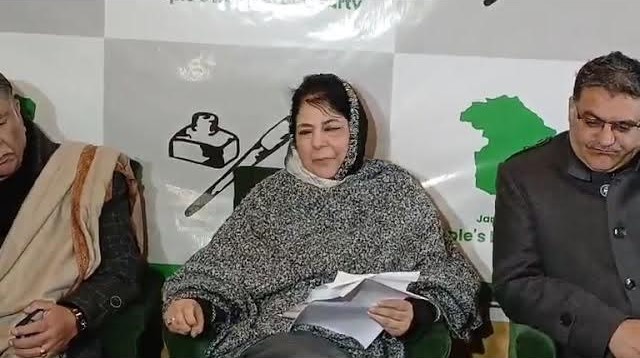
A fresh political confrontation is unfolding in Jammu and Kashmir, with Mehbooba Mufti accusing the ruling National Conference (NC) of failing to defend the region’s cultural and political identity.
In a strongly worded statement, the Peoples Democratic Party (PDP) chief alleged that the NC-led government has become a “silent spectator” at a time when, according to her, Kashmir’s language, traditions, and collective ethos are facing sustained pressure.
Her remarks come at a politically sensitive moment, as debates around statehood restoration, governance, and identity continue to shape public discourse in the post-Revocation of Article 370 era.
“Identity Under Assault”: Mehbooba’s Core Argument
At the heart of Mehbooba Mufti’s criticism is a broader claim—that Kashmir’s distinct identity is being gradually eroded.
She points to:
- Language and Cultural Shifts: Concerns over the diminishing public and institutional use of Kashmiri language and local traditions.
- Changing Administrative Priorities: Perceptions that governance frameworks are drifting away from region-specific sensitivities.
- Symbolic Displacement: A growing anxiety among sections of society that Kashmir’s historical and cultural markers are being sidelined.
While these concerns are not new, Mehbooba’s framing suggests a systematic pattern, rather than isolated developments. Her narrative leans heavily on emotional and identity-driven appeal—something that has long been central to PDP’s political messaging.
NC in the Crosshairs: ‘Silence Over Resistance’
The sharpest part of Mehbooba’s attack is directed at the Jammu & Kashmir National Conference, led by figures like Farooq Abdullah and his son.
She accuses the party of:
- Failing to Speak Out: Allegedly not taking a strong public stand on identity-related concerns.
- Choosing Institutional Comfort: Prioritizing governance stability over political resistance.
- Allowing Narrative Drift: Enabling, through inaction, a shift away from Kashmir’s traditional plural ethos.
From PDP’s perspective, this silence is not neutral—it is framed as complicity.
However, the NC’s approach has historically been different. It has tended to emphasize institutional politics, governance continuity, and constitutional engagement, often avoiding overtly confrontational rhetoric. Supporters argue that this reflects pragmatism rather than passivity.
A Battle of Political Narratives: PDP vs NC
This latest exchange is part of a long-standing rivalry between PDP and NC—one that goes beyond electoral politics into competing visions of Kashmir’s future.
Contrasting Strategies
| Aspect | PDP (Mehbooba Mufti) | NC (Criticized Position) |
|---|---|---|
| Identity & Culture | Actively under threat | Not forcefully defended |
| Political Role | Protector of Kashmiri ethos | Passive, institutional |
| Messaging Style | Emotional, grassroots-driven | Governance-focused |
| Public Appeal | Identity and rights-based | Stability and administration |
For PDP, identity politics is not just strategy—it is central to its political identity. For NC, governance and institutional legitimacy remain key pillars, even if that invites criticism from rivals.
The Larger Context: Post-2019 Kashmir
To understand the intensity of this debate, it is essential to look at the broader political landscape after 2019.
The abrogation of Article 370 fundamentally altered:
- Constitutional Status: Jammu and Kashmir’s transition from statehood to Union Territory.
- Political Space: Reduced autonomy for regional parties and shifting power dynamics.
- Public Discourse: Heightened focus on identity, rights, and representation.
In this environment, political parties are recalibrating their messaging:
- PDP has positioned itself as a voice of resistance and identity preservation.
- NC has projected itself as a mainstream, institutional opposition, focusing on restoration of statehood and democratic processes.
Mehbooba’s latest remarks reflect this divergence—and attempt to sharpen it.
Public Sentiment: Anxiety, Identity & Mobilization
Beyond party politics, the debate taps into a deeper public sentiment.
Across sections of Kashmiri society, there is:
- Anxiety about cultural continuity
- Concern over political representation
- A search for leadership that resonates with identity concerns
Statements like Mehbooba’s are designed to channel this sentiment into political mobilization. By framing identity as being “under attack,” the narrative becomes more immediate and emotionally compelling.
Implications: Pressure, Positioning & Perception
For PDP
- Reinforces its role as a cultural and identity-centric opposition force
- Helps reconnect with its traditional support base
- Positions Mehbooba Mufti as a vocal, uncompromising leader
For NC
- Increases pressure to articulate a stronger stance on identity issues
- Risks perception of being overly cautious or detached
- May need to balance governance responsibilities with political messaging
For Citizens
- Heightens awareness—and concern—about cultural erosion
- Could lead to increased grassroots discussions and mobilization
- Deepens the ongoing debate on identity vs governance priorities
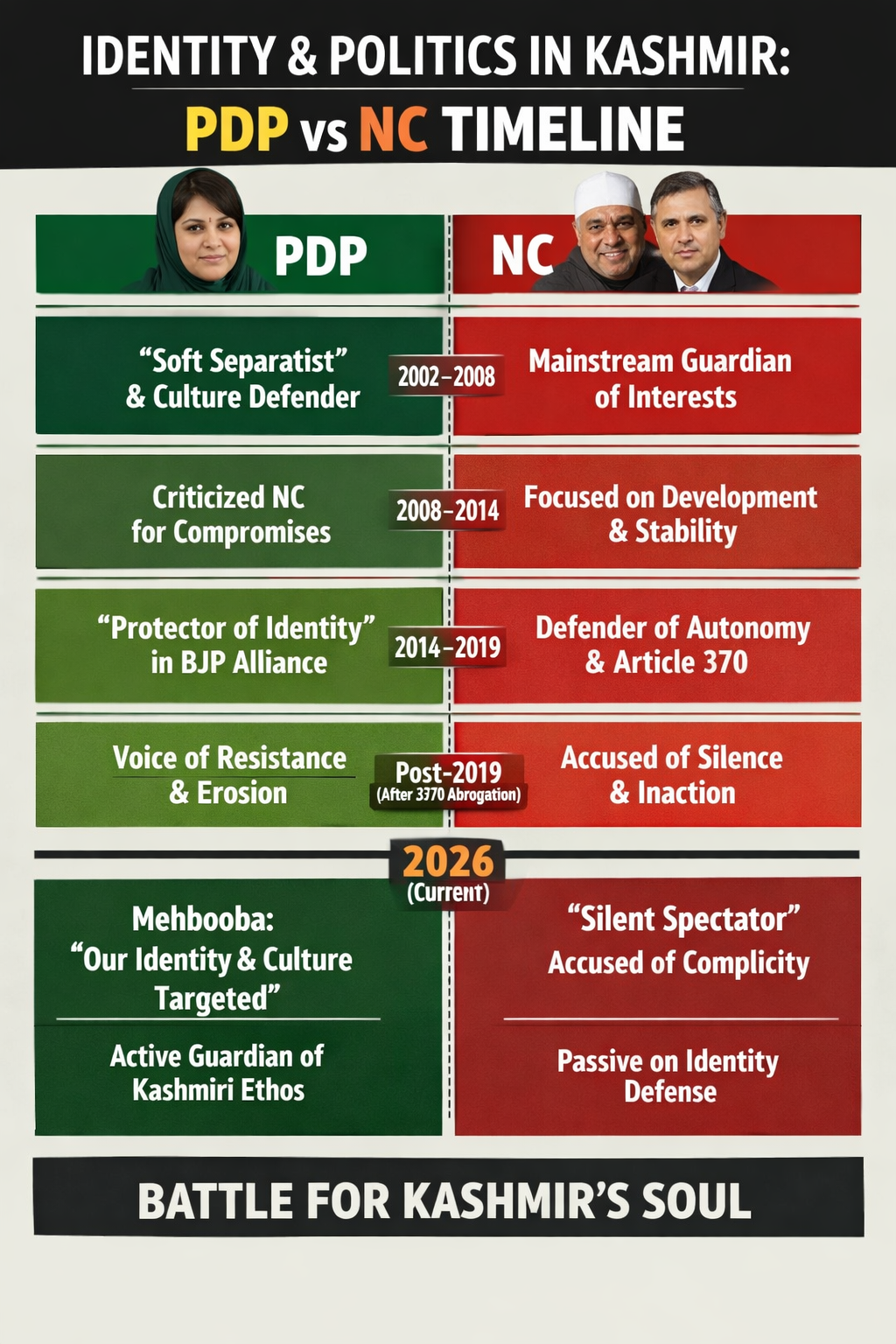
Timeline: Evolution of the Identity Narrative in Kashmir Politics
The current moment is part of a broader historical pattern:
- 2002–2008: PDP emphasizes dialogue and cultural identity; NC focuses on governance.
- 2008–2014: PDP sharpens identity politics; NC stresses development.
- 2014–2019: PDP navigates alliance politics; NC reclaims autonomy narrative.
- Post-2019: PDP adopts resistance-focused rhetoric; NC maintains institutional opposition.
- 2026: Identity debate intensifies, with direct accusations of silence and complicity.
Conclusion: More Than Politics—A Contest Over Kashmir’s Soul
Mehbooba Mufti’s “silent spectator” remark is not just a political jab—it reflects a deeper contest over who defines and defends Kashmir’s identity in a rapidly changing landscape.
At one level, this is a familiar rivalry between PDP and NC. At another, it is a broader struggle over narrative—identity versus governance, emotion versus institution, resistance versus pragmatism.
As Kashmir continues to navigate its post-2019 reality, this debate is likely to grow sharper. The real question is not just who speaks louder—but whose vision resonates more deeply with the people.