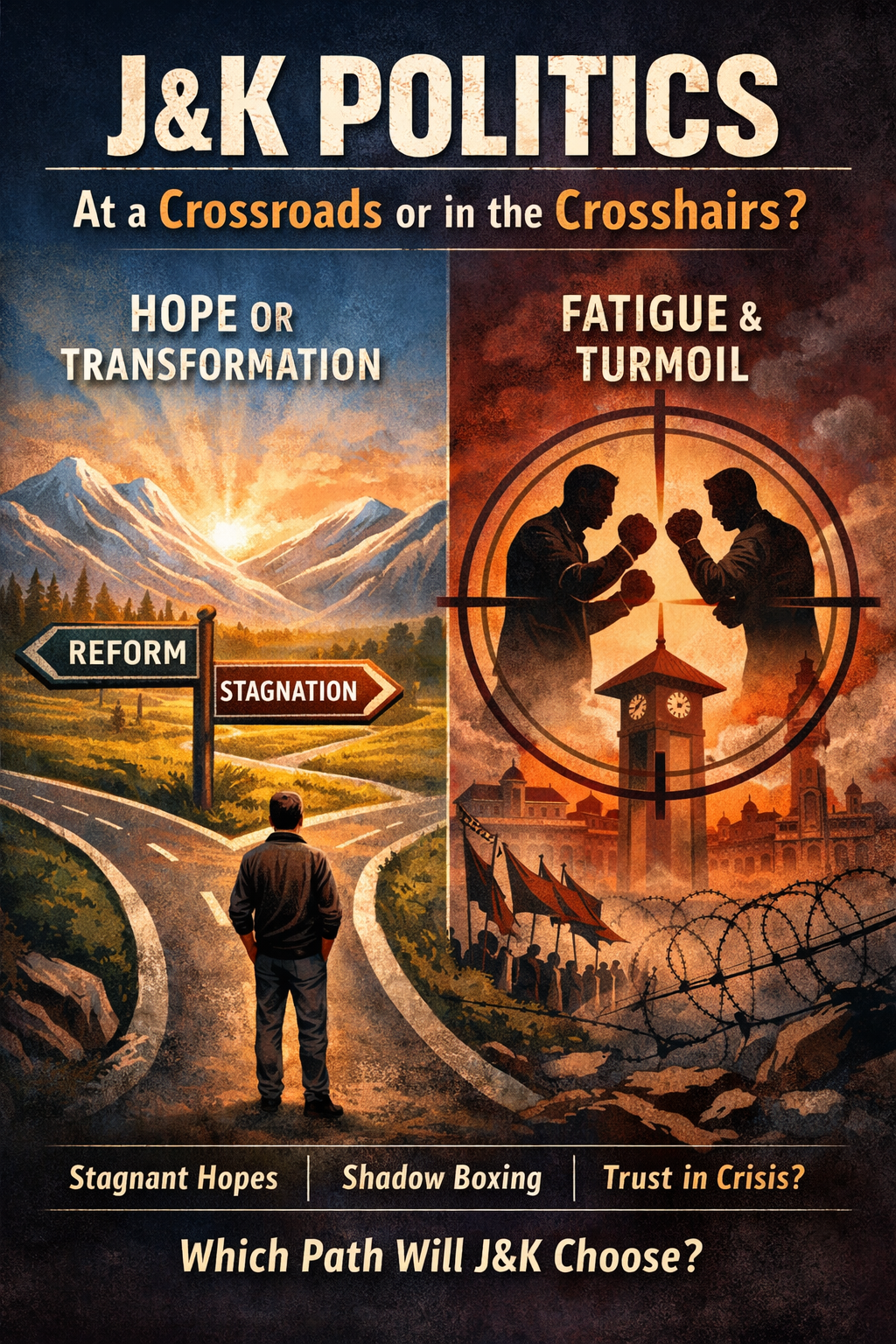
Jammu & Kashmir Politics at a Crossroads or in the Crosshairs? Growing Public Fatigue Raises Tough Questions
By: Javid Amin | 07 June 2026
Between Hope and Disillusionment, the Region’s Political Future Faces a Defining Test
Jammu and Kashmir’s political landscape appears to be caught in an uneasy moment of transition.
Nearly two years after renewed democratic processes revived expectations among large sections of the population, a growing sense of fatigue is becoming increasingly visible across both urban and rural constituencies. The optimism that accompanied promises of responsive governance, accelerated development, and political restoration has, for many citizens, given way to frustration over slow delivery and recurring political confrontations.
The central question confronting the region today is no longer merely who governs, but whether governance itself is keeping pace with public expectations.
Increasingly, voters find themselves asking whether politics in Jammu and Kashmir is moving toward meaningful reform—or simply circling around familiar narratives.
The Fatigue Factor Is Becoming Political Reality
Public disappointment rarely emerges overnight.
It develops gradually when expectations repeatedly collide with delays, bureaucratic hurdles, and political distractions.
Across Jammu and Kashmir, conversations among citizens increasingly reflect concerns over:
- Employment opportunities.
- Infrastructure delivery.
- Administrative responsiveness.
- Public services.
- Development implementation.
- Political accountability.
While these concerns are not unique to the region, their persistence has created a growing perception that political debates often generate more headlines than outcomes.
For many voters, the issue is not a lack of political activity. Rather, it is the feeling that visible political activity has not consistently translated into visible governance results.
This gap between promise and performance is becoming one of the defining themes of contemporary J&K politics.
Politics of Optics vs Politics of Outcomes
A recurring criticism heard across the political spectrum is that much of the current discourse revolves around symbolism rather than execution.
Political parties continue to engage in:
- Press conferences.
- Public statements.
- Social media campaigns.
- Political rebuttals.
- Statehood debates.
- Constitutional discussions.
These issues are undoubtedly important.
However, many citizens increasingly judge political success through a more immediate lens:
Can roads be completed on time?
Can jobs be created?
Can public services improve?
Can administrative decisions be implemented efficiently?
When governance outcomes fail to keep pace with political messaging, public skepticism naturally grows.
The result is what many observers describe as “shadow-boxing politics”—high visibility political contests that often produce limited practical change on the ground.
Governance Under the Union Territory Framework
Part of the challenge stems from Jammu and Kashmir’s unique governance structure.
Since the reorganization of the former state in 2019, governance has operated within a framework that many political actors argue creates overlapping responsibilities and institutional complexities.
Critics frequently point to what they describe as dual power centres, where elected representatives and administrative authorities do not always enjoy complete alignment on priorities and implementation.
Supporters of the current arrangement argue that the system ensures administrative continuity and accountability.
Critics counter that it often slows decision-making and creates uncertainty regarding authority and responsibility.
Regardless of where one stands politically, the practical consequence is that governance outcomes frequently become entangled in institutional debates.
For citizens waiting for projects, services, or reforms, such distinctions often matter less than results.
The Statehood Debate Remains Central—But Is It Enough?
One of the most prominent political issues remains the demand for restoration of full statehood.
Virtually every major mainstream political formation in Jammu and Kashmir has endorsed statehood restoration in some form.
The issue resonates because it touches questions of:
- Democratic representation.
- Political autonomy.
- Administrative authority.
- Regional identity.
Yet there is also a growing public sentiment that constitutional aspirations and governance delivery must move together.
Many citizens support statehood while simultaneously expecting immediate improvements in governance under the existing framework.
This creates a political balancing act for parties seeking to keep statehood at the center of public discourse while also responding to everyday concerns.
Why Public Trust Is the Real Battleground
Beyond elections, speeches, and political rivalries lies a more fundamental challenge: public trust.
Trust is built when citizens believe that institutions are capable of addressing their concerns.
It weakens when promises consistently outpace outcomes.
The danger for any political system is not criticism.
Democracies thrive on criticism.
The greater risk emerges when criticism evolves into cynicism.
When citizens begin to believe that political competition exists primarily for party advantage rather than public benefit, disengagement often follows.
Signs of this sentiment are increasingly visible in discussions surrounding voter enthusiasm, political participation, and expectations from elected representatives.
A Political Class Under Constant Scrutiny
Unlike previous eras, contemporary politics unfolds under relentless public observation.
Every statement, announcement, delay, and controversy is instantly amplified through digital platforms and media ecosystems.
This means political leaders operate in an environment where expectations are not only higher but also more immediate.
Citizens now compare governance performance not only within Jammu and Kashmir but with developments elsewhere in India.
As a result, governments are judged less by intentions and more by measurable outcomes.
The era when political narratives alone could sustain public confidence is rapidly fading.
Crossroads or Crosshairs?
The title question reflects two competing interpretations of Jammu and Kashmir’s current moment.
The Crossroads View
This interpretation suggests opportunity.
The region stands at a point where political institutions can still rebuild trust through:
- Faster governance delivery.
- Administrative reforms.
- Greater transparency.
- Improved public engagement.
- Effective development implementation.
Under this view, current frustrations represent a challenge that can still be addressed.
The Crosshairs View
The alternative interpretation is more cautionary.
It suggests that politics itself is under scrutiny.
Every promise is measured against delivery.
Every announcement is compared with outcomes.
Every delay becomes evidence in a broader public assessment of credibility.
In this scenario, leaders are no longer competing merely against political rivals; they are competing against rising public expectations.
The Road Ahead
Jammu and Kashmir’s political future will likely be shaped less by rhetoric and more by governance performance.
Citizens have heard competing narratives for years.
What many now seek are visible results.
The coming months will test whether political leadership across party lines can move beyond symbolic battles and focus on execution.
The challenge is not only to win arguments.
It is to restore confidence.
Conclusion
Jammu and Kashmir today stands in a space between expectation and uncertainty.
The region is neither devoid of hope nor immune to frustration.
Its politics remains vibrant, contested, and deeply consequential.
Yet a growing fatigue factor suggests that voters are becoming less interested in political theatre and more interested in governance outcomes.
Whether J&K is truly at a crossroads or already in the crosshairs of public scrutiny may ultimately depend on one thing:
Not what leaders promise next, but what they deliver next.

