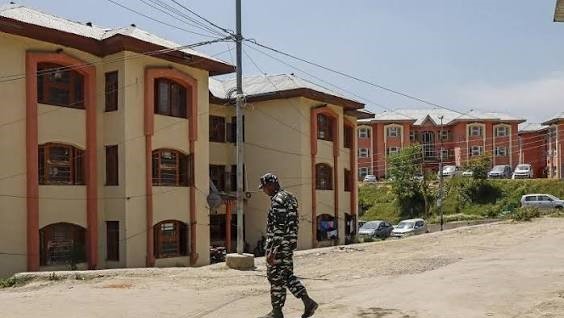
Only 3 Families Returned Under ₹1,618-Crore Kashmiri Pandit Rehab Package: RTI Reveals a Stark Gap Between Policy and Permanent Return
By: Javid Amin | 08 Aug 2026
Government package created jobs and transit housing, but RTI data shows permanent family return remains extremely limited
More than three decades after the mass displacement of Kashmiri Pandits from the Valley, the question of their permanent return remains one of the most difficult chapters in Jammu and Kashmir’s unresolved political and social story.
A recent Right to Information (RTI) response has brought the issue back into focus, revealing that only three families have returned to the Kashmir Valley under the Centre’s 2009 Prime Minister’s Package for return and rehabilitation, despite the package carrying a financial outlay of ₹1,618.40 crore.
The disclosure was made public in April 2026 by Congress leader Sanjay Sapru, who obtained the RTI response and questioned the effectiveness of the rehabilitation programme.
The finding does not mean that only three Kashmiri Pandit families have ever returned to the Valley. Rather, it refers specifically to families returning under this particular rehabilitation package.
That distinction matters.
The same government programme has recorded substantial progress on some of its other components, including employment and transit accommodation. According to the RTI response, 5,880 of the targeted 6,000 jobs for unemployed migrant youth had been filled, while 4,118 of 6,000 planned transit housing units had been completed by April 1, 2026.
Yet those achievements have not translated into anything close to a large-scale, permanent return of families.
And that gap is now at the centre of the debate.
₹1,618 Crore Package, But Only Three Family Returns
The Prime Minister’s Package for Kashmiri migrants was designed to create conditions for return and rehabilitation through a combination of housing assistance, employment, financial support and other measures.
The 2009 package included provisions covering:
- Housing assistance.
- Transit accommodation.
- Employment opportunities.
- Continuation of cash relief.
- Scholarships for students.
- Assistance to agriculturists and horticulturists.
- Financial support for reconstruction of damaged properties.
- Measures aimed at protecting migrant properties.
The housing component provided financial assistance for rebuilding damaged houses and support for certain categories of migrants seeking to construct or purchase homes in group housing societies.
On paper, the approach was comprehensive.
But the RTI figure on permanent returns presents a very different picture.
Only three families are recorded as having returned under the package.
That number has prompted questions over whether rehabilitation has been measured primarily through jobs, buildings and financial allocations, rather than through the more difficult outcome of families actually choosing to rebuild their lives permanently in their ancestral areas.
The 6,000-Job Component Shows a Different Picture
It would be misleading to describe the entire rehabilitation programme as having produced no results.
One of its largest components was employment.
The government had set a target of 6,000 jobs for unemployed Kashmiri migrant youth. The RTI response says 5,880 appointments have been made, with the remaining posts at different stages of recruitment.
That represents significant progress against the employment target.
But employment and permanent resettlement are not necessarily the same thing.
A migrant employee may work in Kashmir without relocating the entire family permanently to the Valley.
This distinction is particularly important because the broader question of return involves far more than employment.
A family considering permanent resettlement must weigh:
Security + housing + children’s education + healthcare + employment + social acceptance + property + community networks + long-term confidence.
A government job can address one part of that equation.
It cannot, by itself, resolve all of it.
Transit Housing Has Expanded — But Permanent Settlement Remains Different
The government has also invested heavily in accommodation for migrant employees.
According to the RTI response, 6,000 transit accommodation units were being constructed in Kashmir for migrant employees. By April 1, 2026, 4,118 units had been completed, while another 1,882 remained under construction.
These figures are important because they demonstrate that physical infrastructure has been created for employees returning to work in the Valley.
But transit accommodation is, by design, different from permanent rehabilitation.
A transit flat can provide a place to live while working.
Permanent return requires something deeper: a sense that the Valley is once again a sustainable and secure home for the entire family.
That is where the policy challenge becomes much more complex.
Why Permanent Return Remains Difficult
The limited number of permanent returns cannot be explained by a single factor.
The issue is tied to more than three decades of displacement, memories of violence, changes in property ownership, disrupted social networks and uncertainty over long-term security.
Security Remains Central
Security is perhaps the most important consideration for families contemplating permanent return.
The Kashmiri Pandit displacement occurred during a period of intense militancy and violence in the Valley. Although the security environment has changed significantly over the years, incidents of targeted violence have continued to shape perceptions of safety.
For families that left Kashmir decades ago, the decision to return is therefore not simply about whether conditions have improved today.
It is also about whether they believe those improvements will remain durable tomorrow.
That confidence cannot be created through housing construction alone.
Livelihoods Must Extend Beyond Government Employment
Another challenge is economic sustainability.
Government employment packages have provided opportunities to thousands of migrant youth, but permanent rehabilitation of entire families requires a broader economic ecosystem.
Families need access to:
- Private-sector employment.
- Entrepreneurship.
- Agriculture and horticulture.
- Professional opportunities.
- Education.
- Healthcare.
- Local markets.
- Financial services.
A return programme becomes considerably more sustainable when families can build livelihoods independently rather than depending almost entirely on one government employment package.
The RTI data itself illustrates this distinction: thousands of jobs have been filled, yet only three families are reported to have returned under the package.
The Trust Deficit Is Harder to Measure
Perhaps the least visible barrier is also one of the most important: trust.
Displacement is not simply a geographic event.
For families separated from their ancestral homes for decades, an entire generation may have grown up outside Kashmir. Children may have been educated in Jammu, Delhi or other parts of India. Professional careers may have developed elsewhere. Social networks may now be firmly established outside the Valley.
Returning therefore means reversing a process that has continued across generations.
A government can build a house.
It cannot order a family to feel at home.
That requires confidence, social reconciliation and a belief that return is not merely possible today but viable for the next generation.
Property and Heritage Remain Part of the Larger Question
The rehabilitation debate also extends beyond employment and housing.
Migrant properties, temples, shrines and other religious and cultural assets remain important parts of the community’s relationship with Kashmir.
The RTI-related political response has raised concerns over the management and protection of migrant religious properties and called for greater institutional accountability.
For many displaced families, return is therefore connected not only with where they will live, but also with what happens to ancestral homes, land, temples and cultural institutions.
A successful rehabilitation strategy must address those questions transparently.
The Numbers Tell Two Stories
The latest RTI data presents a striking contrast.
| Indicator | Status under package |
|---|---|
| Package outlay | ₹1,618.40 crore |
| Employment target | 6,000 jobs |
| Jobs filled | 5,880 |
| Transit accommodation target | 6,000 units |
| Units completed by April 1, 2026 | 4,118 |
| Units under construction | 1,882 |
| Families reported returned under package | 3 |
The numbers suggest that implementation has been considerably stronger in employment and infrastructure than in achieving permanent family resettlement.
That is perhaps the most important takeaway from the RTI disclosure.
A Policy Designed for Return, But Used Heavily for Employment
There is another historical detail worth remembering.
The return-and-rehabilitation framework predates the 2009 package. Earlier schemes had also attempted to encourage Kashmiri Pandit families to return.
The Indian Express reported that an earlier rehabilitation scheme offering financial assistance for rebuilding homes saw only three families opt for the return component, with families moving into accommodation at Sheikhpora. That infrastructure was subsequently incorporated into the employment-based rehabilitation approach.
This history suggests that the difficulty of permanent return is not a new development.
It has been a persistent policy challenge.
The government has repeatedly found it easier to create employment-linked presence than to facilitate large-scale permanent family resettlement.
Is the Rehabilitation Model Measuring the Right Outcome?
The latest controversy raises a fundamental policy question:
Should rehabilitation be measured by money spent and facilities created—or by families actually returning and rebuilding permanent lives?
There is no doubt that jobs, accommodation and financial assistance are important.
But they are means, not necessarily the final objective.
If the ultimate goal is voluntary, dignified and sustainable return, then government evaluation should also examine:
- How many families permanently resettle?
- How many remain in Kashmir after five or ten years?
- How many rebuild ancestral properties?
- How many establish businesses?
- How secure do returning families feel?
- What proportion of children attend local schools?
- How effectively are property disputes resolved?
- How much interaction exists between returning and local communities?
Such indicators would provide a much clearer picture of rehabilitation than expenditure figures alone.
Political Reactions and the Accountability Question
The RTI disclosure has already become politically contentious.
Sanjay Sapru has described the gap between expenditure and actual family return as evidence of serious implementation failure and called for a transparent audit and a time-bound roadmap for sustainable rehabilitation.
The political debate, however, should not obscure the complexity of the issue.
The data shows that the government has made substantial progress on employment and accommodation.
At the same time, the three-family return figure demonstrates that these interventions have not produced a comparable level of permanent resettlement.
Both facts can be true simultaneously.
Return Cannot Be Reduced to a Housing Project
The central lesson from the latest RTI disclosure may be that return is not simply an infrastructure problem.
Building flats is measurable.
Filling government posts is measurable.
Allocating money is measurable.
But rebuilding confidence is much harder.
A genuinely sustainable return policy would have to combine:
Security
Families must have confidence in their physical safety.
Livelihoods
Employment must extend beyond a limited government-job framework.
Housing
Families need permanent homes rather than only transit accommodation.
Property Protection
Disputes and encroachments need transparent and efficient resolution.
Education and Healthcare
Families must be confident about their children’s future.
Social Reconciliation
Returning families need meaningful links with communities in the areas where they resettle.
Cultural Preservation
Temples, shrines and other heritage sites require transparent protection and management.
The Real Challenge Is Not Return — It Is Sustainable Return
The three-family figure is striking precisely because it forces a distinction between physical presence and permanent rehabilitation.
Thousands of migrant employees may have taken up jobs in Kashmir.
Thousands of housing units may have been constructed.
Billions of rupees may have been allocated.
Yet the ultimate test remains whether displaced families believe they can once again make Kashmir their permanent home.
That decision belongs to the families themselves.
Government policy can create conditions.
It cannot manufacture consent.
What a New Rehabilitation Roadmap Could Look Like
If the government wants to move beyond the current impasse, experts and policymakers could consider a more outcome-oriented framework.
1. Conduct a fresh household-level survey
The government should establish how many registered migrant families are genuinely interested in permanent return, temporary return or employment-linked residence.
2. Separate employee accommodation from permanent rehabilitation
Transit housing should not automatically be treated as evidence of permanent resettlement.
3. Offer flexible return models
Different families may require different solutions—reconstruction of ancestral homes, new housing, rural settlement, urban accommodation or support for entrepreneurship.
4. Strengthen property resolution
Fast-track mechanisms could help resolve long-pending disputes involving migrant properties.
5. Create a community dialogue mechanism
Return cannot succeed without rebuilding social relationships that were fractured over decades.
6. Publish measurable annual targets
The government could publicly report progress on permanent returns, property restoration, employment, housing, education and security.
7. Measure retention, not just arrival
A family spending a few months in Kashmir should not automatically be counted as permanently rehabilitated.
The meaningful indicator is whether families remain and establish sustainable lives.
Conclusion: Three Families Are a Statistic — But Behind It Lies a Much Bigger Story
The RTI finding that only three families have returned under the ₹1,618.40-crore 2009 rehabilitation package is a powerful indicator of how difficult permanent rehabilitation has proved to be.
But it should not be reduced to a simple claim that government programmes have achieved nothing.
The record shows substantial progress in some areas: 5,880 jobs have been filled against a 6,000 target, while 4,118 of 6,000 planned transit accommodation units had been completed by April 2026.
The deeper problem is that these achievements have not translated into large-scale permanent family resettlement.
That is where the policy debate needs to move next.
The return of Kashmiri Pandits cannot ultimately be measured only in crores spent, jobs created or flats constructed.
It has to be measured in something far more difficult: families choosing to return, rebuild, remain and once again regard the Valley as home.
Until that happens at meaningful scale, the gap between rehabilitation on paper and rehabilitation in lived reality will remain one of Kashmir’s most difficult unresolved questions.

