Kashmir Labour Paradox: Why Outsiders Thrive While Local Youth Stay Unemployed (2025)
By: Javid Amin | 14 June 2026
The Quiet Takeover No One Wants to Talk About
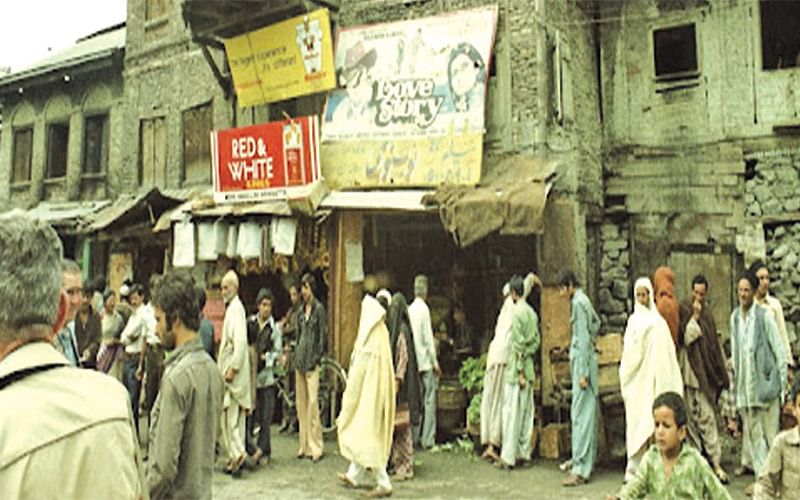
Walk through the apple orchards of Shopian in autumn. Listen carefully. You will not hear Kashmiri voices. The workers harvesting the fruit — bending, climbing, plucking — speak Bhojpuri, Maithili, or Hindi with a Bihari lilt. Visit a construction site in Srinagar’s expanding outskirts. The masons laying bricks, the painters on scaffolding, the men hauling sand — they come from Araria, Samastipur, and West Champaran in Bihar. Step into a brick kiln on the outskirts of Budgam. Same story.
Kashmir — a land that feeds lakhs of workers from Uttar Pradesh, Bihar, Rajasthan, and Punjab — cannot feed its own children.
This is not a small or passing problem. It is a structural contradiction sitting at the heart of one of India’s most strategically important regions. Over 3.70 lakh educated young Kashmiris were registered as unemployed on the J&K employment portal as of January 2025, according to the state’s own deputy chief minister. Of these, more than 1.13 lakh were graduates and postgraduates — people who studied hard, earned degrees, and then found nothing waiting for them at the other end.
Meanwhile, an estimated 3 to 4 lakh migrant workers flood into the valley every spring, pick up daily wages of ₹600 to ₹1,500, work through the season with quiet discipline, and return home before winter with savings that transform their families’ lives back in Bihar or UP.
The paradox is as stark as it is painful: the outsider sees Kashmir as opportunity. The local sees it as a dead end — and dreams of Dubai.
The Numbers That Cannot Be Ignored
Before we understand the why, we need to sit with the scale of what is happening.
Youth unemployment in Jammu & Kashmir has reached 17.4%, nearly double the national average of 10.2%, according to the Baseline Survey Report 2024–25 released under Mission YUVA (Yuva Udyami Vikas Abhiyan). The overall unemployment rate in the UT stands at 6.7%, again almost double the national figure of 3.5%.
Urban youth are hurting the most. The Periodic Labour Force Survey (PLFS) for July–September 2024, published by the Ministry of Statistics, showed that 32% of urban youth aged 15–29 in J&K were unemployed — the highest such figure in the entire country, and nearly twice the national urban youth average. One in three young people in Kashmir’s towns and cities is sitting without work.
Women face an even bleaker reality. Labour surveys consistently show that female unemployment in J&K is more than twice that of men — a gender gap that is far wider than anywhere else in India.
The Centre for Monitoring Indian Economy (CMIE) has at times placed J&K’s overall unemployment as high as 23.1% — among the highest in any state or union territory in India.
In the first quarter of 2024 alone, 3.52 lakh youth registered with the J&K Directorate of Employment, with 1.09 lakh of them holding graduate or postgraduate degrees. These are not school dropouts looking for casual work. These are educated young men and women who expected their qualifications to open doors — and found those doors shut.
Who Are the Outsiders, and Why Do They Choose Kashmir?
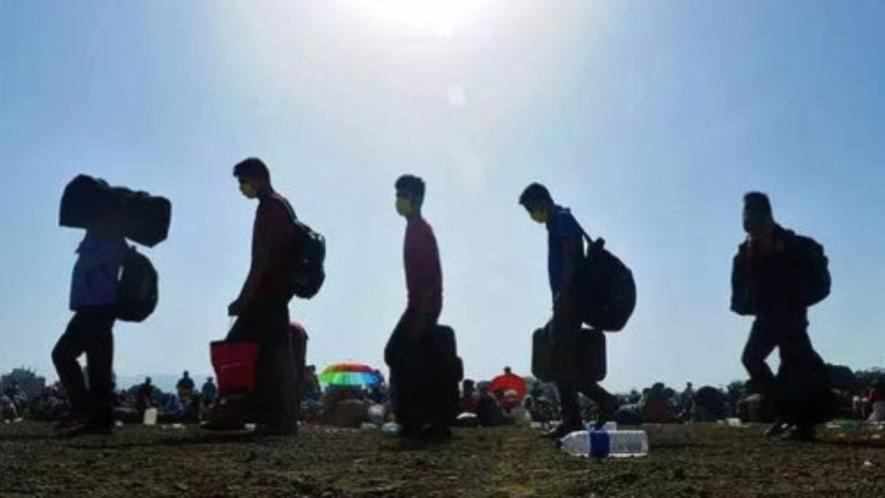
Every spring, as the snow retreats from the valley floor and the first green shoots appear in the rice paddies, a quiet migration begins. Buses and trains from districts in eastern and central India start carrying workers toward Jammu. From there, they climb north on the highway to Srinagar. They rent shared rooms in dense residential neighbourhoods. They contact labour contractors they know from previous seasons. And then they get to work.
The Wage Advantage Is Real — and Massive
The most fundamental reason outsiders prefer Kashmir is simple economics. A daily wage in Kashmir ranges from ₹600 to ₹1,500, depending on the skill level and sector. A mason or carpenter can earn toward the upper end. General agricultural labourers typically earn ₹600–700 per day.
Back in Bihar or Uttar Pradesh, those same workers would earn ₹200 to ₹350 per day — sometimes less.
That gap is not marginal. It is life-changing. A labourer working 200 days in Kashmir can earn ₹1.2 to ₹1.5 lakh in a single season — more than many salaried employees in their home districts earn in a year. Analysts have estimated that 5 lakh migrant workers together earn close to ₹7,875 crore annually from Kashmir’s economy, assuming an average daily wage of ₹700 across 225 working days. That is a colossal transfer of wealth — out of the valley and into the plains of Bihar and UP.
And critically: getting to Kashmir from Bihar does not require a visa, an agent’s fee, a flight, or an exploitative contract. You take a train, pay ₹400–600 for a reserved berth, and arrive. This makes Kashmir — from a cost-benefit perspective — more attractive than entry-level Gulf migration once travel costs, recruitment fees, and living expenses in Dubai or Riyadh are factored in.
Seasonal Demand Creates a Reliable Pipeline
Kashmir’s economy runs in predictable seasonal rhythms, and each season generates intense demand for labour.
Spring and early summer bring agricultural sowing, horticultural maintenance, and the start of the construction season. Summer sees a tourism boom that creates ancillary demand — porters, street vendors, handymen, and hospitality workers. Autumn is the most labour-intensive period: apple harvest. The Kashmir valley produces roughly 2.2 million tonnes of apples annually, and every one of those apples has to be individually picked, sorted, packed, and loaded by human hands within a narrow time window. When migrant workers have left in the past due to unrest or fear — as happened after the abrogation of Article 370 in 2019 and again during targeted killings in 2021 — apple farmers have been unable to harvest their crops in time, with snow destroying fruit left unharvested in the orchards.
Construction, the other major employer, runs from April to October across Kashmir, as work halts during the harsh winters. In this narrow window, brick kilns, housing projects, road construction, and government infrastructure works all compete for the same pool of labour.
Migrant workers, many of whom return to the same contractors year after year, have made themselves indispensable to this seasonal economy.
The Work Ethic Question — Uncomfortable but Real
People who work in Kashmir’s fields and construction sites will say this plainly, even if politicians and academics are reluctant to: migrant workers tend to be more willing to do hard, sustained, physical labour than local workers.
There is a cultural dimension to this. In Kashmir, as in many societies with a longer history of education and government employment, manual labour has gradually become stigmatized. A young man with a graduate degree — or even a young man whose father has a government job — feels a social pressure not to be seen carrying bricks or picking apples for daily wages. The work itself is not disreputable anywhere in the world, but the perception that it represents failure can be powerful enough to keep people away.
Migrant workers, on the other hand, arrive with a single-minded purpose: earn money, save as much as possible, and return home with capital. Their motivation is existential. They are not embarrassed by physical labour — they are energized by the wages it provides. They work from early morning to evening. They do not demand shorter hours, special food, or multiple cigarette breaks. They are, by every account, extraordinarily productive within the context of Kashmir’s informal economy.
Brick kiln owners in Budgam and Baramulla are candid about this dependency. As one owner put it to Outlook India: without labourers from Bihar and UP, the brick kilns would stop functioning. The same is true of apple orchards, paddy fields, and construction sites across the valley.
The Local Side: Why Kashmiri Youth Are Left Behind
Understanding the migrant worker’s advantage is the easier half of this story. The harder question is: why are educated, capable young Kashmiris unable to find work in their own homeland?
The answer involves structural economics, historical policy choices, cultural attitudes, and decades of political instability — none of which can be blamed on the workers themselves.
The Government Job Trap
For decades — going back to the era of Naya Kashmir and the economic policies of the Sheikh Abdullah government — the J&K state administration was the primary employer in the valley. Government jobs offered security, social status, a pension, and a salary that, while modest, was predictable. Families made it their life’s mission to get at least one member into a government post.
This created a cultural and economic dependency that has proved almost impossible to unwind. Today, J&K already has approximately 4.5 lakh government employees — a number the government’s own budget cannot comfortably sustain. New government recruitment has slowed to a trickle compared to the scale of demand. And yet the aspiration for a “sarkari naukri” remains overwhelming, particularly among educated youth.
The result is a generation in a waiting room. Young people spend years — sometimes an entire decade of their twenties — preparing for competitive government exams, hoping for results that may never come. They are not lazy. They are not disengaged. They are caught in a system that told them the government would take care of them, and then quietly stopped being able to do so.
A Private Sector That Never Grew
The structural absence of a robust private sector in Kashmir is the single most consequential factor in its unemployment crisis.
Unlike cities such as Pune, Bengaluru, or Hyderabad — where private industry, IT services, manufacturing, and startups have created millions of jobs independent of government — Kashmir has almost no industrial base worth speaking of. The valley’s geography, its decades of conflict, its political instability, and its distance from major economic corridors have all combined to deter the kind of private investment that generates mass employment.
While the number of industrial units registered in J&K has increased since 2020 (with over 5,000 new registrations by 2024 per UT government data), actual employment generation has remained limited due to delays in operationalisation and the challenging investment climate.
There are no significant IT parks. Manufacturing is minimal. The service sector, outside of government and tourism, is thin. When a young Kashmiri graduate wants a white-collar private sector job, they largely have to leave Kashmir to find one.
The Education-Employment Mismatch
Kashmir has made remarkable strides in education. Its literacy rates have risen steadily, and the valley now produces thousands of graduates and postgraduates each year. But what those graduates are equipped to do, and what the local economy actually needs, are often two very different things.
Universities churn out degree-holders in arts, humanities, and general sciences. The local job market — even in its growth sectors like tourism and horticulture — increasingly needs people with vocational skills, digital capabilities, agri-business expertise, and entrepreneurial instincts. The educational system has not evolved to bridge this gap.
Job training programs exist — Mission Youth, Mission YUVA, Mumkin, Tejaswini, PMEGP — and the government claims to have created nearly 1 million self-employment opportunities since 2021. But a damning detail undermines the headline: independent assessments suggest that fewer than 15% of those trained actually find stable employment as a result. The programs look good on paper. On the ground, they are not delivering at scale.
Political Instability and Its Hidden Economic Cost
This dimension of Kashmir’s unemployment crisis is not discussed enough in polite company, but it is critical.
Kashmir has lived through decades of conflict, militancy, counter-insurgency, frequent shutdowns (hartals), curfews, communication blackouts, and political uncertainty. Each episode — from the insurgency peak of the 1990s through the post-Burhan Wani unrest of 2016, the abrogation of Article 370 in 2019, and the targeted killings of non-locals in 2021 — has had direct economic consequences.
Businesses close during shutdowns. Investors hesitate to commit capital in an environment of uncertainty. Tourism — one of Kashmir’s main engines of private employment — collapses overnight whenever violence flares. Construction stops when labourers flee. The apple harvest rots when supply chains break down.
Each of these episodes costs the economy jobs, investment, and years of recovery. And young people, whose prime working years are finite, pay the highest price. A 25-year-old who loses a year to political disruption does not get that year back.
The Gulf Mirage
Ask any young Kashmiri man in his twenties or thirties what his dream is, and there is a remarkably consistent answer: Dubai. Or Riyadh. Or Muscat. Or any Gulf country where, the story goes, you can earn real money.
This Gulf aspiration has become so deeply embedded in the social fabric of the valley that it has taken on a life of its own — independent of whether it is actually the best economic choice.
The irony, which few people acknowledge, is this: a skilled Kashmiri worker who migrates to the Gulf will earn roughly ₹500–800 per day in many standard labour roles, after deducting recruitment fees, visa costs, flight tickets, accommodation, food, and remittance charges. A migrant from Bihar is already earning ₹600–700 per day in Kashmir — without any of those deductions. The net financial calculation, especially for unskilled or semi-skilled workers, is often not dramatically better in the Gulf than it would be right at home.
But the Gulf carries a social premium that Kashmir does not. The brother who returns from Dubai is seen differently from the man who picks apples in Shopian. The symbolism of international migration — the foreign exchange, the WhatsApp photos from a gleaming Gulf city — carries enormous weight in Kashmiri social circles, regardless of the underlying economics.
The Comparative Reality: A Snapshot
| Factor | Migrant Worker (Bihar/UP) | Kashmiri Youth |
|---|---|---|
| Daily Wage Earned | ₹600–₹1,500 | Seeks salaried role or avoids manual work |
| Primary Motivation | Earn, save, return | Government job or Gulf migration |
| Work Sectors | Construction, orchards, brick kilns, agriculture | Government, IT, professional services |
| Safety Net | None — survival-driven | Land ownership, family income, remittances |
| Risk Appetite | High — works despite security risks | Lower — prefers stability |
| Social Aspiration | Bring capital home | Achieve white-collar status |
| Outcome | Economic prosperity in home state | Prolonged unemployment in Kashmir |
What the Ground Reality Looks Like
Beyond the statistics, what does this paradox look like on the ground, in everyday life?
It looks like Mohammad Rafiq, an apple grower in Shopian, who could not harvest 40% of his apple crop in a single season because migrant workers had fled amid targeted killings and he could not find local replacements at any wage. His fruit rotted on the trees while his family watched helplessly.
It looks like Raees-ud-Din from Araria, Bihar, who first came to Kashmir at age 17, has worked here for over two decades, and considers Kashmir the most rewarding place he has ever worked — better weather, better wages, and people who appreciate skilled work.
It looks like a young Kashmiri engineer with a degree from the National Institute of Technology, Srinagar, who has cleared two competitive exams but is still waiting for an appointment letter that may not come for years, if ever.
It looks like a brick kiln owner in Budgam who flew workers in from Bihar at his own expense during COVID-19 lockdowns because without them, his entire operation would shut down — while young men from the nearby village sat idle.
It looks like a family in south Kashmir with three educated children, one government employee, and two others waiting — for the next exam, the next result, the next announcement — in a kind of suspended animation that can stretch on for years.
What Needs to Change
The paradox of Kashmir’s labour market is not inevitable. It is the product of specific historical choices, structural failures, and policy gaps that can, in principle, be corrected. Here is what genuine change would require:
Build a real private sector. Kashmir needs IT parks, food processing units, light manufacturing clusters, and agri-business infrastructure — not on paper, but operational and generating jobs. The promised investments following Article 370’s abrogation have been slow to translate into actual employment on the ground.
Align education with market needs. Universities need to produce graduates with skills that Kashmir’s economy — and the national economy — actually demands. Coding bootcamps, agri-tech training, hospitality management, and healthcare skills need to be integrated into the curriculum.
Dignify vocational and manual work. A cultural shift is difficult but necessary. Programs that celebrate skilled tradespeople — master craftsmen, expert apple growers, master masons — and that reward vocational excellence with good incomes and social recognition can begin to change how manual work is perceived.
Invest seriously in tourism infrastructure. Kashmir’s natural beauty is an economic asset of almost incalculable value. But converting that beauty into stable, year-round employment requires infrastructure, professional hospitality training, digital marketing capability, and policy certainty. Seasonal employment in tourism will always be fragile; the goal must be year-round economic activity built on the tourism base.
Protect and grow horticulture. The apple economy is Kashmir’s backbone, worth thousands of crores annually. Investing in cold storage, processing facilities, better logistics, and market linkages can multiply employment within the valley — and some of those jobs could well go to local youth rather than seasonal migrants.
Address the government job illusion honestly. Political leaders need to tell young Kashmiris the truth: the government cannot hire everyone. The 4.5 lakh existing government employees represent an already-stretched payroll. The future is in private enterprise, self-employment, and skills-based work — and young people need to be prepared for that reality, not kept waiting for government appointment letters that may never come.
The Bigger Question Kashmir Must Ask Itself
There is a question embedded in this paradox that goes beyond economics. It touches on identity, on dignity, and on what kind of future the valley wants to build.
A region that feeds lakhs of workers from across India — that employs them, shelters them, pays them well, and depends on them for its agricultural survival — should not be a region where its own children cannot find work. That is not just an economic failure. It is a moral and social failure.
The migrant worker from Bihar is not the problem. He is, in many ways, a mirror. His willingness to work hard in difficult conditions for fair wages shows that the wages and the work exist. The problem is the set of structural barriers — cultural, economic, political, and historical — that prevent young Kashmiris from accessing those same opportunities in their own homeland.
Unless those barriers are addressed — not with slogans, schemes, and press conferences, but with sustained, honest, patient investment in economic diversification — the paradox will continue. Outsiders will thrive in Kashmir’s orchards and on its construction sites. And Kashmir’s own youth will keep looking at the departure board at Srinagar International Airport, dreaming of a better life somewhere else.
The tragedy is that the better life they are looking for could, with the right choices, be built right here at home.
Key Facts at a Glance
- Youth unemployment in J&K: 17.4% (national average: 10.2%) — Baseline Survey Report 2024–25, Mission YUVA
- Urban youth unemployment (ages 15–29): 32% — PLFS, July–September 2024
- Registered unemployed youth on J&K portal: 3,70,811 as of January 2025
- Of these, graduates and postgraduates: 1.13 lakh
- Estimated migrant workers in Kashmir per season: 3–4 lakh
- Migrant daily wage in Kashmir: ₹600–₹1,500
- Equivalent wage in home states (UP/Bihar): ₹200–₹350/day
- Estimated annual migrant earnings from Kashmir: ₹7,875 crore
- J&K existing government employees: ~4.5 lakh
- Overall J&K unemployment rate: 6.7% (national: 3.5%)
Sources: Periodic Labour Force Survey (PLFS) 2023–24; Baseline Survey Report 2024–25 under Mission YUVA; J&K Directorate of Employment data; Deccan Herald; Greater Kashmir; Outlook India; Village Square; The Kashmir Images; Kashmir Observer.