Iran Says Strait of Hormuz Will Remain Closed Until US Meets Its Conditions as Global Energy Risks Deepen
By: Javid Amin | 14 Aug 2026
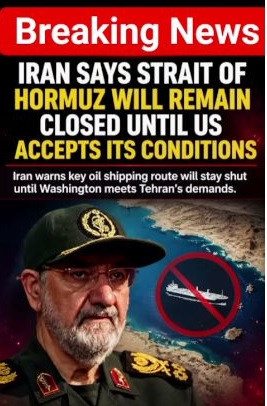
Iran has hardened its position over the Strait of Hormuz, saying the strategically vital waterway will remain closed until the United States changes its policies and accepts Tehran’s demands. The latest declaration turns the strait into an even bigger bargaining chip in the escalating US-Iran confrontation, with consequences stretching from Gulf shipping lanes to oil markets, LNG supplies and the wider Middle East peace process.
Iran Draws a Red Line Over Strait of Hormuz Reopening
Iran’s Supreme National Security Council Secretary Mohsen Rezaei said on August 11 that the Strait of Hormuz would remain closed as long as Washington refused to change its behaviour and accept Tehran’s conditions.
According to Reuters, Rezaei said the United States must end the war and unfreeze Iranian funds held overseas, while additional demands had been communicated through mediators.
The statement came after Rezaei met China’s ambassador to Tehran, adding another diplomatic dimension to an already complicated crisis.
Iran’s message is therefore broader than a dispute over shipping. Tehran is linking the reopening of one of the world’s most important maritime chokepoints to a package of military, economic and regional political demands.
That makes Hormuz not merely a maritime-security issue, but a central negotiating instrument in the US-Iran confrontation.
What Iran Wants From the United States
Iranian officials have outlined a number of conditions over recent days. While the wording and number of demands have varied between statements, the core requirements include:
- Ending the ongoing US-Iran war and military action against Iran.
- Lifting the US blockade and economic sanctions.
- Releasing or unfreezing Iranian assets held overseas.
- Compensation for damage caused during the conflict.
- An end to threats against Iran’s leadership.
- Withdrawal of US naval and air forces involved in the blockade.
- An end to military action against Iran’s regional allies.
- Broader cessation of fighting involving Gaza and Lebanon.
An earlier statement by Mohammad Bagher Zolghadr, another senior Iranian security official, laid out six conditions that included ending threats against Iran’s supreme leader, permanently stopping military operations, withdrawing US forces involved in the blockade, compensating Iran for wartime damage, lifting sanctions and releasing frozen Iranian assets.
The evolving list is important because it shows that Tehran is not treating the Strait of Hormuz as an isolated technical navigation problem.
Iran is attempting to connect maritime access with the entire political settlement surrounding the war.
Why Gaza and Lebanon Are Now Part of the Hormuz Equation
One of the most consequential aspects of Iran’s position is the connection between Hormuz and conflicts outside Iran’s immediate territory.
Tehran has demanded an end to fighting involving Gaza and Lebanon, effectively making the reopening of the waterway part of a wider regional settlement.
This reflects Iran’s broader strategic approach in West Asia. For Tehran, the conflict is not simply about its own territory, sanctions or nuclear policy. It is also about the regional balance of power and the future of Iran-aligned groups and partners.
The linkage creates a difficult diplomatic problem for Washington.
A potential agreement over maritime traffic could theoretically be negotiated between Iran, Oman and the United States. But if reopening Hormuz is simultaneously tied to Gaza, Lebanon, sanctions, frozen assets, military deployments and compensation, negotiations become much larger than a shipping agreement.
That dramatically raises the number of actors and issues involved.
The Strait of Hormuz: Why the World Is Watching
The importance of the dispute becomes clearer when the geography is considered.
The Strait of Hormuz lies between Iran and Oman, connecting the Persian Gulf with the Gulf of Oman and the Arabian Sea. At its narrowest point, the strait is only about 29 nautical miles wide, with designated navigation channels that are much narrower.
Yet this narrow passage carries an enormous share of global energy supplies.
The US Energy Information Administration estimates that oil flows through Hormuz averaged around 20 million barrels per day in 2024, equivalent to roughly 20% of global petroleum liquids consumption and more than one-quarter of global maritime oil trade.
The International Energy Agency similarly estimates that around 20 million barrels per day moved through Hormuz in 2025, representing approximately one-quarter of global seaborne oil trade.
The strait is also crucial for natural gas.
About 20% of global LNG trade passed through Hormuz in 2024, with Qatar accounting for the overwhelming majority of Gulf LNG exports through the waterway. China, India and South Korea were among the biggest destinations for those LNG shipments.
The “20%” Figure Needs Context
The commonly cited figure that Hormuz carries “20% of global oil trade” is broadly accurate as a shorthand, but it requires precision.
The more exact EIA figures show that approximately 20% of global petroleum liquids consumption and around 27% of global maritime oil trade passed through the strait in 2024.
That distinction matters because “global oil trade” and “global oil consumption” are not the same measurement.
A Chokepoint With Few Alternatives
The biggest concern for energy markets is not simply the amount of oil moving through Hormuz. It is the limited ability to replace those flows quickly if the waterway becomes inaccessible.
Saudi Arabia, the UAE and Iran have alternative pipelines, but their combined bypass capacity is only a fraction of the volumes normally moving through Hormuz.
The EIA estimates that Saudi Arabia’s East-West pipeline and the UAE’s Abu Dhabi pipeline together could provide approximately 4.7 million barrels per day of bypass capacity.
That leaves a substantial gap compared with roughly 20 million barrels per day moving through Hormuz under normal conditions.
This is why even the threat of prolonged disruption can influence oil prices.
Markets do not need to wait for every tanker to stop before reacting. Traders price in the possibility of shortages, higher freight costs, insurance premiums, longer routes and supply uncertainty.
Hormuz Is Already Under Severe Pressure
Iran’s latest statement comes against a backdrop in which maritime traffic through the strait has already fallen dramatically.
Reuters reported on August 14 that only a handful of vessels were moving through Hormuz compared with more than 130 ships a day before the February war. Kpler data showed only two vessels passed through on Friday, with no crude oil shipments visible that day.
Nine vessels had passed through on Thursday, compared with five on Wednesday and an August daily average of 12.
The figures underline an important distinction:
The current situation is not simply a theoretical threat of closure. Commercial traffic has already been severely constrained.
Some vessels may travel without transmitting their positions, so tracking data does not necessarily capture every movement. Nevertheless, the decline from pre-war traffic levels demonstrates the scale of the disruption.
US-Iran Standoff Turns Hormuz Into a Negotiating Weapon
Iran’s leverage comes from geography.
Tehran does not need to permanently shut every section of the strait to create economic pressure. Even selective restrictions, attacks on shipping, uncertainty over navigation or increased security requirements can discourage commercial operators.
Shipping companies respond to risk.
If insurers increase war-risk premiums, tanker owners may hesitate to enter the Gulf. If crews face higher security risks, freight costs rise. If ships need to wait offshore, delays increase.
The result can be an energy shock without a complete physical blockade.
Reuters quoted a regional analyst describing Iran’s ability to restrict shipping through Hormuz as its main source of leverage in negotiations.
That leverage explains why Washington is equally determined to prevent Tehran from establishing unrestricted control over the waterway.
The US Position: Blockade, Pressure and a Competing Claim of Control
Washington and Tehran are now presenting fundamentally different versions of the situation.
Iran says the waterway will reopen only when its conditions are met.
The United States has maintained a naval blockade and argued that it has significant control over maritime access.
US Defense Secretary Pete Hegseth said Washington could maintain its naval presence and blockade indefinitely by rotating forces in and out of the region.
That creates a dangerous strategic contradiction.
Iran says it controls whether the strait opens. The United States says its military pressure can determine whether shipping moves.
For global markets, the distinction is less important than the practical outcome: ships are moving far less frequently than before.
Oman Emerges as a Critical Diplomatic Player
One of the more significant developments behind the headlines is the parallel effort involving Iran and Oman.
Iran has said it was close to an agreement with Oman over a new shipping arrangement through the Strait of Hormuz.
But Tehran has repeatedly stressed that an Iran-Oman maritime agreement alone would not automatically reopen the waterway.
Reuters reported on August 8 that Iranian Foreign Minister Abbas Araqchi said the two sides were close to an agreement on a new shipping route, but reopening would still depend on wider conditions, including US compensation to Iran.
Oman has described its negotiations with Tehran as positive and constructive while warning against actions that could undermine the talks.
Oman’s position is particularly important because it sits directly across the strait from Iran and has historically played a role in discreet regional diplomacy.
Why an Iran-Oman Deal May Not Be Enough
The emerging diplomatic picture suggests there are actually two separate questions:
- Can Iran and Oman agree on the technical and legal arrangements governing maritime traffic?
- Can Iran and the United States resolve the larger political dispute that Tehran says must be settled before the strait fully reopens?
The first problem may be manageable.
The second is much harder.
That is why repeated reports of a possible Hormuz agreement have not yet translated into a sustained return to normal commercial shipping.
China’s Role Is Becoming More Important
Rezaei’s meeting with China’s ambassador to Tehran also deserves attention.
China is one of the world’s largest energy importers and among the major Asian destinations for oil and LNG moving through Hormuz.
EIA data show that China, India and South Korea together accounted for a substantial share of LNG flows through Hormuz in 2024.
Beijing therefore has a direct economic interest in the restoration of stable maritime traffic.
China also maintains strategic relations with Iran and deep economic ties with Gulf energy exporters.
That gives Beijing an unusual position: it has incentives to preserve relations with Tehran while simultaneously seeking uninterrupted energy supplies.
The meeting does not by itself prove that China is acting as a formal mediator. But diplomatically, it highlights how the Hormuz crisis has consequences far beyond the US-Iran relationship.
What Happens to Oil Prices If the Closure Continues?
The most immediate international concern is energy pricing.
A sustained disruption could affect:
- Crude oil prices
- Diesel and gasoline prices
- LNG prices
- Tanker freight rates
- Marine insurance premiums
- Refining margins
- Electricity costs in gas-dependent economies
- Food and manufacturing costs through higher transportation expenses
The impact would depend heavily on duration and severity.
A short disruption can potentially be absorbed through inventories, alternative supply and market adjustments.
A prolonged disruption is far more dangerous.
The Congressional Research Service notes that preventing oil shipments through Hormuz could produce rapid price escalation as buyers compete for alternative supplies and inventories are drawn down.
That does not mean oil prices must rise indefinitely.
Global inventories, spare production capacity, alternative pipelines and changing demand can eventually reduce some of the pressure.
But the longer the disruption continues, the greater the economic damage becomes.
Gulf States Face a Difficult Balancing Act
The Gulf Arab states are particularly exposed.
Countries such as Saudi Arabia, the UAE, Qatar, Kuwait and Bahrain depend heavily on maritime routes connected to Hormuz, although their individual levels of dependence differ.
Qatar is especially important in the LNG market because most of its LNG exports leave through Hormuz.
Saudi Arabia and the UAE have greater ability to use alternative infrastructure for some oil exports, but neither is completely insulated from the consequences of regional instability.
The Gulf states therefore face a strategic dilemma.
They need security guarantees from Washington but also need to avoid becoming direct participants in an expanding confrontation with Iran.
For countries located on the eastern and southern approaches to the Gulf, a prolonged Hormuz crisis is not simply an oil-market problem. It is a national-security and economic-stability problem.
India and Asia Could Feel the Shock Quickly
For Asian economies, Hormuz is particularly important because a large proportion of Gulf energy exports ultimately move toward Asian markets.
India, China, Japan and South Korea are major consumers of Middle Eastern oil and gas.
EIA data show that Asian countries dominate destinations for LNG shipped through Hormuz, with China, India and South Korea among the largest recipients.
For India, a prolonged disruption could create pressure through several channels:
- Higher crude import costs
- Greater shipping and insurance expenses
- Pressure on the rupee if the oil import bill rises
- Higher transportation costs
- Potential inflationary pressure
- Increased competition for alternative crude supplies
However, the actual impact would depend on India’s inventory position, the availability of Russian and other non-Gulf crude, global oil prices and the duration of the disruption.
Reuters reported on August 14 that India’s purchases of Russian crude had risen to a record level in July as Asian refiners adapted to the changing energy environment.
That diversification could provide some cushion, although it cannot completely eliminate exposure to a major global oil shock.
The Risk Is Bigger Than Oil
It would be a mistake to view Hormuz only through the lens of crude oil.
The strait is also a major LNG chokepoint.
Around one-fifth of global LNG trade passed through Hormuz in 2024, with Qatar accounting for most Gulf LNG flows through the waterway.
That means a prolonged crisis could affect electricity generation and industrial activity in countries that depend heavily on imported LNG.
The consequences could therefore extend from petrol pumps to power plants.
For Europe, the effect could arrive indirectly through competition for global LNG cargoes. Asian buyers seeking replacement supplies could compete with European importers for flexible LNG shipments, potentially increasing prices across multiple markets.
Shipping Security Is Becoming a Crisis of Its Own
The latest developments also show that the problem is no longer limited to diplomatic rhetoric.
Several commercial vessels have reportedly come under attack or faced serious risks while attempting to transit the waterway.
The UAE has accused Iran of attacking vessels linked to Abu Dhabi National Oil Company. Iran has not accepted responsibility for the latest incidents reported by Reuters.
Any continued attacks create a vicious cycle:
Higher risk → higher insurance costs → fewer ships willing to transit → lower supply → higher prices → greater political pressure.
There is also an environmental dimension.
Damage to tankers can cause oil spills in one of the world’s most strategically and ecologically sensitive maritime regions. Recent reports have already highlighted oil pollution concerns in waters around the Gulf and Oman.
A prolonged military confrontation could therefore create environmental damage alongside economic disruption.
International Law Adds Another Layer of Complexity
The legal status of navigation through international straits is another major issue.
The Strait of Hormuz is an internationally important navigation route, and its operation is governed by a complex framework of maritime law and state practice.
Iran’s ability to influence traffic does not automatically mean that it possesses unrestricted legal authority to deny passage to vessels.
At the same time, the practical ability of a state to control access during an armed conflict can be very different from the normal peacetime legal framework.
This distinction between de facto control and legal entitlement is likely to become increasingly important if the confrontation continues.
The Bigger Strategic Game: Who Blinks First?
At its core, the Hormuz confrontation is becoming a test of economic endurance.
Iran is betting that control over maritime traffic can impose enough pressure on the United States and global energy markets to force concessions.
Washington is betting that sanctions, blockade pressure and military superiority can impose enough economic pain on Iran to make Tehran compromise.
Both strategies carry risks.
If Iran Holds Firm
Tehran could gain negotiating leverage, but it also risks:
- Deeper economic isolation
- Greater damage to its own exports
- Military escalation
- Loss of diplomatic support
- Pressure from Gulf neighbours
- Reduced access to international markets
If the US Maintains the Blockade
Washington could increase pressure on Tehran, but it faces its own costs:
- Higher fuel prices
- Pressure on consumers
- Global inflationary effects
- Increased military expenditure
- Risk of attacks on US forces
- Greater danger of a wider regional war
The conflict therefore contains a classic strategic dilemma: the instrument being used to pressure the opponent can also impose substantial costs on the country using it.
Why the Current Situation Is More Dangerous Than a Normal Oil Shock
Ordinary oil-market disruptions are often driven by production cuts, accidents or temporary political instability.
Hormuz is different because it combines energy security, naval power, sanctions, nuclear tensions and regional warfare in one location.
That creates the possibility of cascading crises.
A maritime incident could trigger retaliation.
Retaliation could disrupt additional shipping.
Shipping disruption could push oil prices higher.
Higher prices could increase political pressure on governments.
Political pressure could lead to further military or economic escalation.
This is why international governments and energy companies are watching the situation so closely.
What to Watch Next
Several indicators will determine whether the crisis moves toward de-escalation or a deeper confrontation.
1. Actual Vessel Traffic
The most important test will be whether commercial shipping begins returning to normal levels.
Diplomatic statements matter, but ships moving safely through Hormuz matter more.
2. Iran-Oman Agreement
A finalized arrangement governing navigation could become the first practical step toward restoring maritime traffic.
3. US Sanctions and Frozen Assets
Any concrete move involving Iranian assets or sanctions could signal whether Washington is prepared to address Tehran’s economic demands.
4. Gaza and Lebanon
If Iran continues linking Hormuz to wider regional ceasefires, developments in Gaza and Lebanon could directly influence maritime negotiations.
5. Oil Prices
A sustained move higher in Brent crude would indicate that markets are pricing in a longer disruption.
6. War-Risk Insurance
Insurance premiums are an important early indicator of whether shipping companies believe the security situation is improving or deteriorating.
7. US Military Posture
Any major increase or reduction in American naval assets around the Gulf would provide clues about Washington’s assessment of the crisis.
The Bottom Line
Iran’s declaration that the Strait of Hormuz will remain closed until the United States meets its conditions marks a significant escalation in the political use of maritime access.
But the story is more complicated than a simple Iranian threat to shut an oil route.
The waterway is already operating at dramatically reduced traffic levels, while Washington and Tehran are locked in competing claims over who controls access. At the same time, Iran and Oman are discussing alternative arrangements, China has a strong economic interest in stability, and Gulf states are caught between security dependence on the United States and the need to avoid a wider confrontation with Iran.
The central issue is therefore no longer simply whether Hormuz is “open” or “closed.”
The real question is under what political, military and economic conditions normal navigation can return — and who will make the first major concession.
For the global economy, the stakes are enormous. Around 20 million barrels of oil per day moved through the strait in 2025, while roughly one-fifth of global LNG trade also relies on the waterway.
If diplomacy succeeds, markets could quickly price in lower risk.
If negotiations fail and shipping remains restricted, the Hormuz crisis could evolve from a regional confrontation into a prolonged global energy and inflation shock.
For now, Tehran’s message is unmistakable: the Strait of Hormuz is not being treated merely as a shipping corridor. Iran is using it as a central bargaining instrument in the struggle over the future of its relationship with Washington and the wider Middle East.