Kulgam Attack Puts Migrant Worker Safety Under Spotlight as Mehbooba Mufti, Farooq Abdullah Question Security and Accountability
By: News Desk | 02 Aug 2026
Srinagar: A deadly attack targeting migrant labourers in Kulgam district of South Kashmir has once again raised difficult questions about the security of vulnerable communities working in Jammu and Kashmir, while opposition leaders have used the incident to demand greater accountability and transparency from the authorities.
The attack, according to the information available, has triggered concern among migrant workers and their families, many of whom depend on seasonal and temporary employment in Kashmir’s agriculture, construction and other sectors.
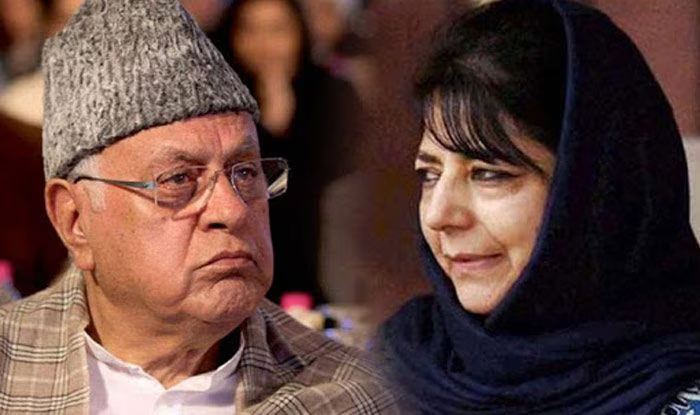
Former Jammu and Kashmir chief minister and PDP president Mehbooba Mufti has raised questions over whether adequate security arrangements were in place to protect migrant workers despite the perceived threat environment.
Meanwhile, National Conference president Farooq Abdullah has called for greater transparency over the identity and responsibility of those behind attacks on civilians, arguing that accountability is essential for maintaining public confidence.
The political reactions come at a sensitive time for Jammu and Kashmir, where the security situation has improved significantly in several areas compared with previous years, but sporadic militant attacks continue to pose a serious challenge.
For migrant workers, the latest incident has renewed an old fear: that they can become vulnerable targets simply because of their identity and economic dependence on employment in the Valley.
Kulgam Attack Brings Migrant Workers Back Into the Security Debate
Migrant workers have long been an important part of Jammu and Kashmir’s economy.
From apple orchards and brick kilns to construction sites, hotels, restaurants and small businesses, workers from different parts of India contribute significantly to the region’s labour force.
South Kashmir, particularly districts such as Kulgam, Anantnag, Pulwama and Shopian, attracts large numbers of seasonal workers during the agricultural and horticultural seasons.
The majority live and work quietly, often in temporary accommodation near farms, construction sites or industrial locations.
That very visibility, however, can make them vulnerable during periods of heightened militancy.
Over the years, migrant labourers have occasionally been targeted by militants in Jammu and Kashmir, particularly during periods when militant groups sought to create fear among non-local workers and disrupt economic activity.
Such attacks have a wider impact than the immediate loss of life.
They can:
- Create fear among migrant communities.
- Disrupt agricultural and construction activity.
- Affect local businesses dependent on migrant labour.
- Damage the perception of security in the region.
- Trigger an exodus of workers.
- Deepen communal and social anxieties.
The Kulgam incident has therefore become a security issue as well as a humanitarian concern.
Mehbooba Mufti Raises Questions Over Security Preparedness
PDP chief Mehbooba Mufti’s response has focused attention on the question of whether the attack could have been prevented.
Her reported criticism centres on the alleged failure of authorities to adequately protect migrant workers despite concerns about their vulnerability.
The political significance of such an allegation is considerable.
Security in Jammu and Kashmir has improved in many respects, but the protection of soft targets remains a difficult challenge.
Militant organisations have increasingly relied on attacks that require relatively limited resources but can produce significant psychological and political consequences.
Migrant labourers, minority communities, political workers, tourists and other civilians can become targets precisely because attacks against them are intended to generate fear beyond the immediate location.
The key question raised by Mehbooba Mufti is therefore not simply why the attack occurred.
It is whether security agencies had sufficient intelligence, surveillance and preventive mechanisms in place to identify and disrupt the threat.
That question will ultimately need to be answered through an objective investigation rather than political claims alone.
Was There a Security Lapse?
The allegation of a security lapse is serious and should be assessed against facts emerging from the investigation.
A genuine security lapse could involve several possibilities:
- Failure to act on specific intelligence inputs.
- Inadequate protection of vulnerable worker settlements.
- Poor coordination between local police and security agencies.
- Insufficient area domination or patrols.
- Lack of verification and monitoring in sensitive locations.
- Failure to respond to previously identified threats.
However, it is important to distinguish between a confirmed security failure and a political allegation of negligence.
Unless an official inquiry establishes that warnings were ignored or preventive measures were inadequate, the claim should remain described as an allegation.
At the same time, questions about security preparedness are legitimate following any successful militant attack.
The authorities have a responsibility to explain how the attackers managed to reach their targets and what measures are being taken to prevent a recurrence.
Farooq Abdullah Seeks Transparency Over Those Behind the Attack
National Conference president Farooq Abdullah has reportedly demanded that the government make public the identity of those responsible for the killings.
His position brings another dimension to the debate: accountability.
In the aftermath of a militant attack, authorities generally focus first on investigation, identification of suspects and operational response.
There is also a legitimate public demand for information.
People want to know:
- Who planned the attack?
- Which militant group was responsible?
- How did the attackers reach the target?
- Were there intelligence failures?
- Were the perpetrators local or foreign?
- Who provided logistical support?
- What action is being taken against those involved?
Farooq Abdullah’s reported demand reflects this broader concern for transparency.
However, naming suspects before an investigation is complete can also create complications.
Authorities must balance the public’s right to information with the integrity of an ongoing investigation.
The most credible approach is therefore to release verified information once investigators have established the facts and sufficient evidence is available.
The Political Battle Over ‘Normalcy’ in Kashmir
The Kulgam attack has also revived an old political argument over the meaning of “normalcy” in Jammu and Kashmir.
The government has repeatedly highlighted improvements in the security environment, increased tourism, economic activity and declining levels of militancy in several parts of the region.
Those developments are significant.
But the continuation of occasional attacks demonstrates that the security challenge has not disappeared completely.
For the opposition, every major attack becomes an opportunity to question government claims and highlight vulnerabilities.
The PDP and NC have both historically argued that security cannot be measured solely by the number of militant incidents.
They have also emphasised the importance of political confidence, civil liberties, democratic institutions and public trust.
The latest incident has therefore created another point of confrontation between the administration and opposition parties.
The government is likely to emphasise its broader security achievements and ongoing counterterrorism operations.
Opposition leaders, meanwhile, are likely to focus on the failure to prevent individual attacks and the need for greater accountability.
Both narratives will shape the political conversation in the coming days.
Migrant Workers: The Forgotten Security Stakeholders
The most important human dimension of the Kulgam incident is the vulnerability of migrant labourers.
Thousands of workers travel to Jammu and Kashmir every year in search of employment.
Many arrive from economically weaker regions and live in modest conditions.
They work long hours in:
- Agriculture.
- Apple orchards.
- Construction.
- Road projects.
- Hospitality.
- Brick kilns.
- Small manufacturing units.
- Local markets.
Their economic contribution is substantial, but their security needs often receive less attention than those of more visible communities.
In many cases, workers live in isolated areas or temporary settlements.
This creates several challenges.
They may not have easy access to police stations.
They may lack reliable communication systems.
They may be unfamiliar with local geography.
And they may not know how to report suspicious activity.
This makes migrant workers a potentially vulnerable group in areas affected by militant activity.
What Security Measures Could Help?
The latest incident should encourage authorities to review existing security arrangements around migrant labour clusters.
A comprehensive strategy could include:
Better Mapping of Migrant Settlements
Authorities need updated information about where migrant workers live and work, particularly in vulnerable rural areas.
Improved Police-Community Coordination
Local police should maintain regular contact with workers and employers so that security concerns can be reported quickly.
Threat-Based Security Deployment
Security arrangements should be based on intelligence assessments rather than blanket measures that are difficult to sustain.
Emergency Communication
Workers should have access to emergency helplines and clear instructions about what to do during a security incident.
Employer Responsibility
Contractors and employers should ensure that workers are housed in reasonably secure locations and that authorities are informed about large labour settlements.
Regular Security Reviews
Security agencies should periodically reassess vulnerable locations, particularly during periods of increased militant activity.
These measures would not eliminate the risk entirely, but they could reduce vulnerabilities.
The Economic Cost of Fear
The consequences of attacks on migrant workers extend beyond security.
Kashmir’s economy depends heavily on labour mobility.
The horticulture sector, for example, requires large numbers of workers during harvesting and packing seasons.
Construction and tourism-related industries also rely on migrant labour.
If workers begin leaving the Valley or refuse to return, businesses may face labour shortages.
Farmers could struggle to harvest crops.
Construction projects could slow down.
Hotels and restaurants could experience staffing difficulties.
The psychological impact can be equally damaging.
A single attack can create fear among thousands of workers who were not directly affected.
That is precisely why militant attacks against civilians are often designed to have a much larger impact than their immediate casualty figures suggest.
Security Agencies Face a Difficult Balancing Act
The administration now faces the challenge of preventing further attacks without creating an atmosphere of permanent fear.
After an attack, security agencies typically increase patrols, conduct searches and strengthen security around vulnerable locations.
Such measures may provide short-term reassurance.
But long-term security requires a combination of intelligence gathering, community engagement and targeted counterterrorism operations.
The challenge becomes particularly complicated in rural areas, where workers may live in scattered settlements far from major security installations.
A blanket security approach is neither practical nor sustainable.
The more effective strategy is likely to involve intelligence-led policing and close coordination between local communities and security agencies.
Political Opposition Is Likely to Intensify
The incident has provided opposition parties with another opportunity to challenge the administration’s security narrative.
Mehbooba Mufti’s emphasis on the alleged security lapse places the government under pressure to explain whether preventive measures were adequate.
Farooq Abdullah’s demand for transparency puts the focus on accountability and the investigation.
Together, the two reactions represent two different but connected political questions:
Could the attack have been prevented?
And:
Who was responsible for carrying it out?
The answers will shape the political debate.
If investigators identify the perpetrators quickly and authorities demonstrate that the attack was the result of a sophisticated or unexpected militant operation, the government’s position may strengthen.
If evidence emerges that specific warnings were ignored or security arrangements were inadequate, opposition criticism is likely to intensify.
The Larger Security Picture in Jammu and Kashmir
It is important to place the Kulgam attack within the broader security context.
Jammu and Kashmir has witnessed a significant decline in large-scale militant violence compared with the peak years of insurgency.
At the same time, militant groups have increasingly adopted tactics aimed at creating psychological impact through attacks on civilians and soft targets.
This means that even as overall violence declines, individual attacks can remain highly consequential.
The challenge for security agencies is therefore evolving.
The objective is no longer simply to prevent large militant operations.
It is also to detect small cells, disrupt local support networks, protect vulnerable communities and prevent isolated attackers from causing mass casualties.
That requires intelligence sharing and rapid response at the local level.
What Happens Next?
The immediate priorities following the Kulgam incident should be clear.
1. Identify the attackers
Investigators must establish who planned and executed the attack.
2. Determine the security circumstances
Authorities should assess whether there was any intelligence failure or lapse in protection.
3. Protect vulnerable workers
Security arrangements around migrant labour settlements should be reviewed immediately.
4. Prevent retaliatory tensions
The administration must ensure that the incident does not trigger communal suspicion or hostility against migrant communities.
5. Maintain transparency
The public should receive verified information as the investigation progresses.
6. Support victims’ families
Compensation, medical assistance and other support should reach victims and their families without unnecessary delays.
Kulgam Attack Puts Security, Accountability and Worker Safety Under Spotlight
The Kulgam attack has once again exposed the difficult intersection of security, politics and civilian vulnerability in Jammu and Kashmir.
For Mehbooba Mufti, the incident raises questions about whether the authorities failed to protect a vulnerable community despite known security concerns.
For Farooq Abdullah, the focus is on transparency and accountability, including clarity over who was responsible for the killings.
For the administration and security agencies, the immediate task is to identify the perpetrators, prevent further attacks and reassure migrant workers that they can continue to earn their livelihoods without becoming targets of violence.
For the workers themselves, however, the issue is far more personal.
They are not political actors.
They are farmers, labourers, construction workers and service providers who travel thousands of kilometres from their homes to earn a living.
Their safety should not depend on the political climate of the day.
The Kulgam incident is therefore a reminder that the definition of security must extend beyond statistics and official claims of normalcy. A truly secure Jammu and Kashmir must also be one where ordinary workers—whether local or migrant—can live and work without fear.
The coming days will reveal whether the attack was an isolated militant operation or part of a broader attempt to target vulnerable communities.
But one lesson is already clear: protecting migrant workers must be treated as an essential component of Jammu and Kashmir’s security strategy, not merely as a response after tragedy strikes.