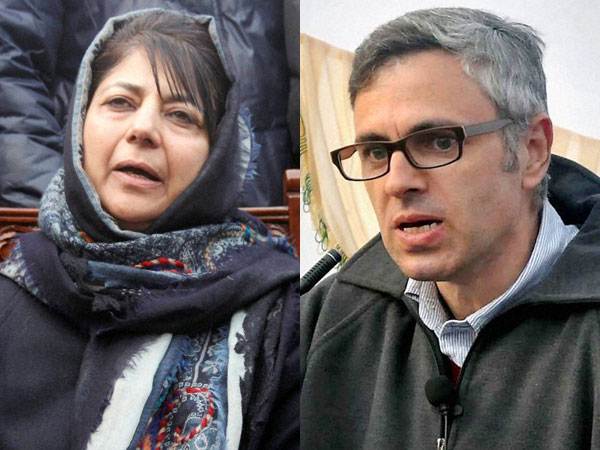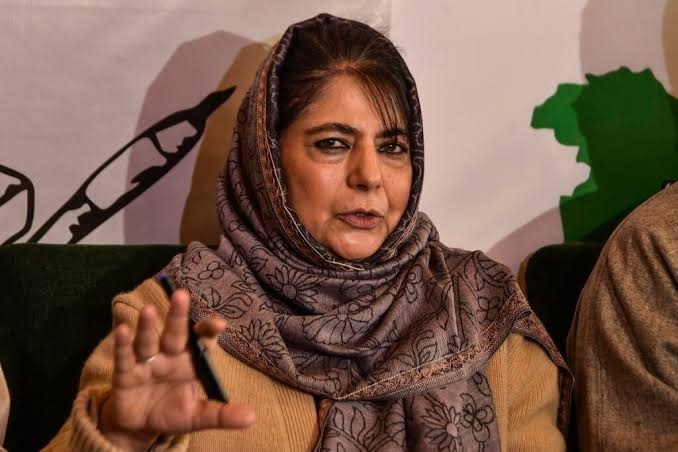
After securing another term as PDP president, former Chief Minister says political compliance cannot replace public trust, renews demand to end raids and review detentions
By: Javid Amin | 05 November 2026
Srinagar: A quiet street is not necessarily a settled society. That was the central message of Peoples Democratic Party (PDP) president Mehbooba Mufti as she cautioned the Centre against interpreting the prevailing calm in Kashmir as proof that political grievances have disappeared.
Speaking to party leaders and workers after being unanimously re-elected as PDP president on Thursday, November 5, Mehbooba argued that administrative control and the cooperation of an elected government cannot, by themselves, resolve Jammu and Kashmir’s deeper political questions. She called on New Delhi to rebuild trust with the people, end what she described as daily raids and harassment of families, and address the continued detention of undertrials, including ill prisoners and people who have been granted bail.
Her remarks were not limited to a criticism of the BJP-led Union Government. She also took a direct swipe at the National Conference government, accusing it of complying with the Centre rather than challenging decisions affecting Jammu and Kashmir.
The speech comes amid a renewed political campaign by the PDP against both the ruling NC in the Union Territory and the Centre in New Delhi. It also gives Mehbooba an opportunity to restate the party’s political identity at a time when it is attempting to recover influence after electoral setbacks.
A political message aimed at both New Delhi and Srinagar
Mehbooba’s most pointed criticism was directed at the National Conference government led by Omar Abdullah.
Referring to the NC’s 50 Assembly seats, she alleged that the party was carrying out the Centre’s wishes, including decisions implemented through the Lieutenant Governor, without offering meaningful resistance.
“There is no doubt that right now, there is a party here with 50 seats that obeys your every command,” she said, arguing that relying on a politically cooperative government to establish normalcy would not resolve Jammu and Kashmir’s underlying problems.
The remark is significant because the PDP is not challenging the Centre alone. It is also trying to position itself as a political alternative to the NC, which returned to power in the 2024 Assembly elections.
The accusation of being a “rubber stamp” is, of course, Mehbooba’s political assessment. The NC could argue that governing a Union Territory with limited constitutional powers requires negotiation with the Centre and the Lieutenant Governor, rather than confrontation on every issue.
That is the central political disagreement: whether cooperation with New Delhi represents pragmatic governance under the existing constitutional arrangement, or whether it risks weakening the elected government’s ability to defend the region’s political interests.
The debate is particularly sensitive because the NC campaigned on restoring statehood and pursuing the political aspirations of Jammu and Kashmir. Its supporters expect it to press those demands, while the government must also manage everyday administration within the powers currently available to it.
Mehbooba is seeking to turn that gap between political expectations and administrative limitations into a challenge to the ruling party’s credibility.
Raids, detentions and families: The human rights dimension
Beyond the political confrontation, Mehbooba devoted a substantial part of her speech to security operations and the treatment of families.
She called for an end to what she described as daily raids and harassment, and demanded that authorities review the cases of undertrials who remain in custody. She specifically referred to prisoners who are ill and people who have been granted bail but allegedly continue to remain behind bars.
She also cited an alleged incident involving a family from Tral. According to her account, authorities targeted relatives of a person who had allegedly left home, including a married daughter living with her in-laws and her husband.
These are serious allegations. They require examination through police records, court orders and independent accounts from the affected families. The speech itself does not establish the circumstances of the arrests or the legal grounds on which the individuals were detained.
But the wider issue she has raised deserves attention: security action against individuals suspected of militant links must operate within the law, and the rights of family members cannot be displaced by suspicion or association.
There are also important legal distinctions between different categories of prisoners. An undertrial is not a convicted person. Someone granted bail is entitled to release subject to the conditions of the court order, while detention under special laws may involve separate legal procedures. Any allegation that a person remains incarcerated despite a bail order should be examined against the relevant judicial record.
Mehbooba’s demand therefore places a specific question before the authorities: are detention procedures, bail orders and the treatment of vulnerable prisoners being implemented properly?
The government and law-enforcement agencies have a responsibility to maintain security. They also have a responsibility to ensure that security measures remain lawful, proportionate and subject to judicial oversight.
Silence versus peace: The larger question Mehbooba wants New Delhi to confront
The strongest line of the speech was her warning that the prevailing silence should not be mistaken for reconciliation.
“Do not mistake this prevailing silence and suffocation, where Kashmiris are unable to speak, for peace,” she said.
It is a political argument that goes beyond the immediate question of security.
There is a difference between the absence of visible unrest and the resolution of political grievances. A region may experience fewer public disturbances while questions about representation, constitutional status, civil liberties and relations with the Union Government remain unresolved.
For Mehbooba, the present calm does not demonstrate that public confidence has been restored. She argues that the Centre must engage with people rather than rely on administrative control or the cooperation of elected representatives.
That argument also raises a difficult question about how peace is measured.
Governments often point to security indicators, public activity, tourism, investment and the functioning of institutions as signs of normalcy. These are relevant indicators, but they cannot by themselves establish whether people feel politically represented or whether grievances have been addressed.
Equally, a political leader’s description of public silence as suffocation is an interpretation, not a substitute for independent evidence about public opinion across the region.
A fuller assessment would require more than competing political claims. It would involve examining the experience of residents, civil society, elected representatives, businesses, students, security agencies and local institutions.
The distinction is important: security stability is valuable, but lasting political stability also requires confidence in institutions and the ability to express disagreement without fear.
PDP’s renewed political campaign against the NC
Mehbooba’s latest intervention follows a series of sharp attacks on the National Conference.
At the PDP’s foundation day gathering in Srinagar on November 2, she accused the NC of contributing to the trust deficit between New Delhi and Kashmir through what she described as changing political positions over the decades.
She questioned the party’s historical record, including its positions on accession, plebiscite, autonomy and the 1975 Indira-Sheikh Accord. She also argued that the NC had failed to protect the political aspirations of the people.
The historical argument is politically contentious. The National Conference’s political evolution has involved several distinct periods, shaped by changing constitutional arrangements, central interventions and negotiations between regional and national leadership. Reducing that history to a single charge of betrayal or inconsistency would overlook its complexity.
Nevertheless, Mehbooba is using that history to draw a contrast between the NC and the PDP.
Her argument is that the PDP was founded to provide an alternative political voice and to pursue a different relationship between Jammu and Kashmir and New Delhi. The party’s emphasis on dialogue, reconciliation and political outreach is being presented as a contrast to what it describes as the NC’s compromises.
The strategy is clear: the PDP wants to challenge the ruling party not only on its current administrative performance but also on its historical political credibility.
A leadership mandate, but also a test of political relevance
Mehbooba’s unanimous re-election as PDP president provides an organisational backdrop to the speech.
According to the party, members of its electoral college from Jammu and Srinagar supported her candidature. Senior leader Abdul Rehman Veeri proposed her name, while Mohammad Khursheed Aalam seconded it. The party said members from Jammu also participated online.
The re-election gives Mehbooba another term at the head of the organisation, but it does not automatically resolve the PDP’s larger electoral challenge.
The party has faced a difficult political period since the collapse of its coalition government with the BJP in 2018, the constitutional changes of August 2019 and the subsequent transformation of Jammu and Kashmir’s administrative status.
In the 2024 Assembly elections, the National Conference emerged as the dominant political force in the Valley and formed the government with Congress support, while the PDP struggled to regain its earlier electoral influence.
The party’s current campaign appears designed to rebuild its political relevance around issues that remain deeply contested: statehood, Article 370, civil liberties, security practices and the relationship between Jammu and Kashmir and the Union Government.
Mehbooba’s re-election therefore has two dimensions. It confirms her continued leadership within the PDP, but it also places responsibility on her to convert political messaging into a stronger organisational presence and public support.
The challenge is not simply to criticise the NC or the BJP. It is to persuade voters that the PDP can offer a credible political alternative.
Article 370 and statehood remain unresolved political questions
The speech also comes against the continuing backdrop of the constitutional changes of August 2019.
The abrogation of Article 370 and the reorganisation of the former state into two Union Territories fundamentally altered Jammu and Kashmir’s constitutional and administrative structure.
In December 2023, the Supreme Court upheld the Union Government’s decision to abrogate Article 370. The court also directed that steps be taken to restore statehood at the earliest and that Assembly elections be held by September 30, 2024. The Assembly elections subsequently took place, but Jammu and Kashmir continues to be administered as a Union Territory.
For regional parties, restoration of statehood remains a major political demand. The National Conference and PDP have both raised it, although they differ in their political approaches and criticism of one another.
Mehbooba’s argument is that constitutional and political questions cannot be settled through security measures or administrative compliance. She has repeatedly called for dialogue, including engagement with stakeholders beyond the elected political leadership.
The Centre, meanwhile, has maintained that the restoration of statehood is part of its stated position, though the timing and precise process remain matters of political and constitutional importance.
This unresolved situation provides the backdrop to her warning. The question is whether the present political arrangement can develop into a relationship based on trust, or whether the absence of a restored statehood framework will continue to fuel dissatisfaction.
What does the Centre’s approach need to address?
Mehbooba’s speech is political, but it raises issues that cannot be answered through political slogans alone.
If the Centre believes that the current situation reflects durable stability, it must also demonstrate that the institutions governing Jammu and Kashmir are trusted, that civil liberties are protected and that security operations are conducted within clear legal boundaries.
There are several areas where public confidence could be strengthened:
-
Transparent detention procedures: Families should be able to establish where detainees are held, the legal basis of detention and the status of their cases.
-
Timely implementation of court orders: Bail orders and other judicial directions must be followed without arbitrary delay.
-
Accountability in security operations: Complaints of unlawful raids, harassment or collective punishment should be examined through credible mechanisms.
-
Political engagement: Elected representatives and civil society should have meaningful opportunities to raise public concerns.
-
A clear statehood roadmap: Greater clarity on the restoration of statehood could help reduce uncertainty surrounding the future political structure.
These are not demands that belong exclusively to the PDP. They are questions of governance, constitutional accountability and public confidence.
The Centre may reject Mehbooba’s characterisation of the situation, but the broader issue of trust cannot be resolved simply by dismissing criticism as political opposition.
The political contest is now as much about credibility as power
Mehbooba’s speech is also part of a wider contest for political space in Kashmir.
The National Conference is in government and must defend its record. The PDP is in opposition and wants to demonstrate that it can still articulate the region’s political concerns. The BJP continues to defend the post-2019 constitutional and administrative changes.
Each party is presenting a different account of what constitutes stability and what needs to happen next.
For the NC, the challenge is to show that it can deliver governance while pursuing its promises within the existing constitutional framework. For the PDP, the challenge is to turn its criticism into a credible political programme. For the Centre, the challenge is to demonstrate that stability is not dependent only on security management but also on public confidence and institutional accountability.
The people of Jammu and Kashmir remain at the centre of this debate, but their views cannot be assumed from the speeches of political leaders alone.
The real test: Can calm become lasting confidence?
Mehbooba Mufti’s warning is likely to resonate with those who believe that the political questions surrounding Jammu and Kashmir remain unresolved. It will also be viewed by critics as an attempt by the PDP to regain political relevance through a familiar narrative of mistrust and alienation.
Both perspectives are part of the political contest.
But one point should not be lost in the argument: peace is more than the absence of visible confrontation. It also depends on whether people have confidence in institutions, whether their rights are protected and whether they believe their political concerns can be raised and addressed.
Mehbooba has challenged New Delhi to look beyond the surface of calm. The Centre’s response, and the actions of the elected government in Srinagar, will matter more than the rhetoric of any single speech.
Her message is direct: silence may indicate that a situation is under control, but it cannot, on its own, prove that trust has returned.