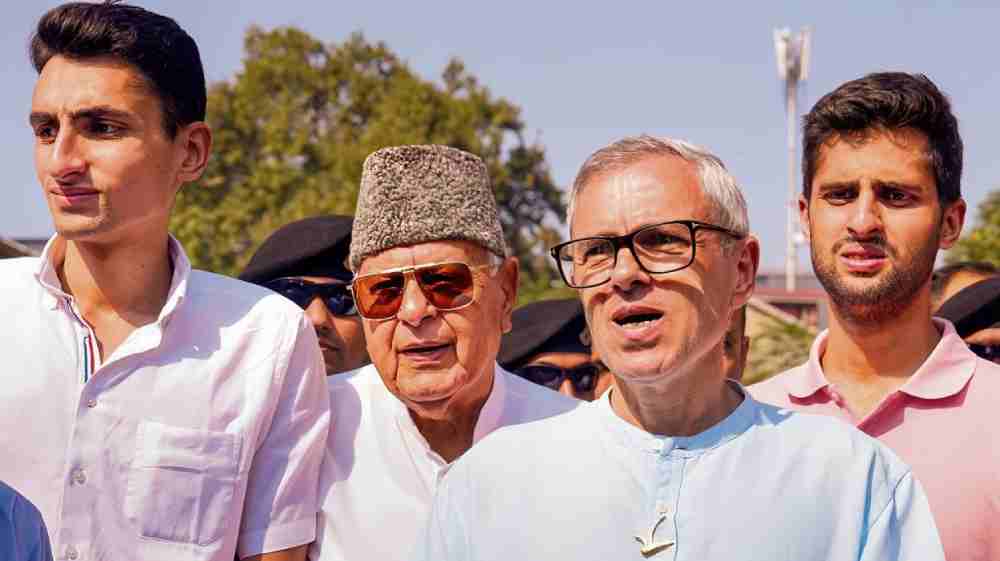
From Srinagar to Tangmarg, the growing visibility of Zahir and Zamir Abdullah has revived questions about dynastic politics, political inheritance and the future leadership of the National Conference. But is a succession plan actually taking shape?
By: Javid Amin | 12 November 2026
Srinagar: Is the National Conference quietly preparing its next generation of leadership? Are the Abdullah family’s younger members gradually being introduced to political constituencies that have historically supported the party? And does the reported Tangmarg connection of Zamir Abdullah indicate a possible attempt to establish a political base beyond Srinagar and central Kashmir?
These questions have returned to the centre of political discussion in Jammu and Kashmir following reports linking Zamir Abdullah, younger son of Chief Minister Omar Abdullah, to a residence associated with his late uncle, Dr Mustafa Kamal, in Tangmarg.
The development has attracted attention because the Abdullah family is not simply another political household in Kashmir. Its history is closely connected with the formation, evolution and political fortunes of the National Conference. From Sheikh Mohammad Abdullah to Farooq Abdullah, then Omar Abdullah, the family has occupied the party’s central leadership space for several generations.
Now, with Omar’s sons, Zahir and Zamir, increasingly visible at political events, discussion about a fourth generation has gained momentum.
There is, however, an important distinction between political visibility and an organised succession plan. Both brothers have already participated in election campaigning and party activities. Yet no formal announcement has established either of them as a future party leader, candidate or office-bearer.
The Tangmarg residence story has added another dimension, but its central claim remains insufficiently verified. The political significance of the location is genuine; the suggestion that it represents a planned electoral launch is still speculation.
The larger story, therefore, is not simply about two young members of a political family. It is about how one of Kashmir’s oldest political organisations is negotiating generational change while facing internal dissatisfaction, questions about leadership accountability and growing public scrutiny of dynastic politics.
The Fourth Generation Has Already Entered the Public Political Space
The Abdullah family’s younger generation first attracted substantial political attention during the 2024 Lok Sabha and Assembly election campaigns.
Zahir and Zamir accompanied their father during campaigning, particularly in Ganderbal, where Omar Abdullah contested the Assembly election. Their participation was not limited to appearing alongside the Chief Minister at public functions. Both interacted with party workers and addressed political gatherings.
During a September 2024 campaign programme in Ganderbal, Zamir referred to the family’s historical connection with the constituency, tracing it back to his great-grandfather, Sheikh Mohammad Abdullah. Zahir, meanwhile, spoke about the political and economic concerns facing Jammu and Kashmir.
Their speeches touched on familiar issues in Kashmir politics, including land, employment, local resources and the role of the Union government.
The development attracted national attention. A September 2024 report by The Telegraph described the brothers as the fourth generation of Abdullahs entering the political arena. PTI subsequently reported their participation in campaigning, public meetings and party-related activities.
In November 2024, the two brothers attended Jammu and Kashmir Legislative Assembly proceedings for the first time. They also visited the National Conference’s youth and students’ organisations and interacted with party activists.
These developments are significant because they establish that the fourth generation’s public introduction to politics began well before the latest Tangmarg speculation.
There is also an important qualification. Both brothers were reported to have said they had no immediate plans to enter active politics and wanted to learn first. They are lawyers by profession, and their participation in their father’s campaign did not amount to a formal declaration of political ambition.
That distinction remains relevant in November 2026. Public appearances, speeches and interaction with party workers demonstrate exposure to political activity, but they do not establish an electoral or organisational succession.
Why Tangmarg Has Become Politically Significant
The Tangmarg connection is rooted in the political history of Dr Mustafa Kamal, younger brother of National Conference president Farooq Abdullah and paternal uncle of Omar Abdullah.
Kamal was a trained doctor who maintained a medical practice in Tangmarg even while participating in politics. His relationship with the area extended beyond electoral calculations. He lived there, worked among local residents and developed a public association with the region.
His political career began in 1983, when he was elected to the erstwhile Jammu and Kashmir Legislative Council. He subsequently contested from the Tangmarg/Gulmarg Assembly constituency in 1987 and returned to the Assembly in 1996.
He served in Farooq Abdullah’s governments and remained associated with the National Conference for decades. He also contested from Pattan and Hazratbal in subsequent by-elections.
Dr Kamal died in July 2026 at the age of 84. His death marked the end of a long political career and the loss of a senior figure in the Abdullah family and the National Conference.
The significance of the reported Tangmarg residence lies in this history. A younger member of the Abdullah family establishing a connection with a place associated with Mustafa Kamal could naturally generate political interest.
But there is a crucial difference between a family connection and an electoral strategy.
The report discussing Zamir’s possible move does not provide independently verified evidence that the property has been formally transferred to him, that he has begun constituency-level political activity there or that the National Conference has decided to position him for a future election.
Until those details are confirmed, the Tangmarg connection should be treated as a reported development with potential political significance, not proof of a planned succession.
Srinagar and Tangmarg: Two Political Bases or One Family Narrative?
The suggestion that one Abdullah heir is emerging from Srinagar while another is being positioned in Tangmarg makes for an interesting political narrative. However, the available reporting does not establish two separate political bases for Zahir and Zamir.
Both brothers were publicly associated with their father’s campaign in Ganderbal in 2024. Both addressed party workers, participated in political outreach and appeared at party-related activities.
The available evidence does not establish that Zahir has been assigned a Srinagar constituency or that Zamir has been selected for Tangmarg or Gulmarg.
This distinction is particularly important because a political base cannot be established merely through a residential address or family association. It normally requires sustained contact with local party workers, participation in public programmes, engagement with constituency-level problems and, eventually, an electoral mandate.
Srinagar, Ganderbal, Beerwah and Gulmarg also have different political histories and electoral dynamics. A family connection to one area does not automatically create a viable political constituency.
The Abdullah family has historically drawn support from several parts of the Valley, but contemporary electoral politics is more competitive. Voters have access to multiple political platforms, and local representatives have their own networks and influence.
Any attempt by a younger Abdullah to enter a constituency would therefore involve more than inheriting a familiar surname.
Beerwah, Ganderbal and Gulmarg: The Electoral Geography Behind the Speculation
Three constituencies are particularly relevant to the present discussion.
Ganderbal has a long association with the Abdullah family. Sheikh Mohammad Abdullah began his political journey in the area, and the constituency has remained an important part of the family’s political history. Omar Abdullah contested and won the seat in the 2024 Assembly election.
Beerwah is associated with Omar Abdullah’s electoral career as well. He represented the constituency after winning the 2014 Assembly election. However, the 2024 election produced a different result, with National Conference candidate Shafi Ahmad Wani winning the seat. That makes any discussion about a future Abdullah family entry into Beerwah a matter of political choice and local acceptance, not an automatic transfer of an existing family seat.
Gulmarg, formerly known as Tangmarg in the Assembly constituency’s earlier nomenclature, carries the political legacy of Dr Mustafa Kamal. His electoral history and long association with the area explain why the reported residence has attracted attention.
The 2022 delimitation exercise changed the constituency map and nomenclature, making Gulmarg the relevant current Assembly constituency name. Tangmarg remains an important geographical reference, but political discussions about contesting the seat should use the present constituency designation.
The distinction is more than technical. It helps separate the emotional and historical significance of a family residence from the practical question of electoral representation.
If Zamir eventually considers politics in the region, he would have to establish his own relationship with Gulmarg’s voters and party organisation. Mustafa Kamal’s legacy may provide familiarity, but it cannot substitute for local political work.
The National Conference Is Facing Its Own Leadership Test
The timing of the succession discussion is particularly interesting because the National Conference is simultaneously dealing with internal questions about power, representation and leadership accountability.
The October 27 cabinet expansion triggered dissatisfaction among several party legislators who felt overlooked. Reports indicated that 18 legislators had met to discuss their concerns, including the distribution of ministerial positions, the influence of the Chief Minister’s close advisers and the implementation of electoral commitments.
The dispute went beyond the allocation of cabinet berths. Some legislators reportedly sought greater consultation in decision-making, a review of ministerial performance and a stronger role for elected representatives within the party.
The issue subsequently reached the Abdullah family’s Gupkar residence, where Farooq and Omar Abdullah met legislators who had raised concerns.
Following the November 6 meeting, Farooq Abdullah acknowledged that the legislators had raised genuine issues and said some concerns would be addressed immediately while others would be considered later. He also rejected suggestions that the National Conference was heading towards a split.
These developments reveal an important organisational challenge.
The party’s leadership is not dealing only with opposition criticism. It is also managing expectations among its own elected representatives, several of whom have political ambitions and established constituencies.
Introducing another member of the Abdullah family into the organisational structure without a clearly defined role could become an additional subject of debate.
The issue is not whether the family has the right to participate in politics. It does. The question is how the party will balance family continuity with the aspirations of senior legislators, emerging grassroots leaders and its wider cadre.
A fourth-generation transition, if it eventually takes place, would unfold within this organisational environment.
The Long Abdullah Political Succession
To understand why the current discussion carries such weight, it is necessary to look at the history of leadership within the National Conference.
Sheikh Mohammad Abdullah: The founder
Sheikh Mohammad Abdullah emerged as one of the most influential political figures in Jammu and Kashmir during the pre-independence period. He led the political movement that evolved into the National Conference and became a central figure in the region’s post-1947 political history.
His political authority, popular mobilisation and relationship with the people of Kashmir gave the party a foundation that continued long after his death.
Farooq Abdullah: The second generation
Following Sheikh Abdullah’s death in 1982, Farooq Abdullah became the central political figure in the family and succeeded him as Chief Minister.
His leadership was tested by political instability, changes in the relationship with New Delhi and the challenges of governing Jammu and Kashmir during difficult periods.
Farooq eventually became the most recognisable face of the National Conference and continued to lead the organisation across several political cycles.
Omar Abdullah: The third generation
Omar Abdullah’s political rise became more visible after he entered electoral politics in 1998. He served as a Union minister and later became Chief Minister in 2009.
In 2002, Farooq Abdullah announced that Omar would take over the party presidency. Omar subsequently became the National Conference’s president, marking a formal generational transition within the organisation.
That transition is an important historical comparison because it involved an identifiable organisational decision, not merely public speculation.
Omar later returned to a central leadership role as the party’s vice-president while Farooq continued as president.
Zahir and Zamir: The fourth generation
The public introduction of Zahir and Zamir began more visibly during the 2024 election campaign.
Their speeches and participation in party activities brought the family’s fourth generation into public view. Their legal backgrounds may also provide a professional foundation for understanding constitutional and governance issues.
However, neither brother has been formally announced as a successor to Omar or assigned a senior organisational responsibility in the party through the developments examined here.
The fourth generation is therefore visible, but the next formal leadership transition remains unannounced.
Dynastic Politics: The Debate the National Conference Cannot Escape
The question of dynastic politics is not new to Jammu and Kashmir. The Abdullah family has faced criticism from political opponents for decades over the concentration of leadership within one family.
The National Conference, however, is not the only party in the region where family members have entered politics.
The Peoples Democratic Party has also experienced generational succession, with Iltija Mufti taking a prominent political role under the leadership of her mother, Mehbooba Mufti.
Other political organisations across India have similar histories, reflecting a wider pattern in which family connections often provide an initial platform for political entry.
Supporters of political families argue that public life should remain open to everyone, including the children of elected representatives. They maintain that a surname does not automatically make someone incapable of public service and that the final judgment belongs to voters.
Critics make a different argument. They contend that inherited political networks, access to senior leaders, media visibility and organisational influence can give family members advantages that ordinary party workers do not enjoy.
This is the central democratic question.
The issue is not whether Zahir or Zamir should be prevented from entering politics. It is whether they would receive the same opportunities, scrutiny and expectations as other aspiring leaders—and whether the National Conference’s organisational processes would allow capable non-family leaders to rise on equal terms.
The party’s ability to answer that question will shape how the next generation is received.
Why the Next Generation Will Face a Different Political Environment
The political environment in which Zahir and Zamir may eventually enter public life is very different from the one in which Sheikh Abdullah and Farooq Abdullah built their political careers.
Today’s voters are dealing with questions of employment, recruitment transparency, public services, economic opportunities, infrastructure, reservation policy and the restoration of statehood.
The constitutional changes of August 2019 have also transformed the political framework within which the National Conference operates. Jammu and Kashmir remains a Union Territory, and the demand for restoration of statehood and the political rights associated with the pre-2019 arrangement remains a central issue.
A younger political leader will therefore face expectations that extend beyond family history and party loyalty.
Voters are likely to ask practical questions:
- What is the leader’s position on restoration of statehood?
- What concrete approach will they take towards the demand for restoration of Article 370?
- How will they address unemployment and recruitment concerns?
- What will they do to improve transparency in government decisions?
- Can they build an independent relationship with voters rather than depend entirely on the family network?
- Will they defend grassroots workers and local representatives within the party?
These are the issues that will determine whether a younger Abdullah becomes a credible political figure in his own right.
The family name may attract attention. It will not automatically answer these questions.
What Would Prove That a Succession Plan Is Underway?
The distinction between political speculation and an actual leadership transition can be tested through identifiable developments.
A formal party position: An appointment to the National Conference’s organisational structure would be a clear indication of greater political involvement.
Regular constituency engagement: Sustained activity in Srinagar, Ganderbal, Beerwah or Gulmarg would indicate an effort to build a local political base.
Public policy positioning: Consistent statements and participation in political programmes on employment, statehood, Article 370 and governance would demonstrate a more defined political identity.
Acceptance within the organisation: Support from party workers, senior legislators and local organisational units would be important in determining whether the younger generation can establish a role beyond family recognition.
An electoral announcement: A decision to contest an Assembly or parliamentary election would provide the clearest evidence of an active political launch.
At present, the available reporting does not establish that these steps have been completed for either Zahir or Zamir.
The Bigger Question: Can the National Conference Renew Itself Without Remaining a Family-Centred Party?
The National Conference is at an important stage in its political history. It remains one of the Valley’s most established political organisations, but its recent internal disagreements show that electoral success does not eliminate organisational tensions.
The cabinet expansion controversy, dissatisfaction among legislators and the public break with the party by former Srinagar MP Aga Syed Ruhullah Mehdi have added to the questions surrounding its future direction.
In this environment, generational renewal could become a significant organisational issue.
A younger leadership may help the party connect with voters who have different expectations from those of earlier generations. It may also bring fresh professional experience, new communication methods and a different approach to public engagement.
But generational renewal cannot simply mean replacing one family member with another.
A sustainable political organisation requires opportunities for leaders from different regions, social backgrounds and professional experiences. It also needs internal consultation, organisational accountability and a clear process through which leadership responsibilities are earned.
If the National Conference eventually introduces Zahir or Zamir into formal leadership, the party will face questions about whether the move represents a genuine expansion of its political talent or the continuation of an established family tradition.
The answer will depend less on where either brother lives and more on the role they are given, the work they undertake and the manner in which the organisation makes that decision.
Conclusion: A Fourth Generation Is Visible, but the Succession Is Not Yet Established
The Abdullah family’s fourth generation has already entered public political life. Zahir and Zamir’s participation in the 2024 election campaign, their speeches in Ganderbal and their interaction with National Conference workers are documented developments.
The reported Tangmarg connection has added fresh interest because of Dr Mustafa Kamal’s long association with the region. It has revived discussion about whether the family may seek to maintain a political presence in more than one part of the Valley.
But there is no verified announcement that Zamir has been assigned Tangmarg or Gulmarg as a political base, nor is there evidence of a formal succession arrangement involving the two brothers.
The more consequential question is whether the National Conference can combine the continuity offered by its historic leadership with genuine organisational renewal.
For a party built around a powerful political legacy, that challenge is not insignificant. Its future will depend not only on who carries the Abdullah surname, but also on whether the next generation can earn political credibility, accommodate internal dissent and respond to the demands of a changing electorate.
The fourth generation may be preparing to take a more visible place in Kashmir’s political landscape. Whether it inherits leadership or earns it remains an open question.


