CJP Protest Escalates Into National Crisis Over Electoral Rolls, Police Action and Civil Liberties
By: Javid Amin | Delhi | 10 October 2026
Delhi remained on heightened security alert on Sunday as the Cockroach Janta Party (CJP) renewed its call for a protest at Jantar Mantar, a day after police action against a planned demonstration demanding the resignation of Chief Election Commissioner Gyanesh Kumar triggered a wider political controversy.
The confrontation, which began with allegations of irregularities in the Special Intensive Revision (SIR) of electoral rolls, has rapidly expanded into a national debate over electoral transparency, police powers, freedom of assembly and the limits of restrictions imposed in the name of public order.
Extensive security deployment, barricades, traffic diversions, restrictions affecting public movement and reports of thousands of detentions have placed the handling of the protest under scrutiny. Meanwhile, the CJP has indicated that it intends to continue its campaign, leaving authorities preparing for another possible mobilisation in the national capital.
The dispute now involves several questions that extend beyond one political organisation or one protest venue. How should allegations of wrongful voter deletion be investigated? What safeguards protect citizens during an electoral-roll revision? How far can police go to prevent an unauthorised gathering? And when security measures affect people who are not participating in a demonstration, how should their necessity and proportionality be assessed?
The answers will determine whether the episode remains a short-lived confrontation between protesters and police or develops into a longer political and legal dispute over the functioning of democratic institutions.
Delhi’s security operation transforms the capital’s political landscape
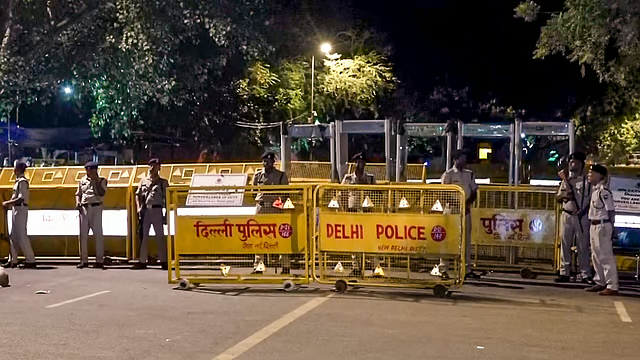
The preparations for the October 10 demonstration involved a substantial security deployment across central Delhi. Police denied permission for the proposed gathering at Jantar Mantar, citing concerns including short notice, law-and-order considerations and alleged non-compliance with conditions during previous demonstrations.
Authorities subsequently deployed personnel, established barricades and prepared interception points to prevent protesters from converging on the proposed venue. Reports described security arrangements extending beyond Jantar Mantar to important roads, transport hubs and locations through which demonstrators were expected to travel.
The scale of the operation prompted comparisons with a lockdown, although the phrase is best understood as a description of the restrictive atmosphere rather than evidence that Delhi was placed under a formally declared citywide lockdown.
The distinction is important. A city may experience intensive security arrangements around a sensitive event without being subject to a blanket shutdown. At the same time, restrictions can have a much wider impact when they affect access to public transport, roads, workplaces and major administrative areas.
Reports of Metro access restrictions, traffic diversions and intensified vehicle checks added to the disruption. Central Delhi corridors around Connaught Place, Janpath, Patel Chowk and Mandi House were among the areas affected by traffic-management measures. Commuters and visitors faced uncertainty about routes, travel times and access to certain locations.
The consequences extended beyond those intending to attend the demonstration. Workers travelling to offices, residents moving through central Delhi, visitors reaching government offices and passengers heading to transport terminals could all be affected by the security arrangements.
This is one of the central challenges in managing major demonstrations in a densely populated capital. Authorities must account for the possibility of crowd surges, clashes, obstruction of emergency routes and disruption around important public institutions. But the broader the restrictions become, the greater the need to explain why particular measures are necessary and how long they will remain in place.
A security plan is not assessed solely by the number of personnel deployed or the number of gatherings prevented. Its effectiveness must also be measured by whether it protects the public while minimising unnecessary disruption to ordinary life.
Why Jantar Mantar became the centre of the confrontation
Jantar Mantar has long served as an important venue for political demonstrations, public campaigns and civil-society gatherings in Delhi. Its location near the national capital’s administrative and political centres makes it a natural focal point for organisations seeking to draw attention to their demands.
However, demonstrations at designated venues remain subject to applicable permissions, conditions and public-order requirements. Police authorities may impose restrictions based on security assessments, expected attendance, traffic considerations and the potential for disruption.
The central dispute in the CJP episode is therefore not simply whether a protest was allowed at a particular location. It concerns how authorities exercise their powers when a proposed demonstration targets a politically sensitive issue and a constitutional institution.
The refusal of permission does not, by itself, establish that the organisers intended to engage in unlawful activity. Equally, the political importance of a cause does not automatically exempt a gathering from reasonable and lawful restrictions.
The relevant questions include whether the grounds for refusing permission were clearly communicated, whether the decision was supported by specific security concerns, whether less restrictive alternatives were considered and whether individuals who were not violating any law were unnecessarily caught up in the operation.
These questions are especially significant when a protest concerns electoral credibility. A campaign challenging the conduct of an election authority can generate strong political emotions because it touches the foundation of representative government. Authorities must therefore manage security risks while ensuring that the response does not unnecessarily deepen mistrust.
Mass detentions become the most controversial part of the operation
The number of people detained during the security operation has become one of the most disputed elements of the story.
Different media reports have cited figures ranging from approximately 2,000 to nearly 7,000 people detained across Delhi. Other reports have referred to several thousand people being released after being held under police powers.
These figures should not be combined into a single definitive total without a clear explanation of the time period, locations covered and categories counted. Some estimates may refer to people detained at particular locations, while others may include a broader operation across multiple police districts. The final number of unique individuals detained requires confirmation from a consistent and authoritative record.
Nevertheless, the scale reflected in the reporting indicates that the police operation reached well beyond a small group of demonstrators gathered at Jantar Mantar.
Reports described people being intercepted at railway stations, the airport, hotels, roads and other locations around the capital. Students, activists, lawyers, journalists, political workers and social-media personalities were among those reported to have been detained.
CJP founder Abhijeet Dipke and co-convenors Saurav Das and Ashutosh Ranka were reported to have been detained after arriving in Delhi. YouTuber Dhruv Rathee was also reported to have been detained in Gurugram ahead of the protest.
The precise circumstances and legal status of each individual need to be assessed separately. Being detained does not necessarily mean that a person has been formally arrested, charged with an offence or found guilty of wrongdoing.
Preventive detention or custody under police powers may be used in particular circumstances to prevent an anticipated breach of peace or manage a public-order situation. Such powers, however, remain subject to legal limits and applicable safeguards.
For each detention, important questions include the legal provision invoked, the reasons communicated to the person concerned, the duration of custody, access to legal assistance and whether any formal case or subsequent proceeding followed.
The distinction between preventing a potential disturbance and punishing a person for political participation is fundamental. Preventive action must be based on lawful grounds and cannot simply be treated as proof that the person detained has committed an offence.
The operation has consequently generated demands for greater clarity about who was detained, where they were taken, how long they were held and whether all those detained were released.
A transparent account of these details would help establish the scale of the operation and allow the legality of individual cases to be assessed on their merits.
The underlying dispute: What is the Special Intensive Revision of electoral rolls?
At the heart of the confrontation is the Special Intensive Revision, commonly known as SIR, a process intended to examine and update electoral rolls.
An electoral roll is the official list of people eligible to vote in a particular constituency. Its accuracy is essential to the conduct of free and credible elections. A voter who is wrongly excluded may be prevented from exercising a basic democratic right, while a list containing duplicate or ineligible entries can undermine confidence in election administration.
Electoral-roll revision is therefore a necessary administrative function. But the process must be accurate, transparent and accessible to eligible voters, particularly when changes affect large populations.
A revision may involve checking whether registered voters remain eligible, identifying duplicate entries, updating records after deaths or changes of residence and correcting inaccurate personal information. These tasks can become complex when people migrate for employment, study or family reasons, or when official records contain spelling errors, inconsistent addresses or outdated details.
The challenge is to distinguish legitimate corrections from wrongful exclusions.
For example, a person who has moved temporarily for work may still be eligible to vote at the appropriate registered location, depending on the applicable rules. A mismatch between documents may require verification rather than automatic exclusion. Similarly, an entry flagged for review should not be assumed to represent fraud until the facts have been examined.
The quality of the process depends not only on the final voter list but also on the procedures used to prepare it. Citizens must be able to understand why an entry has been changed, how to check their status and what steps are available to correct an error.
This is where the controversy surrounding SIR becomes politically significant. If large numbers of names are removed or placed under scrutiny without clear public explanations, concerns about disenfranchisement can grow—even where some changes are legitimate.
Conversely, a deletion figure alone cannot establish that eligible voters have been unlawfully excluded. The reasons for the changes, the eligibility of affected individuals and the functioning of correction procedures must be examined before a conclusion can be reached.
Voter deletion allegations require evidence, not just competing claims
The dispute has included references to approximately 130 million names removed from electoral rolls. Such a large figure demands careful interpretation rather than an automatic conclusion about the scale of wrongful disenfranchisement.
A total number of deleted entries does not necessarily equal the number of eligible voters who have lost their voting rights. The figure may include different categories of changes, and its meaning depends on the geographical scope, period covered and methodology used to compile it.
The decisive questions are more specific.
How many deleted entries belonged to people who remained eligible to vote? What reasons were recorded for removing them? Were the prescribed verification procedures followed? Were affected citizens informed? Could they challenge a decision or restore an incorrectly removed entry? Were complaints resolved before the relevant electoral deadline?
Answers to these questions are essential to determine whether the revision process has produced wrongful exclusions and, if so, how extensive the problem may be.
The Election Commission and the ruling BJP have rejected allegations of deliberate electoral manipulation. The CJP and opposition voices have demanded accountability and raised concerns about the possible deletion of eligible voters.
These positions must be distinguished from established findings. An allegation is not proof of wrongdoing, just as an official denial does not by itself resolve every complaint.
The credibility of the process depends on the availability of verifiable information. Detailed deletion records, clear reasons for changes, accessible voter-status checks and effective correction mechanisms would allow the public to distinguish legitimate administrative revisions from errors that require remedial action.
Independent scrutiny can also help prevent the issue from becoming trapped in a cycle of accusation and denial. When reliable data are available, disputed claims can be tested against evidence rather than political rhetoric.
Ultimately, the measure of a voter-list revision is not simply whether the number of entries has increased or decreased. It is whether the final roll accurately includes eligible citizens and whether anyone wrongly excluded has a practical, timely way to correct the record.
Why CJP is demanding Gyanesh Kumar’s resignation
The CJP has made the resignation of Chief Election Commissioner Gyanesh Kumar a central demand of its campaign. The demand reflects the organisation’s broader allegations concerning electoral-roll revision and its contention that the Election Commission must answer for the disputed process.
Such a demand carries political significance because the Election Commission occupies a critical position in India’s electoral system. It oversees the conduct of elections and is expected to operate independently, apply electoral rules fairly and maintain public confidence in the process.
However, a demand for the resignation of an officeholder is a political position, not a legal finding. Establishing individual or institutional responsibility requires evidence about the decisions taken, the rules applied and the procedures followed.
The wider institutional question is how complaints about election administration should be investigated. If voters believe they have been wrongly removed from the rolls, they need a clear route to challenge the decision. If political parties allege systematic irregularities, those allegations should be capable of being tested against official records and independent evidence.
There is also a distinction between criticising an institution and undermining confidence in the entire electoral system. Democratic accountability requires that election authorities be open to scrutiny, while claims about misconduct should be assessed on evidence.
A credible response would therefore address the substance of the allegations: the number and reasons for deletions, the verification process, the treatment of objections and the safeguards available to voters.
Without such answers, the dispute risks becoming a prolonged political confrontation in which neither side persuades those who do not already agree with it.
From electoral transparency to a broader debate over democratic rights
The police response has increasingly shifted public attention away from the technical details of electoral-roll revision and towards the right to protest.
Opposition figures and activists have criticised the detentions and restrictions, arguing that the measures have curtailed democratic dissent. Authorities, meanwhile, have pointed to public-order considerations and the need to manage a potentially disruptive gathering.
The issue is not whether public order matters. It plainly does. Authorities have responsibilities to prevent violence, protect people and property, maintain emergency access and keep essential services functioning.
But the power to regulate a demonstration must be exercised within the law. Restrictions should be justified by the circumstances and proportionate to the risks being addressed.
This principle becomes particularly important when enforcement extends beyond the proposed protest venue. A person travelling through Delhi, staying in a hotel or arriving at a railway station is not automatically participating in an unlawful gathering. The circumstances of each intervention matter.
Similarly, the fact that a protest has been denied permission does not, on its own, settle whether every subsequent detention was justified. Each case depends on the applicable legal grounds and the facts surrounding the action taken.
The right to peaceful assembly is an important democratic safeguard because it allows citizens to express grievances, organise campaigns and demand accountability. It does not remove all restrictions on public gatherings, but it requires the state to balance legitimate security needs with the protection of lawful expression.
The controversy has therefore raised a broader question: can the authorities prevent a potentially disruptive protest while preserving meaningful space for political dissent?
A clear explanation of restrictions, access to legal remedies and transparent information about detentions would help answer that question. Without those safeguards, even measures introduced for legitimate security reasons can fuel perceptions that peaceful political activity is being treated as a threat in itself.
Transport restrictions and the cost to ordinary Delhi residents
Major security operations in central Delhi affect more than political organisers and police personnel. They can also disrupt the daily routines of residents, workers, traders and visitors.
Traffic diversions may force commuters onto longer routes. Barricades can create bottlenecks at key junctions. Checks at entry points can slow vehicles, while restrictions near Metro stations and other transport hubs can complicate journeys.
The impact is especially significant in a city where many people depend on public transport to reach offices, educational institutions, hospitals and commercial areas. Even a temporary restriction can have wider consequences when it coincides with peak travel hours or affects a major interchange.
Small businesses and street-level commercial activity can also suffer when customers find it difficult to access an area. Delivery workers and app-based transport operators may face delays, route changes and uncertainty about where they can operate.
These effects do not mean that all security restrictions are unjustified. Police may need to control traffic and limit access to particularly sensitive locations. The issue is whether measures are carefully targeted, clearly communicated and reviewed as circumstances change.
Timely traffic advisories, public announcements about station access, clearly marked alternative routes and coordination with transport agencies can reduce unnecessary disruption. Authorities should also distinguish between the areas requiring heightened security and the wider city, where normal activity may be able to continue.
The public should not have to rely solely on social-media rumours to determine whether a route is open or a transport service is operating. Clear, updated information is an important part of responsible crisis management.
UN concern brings international scrutiny to the episode
The controversy has attracted attention beyond India after the United Nations Human Rights Office reportedly expressed concern over mass detentions and emphasised the importance of respecting peaceful assembly rights.
The intervention added an international dimension to a dispute already generating strong domestic political reactions. It also highlighted a broader principle: governments have responsibilities to maintain public order, but their actions remain subject to legal and human-rights standards.
India reportedly pushed back against the UN comments, describing them as unwarranted interference. That response reflects a wider tension often seen when international bodies comment on domestic policing or political disputes.
However, international criticism does not, by itself, establish that every detention or restriction was unlawful. That determination depends on the facts of individual cases, the legal powers used and any relevant judicial findings.
Likewise, describing a matter as domestic does not eliminate the importance of examining how state authorities exercise coercive powers.
The practical questions remain the same: Was there a clear legal basis for the action? Were the measures necessary for the stated purpose? Were they proportionate? Were people able to challenge their detention or the restrictions imposed on them?
Those questions can be addressed through transparent official explanations, independent scrutiny and appropriate legal proceedings.
The international attention also raises the reputational stakes for India. As the world’s largest democracy, the country is regularly judged not only by the conduct of elections but also by the strength of its institutions, the protection of civil liberties and the ability of citizens to challenge government decisions peacefully.
The most effective response to criticism is therefore not simply to exchange political statements, but to make the relevant facts available and demonstrate that legal safeguards are functioning.
Legal scrutiny may become the next stage of the confrontation
With detentions and restrictions at the centre of the dispute, legal challenges could shape the next phase of the controversy.
Potential areas of scrutiny include the refusal of permission for the demonstration, the legal basis for individual detentions, the duration and conditions of custody, and the scope of restrictions imposed on movement and public assembly.
Any legal challenge would need to be assessed on its specific pleadings, evidence and applicable law. The existence of a petition or a reported plan to approach a court should not be described as proof that a restriction has already been declared unlawful.
The legal distinction between preventive action and formal arrest is particularly important. Authorities may exercise preventive powers in defined circumstances, but those powers do not create an unrestricted licence to detain people. Applicable procedures and safeguards continue to matter.
Where a person challenges the legality of a detention, the relevant questions may include whether the authority had the power to act, whether the required procedure was followed and whether the action was justified by the circumstances.
Courts may also be asked to examine whether restrictions on public movement or assembly were legally authorised and proportionate. The outcome will depend on the evidence and arguments presented.
For the organisers, legal proceedings could provide a route to challenge decisions and seek clarity about the status of detained members. For authorities, judicial scrutiny offers an opportunity to demonstrate the legal basis of their actions.
The courts, however, cannot substitute for transparent electoral administration. Even if a dispute over police action is resolved, allegations about voter-list revision will still require their own evidence-based examination.
The two issues are connected politically but distinct legally: one concerns the administration of electoral rolls, while the other concerns the state’s response to protest.
CJP’s fresh protest call puts authorities and organisers under pressure
The CJP has signalled that it intends to continue its mobilisation, with another call for supporters to assemble at Jantar Mantar at 10 am on October 11.
The renewed appeal suggests that the organisation is seeking to keep the electoral-roll controversy in the public spotlight despite the restrictions imposed during the previous day’s operation.
For the CJP, the challenge is to sustain attention on its central demands while ensuring that its campaign remains peaceful and that its claims are supported by evidence. A sustained protest may maintain political pressure, but the campaign’s credibility will also depend on its ability to provide verifiable information about the alleged irregularities.
For the police, Sunday presents another test of crowd management. Authorities must prepare for the possibility of gatherings while ensuring that restrictions remain consistent with the law and are no broader than necessary.
A renewed mobilisation could lead to another confrontation if organisers and police remain unable to agree on the terms under which a gathering can proceed. Alternatively, clear communication, defined boundaries and arrangements that protect both public safety and peaceful expression could help reduce the risk of escalation.
The status of detained organisers also remains a significant concern. Reports about custody and release have not always been consistent, making it important to verify the latest information with official statements and reliable on-ground reporting.
For families, colleagues and supporters, uncertainty about a person’s whereabouts or legal status can intensify anxiety. Clear information about the location of detainees, the legal grounds for custody and the process for contacting them is therefore important in its own right.
The next stage of the protest will reveal whether the confrontation continues to centre on physical access to Jantar Mantar or begins to shift towards negotiations, legal proceedings and a more detailed examination of the electoral-roll allegations.
Political fallout: opposition unity, government credibility and institutional trust
The CJP episode presents different political challenges for the opposition, the government and the Election Commission.
For opposition groups, the detentions and restrictions provide a rallying point around civil liberties and electoral accountability. The issue may help bring together organisations that otherwise differ over political strategy or policy.
But unity around a protest does not necessarily imply agreement on every aspect of electoral reform or the remedies required. Opposition parties will need to explain what evidence they believe establishes wrongdoing and what institutional changes they are seeking.
For the government, the immediate responsibility is to maintain public order and ensure that essential services function. The longer-term challenge is to prevent security measures from becoming a substitute for answering questions about electoral administration.
For the Election Commission, the dispute underscores the importance of public confidence. Electoral institutions depend not only on formal authority but also on the belief that procedures are fair, decisions are explainable and eligible voters can exercise their rights.
An institution can face criticism without every allegation being correct. But where doubts arise over a large-scale administrative exercise, transparent information and accessible remedies are essential to restoring trust.
The political consequences will also depend on how the issue develops beyond the protest itself. If reliable evidence establishes wrongful exclusions, authorities will face pressure to correct them and explain how similar errors will be prevented. If particular allegations prove unsupported, the evidence should be made clear so that public debate can move beyond speculation.
The credibility of all sides will depend on whether they engage with verifiable facts rather than treating every development as confirmation of their existing position.
What a credible resolution would require
The confrontation has created an opportunity to separate the underlying electoral questions from the immediate dispute over policing. Resolving both requires practical steps rather than competing declarations alone.
First, clarify the scale and legal status of the detentions. Authorities should provide accurate information, where legally appropriate, about the number of people detained, the grounds for custody, the status of those still held and whether cases have been registered. The figures should be presented in a way that avoids double counting and distinguishes detention from formal arrest.
Second, make electoral-roll changes easier to verify. Voters need accessible ways to check their registration, understand why an entry has been changed and submit corrections or objections. The revision process should provide clear information about the relevant deadlines and the documents or procedures required.
Third, investigate specific allegations. Claims of wrongful deletion should be assessed through individual cases and reliable data. If errors are found, they should be corrected promptly. If a broader pattern emerges, the responsible authorities should explain the cause and the remedial action being taken.
Fourth, ensure that protest restrictions are legally grounded and proportionate. Where authorities deny permission or impose conditions, clear reasons and practical information about alternatives can reduce uncertainty. Security arrangements should be reviewed as risks change, rather than continuing automatically after the immediate threat has passed.
Fifth, protect access to legal remedies. People detained during a public-order operation must be able to establish their legal status and challenge unlawful action through the appropriate channels. Organisers and authorities alike benefit when procedures are clear and disputes can be examined independently.
These measures would not guarantee agreement between the CJP and the authorities. Political disagreements may persist. But they would help shift the controversy from competing narratives towards evidence, accountability and workable remedies.
The bigger question: Can public order and democratic dissent coexist?
Delhi’s CJP confrontation is no longer just a dispute over permission to hold a demonstration. It has become a wider test of how electoral accountability, public order and civil liberties interact in a functioning democracy.
The CJP wants the resignation of the Chief Election Commissioner and answers to allegations surrounding the revision of electoral rolls. Authorities have focused on preventing disruption and maintaining security in the capital. Opposition voices have questioned whether the response has been proportionate, while international scrutiny has added pressure for clarity about the treatment of protesters.
Each of these issues requires a separate but connected assessment. Electoral-roll allegations must be established or disproved through reliable evidence. Police actions must be judged against the law and the circumstances of individual cases. Restrictions on assembly must be justified by legitimate public-order needs and applied proportionately.
The coming days may see the dispute move between protest sites, courtrooms, political forums and public debate. The eventual outcome will depend less on the number of barricades erected or demonstrators prevented from assembling than on whether the questions at the heart of the controversy receive credible answers.
For the CJP, that means presenting evidence and sustaining a peaceful campaign. For the authorities, it means explaining the security operation and ensuring that legal safeguards remain effective. For the Election Commission, it means making the electoral-roll process sufficiently transparent for legitimate concerns to be examined.
A democracy cannot eliminate disagreement, nor should it attempt to do so. Its institutions are tested by how they respond when citizens question their decisions.
Delhi’s latest confrontation has made that test immediate. Whether the episode deepens political mistrust or leads to greater scrutiny and accountability will depend on what happens next—and on whether evidence and due process are allowed to carry more weight than confrontation alone.


