‘Welcome to New Delhi, Modelled on New J&K’: Omar Abdullah Slams Internet Curbs Ahead of CJP Protest
A 24-hour mobile internet suspension in parts of central Delhi has reignited debate over security restrictions, freedom of protest and the use of measures long associated with Kashmir. The Supreme Court has separately urged authorities to avoid a complete shutdown of public transport.
By: Javid Amin | Srinagar/New Delhi, October 10, 2026
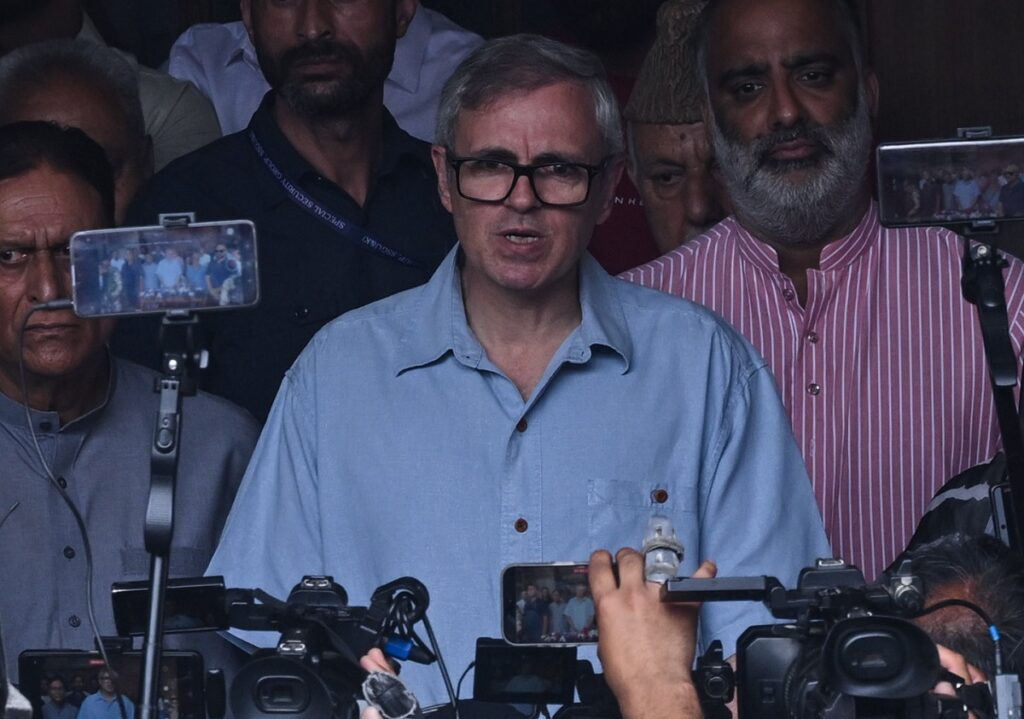
Jammu and Kashmir Chief Minister Omar Abdullah has criticised the suspension of mobile internet services in parts of New Delhi ahead of a planned protest by the Cockroach Janta Party (CJP), saying the restrictions reflect a model of security governance that has long been associated with Jammu and Kashmir.
“Kashmir model has been exported to Delhi. Welcome to the New Delhi, modelled on the New Jammu & Kashmir,” Abdullah wrote on X on October 9, responding to the announcement of a temporary mobile internet shutdown in central Delhi.
The remark brought a familiar Kashmir-related debate into the heart of the national capital, where authorities introduced extensive security measures ahead of the CJP’s proposed demonstration at Jantar Mantar. The protesters are demanding the resignation of Chief Election Commissioner Gyanesh Kumar over allegations surrounding the revision of electoral rolls.
The controversy now extends beyond the protest itself. It has raised questions about how governments balance public safety with freedom of assembly, access to information and the daily needs of ordinary citizens.
What triggered Omar Abdullah’s ‘Kashmir model’ remark?
The immediate trigger was an order authorising the suspension of mobile internet services within a four-kilometre radius of the Janpath–Kartavya Path crossing in central Delhi.
According to reports published on October 9, the restriction was scheduled to run from 10 pm on October 9 until 10 pm on October 10, covering a 24-hour period around the planned protest.
The order applied to mobile internet services across technologies and directed telecom operators, including Airtel, Jio, Vodafone Idea and MTNL, to implement the suspension. Reports said the measure was authorised by the Union Home Secretary under the applicable telecommunications framework.
The restricted zone covers a sensitive part of the capital, where government buildings, major roads and protest-related locations sit within a heavily secured area. Authorities were preparing for a demonstration that could attract activists, students, political supporters and opposition leaders.
The suspension was not a citywide internet shutdown. It was a geographically defined restriction on mobile internet in central Delhi for a specified period.
That distinction matters when assessing the measure. At the same time, even a geographically limited shutdown can affect residents, workers, visitors and commuters who depend on mobile connectivity for navigation, payments, communication and access to news.
Why Kashmir is central to the political debate
Internet restrictions have been a recurring feature of the security landscape in Jammu and Kashmir, particularly during periods of tension, protests and major political developments.
Authorities have historically defended such measures on grounds including preventing the spread of rumours, limiting the mobilisation of crowds and countering potential security threats. Critics, however, have argued that prolonged or repeated shutdowns can restrict access to information, disrupt livelihoods, affect education and healthcare, and make it harder for people to communicate during emergencies.
Abdullah’s reference to a “Kashmir model” draws on that history. His statement suggests that measures associated with the region’s security environment are now being used in the national capital during a politically sensitive protest.
It is a political criticism, rather than a formal finding that the two situations are identical. The security context, scale, duration and legal basis of restrictions can differ from one incident to another. Nevertheless, the comparison has become part of the broader debate over how governments respond to public demonstrations.
For Kashmiris, internet access has particular significance because connectivity restrictions have affected daily life and economic activity across the region at different times. For businesses, students, journalists and families, mobile internet is not simply a social convenience; it is an important means of accessing services and staying connected.
The Delhi restrictions have therefore revived a wider question: should internet shutdowns be used as a routine preventive measure during protests, or should authorities demonstrate why less restrictive options would not be sufficient?
Iltija Mufti also draws parallels with Kashmir
PDP leader Iltija Mufti joined the criticism, drawing a parallel between the restrictions in Delhi and the way protests have been handled in Jammu and Kashmir.
“What started in Kashmir is now engulfing India,” she said, according to reports.
Mufti also alleged that political groups were being treated differently in relation to access to Jantar Mantar, contrasting the restrictions facing CJP protesters with what she described as favourable treatment for BJP supporters during political events connected with the abrogation of Article 370.
These statements represent the leaders’ political assessments of the situation. They raise questions about consistency in the enforcement of protest rules, but the allegations of unequal treatment need to be assessed against the specific permissions, police orders and circumstances of the events being compared.
The underlying issue is significant: restrictions on demonstrations are more likely to attract public scrutiny when political actors believe that similar rules are not being applied consistently.
The comparison also connects the immediate controversy in Delhi with long-running disagreements in Jammu and Kashmir over the handling of demonstrations, political expression and public gatherings.
CJP protest puts Election Commission under renewed scrutiny
The CJP demonstration was called to demand the resignation of Chief Election Commissioner Gyanesh Kumar. The protest is linked to concerns about the Special Intensive Revision (SIR) of electoral rolls and allegations that voter-list changes could disadvantage sections of the electorate.
The CJP and its supporters have demanded accountability over the revision process. Opposition figures have also questioned aspects of the Election Commission’s conduct and raised concerns about the integrity of electoral procedures.
The allegations remain contested. The BJP and the Election Commission have rejected claims of electoral manipulation, and the existence of disputes over voter-list revisions does not, by itself, establish that deletions were unlawful or politically directed.
A central issue is whether electoral-roll changes are being carried out transparently, with adequate safeguards for eligible voters and meaningful opportunities to challenge errors.
Electoral rolls must be accurate: ineligible entries should be addressed, while eligible citizens must not lose their voting rights because of administrative mistakes or inadequate verification. The credibility of any revision exercise depends on transparent procedures, clear explanations for changes and accessible mechanisms for appeal.
For Abdullah, the dispute is connected to a broader concern about electoral fairness. Speaking to reporters in Delhi, he reiterated his criticism of the voter-list changes and questioned how democratic legitimacy could be maintained if elections were not fair. He also linked his concerns to earlier disputes over delimitation in Jammu and Kashmir.
These are political claims that require examination through official records, legal procedures and verifiable evidence. The relevant institutions, in turn, face the task of explaining their decisions in a way that maintains public confidence.
Police cite security concerns; protest permission denied
Delhi Police denied permission for the planned CJP protest, citing procedural issues, law-and-order concerns and the potential impact on traffic and security arrangements.
Authorities prepared an extensive deployment ahead of the October 10 demonstration. Media reports differed on the precise number of personnel involved, with estimates ranging from more than 20,000 to substantially higher figures, depending on the report and the area included in the count.
The security plan also involved restrictions around key locations and changes affecting transport. Officials were preparing for a gathering that could draw a sizeable crowd despite the denial of permission.
From the authorities’ perspective, preventive steps are intended to reduce the risk of violence, overcrowding and disruption around important government areas. The challenge is to ensure that security planning remains targeted and proportionate rather than placing unnecessary burdens on the wider public.
A protest’s lack of police permission does not, on its own, resolve the broader questions about the right to peaceful assembly or the proportionality of every restriction imposed in response. Those questions depend on the applicable law, the facts and the specific orders in force.
The controversy has become more pronounced because the restrictions affected people beyond those intending to attend the protest.
Supreme Court questions sweeping restrictions on transport
The security arrangements also prompted scrutiny from the Supreme Court of India.
On October 9, a bench led by Chief Justice of India Surya Kant, with Justices Joymalya Bagchi and V. Mohana, questioned restrictions affecting Metro and railway services ahead of the protest.
The court made clear that public transport should not be subjected to a complete prohibition and asked authorities to ensure services continued in a regulated manner so that ordinary commuters would not face unnecessary hardship.
The bench stressed the need for proportionality in security measures and urged the authorities to consider the wider public impact of closures and cancellations. It also called for appropriate public advisories.
The observations came amid reports that dozens of Metro stations had been closed or had their access restricted and that some train services had been affected. Published reports differed on the number of Metro stations involved, reflecting variations in the measures reported at different points.
The court’s intervention was specifically concerned with transport restrictions. It should not be interpreted as a ruling that the internet suspension was unlawful, nor as a final decision on the merits of the allegations against the Election Commission.
Even so, the proceedings highlighted a related principle: authorities can take security precautions, but the measures should account for the rights and needs of people who are not participating in the demonstration.
Internet shutdowns and the cost to ordinary citizens
The immediate effect of an internet suspension is not limited to political communication. Mobile connectivity is increasingly woven into everyday activities, from digital payments and online work to transport information, access to public services and communication with family members.
For people inside the affected area, a shutdown can complicate routine tasks even if they have no connection to the demonstration. Visitors may struggle to find directions, workers may face difficulties coordinating travel, and small businesses may lose access to digital transactions or customer communications.
The impact can be particularly difficult for people who rely on mobile data as their primary or only means of accessing the internet.
There is also a public-information concern. During a security operation, residents and commuters need reliable updates about transport, road closures, emergency arrangements and changes to restrictions. Limiting connectivity can make it harder for people to obtain that information unless authorities provide effective alternatives.
This does not mean that every temporary shutdown has the same effects or that authorities can never impose one. It means that the necessity, geographical scope, duration and likely consequences of a restriction deserve careful consideration.
A narrowly tailored measure, supported by a clearly articulated security rationale and accompanied by public communication, raises different questions from a broad or prolonged shutdown. Transparency is essential to assessing the difference.
A wider test for protest management in India
The Delhi episode has brought several issues into the same debate: the freedom to protest, public safety, access to digital communication, the smooth functioning of transport and trust in electoral institutions.
The government and police have a responsibility to prevent violence and protect public infrastructure. Protest organisers, meanwhile, have responsibilities concerning peaceful conduct and compliance with lawful directions. These responsibilities do not eliminate the need for authorities to explain the basis and scope of restrictive measures.
The central question is how to preserve public order without imposing avoidable costs on people who are not involved in a demonstration.
This is also why the comparison with Kashmir has resonated politically. Measures once viewed largely through the lens of the region’s security challenges are now being debated in the capital during a protest linked to national electoral institutions.
But comparisons should be made carefully. A single, time-bound restriction in central Delhi cannot automatically be equated with every shutdown imposed in Jammu and Kashmir over the years. The legal orders, duration, geographic coverage, reasons and effects need to be examined individually.
At the same time, the Delhi episode provides an opportunity to scrutinise the broader policy question of when internet restrictions are justified and what safeguards should apply.
What happens next?
The immediate focus is on the implementation of the security plan for the CJP protest and the practical effect of the temporary internet suspension and transport measures.
The restriction announced for mobile internet was scheduled to expire at 10 pm on October 10. Any extension or additional measure would need to be assessed on the basis of further official orders and verified reporting.
The wider political questions are unlikely to end with the protest. Opposition leaders are continuing to raise concerns about electoral-roll revisions and the Election Commission, while the authorities have defended their approach to public order and rejected allegations of manipulation.
For Abdullah, the internet suspension has become a way to connect the Delhi restrictions with the long-running experience of Kashmir. For the government, the immediate justification has centred on security arrangements surrounding a politically sensitive demonstration.
The strength of either argument must ultimately be judged through the relevant evidence, the applicable legal framework and the actual impact of the measures on citizens.
Conclusion: Security, connectivity and the right to dissent
Omar Abdullah’s “Kashmir model” remark has turned a temporary internet restriction into a wider political discussion about the management of dissent in India.
The immediate facts are clear: mobile internet was ordered suspended for 24 hours within a defined area of central Delhi ahead of the CJP protest, police denied permission for the demonstration, and the Supreme Court urged authorities not to impose a complete shutdown of Metro and railway services.
The larger questions are more complex. How much restriction is necessary to manage a protest? What evidence should justify an internet shutdown? How can authorities protect public safety while ensuring that residents, workers and commuters are not unnecessarily affected?
Those questions extend beyond one party, one demonstration or one region. The Delhi episode has placed them at the centre of a debate that Kashmir has known for years: how to balance security with communication, public order with civic freedom, and government authority with the rights of ordinary citizens.