“E-Challans Can’t Operate in Isolation From Law”: Jammu Bar Questions New Digital Traffic Enforcement Regime
By: News Desk | 05 October 2026
Jammu: The debate over traffic enforcement in Jammu and Kashmir has moved from the roadside to the courtroom.
As electronic challans become an increasingly important tool for detecting traffic violations, the Jammu and Kashmir High Court Bar Association, Jammu (JKHCBAJ) has raised a fundamental question: what happens when the technology gets the violation wrong?
The Bar Association is not opposing stricter traffic enforcement or road-safety measures. Its concern is with what happens after an electronic system generates a challan, particularly when the vehicle owner disputes the violation, the driver cannot be clearly identified, the electronic evidence is questionable or the challan itself has been generated incorrectly.
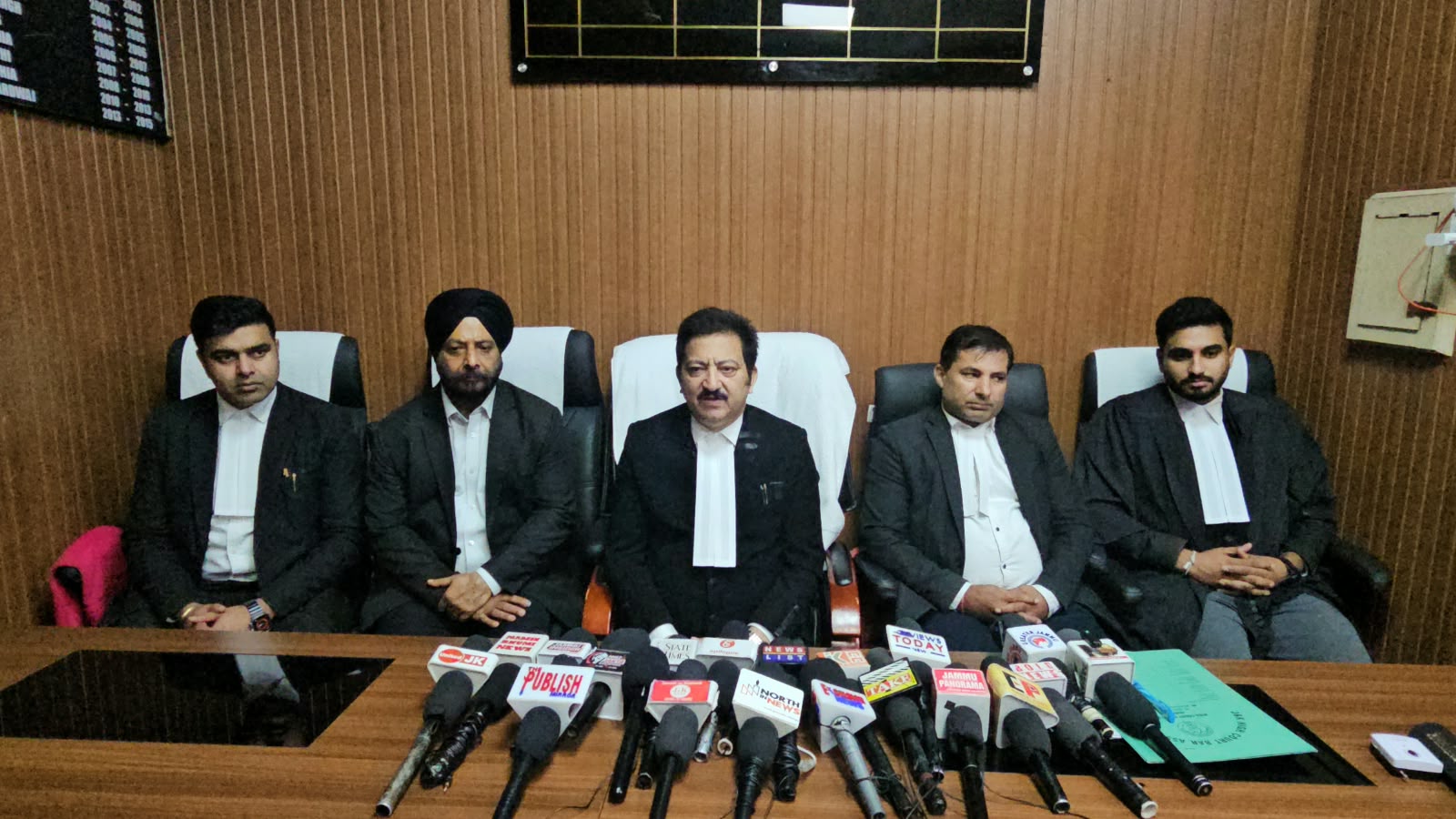
At a press conference in Jammu on October 5, Association president K Nirmal Kotwal, accompanied by office-bearers Baldev Singh, Pardeep Majotra, Anshu Mahajan and Rahul Aggarwal, said technology-driven enforcement must operate alongside transparency, accountability, procedural fairness and safeguards for citizens.
The intervention comes at an especially important moment.
Just days earlier, the Supreme Court directed states and Union Territories to intensify recovery of unpaid e-challans, including measures that can affect vehicle registration, fitness certification, PUC certification, ownership transfers and, in cases involving multiple violations, driving-licence renewal or suspension. The Court was informed that around ₹49,194.05 crore remained recoverable from e-challans issued over time, while approximately ₹26,175.05 crore had already been recovered.
That creates a new reality for motorists.
An e-challan is no longer merely a digital version of a paper fine. Increasingly, it can become the starting point for restrictions on a vehicle and, in certain circumstances, the driver’s licence.
That is precisely why the Jammu Bar’s concerns deserve closer examination.
The Technology Is Not the Dispute. The Process Is.
Electronic enforcement has an obvious attraction.
Cameras, automated number-plate recognition, speed detection systems and other devices can record violations without requiring a traffic officer to physically stop every vehicle. They can improve documentation, reduce discretionary roadside enforcement and create an electronic trail.
J&K has already been using the e-challan framework for years. The Union government’s NIC records show that the J&K e-challan project was launched in January 2019 and was designed to integrate traffic enforcement with vehicle and driving-licence databases.
The newer system therefore represents an expansion and tightening of an existing digital enforcement architecture rather than the sudden arrival of e-challans in Jammu and Kashmir.
The issue now is scale.
When technology detects a violation automatically, the system may know the vehicle, but that does not necessarily mean it knows the driver.
That distinction can become crucial.
A family vehicle may be registered in one person’s name but driven by another. A company vehicle can have multiple drivers. A vehicle may have been sold but the registration transfer may not have been completed. A number plate may be incorrectly read. A camera may capture an unclear image. Or an owner may genuinely dispute whether the vehicle committed the alleged violation.
The Bar Association’s argument is essentially that these possibilities cannot be treated as mere technical inconveniences.
They are questions of legal responsibility.
What Exactly Is the Jammu Bar Worried About?
The Association has called for safeguards where an individual:
- disputes whether the alleged violation actually occurred;
- was not the person driving the vehicle;
- questions the accuracy of electronic evidence;
- believes the challan was generated incorrectly;
- needs to correct an error in the record; or
- wants to challenge the penalty through a meaningful legal mechanism.
The Association says citizens should be able to understand why the challan was issued, what evidence supports it and where they can challenge it. It has also stressed the importance of an accessible review or dispute-resolution mechanism.
This is where the phrase used by the Bar Association becomes important:
“An enforcement mechanism, however technologically advanced, cannot operate in isolation from the fundamental principles of natural justice and due process of law.”
The underlying principle is not new.
Technology can automate the detection of an alleged offence. It does not eliminate the legal requirement to determine what consequences should follow.
The Supreme Court Has Just Made Unpaid Challans Much More Consequential
The timing of the Bar’s intervention is significant.
On September 28, the Supreme Court, in the road-safety case S. Rajaseekaran v. Union of India, directed States and UTs to implement the Ministry of Road Transport and Highways’ electronic-enforcement framework and strengthen recovery of unpaid e-challans.
The Court made clear that simply generating large numbers of electronic penalties is not enough. Authorities also have to recover the fines.
The scale of the problem was laid before the Court.
Authorities were informed that approximately ₹49,194.05 crore remained recoverable from e-challans, while about ₹26,175.05 crore had been recovered.
In other words, roughly ₹23,000 crore remained unrecovered based on the figures recorded in the order.
The Court therefore moved beyond the question of issuing challans and focused on enforcement after issuance.
What Can Happen if an E-Challan Remains Unpaid?
The Supreme Court’s directions are considerably broader than simply telling motorists to pay their fines.
The September 28 order directs authorities to:
- stop renewal of vehicle registration where outstanding amounts remain;
- restrict issuance of duplicate registration certificates;
- withhold certain owner-detail changes;
- deny fitness certificates until outstanding traffic fines are cleared;
- blacklist vehicles with outstanding e-challans on the Parivahan portal;
- block ownership transfers;
- take action affecting driving-licence renewal in cases involving multiple violations;
- take steps toward suspension of an existing licence in applicable cases; and
- conduct random vehicle checks, with directions to take steps to impound vehicles where unpaid e-challans are found.
This is a major shift in practical enforcement.
The unpaid challan can potentially follow the vehicle into its registration, fitness, resale and ownership records.
For a commercial vehicle owner, that can have direct economic consequences.
For an ordinary household, a blocked ownership transfer or registration renewal can turn what may initially have been a relatively small traffic fine into a much larger administrative problem.
But the Supreme Court’s Order Also Recognises the Need for Systemic Safeguards
There is an important part of the Supreme Court order that can easily get lost amid headlines about vehicle seizure.
The Court has also directed implementation of the Standard Operating Procedure dated October 28, 2025, compliance with Section 136A of the Motor Vehicles Act and Rule 167A of the Central Motor Vehicles Rules, and monitoring of electronic enforcement by the National Road Safety Board.
The order also records suggestions concerning:
- integration of VAHAN, SARATHI, e-Challan and other databases;
- monitoring and disposal of unpaid challans;
- proper technical functioning of electronic enforcement systems;
- public monitoring of electronic enforcement;
- publication of information about notified enforcement corridors;
- the number and type of electronic enforcement devices installed;
- categories of violations being monitored; and
- the number of violations detected and challans generated.
The Court’s order specifically records a proposal for a public online dashboard containing such information and regular updates.
That is significant because transparency is not simply a demand coming from the Jammu Bar.
It is also embedded in the broader architecture the Supreme Court is asking governments to build.
Accuracy of Cameras and Devices Is Already a Legal Issue
The question of technological accuracy is not hypothetical.
Jammu and Kashmir’s administration had already designated the Inspector General of Traffic as the authority responsible for certifying that electronic enforcement devices used for issuing challans are accurate and functioning properly, with certification to be renewed annually.
That creates an important chain of accountability.
If a camera generates a challan, there should be a mechanism for establishing that the equipment was authorised, operational and properly calibrated or certified.
The more enforcement powers become automated, the more important that chain becomes.
A motorist challenging a challan should not have to fight an invisible algorithm. There should be an identifiable record showing what detected the violation, when it detected it and what evidence was generated.
The Driver and the Vehicle Are Not Always the Same Person
This may become one of the most practical challenges for automated enforcement.
An electronic system typically begins with a registration number.
But a registration number identifies a vehicle, not necessarily the person who was driving at the time.
Consider a simple example.
A car registered to a father is being driven by his son. An automated camera records a traffic violation. The challan reaches the registered owner.
Who is legally responsible?
Or consider a commercial vehicle operated by several drivers.
Or a vehicle sold months earlier, with the ownership transfer still pending.
Or a vehicle whose registration plate was cloned.
These situations are not arguments against e-challans. They are reasons why an enforcement system needs a clearly defined mechanism for attribution and challenge.
J&K Already Has a Digital Route for Challan Grievances
One point in the broader debate should also be made clear: there are already mechanisms through which e-challans can be challenged or grievances raised.
The official MoRTH e-Challan system provides a grievance facility, including for Jammu and Kashmir. The portal allows users to submit details of a challan and describe the problem, with supporting images where applicable.
The national system also integrates with the Virtual Courts framework. Official e-Challan material states that challans forwarded to Virtual Court can be paid through the relevant process, while the government service description describes the system as integrating traffic enforcement with virtual-court disposal.
So the central issue is not the complete absence of a remedy.
The harder question is whether the remedy is visible, understandable and practically accessible to an ordinary motorist.
That distinction is at the heart of the Bar Association’s concern.
Digital Access Can Become a New Barrier
For a technology professional, contesting an e-challan may seem straightforward.
For someone unfamiliar with online portals, Aadhaar-based verification, vehicle databases, digital payments and virtual courts, the process can be much less obvious.
This matters in Jammu and Kashmir, where motorists include elderly vehicle owners, rural residents, small transport operators and people who may not routinely use government digital services.
The objective of digitisation should be to reduce friction.
If the system replaces a physical queue with a confusing digital maze, the technology may have changed while the underlying accessibility problem remains.
The answer does not necessarily mean abandoning online enforcement.
It could mean providing multiple channels: online grievance filing, clear evidence access, assisted counters, helplines, court-based remedies and time-bound correction procedures.
The ₹49,194-Crore Figure Changes the Policy Conversation
The Supreme Court’s intervention also reflects a larger economic problem.
Traffic enforcement is not only about road discipline. It is also about whether penalties imposed under law are actually collected.
The Court’s figures show a huge gap between the value of e-challans generated and the amount recovered. Approximately ₹49,194 crore was recoverable, against ₹26,175 crore recovered at the time the figures were presented.
For governments, that is a compliance problem.
For motorists, however, the new recovery mechanisms mean that ignoring a challan may become increasingly difficult.
The days when a traffic fine could simply sit unnoticed in an online database are likely to become less common.
That makes the accuracy of the original challan more important, not less.
Strong Recovery and Due Process Are Not Opposing Ideas
This is where the debate needs some balance.
There is a legitimate public interest in recovering lawful traffic penalties.
A system in which millions of violations are detected but fines are rarely recovered weakens deterrence. It also creates an unfair situation in which motorists who follow the rules effectively subsidise those who repeatedly ignore them.
The Supreme Court’s approach addresses that problem directly.
But stronger recovery does not remove the need to distinguish between a valid unpaid challan and a challan that is genuinely disputed or erroneous.
The Court’s own order recognises that challans can be before courts and refers to mechanisms through which contested challans are dealt with.
The policy challenge, therefore, is not whether enforcement should be strong.
It is whether the system can be made strong and accurate at the same time.
What the Jammu Bar Wants Government to Examine
The JKHCBAJ has called for a review of the implementation framework and stronger safeguards around issuance and recovery.
Its concerns broadly point toward five requirements:
First, evidence transparency.
A citizen should be able to understand what violation was detected and what evidence supports the challan.
Second, correction mechanisms.
If a vehicle number has been misread or a technical error has occurred, correction should not require an unnecessarily complicated legal battle.
Third, driver identification.
Where liability depends on who was driving, the system should provide a clear legal mechanism for resolving that question.
Fourth, accessible dispute resolution.
Digital enforcement should come with an equally accessible digital and physical remedy.
Fifth, accountability.
There should be an audit trail showing how the electronic system works, how devices are certified and how disputed cases are handled.
These are not necessarily anti-enforcement demands.
They are demands for a more accountable enforcement architecture.
The Economic Impact on Transport Operators Could Be Larger
The debate becomes even more important for commercial drivers and transport operators.
For a private car owner, an unpaid challan may eventually interfere with registration or vehicle transfer.
For a taxi operator, truck owner, bus operator or small transport entrepreneur, repeated enforcement action can affect the economics of the entire business.
A blocked fitness certificate can mean a vehicle cannot legally operate.
A blocked registration service can complicate transactions.
A suspended driving licence can directly affect a driver’s livelihood.
That makes procedural fairness particularly important when enforcement consequences extend beyond a one-time monetary penalty.
The Supreme Court’s directions are intended to create precisely this kind of pressure so that fines are not ignored. But the economic consequences also underline why erroneous enforcement must be capable of being challenged quickly.
The Real Test Will Come After the First Wave of Enforcement
The effectiveness of the new regime will not be measured simply by how many e-challans are generated.
It will be measured by several indicators:
How many violations are detected?
How many challans are actually paid?
How many are successfully challenged?
How many are withdrawn because they were erroneous?
How quickly are legitimate disputes resolved?
How often are vehicles impounded?
How many licences are suspended?
And, crucially, how often does technology produce a wrong result?
A transparent public dashboard, as contemplated in the Supreme Court proceedings, could help answer some of those questions.
Without such information, the public sees only two ends of the system: the challan arriving on a phone and the penalty being enforced.
The middle, where evidence is checked and disputes are resolved, remains much less visible.
Jammu’s E-Challan Debate Is Part of a Bigger National Transition
What is happening in Jammu is not an isolated administrative controversy.
India is moving toward increasingly automated road enforcement. The legal framework already envisages electronic monitoring through devices such as speed cameras, CCTV cameras, speed guns and body-worn cameras. The Supreme Court has now directed States and UTs to implement the national electronic-enforcement framework more forcefully.
That means the volume and importance of digital traffic enforcement are likely to grow.
The larger question is whether India’s legal and administrative systems can evolve at the same speed.
A camera can record an event in a fraction of a second.
A citizen may need days or weeks to explain why that recording does not establish liability.
That imbalance is precisely where due process becomes important.
What Motorists Should Keep in Mind
For vehicle owners, the practical lesson is simple: an e-challan should not be ignored.
The official MoRTH e-Challan platform allows motorists to check challan status and provides a grievance mechanism. Where a challan has entered the court process, the Virtual Court system may become relevant.
Motorists should also be cautious about fraudulent websites and messages. The official e-Challan portal specifically warns users about fake websites and mobile applications impersonating government services and advises users to access the official system rather than follow suspicious payment links.
At the same time, a citizen who genuinely disputes a challan should have a clear route to challenge it rather than simply refusing payment.
That distinction will become increasingly important as recovery mechanisms become more stringent.
The Question Jammu Has Put on the Table
The Jammu Bar Association’s intervention comes at a moment when the government and the Supreme Court are pushing in the same broad direction: make traffic enforcement more effective.
The difference lies in what must accompany that enforcement.
For the Supreme Court, the immediate problem is clear: issuing lakhs of challans without recovering the fines undermines the purpose of the law.
For the Bar Association, the concern is what happens when enforcement becomes sufficiently powerful to restrict registration, fitness, ownership transfers or licences.
Both questions ultimately lead to the same point.
A modern traffic system cannot be judged only by how efficiently it detects violations. It must also be judged by how reliably it corrects mistakes.
The future of e-challans in Jammu and Kashmir will therefore depend on more than cameras, databases and automated notices. It will depend on whether citizens can see the evidence, understand the allegation, challenge an error and receive a timely decision.
Technology can make enforcement faster. It cannot, by itself, make enforcement fair.
That is the issue the Jammu Bar Association has placed before the administration at precisely the moment India’s traffic enforcement system is becoming more automated, more integrated and far more consequential for vehicle owners.