Mumbai, Delhi protests put voter-roll revision, Election Commission autonomy and electoral rights at centre of national political debate
By: Javid Amin | 04 October 2026
New Delhi/Mumbai: What began as a youth-led campaign against the Election Commission’s Special Intensive Revision of electoral rolls is rapidly becoming a wider political confrontation over voter rights, electoral transparency and the institutional independence of India’s poll body.
The Cockroach Janta Party (CJP), founded by Abhijeet Dipke, has emerged as one of the most visible organisers of the latest protests, demanding the resignation of Chief Election Commissioner Gyanesh Kumar and a halt or review of the SIR exercise.
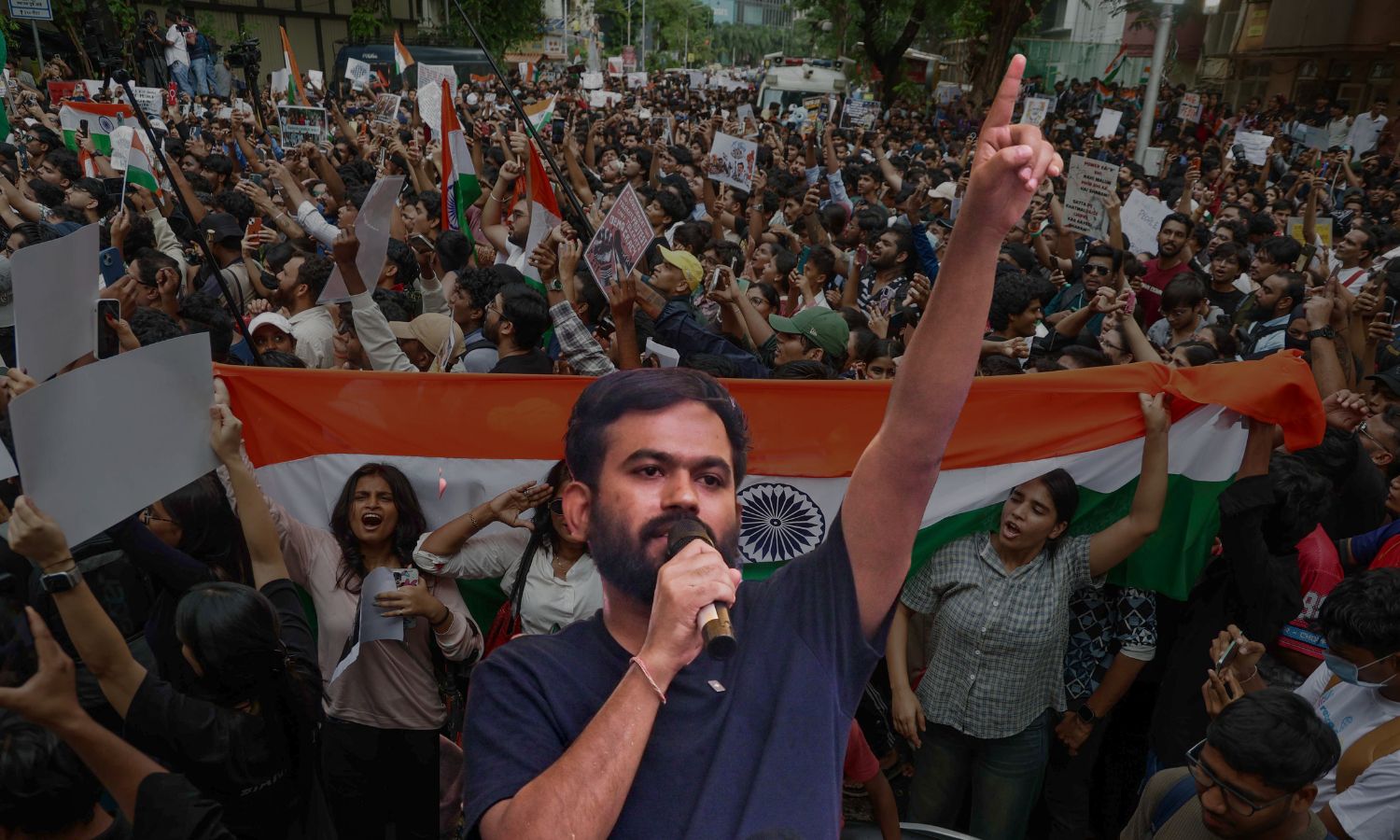
The agitation gathered momentum in Mumbai on October 2, when thousands attended a CJP protest at Shivaji Park. A separate mobilisation in Delhi the same day saw more than 700 protesters detained, according to police-linked reports. Opposition parties, student organisations and civil-society activists have also joined or expressed support for demonstrations questioning the conduct and implications of the voter-roll revision.
The Election Commission, however, maintains that the revision process is intended to improve the accuracy of electoral rolls. Its official voter-service portal provides facilities for checking names, submitting documents against notices and applying for inclusion or deletion under the prescribed procedures.
The result is a growing political dispute in which two very different narratives are now competing: protesters see SIR as a potential threat to legitimate voters, while the election machinery presents roll revision as part of maintaining accurate electoral registers.
Mumbai Becomes the First Major Flashpoint
The latest phase of the CJP campaign began in Mumbai on Gandhi Jayanti.
Police had initially denied permission for the proposed gathering at Shivaji Park. CJP founder Abhijeet Dipke nevertheless announced a “Jail Bharo Andolan” and said the organisation would proceed with its protest. Police had cited issues including the absence of the necessary permission for use of the ground, possible traffic congestion, noise and the movement of patients to nearby hospitals.
The protest eventually attracted thousands at Shivaji Park.
The gathering included Dipke and other CJP organisers as well as public figures from the film and music industries. Among those reported to have attended or expressed support were Naseeruddin Shah, Shabana Azmi, Vishal Dadlani and filmmaker Vishal Bharadwaj.
The central demand was straightforward: protesters wanted Gyanesh Kumar to resign and sought greater scrutiny of the SIR exercise.
The scale of the Mumbai gathering gave the campaign a visibility beyond the CJP’s own organisational base. Reports put attendance in the thousands, with some estimates running significantly higher, although crowd estimates vary by source.
Death of 75-Year-Old Man Adds a Human Dimension
The Mumbai protest was also marked by the death of a 75-year-old Thane resident.
According to police and media reports, Gopalakrishna Subbaiya Pillai arrived at Shivaji Park to attend or observe the protest. He later complained of chest pain and was taken to Sushrusha Hospital, where he died while undergoing treatment. Police said doctors attributed the death to a heart attack and an accidental death report was registered.
The death should not, however, be presented as evidence that the protest caused his death. Available reporting establishes that the cardiac event occurred in connection with his presence at the gathering, but it does not establish that the demonstration itself caused the medical emergency.
The episode nevertheless highlighted the logistical and safety challenges that accompany large public demonstrations, particularly where elderly participants are involved.
Delhi Protest Turns More Confrontational
While Mumbai saw a large gathering, Delhi witnessed a more confrontational sequence of events.
Opposition parties, student organisations and youth groups attempted to demonstrate around Jantar Mantar on October 2, demanding action against the Chief Election Commissioner and raising objections to the SIR process.
Police said more than 700 people were detained from Jantar Mantar and surrounding areas. Those detained reportedly included political leaders and activists from the Aam Aadmi Party, Left parties and student organisations.
Among those reported detained were AAP leaders Atishi, Saurabh Bharadwaj and Sanjeev Jha, CPI(M) leaders Brinda Karat and M A Baby, RJD leader Manoj Jha, AISA national president Neha Bora and other student and youth activists.
Security around central Delhi was heavily reinforced. Barricades were installed and police, Rapid Action Force and other security personnel were deployed to prevent the gathering from moving beyond designated areas.
The Delhi demonstrations subsequently generated additional controversy over police conduct. On October 3, three female journalists alleged that police personnel sexually harassed or manhandled them during the protest. The Delhi Police assigned the complaints to its Crime Branch for investigation and said CCTV footage and other evidence would be examined. Those allegations remain subject to investigation.
What Is the SIR Controversy About?
At the centre of the dispute is the Special Intensive Revision, or SIR, of electoral rolls.
Electoral-roll revision is not itself an unusual feature of India’s election system. The controversy is over the scale, methodology and consequences of the current exercise, particularly allegations that genuine voters may have been excluded or required to undertake additional steps to establish their eligibility.
The Election Commission’s own voter-service portal currently provides dedicated SIR-2026 services, including options to search one’s name in the previous SIR, fill an enumeration form and submit documents against a notice. It also provides the normal procedures for voter registration and deletion.
This is important because the political argument is not simply about whether electoral rolls should be revised.
The deeper question is how such revisions are conducted, how voters are notified, how disputed names are restored, and what safeguards exist to ensure that legitimate citizens are not inadvertently excluded.
Allegations of Mass Deletions Remain Politically Contested
Opposition leaders and protest organisers have alleged that large numbers of names have been removed from voter lists and that legitimate voters could lose their ability to participate in elections.
Those allegations have become the central political argument behind the demonstrations.
However, claims about the precise number of legitimate voters allegedly disenfranchised should not automatically be treated as established fact.
The Election Commission’s position is that electoral-roll revision is intended to identify and correct inaccurate entries, including duplicate, shifted, deceased or otherwise ineligible entries. Maharashtra’s Chief Electoral Officer, for example, has published SIR-related material including an ASDD list covering absent, shifted, dead and duplicate entries, along with SIR instructions, FAQs and help-desk information.
At the same time, disputes over individual entries and the procedures used to challenge them are real political and administrative issues. Reports from Bengaluru, for example, have highlighted scrutiny of hundreds of Form-7 applications in one constituency, illustrating why the verification process has become a contentious part of the SIR debate.
The critical distinction is therefore between names being removed as part of a statutory electoral-roll exercise and legitimate voters being wrongly excluded. The latter requires individual verification and evidence rather than political assertion alone.
Why Gyanesh Kumar Has Become the Focus
The protests have increasingly personalised the institutional dispute around Chief Election Commissioner Gyanesh Kumar.
CJP organisers have demanded his resignation, while opposition leaders and activists have questioned the Election Commission’s functioning and the process through which the CEC is appointed.
Dipke’s organisation has also demanded greater transparency in the appointment of election commissioners, including a broader role for civil society.
The controversy therefore extends beyond SIR itself.
It has opened a larger discussion about whether India’s election-management institutions should have stronger safeguards against perceptions of political influence and whether the existing appointment mechanism provides sufficient institutional distance from the executive.
These are questions of institutional design, rather than proof by themselves that an election result or voter-roll revision has been manipulated.
Farooq Abdullah Takes the Debate to Jammu and Kashmir
The controversy has also reached Jammu and Kashmir’s political discourse.
National Conference president Farooq Abdullah used the fifth Halla Bolle conclave in Srinagar to criticise the alleged deletion of names from electoral rolls and express support for those protesting against the SIR exercise.
Abdullah said that no Indian citizen should be removed from the voter list in a manner that deprives them of their constitutional right to vote. He also criticised the Election Commission’s institutional structure and called for greater autonomy for the poll panel.
His strongest political message was that people were beginning to show courage and that “change” was coming.
Referring to the protests in Mumbai and Delhi, Abdullah said that citizens and political parties were beginning to resist what they considered unacceptable.
He also praised AISA president Neha Bora over her reported confrontation with police during the Delhi protests.
But Abdullah’s remarks about selective targeting and the alleged political purpose of voter deletions are political allegations. They should not be treated as independently established findings without supporting evidence.
The Appointment of the Election Commission Becomes Part of the Argument
Abdullah also raised a separate institutional issue: the manner in which the Chief Election Commissioner is selected.
He argued that the Election Commission should have been made fully autonomous and criticised what he described as an imbalance between government and opposition representation in the selection mechanism. He alleged that the present arrangement gives the government an effective advantage.
That argument has resonance beyond the current SIR dispute because the independence of election-management institutions is a recurring issue in democracies.
The practical question is not simply whether the Election Commission is legally independent. It is also whether its procedures, appointments, decisions and public communication command confidence across competing political constituencies.
The current protests have brought that question back into the national conversation.
From Mumbai to Delhi, and Now a Wider Campaign
The agitation is no longer confined to one organisation or one city.
CJP has announced another major mobilisation at Jantar Mantar in Delhi on October 10, with Dipke calling for supporters from across India to travel to the capital if Gyanesh Kumar does not resign.
Meanwhile, opposition parties have begun organising their own demonstrations.
On October 4, Shiv Sena (UBT) leader Uddhav Thackeray and Maharashtra Navnirman Sena chief Raj Thackeray jointly led a protest in Mumbai against the SIR exercise and demanded the CEC’s resignation. Leaders from Congress and the Sharad Pawar-led NCP faction also participated.
The joint appearance was politically significant because the two Thackeray cousins have generally occupied separate political spaces in Maharashtra.
It demonstrates that the electoral-roll dispute is beginning to intersect with wider opposition politics.
A Protest Movement Meets an Institutional Process
The central challenge for the country now is to separate three different questions that are increasingly being discussed together.
The first is whether electoral rolls require intensive verification and correction.
The second is whether the SIR process is being implemented transparently and with adequate safeguards for legitimate voters.
The third is whether India’s Election Commission enjoys sufficient institutional independence and public confidence.
These questions overlap, but they are not identical.
An electoral roll can legitimately contain duplicate, deceased, shifted or otherwise ineligible entries. At the same time, any legitimate voter who is wrongly excluded faces a serious democratic problem.
That is why the mechanisms for notice, verification, objection, appeal and restoration matter as much as the deletion process itself.
The Road Ahead: Verification Will Matter More Than Slogans
The political temperature around SIR is likely to remain high as planned demonstrations approach.
For protesters, the immediate demands are clear: resignation of the CEC, greater transparency and scrutiny of the voter-roll revision process.
For the Election Commission, the credibility challenge lies in demonstrating that legitimate voters can check their status, respond to notices and secure correction of errors through accessible procedures.
The official voter portal already provides facilities to search names, submit documents against notices and register as voters.
The real test, however, will be whether those safeguards work effectively on the ground.
For an ordinary citizen, the issue is ultimately much simpler than the political slogans surrounding it.
Is my name on the electoral roll? If it is missing, can I find out why? Can I challenge the decision? And can the system correct an error before I lose my opportunity to vote?
Those questions go to the heart of the present controversy.
Jammu and Kashmir Adds Another Political Layer
Farooq Abdullah’s intervention gives the national SIR dispute an additional dimension in Jammu and Kashmir, where questions about representation, elections and political rights have remained particularly sensitive since the constitutional and administrative changes of 2019.
By linking the protests to a broader argument about institutional autonomy, Abdullah has moved beyond the immediate question of individual voter deletions.
His message is that electoral democracy depends not only on holding elections but also on public confidence in the institutions that prepare the electoral rolls and conduct those elections.
That proposition is broader than the allegations currently being exchanged over SIR.
Whether the coming protests produce institutional changes, procedural revisions or simply deepen the political confrontation will depend largely on what happens next: how disputed voter entries are handled, how transparently the Election Commission responds to criticism, and whether political parties choose evidence-based scrutiny or continued mobilisation.
For now, Mumbai and Delhi have transformed what was initially a technical electoral-roll exercise into a much larger political debate over voter rights, institutional autonomy and trust in India’s electoral system.
And with another CJP mobilisation announced for October 10, the dispute is unlikely to disappear from the national political agenda soon.