Makkah Defence Alliance Activated: Pakistan and Türkiye Move Towards Saudi Deployment as Yemen War Reaches Bab el-Mandeb
By: Javid Amin | 05 October 2026
Pakistan, Saudi Arabia and Türkiye have moved their newly signed Makkah Defence Alliance into its first operational phase as Saudi-backed Yemeni forces launch a major offensive against the Houthis around the strategic Bab el-Mandeb Strait. The developments bring together three separate but increasingly connected stories: Saudi Arabia’s security concerns, the widening Yemen conflict and the struggle for control of one of the world’s most important maritime chokepoints.
The Middle East’s security map is changing again.
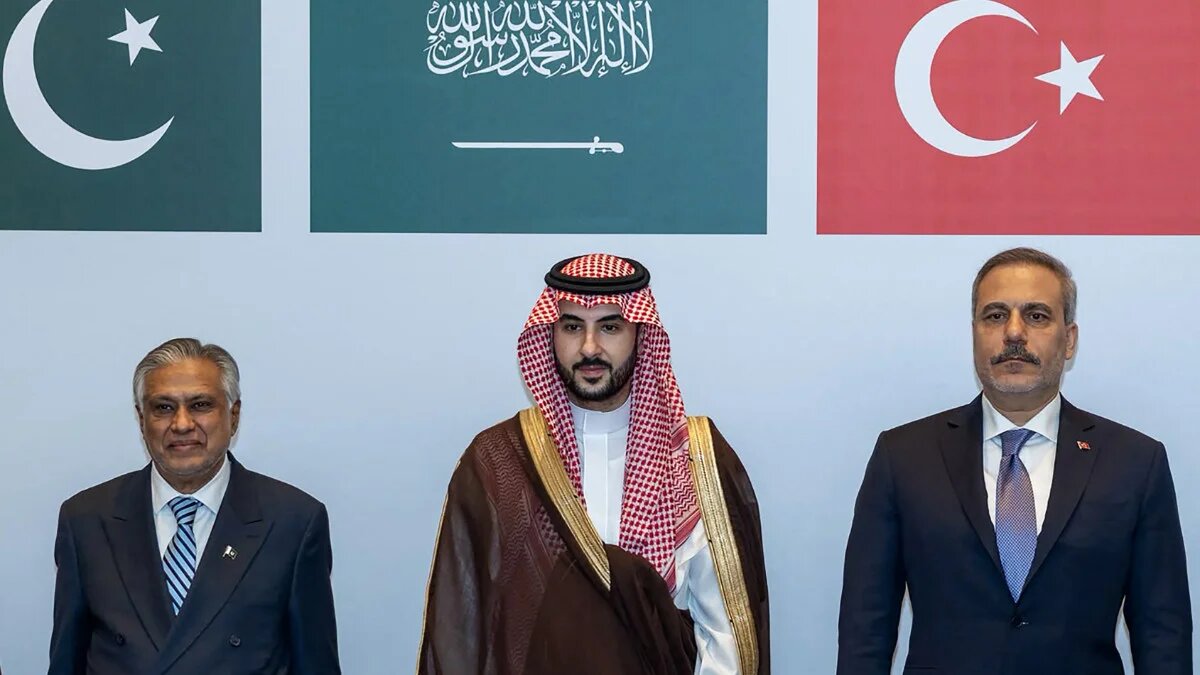
In Riyadh, Saudi Arabia, Pakistan and Türkiye have agreed to begin practical implementation of their Makkah Defence Agreement, including arrangements for the rapid deployment of agreed military forces and capabilities to Saudi Arabia.
On the ground in Yemen, meanwhile, forces loyal to the internationally recognised Yemeni government and backed by Saudi Arabia have launched a major counteroffensive against the Iran-aligned Houthi movement, reclaiming several areas near the strategically important Bab el-Mandeb Strait.
Taken separately, each development would be significant.
Together, they signal a much broader regional security shift.
The Makkah agreement was signed only two months ago. Its central provision says that an armed attack against any one of the three countries will be regarded as an attack against all three. Pakistan’s Foreign Ministry has described the accord as defensive and intended to strengthen collective deterrence rather than target a particular country.
Now, amid renewed attacks on Saudi Arabia and an expanding Yemen offensive, that principle is being translated into practical military preparations.
The three countries have not publicly announced a specific troop number or deployment timetable.
But the language coming out of Riyadh is significant: the alliance says it will provide agreed military forces and capabilities and ensure their rapid deployment inside Saudi Arabia.
At almost the same time, Saudi-backed Yemeni forces have moved toward the Bab el-Mandeb, one of the most sensitive points on the global shipping map.
The result is a regional security equation that now stretches from Saudi cities and holy sites to Yemen’s Red Sea coast and the international shipping lanes beyond it.
The Makkah Alliance moves from paper to action
The agreement between Saudi Arabia, Pakistan and Türkiye was signed in Makkah on August 7, 2026, during a summit attended by Saudi Crown Prince Mohammed bin Salman, Turkish President Recep Tayyip Erdoğan and Pakistani Prime Minister Shehbaz Sharif.
Its central principle is straightforward:
An armed attack on one member is to be regarded as an attack on all three.
The agreement also envisages broader defence cooperation and collective deterrence.
Pakistan has specifically described the accord as defensive in nature and said it is not directed against any particular country.
Islamabad’s official statement says the agreement is intended to strengthen collective deterrence against external aggression and enhance the three countries’ ability to defend their sovereignty and territorial integrity.
That distinction is important because the alliance is emerging during an exceptionally volatile period involving Iran, the United States, Israel and the Yemen conflict.
The pact was initially viewed as a political and strategic framework.
That changed this week.
Riyadh meeting triggers the first practical implementation
On October 5, the Strategic Political and Defence Committee of the Makkah Alliance held an emergency meeting in Riyadh.
The committee reviewed the security situation and approved recommendations for implementing the alliance’s collective-defence commitments.
The joint statement said the three countries would “move immediately” toward practical implementation and take measures to provide agreed military forces and capabilities and ensure their rapid deployment in Saudi Arabia.
The deployment is to take place under existing arrangements and according to the national laws of the three countries.
The announcement does not specify:
- how many Pakistani personnel will deploy;
- how many Turkish personnel will deploy;
- which military branches will participate;
- whether aircraft or naval units will be deployed;
- where the forces will be stationed;
- or exactly when the first units will arrive.
Those details matter.
A political commitment to rapid deployment is not the same thing as a fully defined expeditionary force.
For now, the confirmed development is that the three governments have authorised practical preparations for deployment.
Why Saudi Arabia has invoked the alliance now
The immediate backdrop is Yemen.
The Houthis, who control large parts of northern and western Yemen and are aligned with Iran, have intensified attacks in the region.
Saudi Arabia has reported attacks involving missiles and drones, including threats to cities, economic infrastructure and other targets.
The three countries’ joint statement also condemned attempts to target Makkah and Madinah, as well as attacks on Saudi cities and civilian and economic facilities.
For Riyadh, the issue is therefore not simply the Yemen battlefield.
It is the possibility that the conflict could spill across the border and threaten Saudi territory directly.
That is precisely the kind of scenario for which the Makkah agreement was designed.
Pakistan had already signalled this interpretation in September.
Pakistan’s Defence Minister Khawaja Asif said that if the Yemen conflict spilled into Saudi Arabia, the Makkah agreement could become operational.
That warning has now been followed by the alliance’s first formal decision to implement collective-defence measures.
Pakistan and Türkiye are not simply sending a political message
The decision has practical military implications.
Pakistan has one of the region’s largest and most experienced armed forces, while Türkiye has developed significant capabilities in drones, air defence, naval systems, electronic warfare and expeditionary operations.
Saudi Arabia, meanwhile, possesses a sophisticated military infrastructure and a strategic geographic position linking the Persian Gulf, Red Sea and Arabian Peninsula.
The three countries therefore bring different capabilities to the alliance.
But the governments have not publicly said that Pakistani or Turkish forces will immediately enter combat operations in Yemen.
That distinction should be maintained.
The current announcement concerns rapid deployment of agreed forces and capabilities to Saudi Arabia.
Whether those forces eventually participate in combat, provide air defence, protect critical infrastructure, conduct maritime operations or undertake another mission remains dependent on subsequent decisions.
Pakistan’s role is especially sensitive
Islamabad’s involvement carries particular significance.
Pakistan has historically maintained close defence and security ties with Saudi Arabia.
Pakistani military personnel have previously been stationed in Saudi Arabia for training, advisory and security-related roles.
But Pakistan has also repeatedly tried to avoid being drawn into direct combat operations in regional conflicts.
That balancing act becomes more complicated under a collective-defence arrangement.
The Makkah pact says an armed attack against one member is an attack against all.
Yet Pakistan’s official description of the agreement stresses sovereignty, defensive cooperation and peaceful dispute resolution.
The practical challenge for Islamabad will therefore be defining what collective defence means in a crisis:
Does it mean troops defending Saudi territory?
Does it include air-defence operations?
Could it extend to maritime security?
Would Pakistani forces participate in operations inside Yemen?
The current agreement announcement does not answer those questions.
Türkiye’s role is equally significant
Türkiye brings another dimension to the alliance.
Ankara has sought a more prominent role in Middle Eastern security while maintaining relationships with countries that do not always share the same strategic priorities.
Turkish Foreign Minister Hakan Fidan, Defence Minister Yaşar Güler and Chief of General Staff Gen. Selçuk Bayraktaroğlu were involved in the Riyadh consultations preceding the emergency meeting.
Türkiye’s participation means the Makkah arrangement is not simply a Gulf security initiative.
It links:
the Arabian Peninsula + South Asia + a major NATO member.
That gives the alliance a broader strategic footprint.
At the same time, Ankara has also emphasised diplomacy and peaceful solutions to regional crises, meaning its military participation does not necessarily imply support for an unlimited Yemen war.
Then came the Yemen counteroffensive
While the Makkah alliance was being activated in Riyadh, the battlefield in Yemen was changing.
Saudi-backed forces loyal to Yemen’s internationally recognised government launched a major offensive against the Houthis in southwestern Yemen.
The operation focused heavily on areas surrounding the Bab el-Mandeb Strait.
According to AP, Yemeni government forces, supported by more than 100 Saudi aircraft, retook the towns of Dhubab, Bab and Hadeid.
Reuters separately reported that Saudi-backed Yemeni forces were advancing toward Mocha and had pushed Houthi forces out of territory captured during the previous month.
The fighting is therefore not merely about small towns.
It is about control of territory adjacent to a maritime chokepoint.
Why Bab el-Mandeb matters so much
The Bab el-Mandeb Strait is a narrow maritime passage connecting the Red Sea with the Gulf of Aden and the Arabian Sea.
It sits between Yemen and the Horn of Africa.
Its geography makes it strategically important for shipping travelling between:
the Indian Ocean → Red Sea → Suez Canal → Mediterranean.
Before the Houthi attacks that began affecting Red Sea shipping in late 2023, the route carried substantial volumes of energy and commercial cargo.
The disruptions that followed forced many vessels to take a much longer route around the Cape of Good Hope.
That added:
- sailing time;
- fuel consumption;
- crew costs;
- insurance premiums;
- vessel requirements;
- and ultimately freight costs.
The US Energy Information Administration estimates that about 4.2 million barrels per day of crude oil and petroleum products passed through Bab el-Mandeb in the first half of 2025, although that was roughly half the 2023 level because many ships were avoiding the route.
The strategic importance of the strait therefore extends well beyond Yemen.
Bab el-Mandeb and Hormuz are becoming linked
This is where the latest developments become especially important.
The Middle East’s current energy crisis involves two major maritime chokepoints.
Strait of Hormuz
The gateway between the Persian Gulf and the Gulf of Oman.
It is central to oil and LNG exports from Gulf producers.
Bab el-Mandeb
The gateway between the Red Sea and Gulf of Aden.
It is crucial for shipping between Asia, the Middle East and Europe.
A vessel moving from the Gulf toward Europe can potentially encounter both.
That means a crisis affecting Hormuz can be compounded by another affecting Bab el-Mandeb.
The two routes are geographically separate but economically interconnected.
The Houthis still have options even after losing territory
The Yemeni government forces’ territorial gains do not automatically mean the Houthi threat has disappeared.
The Houthis have built an asymmetric military capability over years of conflict.
They can use:
- drones;
- ballistic missiles;
- cruise missiles;
- coastal weapons;
- dispersed military units;
- irregular warfare.
Even if they lose physical control of sections of the coastline, they may retain the ability to threaten ships or launch attacks against Saudi territory.
AP reported that the Houthis responded to the offensive with missile and drone attacks targeting Saudi oil facilities, airports and military positions. Some of the claims could not be independently verified.
That is a critical distinction.
Territorial control and long-range strike capability are not the same thing.
A military force can lose ground while retaining the ability to impose costs on an opponent.
Saudi Arabia is trying to solve two problems at once
Riyadh’s military strategy now has two interconnected objectives.
The first is to prevent the Houthis from consolidating their hold over strategically important parts of Yemen.
The second is to protect Saudi territory from missile and drone attacks.
That explains why the Bab el-Mandeb operation and the Makkah Alliance activation are happening at almost exactly the same time.
Saudi Arabia is effectively building a layered response:
Yemeni forces fight for territory.
Saudi forces provide air power and broader military support.
Pakistan and Türkiye prepare collective-defence capabilities for Saudi territory.
The United States provides intelligence and other support to Riyadh.
The arrangement creates a wider regional security network around the Yemen conflict.
The Iran connection
The Houthis are widely described by governments and international observers as an Iran-aligned movement.
Iran has provided support to the group, although the extent and nature of Iranian operational control over Houthi decisions is a matter of continuing debate.
For Saudi Arabia, however, the strategic concern is clear.
A powerful Houthi movement on the Red Sea coast gives an Iran-aligned actor the ability to threaten:
- Saudi territory;
- Red Sea shipping;
- energy infrastructure;
- maritime trade;
- and the security of the Arabian Peninsula.
The Yemen battlefield therefore sits inside the larger strategic competition involving Iran and its regional opponents.
But it would be misleading to describe every Houthi military decision as automatically directed by Tehran.
The Houthis have their own political and military agenda inside Yemen.
The US is quietly part of the equation too
Washington has supported Saudi Arabia with intelligence and operational assistance.
That support has become increasingly relevant as the Yemeni government launches its offensive.
The United States has an additional reason to care about Bab el-Mandeb.
The waterway affects global shipping.
If commercial traffic is repeatedly attacked, the consequences extend to European, Asian and American markets.
The EIA notes that Red Sea attacks have already caused ships to divert around the Cape of Good Hope, adding significant time and cost to voyages.
The US therefore has both a strategic and economic interest in keeping the maritime route open.
A new regional security architecture is emerging
The Makkah Alliance is important because it represents an attempt by regional and neighbouring powers to create a security arrangement that does not depend entirely on traditional US-led structures.
Saudi Arabia remains a major US security partner.
Türkiye remains a NATO member.
Pakistan has long-standing military ties with Saudi Arabia.
The three countries nevertheless decided to create their own collective-defence framework.
The alliance agreement says the security of each member is an integral part of the security of the others.
The October 5 decision now begins converting that political principle into operational arrangements.
The alliance has also appointed retired Pakistani Lt. Gen. Nauman Mahmood as its first secretary-general for a three-year term, indicating that institutionalisation is moving alongside military planning.
That is an important development.
The alliance is not simply a declaration.
It is beginning to develop an organisational structure.
This is not NATO — but the comparison is unavoidable
The Makkah agreement’s collective-defence principle resembles the logic of NATO’s Article 5.
But there are important differences.
NATO has decades of institutional development, integrated command structures, established planning systems, standardised procedures and a large permanent military architecture.
The Makkah Alliance is new.
Its institutions are still being developed.
Its force commitments have not been publicly detailed.
And its first operational test is occurring only weeks after its creation.
That makes the coming months important for understanding whether the alliance develops into a durable defence structure or remains primarily a political and deterrence framework.
The economic stakes are enormous
The military developments are unfolding alongside a wider energy crisis.
Oil prices remain highly sensitive to developments in both Hormuz and Bab el-Mandeb.
Reuters reported Brent crude around $100.59 a barrel on October 6, after rising amid renewed tanker-security concerns.
The price is important, but the shipping implications may be even more consequential.
A tanker does not have to be destroyed for the crisis to affect the global economy.
If insurers increase war-risk premiums, shipping becomes more expensive.
If vessels avoid the Red Sea, journeys become longer.
If ships avoid Hormuz, alternative supply routes face capacity constraints.
If both chokepoints become unreliable, energy and freight markets face a much larger problem.
India is directly exposed
For India, Bab el-Mandeb is not an abstract geopolitical issue.
India is one of the world’s major energy importers and has extensive commercial ties with the Gulf and Europe.
Indian shipping companies and exporters can be affected by longer routes around Africa.
The energy consequences can appear in:
- crude prices;
- petroleum products;
- aviation fuel;
- fertiliser;
- chemicals;
- electricity generation;
- transport costs.
The EIA’s historical data also shows why the Gulf matters particularly to India: Asian markets absorb the overwhelming majority of oil moving through the major Gulf maritime routes. India is among the largest destinations for Hormuz-linked crude flows.
The Red Sea route is similarly important for India’s trade with Europe.
A prolonged disruption therefore creates a two-sided pressure:
higher energy costs from the Gulf + longer trade routes toward Europe.
The humanitarian cost in Yemen is already rising
The military developments should not be viewed only through the lens of strategy.
Yemen has endured years of conflict, displacement and humanitarian hardship.
The renewed fighting is creating another wave of displacement.
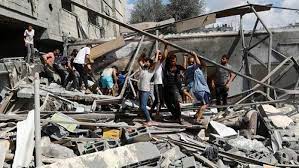
AP reported that the latest escalation had killed at least 959 people, injured more than 4,200 and displaced nearly 174,000 people, according to UN figures cited in its reporting.
Those numbers underline the central dilemma.
For Saudi Arabia and its allies, the argument is that the Houthi threat must be confronted.
For civilians in Yemen, however, every new offensive means another round of displacement, damaged infrastructure and disrupted access to food and healthcare.
A military campaign around Bab el-Mandeb may alter the regional balance.
But it does not by itself resolve Yemen’s political conflict.
The risk of a wider regional escalation
The most important question now is whether the Yemen front remains contained.
Several actors are already involved:
Saudi Arabia — backing the Yemeni government and conducting air operations.
Yemeni government forces — attempting to regain territory.
Houthis — resisting the offensive and retaining missile and drone capabilities.
Iran — politically and strategically aligned with the Houthis.
United States — providing intelligence and support to Saudi Arabia.
Pakistan and Türkiye — activating collective-defence preparations under the Makkah Alliance.
That is a large number of external actors around one battlefield.
The greater the number of military actors, the greater the possibility of miscalculation.
What happens if Saudi Arabia itself comes under heavier attack?
This is perhaps the most important question surrounding the Makkah pact.
The alliance has now been activated in response to attacks on Saudi Arabia.
If Houthi attacks intensify, the demand for additional Pakistani and Turkish military support could increase.
That could mean:
- air-defence deployments;
- military advisers;
- logistical support;
- naval security;
- protection of critical infrastructure;
- intelligence cooperation;
- or potentially other forms of military assistance.
But there is no public confirmation yet that Pakistani or Turkish forces will conduct combat operations against the Houthis inside Yemen.
The precise mission will determine how far the alliance’s first operational test actually goes.
The Bab el-Mandeb battle could determine the next phase
Control of the strait has enormous strategic value.
The Yemeni government wants to demonstrate that the Houthis cannot permanently control the maritime gateway.
Saudi Arabia wants to restore security along its southern flank.
The Houthis want to retain leverage over the Red Sea and maintain their political and military position inside Yemen.
Iran benefits strategically from pressure on Saudi Arabia and Western-linked shipping, although the Houthis retain their own calculations.
The United States wants maritime routes protected.
Europe wants the Red Sea route stabilised.
Asian economies want energy and commercial flows to continue.
That makes a relatively narrow stretch of water the focus of a remarkably large geopolitical contest.
What to watch next
The coming weeks will reveal whether the latest developments remain limited or expand into a broader regional confrontation.
1. Pakistani and Turkish deployment
The biggest immediate question is what forces will actually arrive in Saudi Arabia and what missions they will be assigned.
2. Houthi retaliation
The intensity and geographical reach of Houthi missile and drone attacks will be critical.
3. Bab el-Mandeb shipping
Commercial shipping patterns will show whether the Yemeni offensive genuinely improves maritime security.
4. Saudi military operations
Riyadh’s decision on whether to deepen the Yemen campaign will shape the next phase of the conflict.
5. Iran’s response
Any direct Iranian military involvement would significantly alter the strategic equation.
6. US policy
Washington’s wider confrontation with Iran will remain an important backdrop.
7. Oil and insurance markets
Even without a major new war, sustained shipping disruption could keep energy and freight prices elevated.
A new chapter for the Makkah Alliance
The significance of the October 5 decision goes beyond Yemen.
Until now, the Makkah Defence Alliance was largely a newly created strategic framework.
It now faces its first practical test.
The three countries have agreed to implement collective-defence commitments and prepare the rapid deployment of military forces and capabilities to Saudi Arabia.
The move gives Saudi Arabia additional regional security backing.
It gives Pakistan and Türkiye a more direct role in Gulf security.
And it sends a message to armed groups threatening Saudi territory that Riyadh is no longer responding alone.
But it also creates a new question:
How far will collective defence extend?
Will the alliance remain focused on protecting Saudi territory?
Will it contribute to maritime security?
Will it become involved in Yemen?
Or will its military presence primarily serve as deterrence?
Those answers have not yet been publicly defined.
Conclusion: Yemen has become the new pressure point
The latest developments show how quickly a regional crisis can connect separate theatres.
The Iran-US confrontation has increased pressure across the Gulf.
The Houthis have emerged as a major factor in Red Sea security.
Saudi Arabia is fighting to prevent a hostile force from consolidating control near Bab el-Mandeb.
Pakistan and Türkiye are preparing to support Saudi Arabia under a newly created collective-defence pact.
And global shipping and energy markets are watching closely.
The most significant development is not simply that Pakistan and Türkiye may send forces to Saudi Arabia.
It is that the Makkah Defence Alliance has moved from a political agreement toward operational implementation at precisely the moment Yemen is becoming another major front in the wider Middle East crisis.
The immediate battlefield is Yemen.
The strategic battlefield stretches much farther.
It runs from the Saudi border to Bab el-Mandeb, from the Red Sea to the Gulf, and from regional military bases to global oil and shipping markets.
For Saudi Arabia, the priority is territorial security.
For Pakistan and Türkiye, the coming test will be how far their collective-defence commitment extends.
For the Houthis, the question is whether losing territory around Bab el-Mandeb can be compensated by continued missile and drone pressure.
For Iran, the Yemen front provides another source of strategic leverage.
And for the rest of the world, the central concern is simpler:
Can one of the world’s most important maritime corridors remain open while another Middle Eastern conflict is rapidly expanding around it?
The answer could have consequences not only for Yemen and Saudi Arabia, but for energy prices, global shipping, Asian economies and the wider balance of power across the Middle East.