Ranji Trophy 2025–26 Final: Jammu & Kashmir’s Historic Dream Meets Karnataka’s Dynasty in Hubballi
By: Javid Amin | 23 February 2026
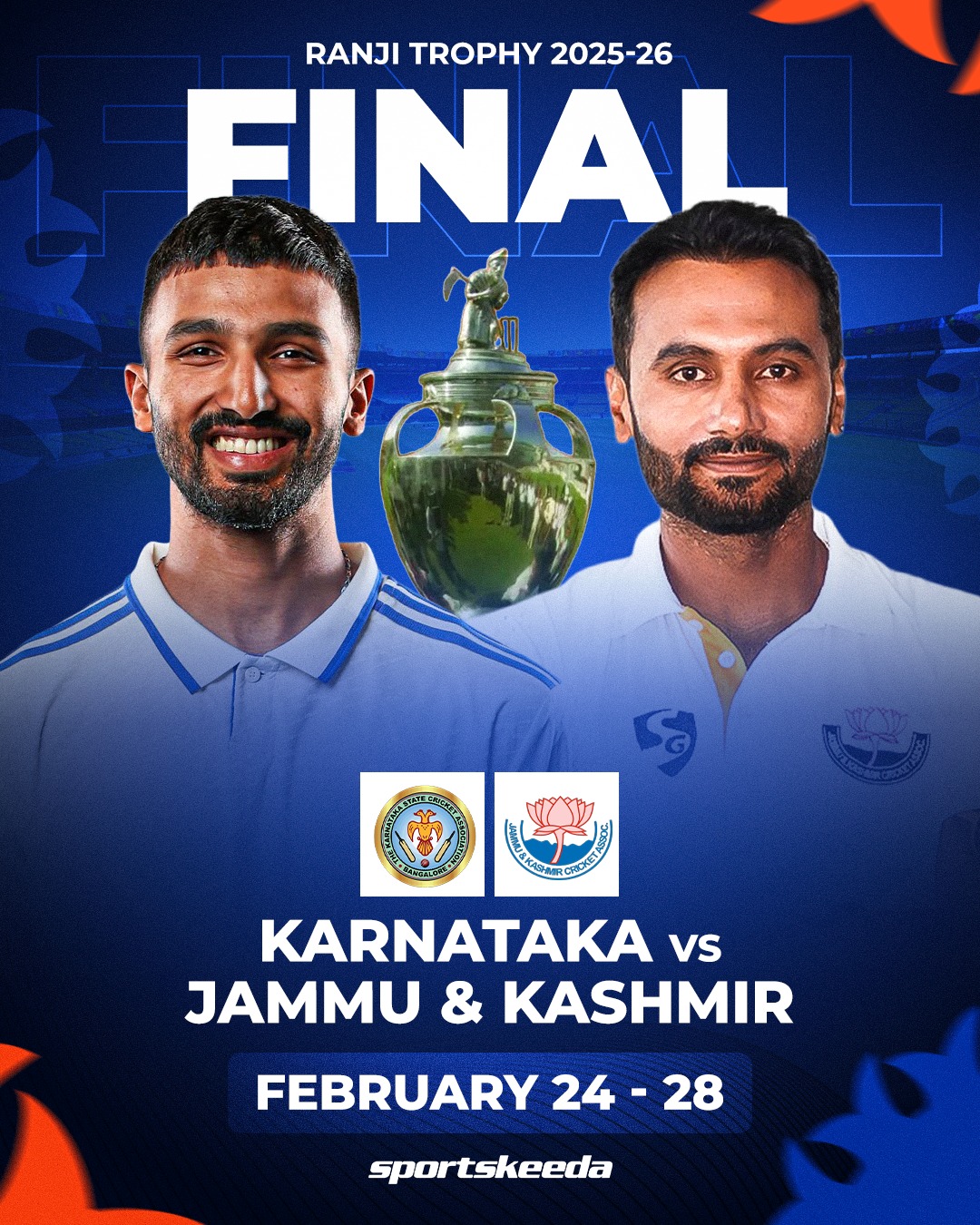
The Ranji Trophy final is rarely just about cricket. It is about legacy, systems, culture, and the weight of decades. The 2025–26 summit clash brings two contrasting narratives face to face: Jammu & Kashmir playing their maiden final after 67 years in the competition, and Karnataka chasing a record-extending ninth title.
Hosted in Hubballi from February 24–28, 2026, this final has evolved into a five-day examination of temperament and technique. Jammu & Kashmir won the toss and chose to bat first — a decision rooted in belief, not caution. Under the leadership of Paras Dogra, the team signaled that they were not here merely to participate. They were here to compete.
On the other side stood Karnataka — one of Indian domestic cricket’s most structured and decorated units. Their pedigree includes eight Ranji crowns and a conveyor belt of players who have represented India at the highest level.
The clash, therefore, is more than tactical. It is symbolic: establishment versus emergence.
The Stakes: A Ninth Title vs A First in 67 Years
Karnataka’s pursuit is about extending dominance. Titles validate systems. A ninth Ranji Trophy would further cement their status as one of India’s premier domestic cricket institutions.
For Jammu & Kashmir, the equation is different. Their first appearance in a Ranji final marks a generational shift. Having entered the competition in 1959, they spent decades battling structural disadvantages — limited exposure, fewer resources, and a long-standing perception gap.
This final is the visible result of cultural reconstruction within J&K cricket.
Day-by-Day Breakdown: Karnataka vs Jammu & Kashmir
Day 1: Confident Beginnings and Middle-Session Collapse
Jammu & Kashmir’s decision to bat first was deliberate. Finals often reward first-innings dominance, especially on surfaces that tend to slow down.
Yawer Hassan justified that call with a fluent half-century. His innings was not flamboyant — it was controlled and technically sound. He left well outside off, punished anything overpitched, and rotated strike effectively.
Shubham Pundir supported him in a steady partnership that frustrated Karnataka’s new-ball attack.
However, Karnataka’s discipline began to show in the middle session. V. Kaverappa led the charge, hitting consistent lengths and forcing J&K’s batters into indecision. A cluster of wickets shifted momentum.
By stumps, Jammu & Kashmir had posted a competitive but modest total. It was not commanding — but neither was it submissive. The innings reflected resilience under scoreboard pressure.
Day 2: Karnataka’s Methodical Response and Auqib Nabi’s Intervention
Karnataka began their first innings with composure. R. Samarth anchored proceedings, demonstrating the value of experience in high-pressure contests. His approach was classic Ranji cricket: patience, shot selection, and tempo control.
But Auqib Nabi once again proved why he is considered J&K’s strike weapon.
Nabi’s spell combined pace with seam movement. He targeted the top of off stump, extracting late deviation and forcing batters to commit. His breakthroughs ensured that Karnataka never fully broke away.
Despite the resistance, Karnataka edged ahead by stumps, securing a narrow lead. Yet, psychologically, the match remained balanced. J&K’s bowlers ensured Karnataka did not convert their platform into dominance.
Day 3: Paras Dogra’s Experience and Tactical Resistance
The third day often decides Ranji finals. With the first-innings deficit in mind, J&K needed stability.
Paras Dogra, at 40, provided exactly that.
Dogra’s innings was about situational awareness. He absorbed pressure, allowed younger batters to settle, and chose calculated moments to counterattack. Alongside Shubham Khajuria, he rebuilt after early setbacks.
Karnataka’s spinners tightened the screws in the afternoon session. The surface began offering grip, and run-scoring required discipline.
J&K did not collapse. They accumulated.
By close of play, the contest had tilted into a strategic stalemate — both sides sensing opportunity.
Day 4: Lower-Order Grit and a 200+ Target
Championship teams often rely on lower-order resistance. Jammu & Kashmir found crucial contributions down the order.
Abid Mushtaq and Vivrant Sharma added valuable runs, pushing the overall lead past 200. In a final, a 200-plus fourth-innings target carries scoreboard pressure far beyond the numbers.
Karnataka began their chase cautiously. The early overs were about survival, not acceleration.
But J&K’s bowlers struck at regular intervals. Discipline remained their hallmark. Field placements were aggressive — slip cordons stayed in place longer than expected, signaling intent to attack.
As stumps approached, the final day was set up for a tense finish.
Day 5: Momentum in Flux
On the fifth morning, Karnataka resumed their chase with history within reach. For them, it is about legacy consolidation.
For Jammu & Kashmir, it is about rewriting decades of narrative.
The match remains finely poised. Every session has swung momentum. Every partnership has redefined probability.
This is what Ranji finals are meant to look like — attritional, tactical, and emotionally charged.
Jammu & Kashmir’s Journey to the Final
67 Years in the Making
When Jammu & Kashmir first entered the Ranji Trophy in 1959, few imagined they would one day contest a final. For decades, they existed on the periphery of Indian domestic cricket.
Progress was gradual. Infrastructure evolved slowly. Exposure remained limited.
But the 2025–26 season changed everything.
Knockout Shockwaves: Delhi and Bengal
In the knockout stages, J&K stunned Delhi with disciplined bowling and fearless batting. That victory established belief.
The semifinal against Bengal became their defining moment — a six-wicket triumph that dismantled a heavyweight side.
Auqib Nabi’s seam bowling destroyed Bengal’s top order, while Vanshaj Sharma and Abdul Samad guided the chase with composure.
That win did not just secure a final berth. It shattered a psychological ceiling.
The Cultural Shift Within J&K Cricket
Multiple insiders point to one key transformation: mindset.
For years, Jammu & Kashmir teams carried an inferiority complex when facing established domestic powers. That narrative has now been replaced by tactical clarity and competitive self-belief.
Coaches and support staff focused on:
-
Mental conditioning
-
Fitness benchmarks aligned with top domestic teams
-
Defined player roles
-
Seam-bowling depth
-
Allrounder balance
This shift mirrors broader structural improvements under the governance of the Board of Control for Cricket in India, which has expanded domestic competitiveness across regions.
Karnataka: The Weight of Eight Titles
Karnataka are not merely participants. They are architects of domestic excellence.
Their eight Ranji titles place them among the elite. The team’s systems emphasize:
-
Strong grassroots cricket
-
Seam-to-spin adaptability
-
Deep batting line-ups
-
Bench strength
In finals, experience matters. Karnataka have navigated such pressure before.
Their pursuit of a ninth title is about preserving a winning culture.
Key Players: Jammu & Kashmir
| Player | Role | Impact |
|---|---|---|
| Paras Dogra | Captain & Batter | Veteran stability, leadership in high-pressure moments |
| Auqib Nabi | Fast Bowler | Strike weapon; dismantled Bengal in semifinal |
| Shubham Khajuria | Opener | Aggressive starts set tone |
| Yawer Hassan | Top-order Batter | Day 1 fifty in final, technical composure |
| Abid Mushtaq | Allrounder | Spin control and lower-order runs |
| Vivrant Sharma | Allrounder | Balance, flexibility, fielding intensity |
| Vanshaj Sharma | Batter | Crucial semifinal performance |
Tactical Themes of the Final
1. Seam vs Structure
J&K’s attack relies heavily on pace discipline. Karnataka counter with structured batting depth.
2. Experience vs Momentum
Karnataka bring final experience. J&K bring fearless momentum.
3. Fourth-Innings Psychology
Chasing in a final magnifies pressure. Scoreboard dynamics are central.
Why This Final Matters Beyond Cricket
For Karnataka, it is about extending an era.
For Jammu & Kashmir, it is about visibility and aspiration.
Young cricketers across the Valley now see a pathway to the pinnacle of domestic cricket. Success at this stage can catalyze:
-
Infrastructure investment
-
Sponsorship interest
-
Expanded talent scouting
-
Youth academy development
Representation fuels ecosystem growth.
The Broader Significance of the Ranji Trophy
The Ranji Trophy remains the foundation of India’s cricketing depth. Many international stars have emerged through its grind.
This final reinforces why domestic cricket matters: it tests technique, temperament, and endurance across five days.
Jammu & Kashmir’s rise enriches the tournament’s diversity and competitiveness.
Conclusion: Legacy in Motion
As the fifth day unfolds in Hubballi, the narrative remains unwritten.
If Karnataka win, they extend a dynasty.
If Jammu & Kashmir prevail, it becomes one of the most transformative moments in Indian domestic cricket history.
Either way, the 2025–26 Ranji Trophy final has already delivered what sport promises at its best: belief, drama, and the possibility of rewriting history.
For Jammu & Kashmir, merely reaching this stage has changed perception.