Mehbooba Mufti Slams Omar Abdullah Government: “Betrayal of Mandate” in J&K
By: Javid Amin | 23 April 2026
Rising Political Heat in Jammu & Kashmir
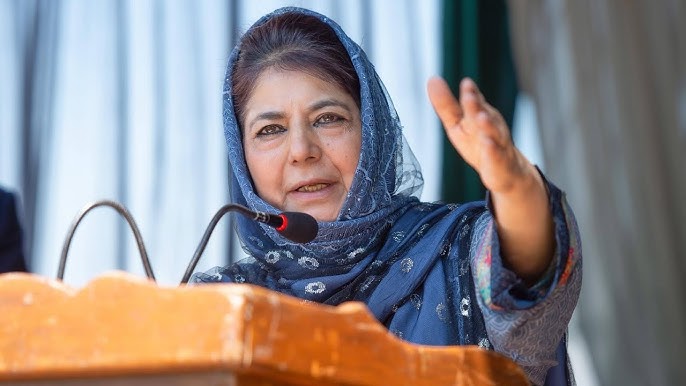
In a sharp escalation of political rhetoric, Mehbooba Mufti has accused the Jammu and Kashmir National Conference (NC) government led by Omar Abdullah of betraying voters despite securing massive electoral support.
Her remarks reflect a broader churn in Kashmir’s political landscape, where governance delivery, economic distress, and public sentiment are increasingly shaping narratives ahead of future electoral battles.
Core Allegations: “Promises Made, Promises Broken”
Unemployment and Youth Distress
Mufti’s most forceful criticism centers on the growing unemployment crisis. She highlighted that even educated youth across Kashmir remain jobless, creating a deep sense of uncertainty within families.
She warned that prolonged joblessness is not just an economic issue but a social one—fueling frustration, anxiety, and, in some cases, substance abuse among young people.
This framing taps into one of the most sensitive fault lines in the Valley today: a generation caught between qualifications and limited opportunities.
Power Promises vs Ground Reality
The former Chief Minister also questioned the NC’s promise of providing 200 units of free electricity to households.
According to her:
- The promise remains largely unfulfilled
- Hydropower assets are allegedly being handed to “outsiders”
- Local stakeholders feel excluded from resource benefits
This issue carries both economic and emotional weight, as electricity remains a daily concern for households and a symbol of resource control in the region.
Allegations of Religious Interference
Mufti raised concerns over alleged restrictions on religious practices, claiming that prayer leaders are being asked to vet sermons before delivering them in mosques.
If substantiated, such measures could trigger serious debate around civil liberties and religious freedom—issues that resonate deeply in Kashmir’s socio-political fabric.
Community Concerns: Sikh Representation
Highlighting inclusivity, Mufti pointed to the grievances of Sikh communities in Jammu & Kashmir, stating that they have not received adequate support despite their longstanding presence and contributions.
By raising this, she attempts to broaden her critique beyond traditional political bases and position herself as a voice for minority concerns.
Fruit Growers and Highway Bottlenecks
One of the most tangible governance issues raised was the plight of fruit growers:
- Trucks carrying apples and other produce reportedly remain stranded for weeks on the Srinagar–Jammu highway
- In contrast, pilgrimage-related traffic is cleared more efficiently
For an economy heavily dependent on horticulture, logistical delays translate directly into financial losses, making this a politically potent issue.
Closure of Srinagar–Muzaffarabad Trade Route
Mufti also criticized the continued shutdown of the cross-Line of Control trade route between Srinagar and Muzaffarabad.
She argued that:
- The route had boosted local trade and economic resilience
- Its closure has hurt traders and fruit growers
This issue also carries symbolic value, tied to cross-border engagement and economic interdependence.
Political Context: PDP vs NC Rivalry Reignited
The latest remarks underline the intensifying rivalry between Mufti’s People’s Democratic Party (PDP) and the National Conference.
Strategic Positioning by PDP
- Reclaiming grassroots credibility
- Reconnecting with youth, farmers, and marginalized groups
- Reframing PDP as a responsive alternative
Mufti also addressed criticism of her party’s past alliance with the BJP, maintaining that PDP did not compromise on core public interests—a claim that remains contested in political circles.
Reading the Public Mood
Mufti’s narrative appears calibrated to align with emerging public concerns:
- Economic Anxiety: Unemployment and rising cost pressures
- Governance Fatigue: Perception of delayed or unfulfilled promises
- Identity & Rights: Sensitivity around religious and community issues
By amplifying these themes, she is attempting to convert diffuse dissatisfaction into a coherent political challenge.
Electoral Implications: Shifting Ground Ahead?
1. PDP’s Attempted Comeback
Mufti’s aggressive stance could help PDP regain lost ground, especially among disillusioned voters seeking alternatives.
2. Pressure on NC’s Credibility
If the “betrayal of mandate” narrative gains traction, the NC may face growing scrutiny over delivery gaps.
3. Risk of Opposition Fragmentation
Competition between PDP and NC could split votes, particularly in a multi-party contest, potentially reshaping electoral arithmetic.
4. Youth Vote as Kingmaker
With unemployment emerging as a defining issue, the political formation that offers credible solutions may gain a decisive edge.
Broader Governance Questions
Beyond party politics, the debate raises structural questions:
- Can electoral mandates translate into measurable governance outcomes?
- How effectively are economic and infrastructural challenges being addressed?
- Is there a widening gap between policy announcements and implementation?
These questions are central not just to political discourse but to everyday life in Jammu & Kashmir.
Final Take: A Narrative Battle with Real Stakes
Mehbooba Mufti’s critique is more than routine opposition rhetoric—it is a calculated political intervention aimed at reshaping the narrative in Jammu & Kashmir.
By linking unemployment, governance gaps, and community concerns, she is constructing a broad-based critique of the current administration. Whether this translates into electoral gains will depend on two factors: the NC government’s response on the ground, and PDP’s ability to convert criticism into credible alternatives.
For now, the political contest is clearly shifting from mandate to performance—and voters will be watching closely.