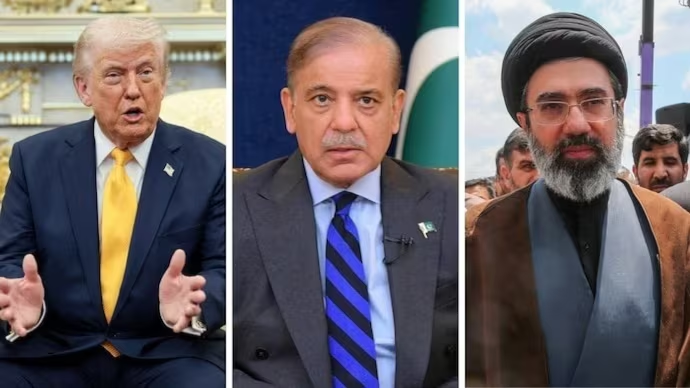
US–Iran Standoff at Breaking Point: Fragile Truce, Rising Violations, and Hormuz Flashpoint
By: Javid Amin | 23 April 2026
The confrontation between the United States and Iran has entered a dangerous and highly unstable phase, where a fragile two-week ceasefire is holding in form—but steadily eroding in substance.
At the center of this geopolitical crisis lies the Strait of Hormuz, a narrow maritime artery that now doubles as both a bargaining chip and a battlefield.
With negotiations in Islamabad stalled and military posturing intensifying, the risk of renewed escalation is no longer hypothetical—it is imminent.
Ground Reality: A Ceasefire in Name, Conflict in Practice
The two-week truce, brokered by Pakistan, followed nearly 40 days of sustained strikes and counterstrikes involving US and Israeli operations against Iranian targets.
What the Ceasefire Intended:
- Temporary halt to offensive operations
- Safe reopening of Hormuz for global shipping
- Diplomatic window for negotiations
What Is Happening Instead:
- Ship seizures and enforcement actions by US naval forces
- Iran reasserting control over Hormuz, including selective disruptions
- Commercial vessels facing live-fire risks mid-transit
The result is a paradox:
a ceasefire that exists diplomatically but is unraveling operationally.
Washington’s Strategy: Maximum Pressure at Sea
Under Donald Trump, the United States has adopted a hardline maritime doctrine:
- Naval blockade enforcement remains active
- Mine-clearing operations in Hormuz have been significantly expanded
- A controversial directive authorizes forces to engage Iranian vessels suspected of laying mines
This signals a shift from deterrence to preemptive enforcement, increasing the likelihood of direct confrontation.
For Washington, the calculus is clear:
control the sea lanes, control the negotiation leverage.
Tehran’s Response: Strategic Resistance and Internal Divisions
Iran’s approach is more layered—balancing external defiance with internal political friction.
External Posture:
- Assertion of authority over Hormuz
- Legislative efforts to regulate or restrict transit
- Signals of readiness for escalation if provoked
Internal Dynamics:
- Moderates, including figures aligned with parliamentary leadership, show conditional openness to talks
- Hardliners within the Islamic Revolutionary Guard Corps (IRGC) oppose compromise
Key figures like Ahmad Vahidi—aligned with power centers close to Mojtaba Khamenei—are currently shaping Tehran’s harder stance.
This internal divide significantly limits Iran’s negotiating flexibility, even if diplomatic openings emerge.
Islamabad Talks: A Diplomatic Deadlock
Despite initial optimism, negotiations in Islamabad have stalled:
- The US insists on security guarantees and nuclear concessions
- Iran denies formal talks under blockade pressure
Pakistan’s mediation has succeeded in delaying escalation—but not in bridging core differences.
The absence of progress now increases the risk that:
- The ceasefire expires without renewal
- Military options regain primacy
Global Shockwaves: Oil, Inflation, and Strategic Anxiety
The impact of the crisis is already reverberating globally.
Energy Markets:
- Oil prices have surged to the $89–95 per barrel range
- Volatility is driven by uncertainty around Hormuz access
Economic Fallout:
- Central banks, including the Reserve Bank of India and Bank of Japan, are factoring war risk into inflation models
- Shipping insurance and logistics costs are rising sharply
Strategic Reality:
Any sustained disruption in the Strait of Hormuz could trigger a global energy shock with cascading economic consequences.
Scenario Mapping: The Next 2–3 Weeks
1. Escalation & Return to Hostilities
Likelihood: High
- Trigger: Ship seizure, mine incident, or Israeli strike
- Outcome: Direct clashes, Hormuz disruption
- Impact: Oil > $100/barrel, regional war risk
2. Extended Truce Without Breakthrough
Likelihood: Medium–High
- Managed tension, no formal agreement
- Continued violations without full-scale conflict
- Markets adapt to sustained instability
3. Partial Compromise
Likelihood: Low–Medium
- Limited easing of blockade
- Controlled maritime corridors
- Temporary market stabilization
4. Internal Shift in Iran
Likelihood: Low
- Moderates gain influence
- Diplomatic engagement resumes
- Fragile but meaningful de-escalation
Key Watchpoints: Where the Crisis Could Turn
- Ceasefire expiry timeline: No extension could trigger immediate escalation
- Hormuz traffic disruptions: Fastest escalation trigger
- Iran’s internal power balance: निर्णायक factor in diplomacy
- US military directives: Limited room for tactical restraint
Strategic Conclusion: A Cycle of Fragile Calm and Imminent Risk
The US–Iran confrontation is now locked in a dangerous equilibrium:
- Neither side is willing to back down
- Both are prepared for escalation
- Diplomacy exists—but without traction
The most probable near-term outcome is a continuation of the fragile truce punctuated by violations, with a high risk of sudden escalation.
In strategic terms, this is not stability—it is contained volatility.
And as long as the Strait of Hormuz remains contested, the entire global system—from energy markets to security alliances—will remain on edge.