Abdullah & Mirwaiz on One Stage in Srinagar: A Rare Convergence Signals Memory, Loss & Possible Reconciliation in Kashmir
By: Javid Amin | 04 May 2026
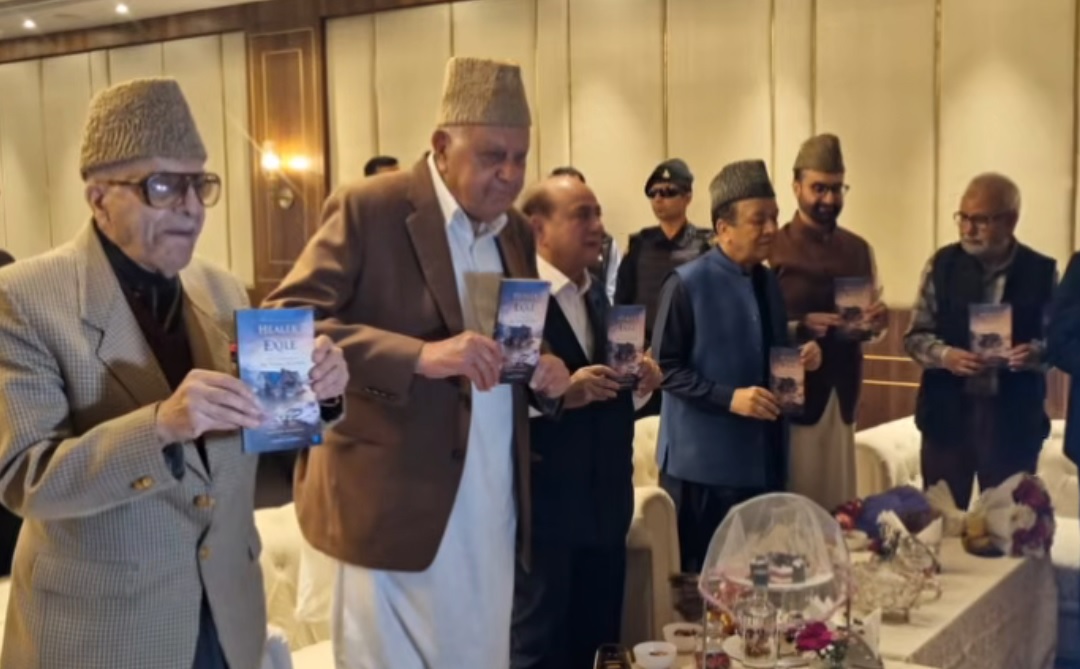
In a region where political lines are often sharply drawn, a quiet yet powerful moment unfolded in Srinagar on May 2, 2026. The launch of Healer in Exile: The Untold Story of Dr. Sushil Razdan turned into more than a literary gathering—it became a rare platform where mainstream and separatist voices shared space, memory, and a subtle message of reconciliation.
The presence of Farooq Abdullah and Mirwaiz Umar Farooq under one roof drew attention across political and civil circles in Kashmir. While both leaders carefully framed their participation within a cultural and literary context, the symbolism of the moment was hard to ignore.
A Book Launch That Became a Political Mirror
The event marked the release of Healer in Exile, authored by Sachin Razdan, chronicling the life of his father, Dr. Sushil Razdan—a respected neurologist whose career was shaped by both service and displacement.
Dr. Razdan represents a generation of Kashmiri Pandits whose lives were uprooted during the turbulent years around the 1990 Kashmiri Pandit exodus. His story, rooted in healing and exile, provided a deeply human lens through which larger questions of identity, belonging, and return were revisited.
The audience reflected a broad cross-section of Kashmiri society—leaders from the National Conference, PDP, BJP, Congress, senior bureaucrats, and civil society members. This diversity itself underscored the event’s importance as a shared civic space rather than a partisan gathering.
Farooq Abdullah: “The Greatest Loss of Kashmir”
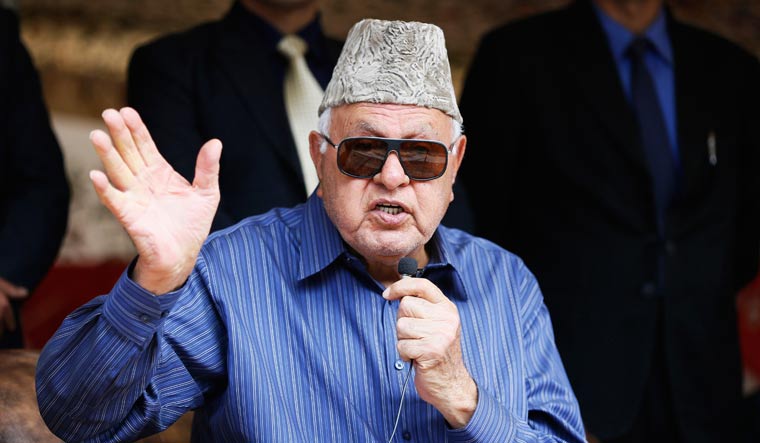
Speaking with characteristic candor, Farooq Abdullah described the exodus of Kashmiri Pandits as the “greatest loss” the Valley has endured in recent history.
His message was direct yet layered:
- Kashmir’s identity, he emphasized, has always been plural—home to Hindus, Muslims, Sikhs, and others.
- The absence of Pandits is not just demographic but civilizational.
- Their return, he argued, is essential to restoring the Valley’s cultural balance.
Abdullah also issued a warning against growing communal narratives. Without naming specific forces, he cautioned that divisions along religious lines risk validating the Two-nation theory—a concept he firmly rejected.
His remarks aligned with his long-standing political position that Kashmiriyat—a composite cultural identity—must remain the foundation for any future reconciliation.
Mirwaiz Umar Farooq: A Carefully Framed Presence
Mirwaiz Umar Farooq’s participation carried its own significance. Traditionally associated with separatist politics, his appearance alongside mainstream leaders was notable, especially in the post-Revocation of Article 370 landscape.
He was quick to clarify that his presence was “purely literary and social,” distancing the moment from formal political interpretation. Yet, his words carried depth:
- He paid tribute to Kashmiri Pandit teachers, invoking a quote attributed to Imam Ali: “If someone has taught you even one word, he is your sardar.”
- He highlighted the shared intellectual heritage of Kashmir, where Pandits played a central role in education and scholarship.
- Reflecting on Dr. Razdan’s life, he described his work as an embodiment of “humanity, love, and care.”
The Mirwaiz’s tone was reflective rather than political—yet it subtly reinforced the idea of coexistence rooted in shared history.
Kashmiri Pandits: Memory, Identity & the Question of Return
At the heart of the event was a collective remembrance of the Kashmiri Pandit community—its contributions and its absence.
Historically, Pandits have been central to Kashmir’s:
- Intellectual traditions
- Administrative systems
- Medical and educational institutions
Their displacement in the early 1990s remains one of the most sensitive and unresolved chapters in Kashmir’s history.
Both Abdullah and Mirwaiz, despite representing different political streams, converged on one point: the loss is not just of a community, but of a shared cultural fabric.
However, the question of return remains complex. Ground realities—security concerns, housing, employment, and trust deficits—continue to shape the discourse. While political appeals carry symbolic weight, sustainable return requires structural and policy-backed solutions.
Rare Optics in a Changing Political Landscape
The optics of the event are perhaps its most discussed aspect.
In Kashmir’s traditionally polarized political ecosystem, interactions between separatist leadership and mainstream politicians have been limited, especially in public forums. This makes the Srinagar gathering noteworthy.
Post-2019, the region has seen shifts in political engagement:
- Reduced visibility of separatist platforms
- Recalibration of mainstream politics
- Increased emphasis on civil society and cultural spaces
Within this context, the event can be read as a form of “soft engagement”—where cultural platforms become neutral ground for dialogue, even if indirect.
Beyond Symbolism: Is There a Deeper Signal?
While it would be premature to interpret the event as a political realignment, it does hint at subtle shifts:
- Adaptive Engagement: Leaders are exploring non-political spaces to connect with broader audiences.
- Shared Narratives: Memory of loss—especially regarding Kashmiri Pandits—remains a unifying theme.
- Public Messaging: Emphasis on coexistence and reconciliation is gaining visibility, even across ideological divides.
At the same time, both Abdullah and Mirwaiz maintained clear boundaries, ensuring their participation was not framed as political convergence.
Conclusion: A Moment of Reflection, Not Resolution
The Srinagar event did not produce policy announcements or political breakthroughs. What it did offer, however, was something equally important—a moment of shared reflection.
In a region often defined by its divisions, the coming together of diverse voices to acknowledge a common loss carries its own quiet significance.
Whether this moment evolves into something more substantial depends on future engagement—both at the political and societal levels. For now, it stands as a reminder that beneath the layers of conflict, there remains a memory of coexistence waiting to be reclaimed.