Iran Condemns US Attacks on Indian-Crewed Vessels After Death of Three Indian Seafarers
By: Javid Amin | 12 June 2026
Iran Slams US Over Attacks on Indian-Crewed Ships, Extends Condolences After Death of Three Sailors
Amid growing international concern over maritime security in the Gulf region, Iran has strongly criticized the United States over attacks on merchant vessels carrying Indian crew members off the coast of Oman, incidents that resulted in the deaths of three Indian seafarers.
The unusually sharp statement from Tehran comes as India has intensified diplomatic pressure on Washington, describing the attacks on commercial shipping as “unacceptable” and raising concerns about the safety of Indian nationals working aboard merchant vessels operating in conflict-prone waters.
The controversy has added a new dimension to the broader regional crisis, placing the safety of civilian shipping and international maritime law at the center of an already tense geopolitical confrontation.
Iran Condemns Attacks, Calls Them a Threat to Global Security
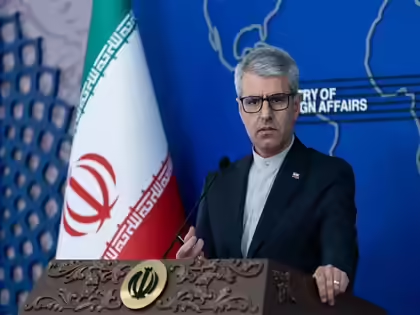
Iran’s Foreign Ministry spokesperson, Esmaeil Baqaei, condemned the attacks and expressed condolences to the families of the deceased Indian sailors.
In a public statement, Baqaei said the attacks demonstrated what he described as America’s policy of “armed robbery” and “state piracy,” while arguing that such actions threaten global peace, maritime security, and freedom of navigation. He also extended sympathy to the Government of India and the Indian people following the deaths of the three sailors.
Iran further urged the international community to hold Washington accountable for actions that it claims endanger civilian shipping and international trade routes.
Three Indian Seafarers Killed in Gulf Waters
The diplomatic row follows a series of attacks on commercial vessels operating near the Oman coast.
According to reports, three vessels carrying Indian crew members came under attack during the week. One of those incidents resulted in the deaths of three Indian seafarers, triggering outrage in India and renewed scrutiny of maritime security in the Gulf region.
Reuters reported that the fatalities occurred after a U.S. strike on a tanker near Oman, leading India to lodge formal protests with Washington. The incident has become one of the deadliest involving Indian merchant sailors in recent years.
India is one of the world’s largest suppliers of maritime manpower, with thousands of Indian seafarers serving aboard international commercial vessels operating across the Gulf, Arabian Sea, and Strait of Hormuz.
India Summons Top US Diplomat
In a rare diplomatic move, New Delhi summoned U.S. Chargé d’Affaires Jason Meeks for the second time within days to protest the attacks.
Indian officials reportedly told the American diplomat that the use of lethal force against commercial vessels carrying Indian crew members was unacceptable and deeply concerning. The Ministry of External Affairs emphasized that civilian shipping must never become collateral damage in regional conflicts.
India has consistently called for de-escalation in the region and has urged all parties to prioritize diplomatic solutions over military action. The government has also sought assurances regarding the safety of Indian citizens working aboard commercial ships transiting through Gulf waters.
Maritime Security Emerges as a Major Concern
The attacks have reignited concerns about the security of commercial shipping lanes in and around the Gulf of Oman and the Strait of Hormuz.
These waterways are among the world’s most strategically important maritime corridors, carrying a substantial share of global energy exports and international trade.
Shipping companies, insurers, and governments are increasingly worried that escalating military tensions could expose civilian vessels to greater risks. Maritime experts warn that even isolated attacks can have far-reaching consequences, including increased insurance premiums, higher freight costs, and disruptions to global supply chains.
The deaths of the Indian sailors have become a stark reminder of how geopolitical conflicts can directly affect civilian workers far from political decision-making centers.
Human Cost of the Gulf Crisis
Beyond the diplomatic confrontation, the tragedy has highlighted the vulnerability of merchant mariners operating in conflict zones.
Indian seafarers form a significant part of the global shipping workforce and often serve on vessels sailing through some of the world’s most sensitive maritime regions.
Families of the deceased sailors have called for accountability and stronger international protections for civilian crews. The incident has also sparked debate within India about maritime security, diplomatic responses, and the protection of Indian nationals working overseas.
Opposition leaders and maritime organizations have urged the government to take a more active role in ensuring that commercial vessels carrying Indian crews receive adequate protection in high-risk waters.
Why This Matters Globally
The dispute extends beyond India, Iran, and the United States.
At stake are fundamental questions about:
- Freedom of navigation.
- Protection of civilian shipping.
- International maritime law.
- Safety of commercial seafarers.
- Stability of global energy supply routes.
Any prolonged insecurity in the Gulf region could have implications for global trade, energy markets, and international shipping operations.
The incident also demonstrates how regional military confrontations can rapidly acquire international dimensions when civilian casualties involve nationals from third countries.
Key Developments at a Glance
| Development | Details | Significance |
|---|---|---|
| Iranian Condemnation | Tehran criticizes US attacks on Indian-crewed vessels | Escalates diplomatic pressure on Washington |
| Indian Casualties | Three Indian sailors killed off Oman coast | Human cost of regional conflict |
| India’s Response | US diplomat summoned again by New Delhi | Signals strong diplomatic concern |
| Maritime Security | Multiple vessels attacked in Gulf waters | Raises risks for global shipping |
| International Impact | Calls for accountability and de-escalation | Wider geopolitical implications |
Outlook
The deaths of three Indian seafarers have transformed what might have been viewed as another maritime security incident into a significant diplomatic issue involving India, Iran, and the United States.
While Tehran has used the tragedy to intensify criticism of Washington, New Delhi’s focus remains on accountability, maritime safety, and the protection of Indian citizens working abroad.
As investigations continue and diplomatic exchanges intensify, the incident is likely to remain a key point of discussion in regional security debates and international maritime forums.
For India, the central question is no longer only about geopolitics in the Gulf—it is about ensuring that Indian lives and commercial shipping are protected from the consequences of escalating regional conflicts.