AIIMS Awantipora Row: Mehbooba Mufti’s Visit Sparks Political Storm in Jammu and Kashmir
By: Javid Amin | 06 May 2026
From a Site Inspection to a Political Showdown, the AIIMS Awantipora Controversy Exposes Competing Claims Over Development, Accountability and Political Relevance
A Hospital Project Has Suddenly Become a Political Flashpoint
What began as a visit to a major healthcare project has rapidly evolved into one of the most talked-about political controversies in Jammu and Kashmir.
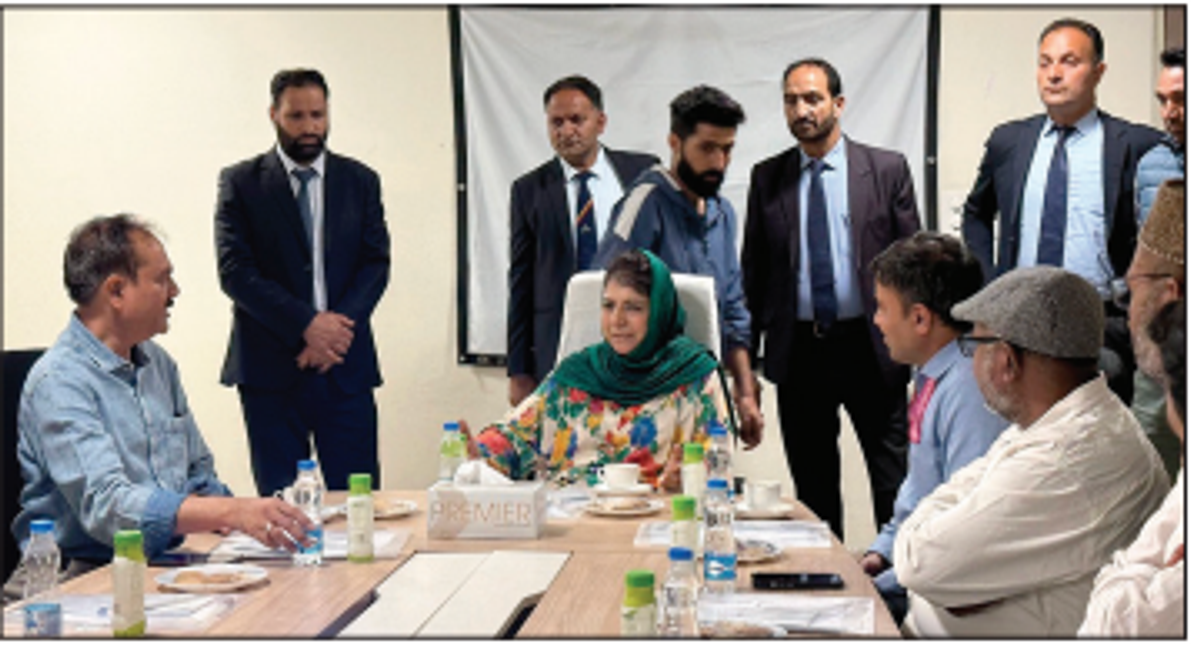
PDP president Mehbooba Mufti visited the under-construction AIIMS Awantipora facility in South Kashmir and later spoke with Union Health Minister Jagat Prakash Nadda, urging him to expedite the project’s completion. She subsequently said the minister assured her that the institution would be completed on time.
On the surface, the intervention appeared focused on healthcare infrastructure.
Within hours, however, it triggered sharp reactions from the ruling National Conference, opened a fresh PDP-NC confrontation, and sparked wider questions about political authority, development ownership, and the future of one of Kashmir’s most significant healthcare projects.
What Exactly Happened?
During her visit to the AIIMS site at Awantipora, Mehbooba Mufti reviewed the progress of construction and interacted with officials overseeing the project. She described the institution as an important healthcare asset for Jammu and Kashmir and linked it to the vision of her late father, Mufti Mohammad Sayeed, under whose government the project was originally sanctioned.
After the visit, she publicly disclosed that she had spoken with Nadda and requested that the remaining work be expedited.
In her statement, Mehbooba argued that Jammu and Kashmir’s healthcare system remains under immense pressure and that AIIMS Awantipora must become operational as early as possible to provide quality tertiary healthcare services.
Why Did the Visit Become Controversial?
The controversy was not about the AIIMS project itself.
Instead, it centred on the question of authority.
Several leaders from the ruling National Conference questioned the capacity in which Mehbooba Mufti conducted what they described as a “review” of a centrally funded institution.
J&K Health Minister Sakina Itoo publicly criticized the move, suggesting that some former rulers were behaving as if they still occupied positions of power and questioning under what authority such a review was undertaken.
NC chief spokesperson Tanvir Sadiq went further, calling the exercise “constitutional trespass” and accusing the PDP of seeking publicity through administrative grandstanding.
The criticism reflected a broader concern within the ruling establishment that unelected political leaders should not be perceived as exercising oversight over public institutions.
Sajad Lone Enters the Debate
The controversy took another turn when Sajad Lone joined the discussion.
Lone questioned the constitutional basis of the exercise and asked under what legal or administrative authority a former chief minister could chair or conduct a review meeting involving a central government institution. He described the situation as raising serious constitutional questions.
His intervention was notable because it came from outside the NC-PDP rivalry and broadened the debate beyond routine political criticism.
PDP’s Counterattack: Focus on Healthcare, Not Politics
The PDP quickly pushed back.
Pulwama MLA Waheed Ur Rehman Para accused the government of politicizing a healthcare issue instead of focusing on the urgent need to operationalize AIIMS Awantipora. He argued that patients across Jammu and Kashmir continue to suffer due to inadequate access to advanced medical facilities and that public representatives should be encouraging faster completion rather than engaging in political disputes.
The PDP’s argument is straightforward:
If a project of such importance is delayed, any political leader has a right—and perhaps a responsibility—to highlight the issue.
That position has found support among sections of the public frustrated by repeated delays in major infrastructure projects.
The Bigger Issue: Why AIIMS Awantipora Matters
Lost amid the political sparring is the actual importance of AIIMS Awantipora.
The institution is expected to become one of the largest healthcare, teaching and research facilities in Jammu and Kashmir. It was conceived as a major step toward reducing dependence on referral centres outside the Union Territory.
For years, patients requiring specialized treatment have frequently travelled to institutions in Delhi, Chandigarh and other cities.
Health experts have long argued that a fully operational AIIMS in Kashmir could:
- Expand access to super-speciality healthcare.
- Reduce treatment costs for families.
- Improve medical education.
- Strengthen research capacity.
- Generate employment opportunities.
- Reduce patient referrals outside J&K.
These practical concerns explain why public interest in the project remains high regardless of political affiliation.
Why the Timing Is Politically Significant
The controversy comes at a sensitive moment in Jammu and Kashmir politics.
In recent weeks, political debate has been dominated by:
- Statehood restoration.
- Article 370.
- The NC’s Dachigam retreat.
- Opposition criticism of the government.
- Questions about governance delivery.
Against that backdrop, AIIMS Awantipora offers something different.
Unlike constitutional debates, healthcare is an issue that directly affects everyday life.
This is precisely why the project has become politically valuable.
For the PDP, it offers an opportunity to project itself as a watchdog focused on public welfare.
For the National Conference, it represents a governance success story it does not want rivals to appropriate.
For the Centre, timely completion of the institution could become a visible example of infrastructure delivery in Jammu and Kashmir.
Who Wins This Political Battle?
Politically, both sides are attempting to shape public perception.
Mehbooba Mufti’s Objective
Position herself as a proactive leader raising issues that directly affect ordinary citizens and pressing New Delhi for action.
NC’s Objective
Prevent the opposition from claiming ownership of a major public project while reinforcing the legitimacy of the elected government.
Public’s Objective
Most citizens appear less interested in who gets political credit and more interested in one question:
When will AIIMS Awantipora actually become fully operational?
The Real Story Is the Delay
The controversy may dominate headlines today.
But the larger issue remains unchanged.
The success or failure of AIIMS Awantipora will ultimately be judged not by political statements, social media exchanges, or site visits.
It will be judged by:
- Construction progress.
- Operational readiness.
- Faculty recruitment.
- Patient services.
- Healthcare outcomes.
Until those questions are answered, political credit claims will remain secondary to public expectations.
Conclusion
The AIIMS Awantipora controversy reveals how deeply politicized even development projects have become in Jammu and Kashmir.
Mehbooba Mufti’s visit and her outreach to JP Nadda have undoubtedly succeeded in drawing attention to the project and the broader healthcare challenges facing the region. At the same time, the strong reaction from the National Conference shows how fiercely political parties are competing to define the development narrative ahead of future political battles.
For the public, however, the debate is much simpler.
The real question is not who reviewed the project.
The real question is when the doors of AIIMS Awantipora will finally open to patients.