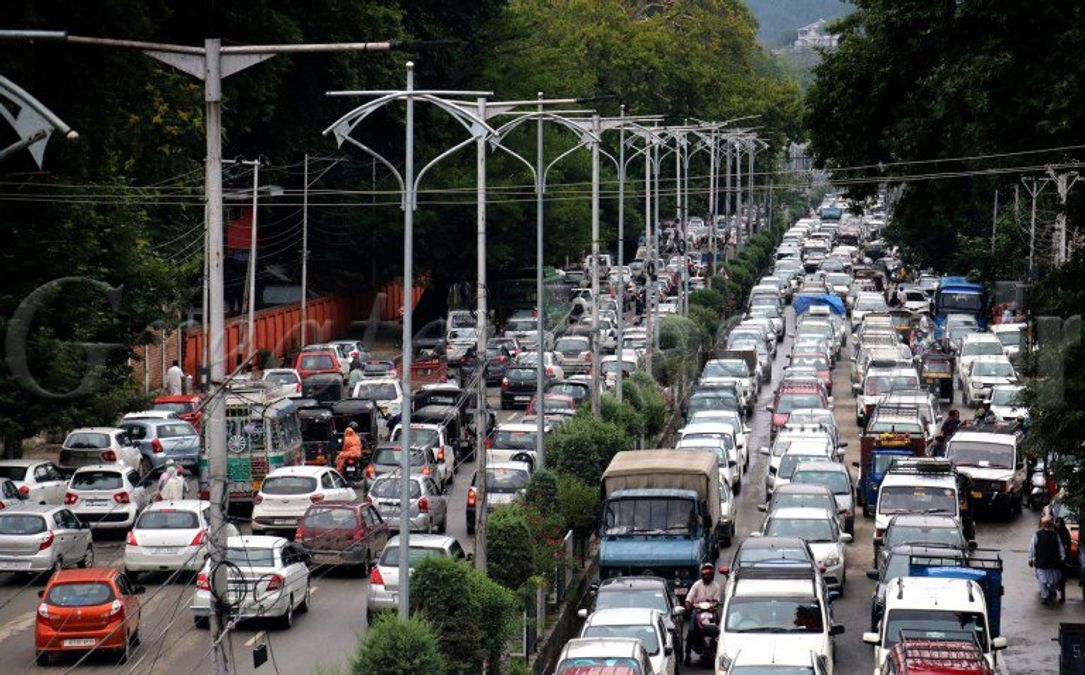
Kashmir’s Traffic Crisis: Why a 15-Minute Drive in Srinagar Now Takes an Hour
By: Javid Amin | 19 June 2026
A short hop from MA Road to Lal Chowk used to take five minutes. These days, it can eat up nearly an hour. Ask anyone who drives through Srinagar on a weekday evening, and they will tell you the same thing in different words: the city is stuck.
This isn’t an occasional bad day caused by a VIP movement or a sudden downpour. It has become the default condition of Srinagar’s roads — and increasingly, of South Kashmir’s towns too. Commuters inch through Lal Chowk, Rambagh, Jehangir Chowk, Nowgam, Dalgate and Hazratbal at a crawl. Patients in ambulances lose precious minutes. School vans run late. Shopkeepers watch customers turn back rather than fight through the jam.
Kashmir’s traffic problem is no longer a Srinagar-only story, and it is no longer just an inconvenience. It has quietly become one of the region’s biggest civic, economic, and public health challenges — and the people living through it every day are demanding answers.
A City Built for a Different Era, Carrying Today’s Load
Srinagar’s core roads were laid out decades ago, when the city’s population, vehicle count, and commercial footprint were a fraction of what they are now. Many of these roads were simply never designed to carry the volume of cars, two-wheelers, buses, and goods vehicles that pass through them today.
Officials have acknowledged this gap directly. Responding to questions in the Jammu and Kashmir Legislative Assembly, Deputy Chief Minister Surinder Choudhary noted that the city’s older road stretches, being legacy alignments, are struggling to keep pace with rising traffic, faster urbanisation, and growing commercial activity — a mismatch that shows up as congestion at peak hours.
It’s a polite, technical way of describing what residents feel viscerally every single day: roads built for yesterday’s Srinagar are buckling under today’s traffic.
What’s Actually Choking Srinagar’s Roads — According to the Ground Reports
It would be convenient to blame one factor — a flyover, a single road project, or a new piece of infrastructure — for Kashmir’s congestion crisis. But a closer look at recent assessments, court interventions, and on-ground accounts paints a more layered picture.
1. Illegal Parking and Encroachment of Public Space
A detailed road safety assessment by the Motor Vehicles Department’s Flying Squad, accessed by local media in June 2026, flagged a troubling pattern across Srinagar’s Central Business District and the busy TRC–Jehangir Chowk Flyover–Hyderpora corridor. The report pointed to large-scale encroachment of designated public parking spaces by commercial establishments in and around Lal Chowk, which forces commuters to park along roadsides instead — squeezing already-saturated markets even tighter.
The same assessment also flagged illegal U-turns, wrong-side driving, and the near-total absence of designated bus stops as factors compounding the chaos, warning that these violations are pushing the city toward a serious road safety crisis rather than just a slow-commute problem.
This isn’t a new pattern. The Jammu and Kashmir High Court itself has weighed in on the issue, observing that roadside parking is one of the chief reasons behind Srinagar’s daily jams and directing authorities to frame a policy banning vehicle parking on roads and highways. When a no-parking plan was rolled out along stretches like Lal Chowk to Dalgate and Jahangir Chowk to Karan Nagar, commuters did report smoother commutes — but traders pushed back, and shoppers continued to demand more designated parking alternatives, showing just how tangled the parking question really is.
2. Roadside Vending That Swallows Carriageways
Every Sunday, according to residents, the situation at Lal Chowk turns particularly chaotic. Vendors set up stalls directly on busy roads, reducing the usable carriageway and leaving pedestrians with barely any space to walk. Commuters have described ambulances and private vehicles getting stuck for hours, with locals openly questioning why enforcement seems to disappear specifically on weekends.
This isn’t confined to Srinagar. In Anantnag, South Kashmir’s largest town, similar tensions have played out. District authorities ordered street vendors off footpaths near the town’s main hospital corridor, citing frequent jams and delayed ambulances as justification. The move triggered its own backlash — critics pointed out that many of these vendors are daily-wage earners with no other livelihood, turning a traffic-management decision into a livelihood debate. Both things can be true at once: encroachment does worsen congestion, and enforcement without alternatives creates real hardship.
3. Cycle Tracks — Built With Good Intentions, Undone by Poor Upkeep
This is where ground reality complicates the popular narrative. Srinagar Smart City Limited did build dedicated cycle tracks along stretches like Foreshore Road and parts of Lal Chowk, with a genuine vision of making the city more cyclist-friendly. Early reception among cycling enthusiasts was positive.
But within months, cyclists reported a different story. Food vendors, ice-cream carts, and vegetable sellers had taken over large sections of these tracks, forcing cyclists back onto the main road amid fast-moving traffic — the exact danger the tracks were meant to prevent. One cyclist described being forced to repeatedly dismount and use the footpath while riding from Hazratbal to Nishat, simply because the dedicated lane was blocked by carts. A Srinagar Smart City Limited official acknowledged the problem, saying authorities would work to clear the encroachments and restore the tracks to their intended purpose.
So the real story isn’t that cycle tracks “stole” road space from cars and created gridlock on their own. It’s that without consistent enforcement, these tracks became contested ground — neither fully functional for cyclists nor genuinely freed up for vehicle traffic. That’s an enforcement and maintenance failure as much as a design one, and it’s a distinction worth getting right.
4. Diversions, Dilapidated Stretches, and Knock-On Bottlenecks
Even routine traffic diversions have shown how fragile Srinagar’s road network is. On one Sunday in April 2026, central routes including MA Road, Lal Chowk, and Abdullah Bridge saw prolonged gridlock after diversions around Sangarmal pushed vehicles onto already-stressed connecting roads. A poorly maintained stretch near Sangarmal made things worse, restricting flow even further. A normally five-minute journey stretched to nearly an hour for many commuters that day.
This kind of cascading failure — where one diversion or one bad patch of road ripples outward into multiple junctions — is a recurring pattern, not a one-off.
5. Infrastructure That Hasn’t Solved the Problem It Was Built For
Srinagar has invested in multilevel parking facilities, including one near Lal Chowk built at the old bus stand site, specifically to ease city-centre congestion. Yet busy corridors such as Lal Chowk, Residency Road, and Hari Singh High Street continue to see heavy jams. Observers point to a familiar mix of reasons: persistent roadside parking habits, narrow access points to the multilevel facilities themselves, and weak on-ground enforcement that lets old habits continue despite new infrastructure being available.
It’s a reminder that building infrastructure alone doesn’t change behaviour — without enforcement and genuine accessibility, even well-funded solutions can sit underused while the old problems persist right next to them.
The South Kashmir Picture: Anantnag’s Unplanned Growth
While Srinagar dominates the headlines, South Kashmir’s towns are facing a parallel — and in some ways more structural — crisis. Anantnag, the largest town in the Kashmir valley by area and population, has grown for decades without a formal master plan.
Officials reviewing the town’s draft Master Plan and Land Use Plan 2044 have been candid about the consequences: unregulated urban sprawl has led directly to traffic congestion, encroachments, and the steady loss of open spaces. Several of Anantnag’s key roads — including the Cheeni Chowk–Malakhnag–Sherpora stretch, the Janglat Mandi–Sherpora–Donipawa route, and the Mattan Chowk–Dangerpora–Court Road corridor — are simply too narrow for the volume of vehicles and pedestrians now using them daily.
District officials in Anantnag have held repeated stakeholder meetings with traders, market associations, and transport unions to address congestion hotspots like Mehndi Kadal, Lal Chowk (Anantnag’s own city centre, distinct from Srinagar’s), Ganjiwara, and Court Road — underlining that the lack of organised parking remains a central, unresolved complaint.
Further south, Pahalgam — one of Kashmir’s most visited tourist destinations — has reported severe congestion driven almost entirely by seasonal tourist influx, with key approach roads struggling to absorb the surge in vehicles during peak travel months.
How This Plays Out in Daily Life
Commuters Are Losing Hours They Can’t Get Back
For office-goers, students, and patients, traffic isn’t background noise anymore — it’s a direct tax on time. A short, predictable commute has become a daily gamble, with delays compounding stress, missed appointments, and disrupted routines.
Businesses Are Quietly Bleeding Money
Lal Chowk’s identity as Srinagar’s commercial heart means delivery trucks, supply vehicles, and customer footfall all depend on roads staying usable. When haphazard diversions and roadblocks force transporters to park randomly or take longer routes, the cost shows up in delayed deliveries, higher logistics expenses, and ultimately in the price tags shoppers pay. Traffic chaos doesn’t just frustrate people — it erodes the very commercial revival that Smart City projects were meant to support.
Emergency Services Pay the Steepest Price
Multiple reports — from Anantnag’s hospital-adjacent vending disputes to Srinagar’s diversion-related gridlocks — describe ambulances stuck in traffic, sometimes for extended periods. When a five-minute route becomes an hour-long ordeal, the consequences for emergency care are not hypothetical.
Health and Environment Take a Quiet Hit
Idling engines, longer commute times, and constant stop-start driving translate into higher fuel consumption, worse air quality, and rising stress levels in a region already navigating considerable pressures. It’s a slow-building cost that rarely makes headlines on its own but adds up year after year.
Why Quick Fixes Keep Falling Short
Srinagar and Anantnag have both tried short-term interventions — temporary diversions, enforcement drives, occasional anti-encroachment sweeps, new parking zones. Many of these produce visible relief for a few days or weeks. Few have proven durable.
The Chief Secretary’s office itself has acknowledged this churn, recently directing the Jammu and Srinagar Municipal Corporations to intensify anti-encroachment drives specifically to ease traffic and improve pedestrian safety — a sign that even at the top levels of administration, this remains a live, unresolved problem rather than something already fixed.
What’s increasingly clear from the ground reports is this: Kashmir’s traffic crisis isn’t the result of any single decision gone wrong. It’s the cumulative weight of legacy road design, unchecked encroachment, weak enforcement consistency, growing vehicle ownership, and urban growth that has consistently outpaced planning.
What Smarter Solutions Could Look Like
Make Parking Policy Real, Not Just Written Down
Court-mandated no-parking zones have shown measurable results where actually enforced. The bigger lesson is that enforcement needs to be continuous — not a one-week drive followed by months of silence — and paired with genuinely accessible alternative parking that doesn’t push traders and shoppers back onto the roadside out of necessity.
Protect Cycling Infrastructure Instead of Abandoning It
The Foreshore Road and Lal Chowk cycle track experience shows that good intentions need ongoing maintenance to survive. Rather than concluding that cycling infrastructure doesn’t work in Kashmir, the more accurate lesson is that it needs dedicated upkeep, clear signage, and consistent action against encroachment — otherwise scarce road space ends up serving neither cyclists nor motorists.
Expand and Modernise Public Transport
A genuinely reliable public bus network — with dedicated stops, predictable schedules, and decent coverage — remains one of the most direct ways to reduce private vehicle dependence. Authorities have already begun exploring e-rickshaw zones and one-way traffic systems in both Srinagar and Jammu; scaling these thoughtfully, rather than piecemeal, will matter.
Let Technology Do More of the Heavy Lifting
Srinagar’s Intelligent Traffic Management System, rolled out by Srinagar Smart City Limited with more than a thousand surveillance cameras, already issues e-challans for violations like red-light jumping, wrong-lane driving, and illegal halting. The infrastructure exists. The next step is using that real-time data not just for penalties, but for actively rerouting traffic, optimising signal timing, and identifying chronic bottleneck points before they spiral into the kind of gridlock seen on MA Road and Abdullah Bridge.
Give Anantnag — and Other Towns — a Real Master Plan
Anantnag’s congestion is, at its root, a planning gap. The town’s draft Master Plan and Land Use Plan 2044, now open for public feedback, is a genuine opportunity to bake wider roads, designated vending zones, and proper parking into the town’s growth — rather than retrofitting fixes after the fact, as has happened repeatedly over the past two decades.
Balance Enforcement With Livelihood Realities
The backlash against vendor removals in Anantnag is a reminder that traffic solutions can’t simply displace one set of problems onto vulnerable communities. Designated, regulated vending zones — rather than blanket bans — could ease congestion without pushing daily-wage earners into financial distress.
The Bigger Question: Is Kashmir Planning for Today, or Already Behind for Tomorrow?
Urban growth in Srinagar, Anantnag, and other Kashmir towns isn’t going to slow down. Tourism keeps climbing. Vehicle ownership keeps rising. Commercial activity keeps expanding into spaces never designed to hold it.
The real test isn’t whether authorities can clear today’s jam at Lal Chowk or this week’s diversion near Sangarmal. It’s whether the next decade of growth gets built around genuine mobility planning — wider roads where they’re truly needed, protected space for cyclists and pedestrians, reliable public transport, and parking policy that’s enforced consistently rather than in bursts.
Conclusion: Kashmir’s Roads Need a Plan, Not Another Patch
The story emerging from ground reports across Srinagar and South Kashmir is consistent: this isn’t about one flawed project or one bad road design. It’s about years of infrastructure decisions struggling to keep up with a region that has grown faster than its roads.
Fixing it will take more than another enforcement drive or another diversion order. It needs parking policy that holds up beyond a single court hearing, cycling infrastructure that’s actually protected, public transport people can rely on, smart-traffic technology used to its full potential, and town plans — like Anantnag’s long-delayed master plan — finally translated into roads built for the Kashmir of 2026, not the Kashmir of 1990.
Until that joined-up approach arrives, the five-minute drive that turns into an hour will likely remain part of daily life across the Valley.
This report is based on verified ground accounts, official assembly statements, Motor Vehicles Department assessments, and court directions reported by Rising Kashmir, Greater Kashmir, The Kashmir Horizon, The Right News, Kashmir Reader, and Daily Excelsior through June 2026.


