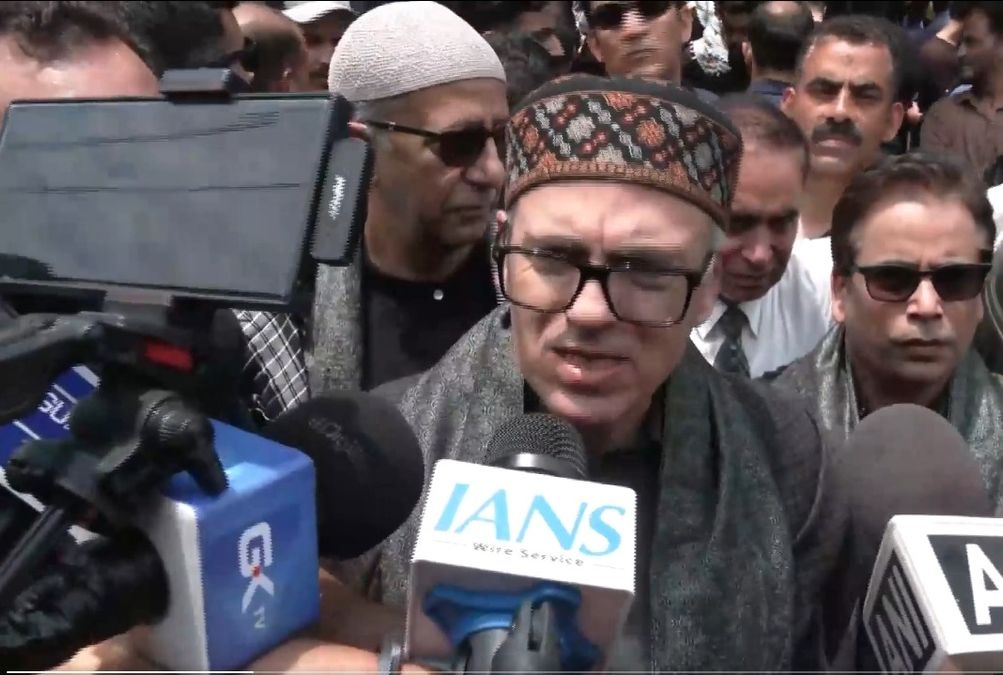
Omar Abdullah Fires Back at PDP Over Recruitment Row, Says ‘Ulta Chor Kotwal Ko Daante’
By: Javid Amin | 26 June 2026
War of Words Intensifies as Recruitment Becomes Jammu & Kashmir’s Biggest Political Flashpoint
The political battle over government recruitment in Jammu & Kashmir has escalated after Chief Minister Omar Abdullah strongly rejected the People’s Democratic Party’s (PDP) allegations of “backdoor appointments,” responding with the Hindi proverb, “Ulta chor kotwal ko daante”—a phrase commonly used to accuse someone of hypocrisy by suggesting that the guilty are accusing others of the very wrongdoing they themselves committed.
The Chief Minister’s sharp rebuttal came after the PDP accused the National Conference (NC)-led government of allowing irregular appointments and expanding outsourcing practices in government departments.
Rather than merely denying the allegations, Omar Abdullah turned the attack back on the opposition, arguing that the PDP had itself faced similar accusations during its tenure in government.
The exchange has transformed an administrative controversy into one of the most politically charged debates in Jammu & Kashmir, where employment remains a defining issue for thousands of educated young people.
PDP’s Allegations: Questions Over Recruitment and Outsourcing
The controversy began after the PDP accused the government of compromising transparency in public recruitment.
The party alleged that recruitment procedures were increasingly moving away from merit-based systems and questioned the growing dependence on outsourcing agencies for manpower across government departments.
PDP leaders argued that:
- Recruitment should take place only through established bodies such as the Jammu & Kashmir Public Service Commission (JKPSC) and the Jammu & Kashmir Services Selection Board (JKSSB).
- Outsourcing reduces opportunities for permanent government employment.
- Public confidence suffers when recruitment processes appear opaque.
- Young job aspirants deserve equal and transparent opportunities.
The party linked these concerns to the broader challenges of unemployment, arguing that educated youth should not be denied access to secure public-sector jobs through indirect hiring mechanisms.
Omar Abdullah’s Counterattack: Turning the Narrative
Responding to the allegations, Omar Abdullah dismissed the criticism outright and accused the PDP of political hypocrisy.
Using the proverb “Ulta chor kotwal ko daante,” he suggested that the opposition was attempting to criticize practices for which it had itself been criticized while in office.
The phrase carries significant political and cultural resonance in India, often used in public discourse to suggest that an accuser lacks moral authority because of their own past conduct.
By invoking it, the Chief Minister sought to shift the debate away from the allegations against his government and toward the PDP’s record during its years in power.
His response reflects a familiar strategy in competitive politics: countering criticism not only by denying wrongdoing but also by questioning the credibility of the accuser.
Recruitment Controversy Comes Amid Official Data and Judicial Scrutiny
The exchange between the NC and PDP unfolds against the backdrop of a wider debate over recruitment practices in Jammu & Kashmir.
Official data placed before the Legislative Assembly has shown that 22,886 positions were outsourced over the previous two years, with government expenditure on outsourced services exceeding ₹62 crore during the 2025–26 financial year.
These figures have fueled criticism from multiple opposition parties, who argue that excessive outsourcing limits opportunities for recruitment through regular competitive examinations.
The issue has gained further prominence following observations by the Jammu & Kashmir and Ladakh High Court in recruitment-related matters. The Court has emphasized that public employment must adhere to constitutional principles of equality and transparency, while criticizing selective recruitment practices in specific cases.
However, it is important to distinguish between the Court’s observations in individual recruitment disputes and the broader political allegations. There has been no judicial finding that establishes the current government engaged in the specific “backdoor appointments” alleged by the opposition.
Government’s Position: Outsourcing Meets Operational Needs
The National Conference-led government has consistently defended its administrative approach.
Officials maintain that outsourced manpower is engaged primarily to meet urgent operational requirements in sectors such as:
- Healthcare
- Information technology
- Housekeeping
- Security services
- Technical support
- Transport and logistics
The government argues that outsourcing follows established procurement rules, including e-tendering and other prescribed procedures, and is intended to supplement—not replace—regular recruitment conducted through statutory recruitment agencies.
From the administration’s perspective, outsourcing helps maintain continuity in essential public services while recruitment processes for permanent posts continue through institutional channels.
Why Jobs Have Become the Most Sensitive Political Issue
Employment has emerged as one of the defining issues in Jammu & Kashmir’s political landscape.
With a large number of graduates competing for limited government vacancies, recruitment policies carry significant social and political consequences.
For many young people, government employment represents:
- Financial stability
- Long-term career prospects
- Social security
- Merit-based advancement
- Economic mobility
Consequently, any controversy involving recruitment, outsourcing, or alleged irregularities attracts widespread public attention.
Political analysts note that opposition parties increasingly view employment as a central campaign issue because it directly affects families across both urban and rural areas.
A Battle of Narratives Between NC and PDP
The recruitment controversy has also become part of a broader political contest between the National Conference and the People’s Democratic Party.
| Issue | National Conference Position | PDP Position |
|---|---|---|
| Recruitment Allegations | Denies wrongdoing; accuses PDP of hypocrisy | Seeks independent, transparent recruitment |
| Outsourcing | Administrative necessity to address staffing gaps | Excessive reliance undermines merit-based employment |
| Political Narrative | Opposition lacks credibility due to its own past | Government must answer present-day concerns |
| Core Message | Governance continuity and service delivery | Fair opportunities and accountability |
Both parties are attempting to frame themselves as defenders of the interests of Jammu & Kashmir’s youth, though they differ sharply on the causes of the current controversy and the solutions required.
Public Trust at the Centre of the Debate
Beyond the political exchanges, the controversy raises broader questions about public confidence in recruitment systems.
Experts argue that transparency in public employment is essential to maintaining trust in democratic institutions.
When recruitment processes are perceived as open, competitive, and merit-based, confidence in governance is strengthened.
Conversely, prolonged allegations of favoritism or opacity—whether proven or unproven—can contribute to public skepticism, particularly among unemployed youth awaiting government recruitment.
This is why the debate extends beyond party politics and touches on fundamental issues of governance and institutional credibility.
What Lies Ahead?
The recruitment controversy is likely to remain a prominent political issue in the coming months.
Several developments could influence its trajectory:
Judicial Oversight
Any future litigation related to recruitment practices may further shape public discourse on transparency and accountability.
Government Recruitment
The pace of recruitment through JKPSC and JKSSB will be closely watched by job aspirants and political parties alike.
Political Campaigns
Employment and recruitment transparency are expected to remain central themes in the opposition’s campaign strategy.
Public Expectations
Young people continue to seek timely recruitment, clear procedures, and equal opportunities, regardless of the political narrative surrounding the issue.
Conclusion
Chief Minister Omar Abdullah’s sharp response to the PDP’s allegations has intensified an already heated political debate over recruitment and governance in Jammu & Kashmir.
By invoking the phrase “Ulta chor kotwal ko daante,” the Chief Minister sought to challenge the opposition’s credibility and shift attention to its own record in government. The PDP, meanwhile, continues to argue that transparency, merit-based recruitment, and reduced reliance on outsourcing should be priorities for the current administration.
While the exchange has added political drama to the controversy, the underlying issue remains unchanged: ensuring that recruitment to public employment is transparent, fair, and capable of restoring the confidence of thousands of young people seeking opportunities in Jammu & Kashmir.
Ultimately, for citizens, the focus is likely to remain less on political rhetoric and more on whether recruitment systems deliver equal opportunity, timely appointments, and accountable governance.