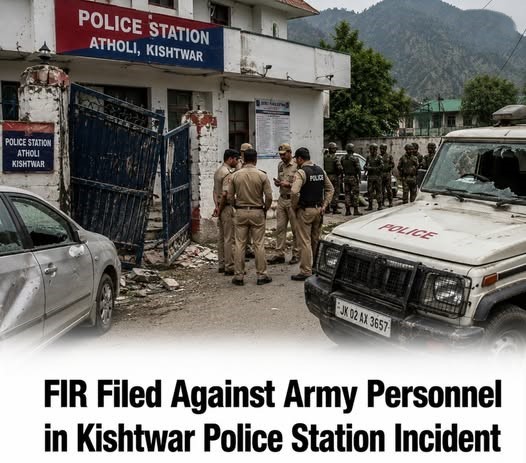
Kishtwar Police Station Clash: FIR Against Army Personnel Raises Questions Over Discipline, Accountability and Civil-Military Coordination
By: Javid Amin | 25 June 2026
Alleged assault at Atholi Police Station involving 17 Rashtriya Rifles personnel becomes a sensitive test for institutional accountability in Jammu & Kashmir
A serious confrontation between personnel of the Indian Army and Jammu & Kashmir Police in Kishtwar district has triggered concerns over discipline, institutional coordination and civil-military relations in a sensitive security region.
An FIR has been registered against around 40 Army personnel, including senior officers of the 17 Rashtriya Rifles, for allegedly entering Atholi Police Station on June 24, 2026, assaulting police officials and damaging property.
According to the allegations mentioned in the case, the incident involved violence inside the police station following a dispute related to the seizure of a private vehicle linked to an Army officer over traffic violations.
The matter has drawn attention because clashes between security forces operating in the same region are rare and carry wider implications beyond the immediate legal proceedings.
What happened at Atholi Police Station?
The alleged incident took place between 12 pm and 1 pm on June 24 at Atholi Police Station in Kishtwar district.
According to the FIR, a group of Army personnel allegedly arrived at the police station after a vehicle associated with an Army officer was seized by police authorities for traffic-related violations.
The complaint alleges that the personnel entered the station premises and attacked police officials.
The allegations include:
- Assault on police personnel
- Damage to government property
- Disruption of police functioning
- Use of force inside a police facility
Authorities have initiated legal proceedings and investigation into the matter.
Who has been named in the FIR?
The FIR reportedly names several personnel, including senior officers linked to the 17 Rashtriya Rifles unit.
Those named include:
- Colonel N. Arun Gandhi, Commanding Officer, 17 Rashtriya Rifles
- Major Vikas Sharma
- Naib Subedar Shankar Gurkhe
- Several soldiers
- Around 30–40 unidentified personnel
The investigation will determine individual responsibility based on evidence, witness statements and available records.
Serious charges filed under BNS and public property law
The case has been registered under multiple provisions of the Bharatiya Nyaya Sanhita (BNS) and the Prevention of Damage to Public Property Act.
The charges reportedly include:
- Attempt to murder
- Rioting
- Assault on public servants
- Criminal trespass
- Unlawful assembly
- Damage to public property
The inclusion of serious sections, including Section 109 of BNS related to attempt to murder, indicates the gravity of the allegations.
However, the final legal position will depend on the outcome of the investigation and judicial proceedings.
Police officials allegedly injured
According to the complaint, several police officials were allegedly attacked during the incident.
Those reportedly affected include:
- SHO Amrit Katoch
- SDPO Vijay Kumar Bhagat
- ARTO officials
- Other police personnel
The FIR alleges that uniforms were torn, officials were assaulted and vehicles were damaged during the confrontation.
The allegations also mention the presence of weapons, including lathis, iron rods and service weapons.
The trigger: Vehicle seizure dispute
The immediate trigger behind the confrontation was reportedly the seizure of a private vehicle connected to an Army officer.
Police had allegedly taken action over traffic violations, following which the dispute escalated.
Officials investigating the matter will examine:
- Whether the vehicle seizure followed legal procedure
- Whether the response by Army personnel was justified
- Whether excessive force was used
- Who was responsible for escalation
Army response: Matter under examination
The Indian Army has acknowledged that the FIR has been registered and stated that the matter is being examined through appropriate institutional mechanisms.
The Army has indicated cooperation with the police investigation and said action would be taken based on findings of the inquiry process.
The response reflects the seriousness with which such allegations are treated, especially when they involve personnel from security institutions.
Why the incident matters for J&K
Jammu & Kashmir has a unique security environment where multiple agencies operate together, including:
- Army
- Police
- Central armed forces
- Civil administration
Coordination between these institutions is critical for maintaining public confidence and effective security operations.
A confrontation between two major security organisations creates concerns because it can affect:
Institutional trust
People expect security agencies to operate with discipline and mutual coordination.
Public confidence
Questions around accountability can influence how communities view law enforcement institutions.
Operational cooperation
Security operations require strong coordination between different agencies, particularly in sensitive areas.
Civil-military relations under scrutiny
The incident has renewed debate about maintaining clear boundaries between military responsibilities and civilian policing.
The Army plays a major role in J&K’s security framework, while police remain responsible for law enforcement and criminal investigations.
Experts say both institutions must work within their legal mandates to avoid situations that can weaken public trust.
Transparent investigation and accountability are considered essential to prevent similar incidents in the future.
Legal challenges ahead
The case involves several complexities because senior officers have been named.
Key questions before investigators include:
- What evidence supports the allegations?
- Were weapons used during the incident?
- Was the action planned or a result of sudden escalation?
- Who gave instructions, if any?
- What role did individual personnel play?
The answers will depend on investigation findings, evidence collection and court proceedings.
Political sensitivity in a fragile security environment
Any dispute involving security forces in J&K attracts significant attention because of the region’s history and security challenges.
Political groups and public observers are likely to closely monitor:
- The pace of investigation
- Transparency of proceedings
- Accountability measures
Authorities will face the challenge of ensuring justice while maintaining institutional stability.
The road ahead
The Kishtwar incident is likely to become an important case study in accountability and coordination among security institutions.
A fair and transparent investigation will be critical to establish facts and prevent speculation.
For Jammu & Kashmir, where security forces and civil authorities work in close proximity, maintaining discipline, professionalism and mutual respect remains essential.
The outcome of this case will not only determine individual responsibility but may also influence public confidence in the institutions responsible for maintaining law and order.

