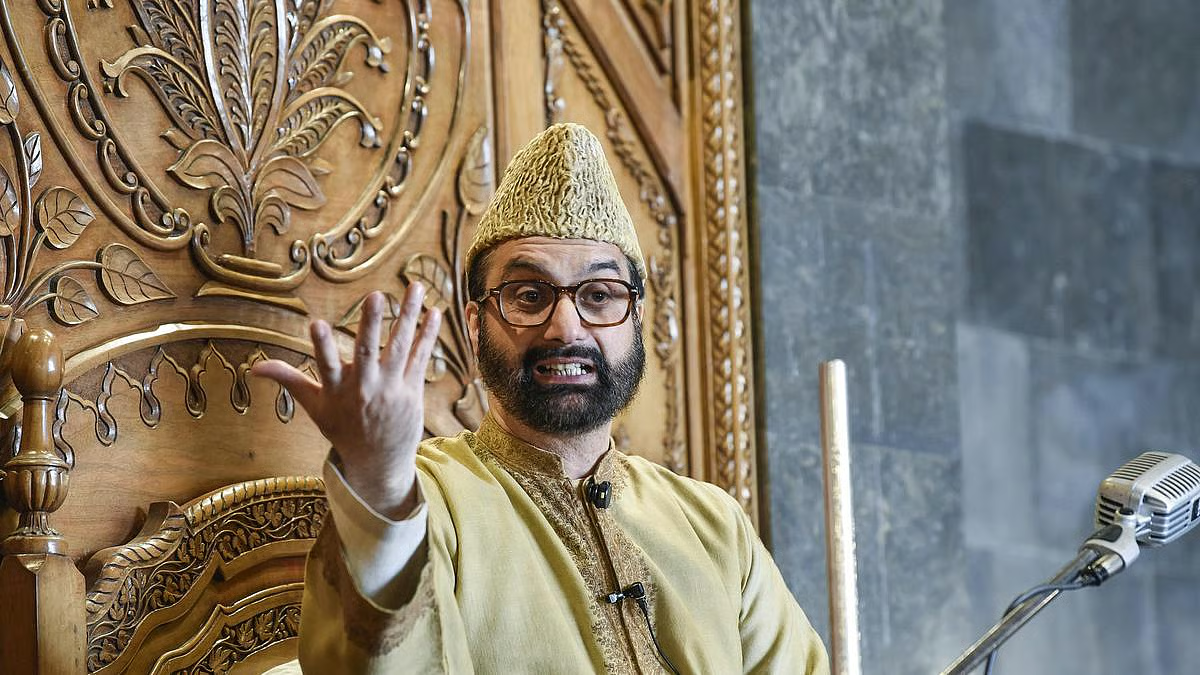
Mirwaiz Umar Farooq Urges PM Modi to Revive India-Pakistan Dialogue, Calls for Return to ‘Spirit of Engagement’
By: Javid Amin | 26 June 2026
Hurriyat Leader Says Lasting Peace in South Asia Requires Political Dialogue, Confidence-Building and Sustained Diplomatic Engagement
At a time when relations between India and Pakistan remain at one of their lowest points in recent years, Hurriyat Conference chairman Mirwaiz Umar Farooq has appealed to Prime Minister Narendra Modi to revive the “spirit of engagement” between the two neighbouring countries, arguing that dialogue remains the only sustainable path toward lasting peace and regional stability.
Addressing a gathering in Srinagar, the Mirwaiz said decades of confrontation have deepened mistrust and suffering, while periods of diplomatic engagement have historically generated hope for peace. Referring to previous peace initiatives, he urged New Delhi to explore avenues for renewed dialogue with Islamabad and work toward resolving long-standing disputes through political and diplomatic means.
His remarks have once again brought the India-Pakistan relationship—and the future of Kashmir—into public discussion, even as the official positions of both governments remain far apart.
Mirwaiz’s Appeal: ‘Revive the Spirit of Engagement’
In his address, Mirwaiz Umar Farooq stressed that dialogue should not be viewed as a sign of weakness but as an instrument for reducing tensions and preventing conflict.
According to him, sustained engagement between India and Pakistan has, at different points in history, created opportunities for confidence-building and opened channels for addressing contentious issues.
He urged Prime Minister Narendra Modi to revive what he described as the “spirit of engagement” that characterised earlier diplomatic initiatives, saying peaceful dialogue offers a better alternative to prolonged confrontation.
The Hurriyat leader also reiterated his long-held position that the Kashmir issue remains central to India-Pakistan relations and requires a political process alongside security measures.
Kashmir at the Centre of the Conversation
Mirwaiz argued that while security concerns continue to shape policy in Jammu and Kashmir, lasting peace would require political engagement and greater efforts to address the aspirations and concerns of people in the region.
He maintained that unresolved disputes have contributed to recurring cycles of instability over several decades.
These remarks are consistent with the Hurriyat Conference’s longstanding advocacy for dialogue involving stakeholders connected to the Kashmir issue.
However, the Government of India has consistently maintained that Jammu and Kashmir is an integral part of India and that any matter relating to the Union Territory is an internal issue. New Delhi has also repeatedly stated that any dialogue with Pakistan can proceed only in an environment free from terrorism and cross-border violence.
Remembering Earlier Peace Initiatives
By invoking the “spirit of engagement,” Mirwaiz appeared to reference earlier diplomatic efforts that had briefly improved relations between India and Pakistan.
The Vajpayee Peace Initiative
Former Prime Minister Atal Bihari Vajpayee’s outreach to Pakistan, including the Lahore Bus Diplomacy in 1999, is widely remembered as one of the most significant attempts to improve bilateral relations.
Vajpayee’s vision of resolving differences through “Insaniyat, Jamhooriyat and Kashmiriyat” continues to be cited in discussions on Kashmir.
The 2003 Ceasefire
The ceasefire agreement along the Line of Control (LoC) in 2003 significantly reduced cross-border firing for several years, providing relief to border communities and creating space for diplomatic engagement.
Composite Dialogue Process
Between 2004 and 2008, India and Pakistan held multiple rounds of the Composite Dialogue covering issues such as peace and security, trade, cultural exchanges, water-sharing and Kashmir.
Several confidence-building measures emerged during this period, including cross-LoC bus services and trade routes connecting divided families across Jammu and Kashmir.
Although these initiatives did not resolve core disputes, they demonstrated that sustained diplomatic engagement could reduce tensions and improve people-to-people contacts.
Why India-Pakistan Dialogue Has Remained Elusive
Since Independence in 1947, India and Pakistan have engaged in numerous rounds of negotiations, but almost every diplomatic breakthrough has eventually encountered setbacks.
Talks have frequently been suspended following military confrontations, terrorist attacks, political transitions or deteriorating bilateral relations.
In recent years, relations have remained strained due to differences over terrorism, Kashmir, cross-border security and diplomatic engagement.
Following the constitutional changes in Jammu and Kashmir in August 2019, bilateral relations witnessed a further decline, with formal political dialogue remaining largely suspended.
Although the reaffirmation of the 2003 ceasefire understanding by military officials in 2021 helped reduce cross-border hostilities, comprehensive diplomatic engagement has not resumed.
The Current Diplomatic Climate
The present political environment presents significant challenges for any renewed dialogue.
India has consistently maintained that terrorism and violence remain the primary obstacles to normalisation of bilateral relations.
Pakistan, meanwhile, continues to emphasise the Kashmir issue as central to bilateral engagement.
These differing priorities have contributed to the absence of structured diplomatic talks despite occasional backchannel communication and limited functional engagement on humanitarian or technical matters.
Against this backdrop, Mirwaiz’s remarks reflect broader calls from sections of civil society advocating renewed diplomatic efforts to reduce regional tensions.
Political Sensitivity Surrounding Kashmir
Any discussion involving Kashmir remains politically sensitive in both India and Pakistan.
Within India, political parties often differ on the methods through which peace, development and security should be pursued in Jammu and Kashmir.
Supporters of renewed dialogue argue that diplomacy can complement security measures by reducing mistrust and creating opportunities for long-term stability.
Others contend that meaningful dialogue cannot progress without credible action against cross-border terrorism and security threats.
As a result, proposals for renewed engagement frequently generate both support and criticism across the political spectrum.
Public Sentiment: Hope Mixed With Skepticism
Across Jammu and Kashmir, reactions to calls for dialogue often reflect a combination of hope and caution.
Many residents, particularly those living near border areas, have experienced the human cost of prolonged tensions, including displacement, disrupted livelihoods and uncertainty.
For such communities, periods of reduced hostilities have historically brought tangible improvements in daily life.
At the same time, repeated breakdowns in previous peace initiatives have left many observers skeptical about whether fresh dialogue can produce lasting results without sustained political commitment from both governments.
What Would Be Needed to Restart Dialogue?
Diplomatic experts generally agree that any meaningful revival of India-Pakistan engagement would require multiple confidence-building measures.
These could include:
Restoring Diplomatic Communication
Regular official-level interactions can help reduce misunderstandings and manage crises more effectively.
Strengthening the Ceasefire
Maintaining peace along the Line of Control remains essential for improving security and public confidence in border regions.
Expanding Humanitarian Exchanges
Facilitating cultural, academic and family exchanges can help rebuild trust at the people-to-people level.
Economic and Trade Cooperation
Limited economic engagement has historically served as a stabilising factor during periods of improved bilateral relations.
Sustained Political Commitment
Perhaps the most important requirement is consistent political will from both governments to continue engagement even during periods of disagreement.
The Road Ahead
Mirwaiz Umar Farooq’s appeal has once again revived discussion on the future of India-Pakistan relations and the role of dialogue in addressing long-standing regional challenges.
Whether his call influences official policy remains uncertain.
At present, the positions of New Delhi and Islamabad continue to differ significantly on key issues, particularly concerning terrorism, Kashmir and the conditions necessary for resuming comprehensive talks.
Nevertheless, the remarks reflect an enduring debate that has shaped South Asian diplomacy for decades: whether sustained engagement, despite deep disagreements, offers a more effective path toward stability than prolonged diplomatic disengagement.
As geopolitical realities evolve and regional security remains a priority for both nations, the question of dialogue is likely to remain central to discussions about peace, conflict management and the future of South Asia.

