NC, PDP Renew Commitment to Restore J&K’s Special Status on August 5 Anniversary
By: Javid Amin | 05 Aug 2026
Srinagar: Seven years after the constitutional changes of August 5, 2019, Jammu and Kashmir’s two principal regional political parties—the National Conference (NC) and the People’s Democratic Party (PDP)—have renewed their commitment to pursuing the restoration of the region’s constitutional rights and political identity.
Marking the anniversary of the abrogation of Article 370 and Article 35A, leaders of both parties described the 2019 decision as a defining political moment that fundamentally altered Jammu and Kashmir’s constitutional relationship with the Union of India.
While both parties remain united in opposing the changes introduced in 2019, they continue to differ on how that political objective should be pursued, reflecting the evolving dynamics of opposition politics in the Union Territory.
August 5 Continues to Shape J&K’s Political Narrative
For regional political parties, August 5 remains one of the most significant dates in Jammu and Kashmir’s contemporary political history.
On August 5, 2019, Parliament approved measures that effectively rendered Article 370 inoperative and led to the bifurcation of the erstwhile state into the Union Territories of Jammu & Kashmir and Ladakh.
The BJP has consistently defended the decision as a historic reform that strengthened national integration, extended central laws uniformly and accelerated development.
The NC and PDP, however, continue to argue that the move removed constitutional guarantees and altered the federal relationship between Jammu and Kashmir and the Union.
That difference continues to define the region’s political discourse.
National Conference: Statehood First, Constitutional Restoration Remains Part of Its Long-Term Position
The National Conference has, over the past year, concentrated much of its political campaign on the restoration of full statehood to Jammu and Kashmir.
Chief Minister Omar Abdullah and senior NC leaders have repeatedly argued that restoring statehood is an urgent democratic necessity and have urged the Union government to fulfil its commitment following the Supreme Court’s 2023 judgment.
At the same time, the party has maintained that its broader constitutional position regarding the pre-2019 status of Jammu and Kashmir remains unchanged.
The NC’s approach has largely focused on:
- Restoration of full statehood.
- Strengthening democratic institutions.
- Constitutional and legal advocacy.
- Political engagement through democratic processes.
This strategy reflects the party’s belief that immediate constitutional and administrative gains can create a foundation for addressing broader political issues.
PDP: Article 370 Remains the Central Political Demand
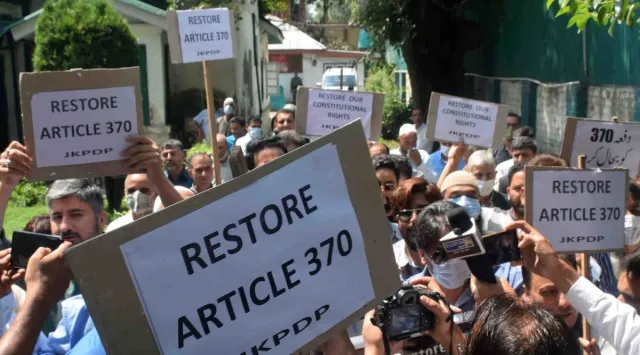
The PDP has adopted a more direct approach, insisting that the restoration of Article 370 and Article 35A remains the central political issue.
PDP president Mehbooba Mufti has repeatedly argued that restoring statehood alone cannot compensate for the constitutional changes introduced in August 2019.
According to the PDP, the struggle is about:
- Constitutional guarantees.
- Political dignity.
- Democratic rights.
- Federal principles.
- Restoration of the constitutional safeguards that existed before August 2019.
The party has also organised symbolic protests and public campaigns to keep Article 370 at the centre of political discourse.
For the PDP, August 5 represents not merely an anniversary but a continuing political campaign.
Shared Objective, Different Political Strategies
Although the NC and PDP continue to oppose the 2019 constitutional changes, their methods differ considerably.
| Issue | National Conference | People’s Democratic Party |
|---|---|---|
| Immediate Priority | Restoration of statehood | Restoration of Article 370 and Article 35A |
| Long-Term Position | Constitutional restoration through democratic and legal means | Constitutional restoration through political mobilisation and democratic campaign |
| Political Strategy | Institutional engagement and constitutional advocacy | Public mobilisation, symbolic protests and political outreach |
| Focus | Democratic governance and statehood | Constitutional identity and rights |
These differences do not necessarily represent disagreement over the broader constitutional question.
Rather, they reflect differing assessments of political priorities and the most effective route towards achieving long-term objectives.
Can Opposition Parties Build a Common Platform?
One of the recurring questions in Jammu and Kashmir politics is whether regional parties can build a united platform despite their strategic differences.
Both the NC and PDP have repeatedly criticised the constitutional changes of 2019.
Both have expressed support for restoring democratic institutions and greater political autonomy.
However, differences over sequencing and political messaging have complicated efforts to build a common opposition campaign.
The NC has increasingly sought to rally support around statehood, arguing that it is a constitutionally attainable objective.
The PDP has cautioned against allowing Article 370 to fade from the political agenda.
These differing emphases have occasionally prevented joint political programmes, even where the broader political objectives overlap.
Article 370 Remains the Defining Political Issue
Despite changing political circumstances, Article 370 continues to dominate regional politics.
For many regional political leaders, the issue extends beyond constitutional law.
It is also presented as a question of:
- Identity.
- Federalism.
- Democratic representation.
- Constitutional guarantees.
- Political trust.
At the same time, the legal landscape has changed significantly.
In December 2023, the Supreme Court upheld the constitutional validity of the Union government’s decision relating to Article 370 while directing that statehood be restored to Jammu and Kashmir at the earliest.
That judgment settled the legal position but did not end the political debate.
Regional parties continue to advocate their respective constitutional and political positions through democratic means.
BJP’s Position Remains Unchanged
The BJP continues to maintain that the abrogation of Article 370 was a historic and irreversible decision.
According to the party, the move:
- Fully integrated Jammu and Kashmir with the rest of India.
- Extended constitutional rights and welfare schemes.
- Improved governance.
- Encouraged economic development.
- Strengthened national unity.
The party has consistently rejected opposition demands for restoring Article 370.
This sharp difference ensures that the issue remains one of the most contested subjects in national politics.
What Does This Mean for J&K Politics?
The anniversary has once again highlighted that Article 370 remains the defining issue in Jammu and Kashmir’s political landscape.
While the NC and PDP continue to pursue different political strategies, both have reaffirmed that the constitutional changes of 2019 remain central to their political narratives.
The coming months are likely to see continued debate over:
- Restoration of statehood.
- Democratic governance.
- Constitutional safeguards.
- Regional identity.
- Federal relations.
How these issues shape future political alignments will depend not only on regional parties but also on the Union government’s response to the demand for statehood and the broader constitutional conversation.
Outlook: A Shared Goal, Different Roads
Seven years after Article 370 was rendered inoperative, the constitutional question continues to shape every major political debate in Jammu and Kashmir.
The National Conference and the People’s Democratic Party remain committed to challenging the political legacy of the 2019 decision, but they have chosen different paths.
The NC is prioritising the restoration of statehood while maintaining its broader constitutional position.
The PDP continues to insist that Article 370 itself must remain at the heart of the political movement and that statehood alone cannot address what it sees as the erosion of Jammu and Kashmir’s constitutional identity.
Whether these parallel strategies eventually converge into a broader opposition platform remains uncertain.
What is clear, however, is that Article 370 continues to be the defining political fault line in Jammu and Kashmir, and the anniversary of August 5 remains a powerful reminder that the constitutional debate is far from over.


