Altaf Bukhari, Tanvir Sadiq Call for Restraint on Youth Cases as Kashmir’s Trust Debate Returns
By: News Desk | 11 Aug 2026
Srinagar: At a time when Jammu and Kashmir is entering another politically sensitive period ahead of Independence Day, two prominent regional political voices have put the spotlight on an issue that goes beyond routine law-and-order debates: how the government deals with young people who have faced police cases, FIRs or scrutiny over past incidents.
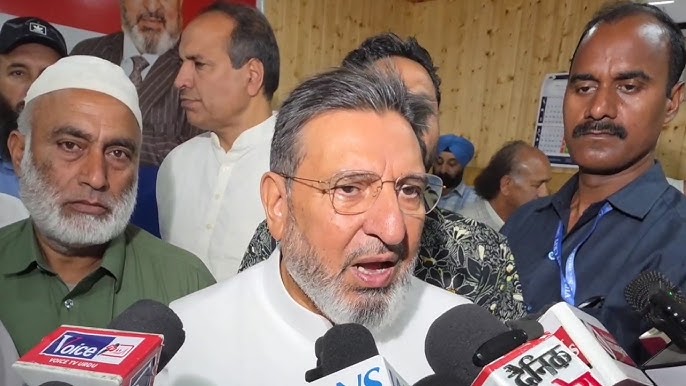
Apni Party president Syed Mohammad Altaf Bukhari has repeatedly argued for confidence-building measures, dialogue and an opportunity for Kashmiri youth to return to normal life rather than remaining trapped by the consequences of past political turmoil. National Conference chief spokesperson and Zadibal MLA Tanvir Sadiq, meanwhile, has also sought relief for young people facing cases, arguing that a punitive approach can deepen alienation rather than strengthen public confidence.
Together, the positions underline a growing political argument in Jammu and Kashmir: security and accountability may remain necessary, but long-term stability also depends on trust, rehabilitation and giving young people a stake in a peaceful future.
Bukhari’s Message: Move Beyond the Politics of Past Cases
Bukhari’s recent political messaging has consistently focused on the need to reduce the trust deficit between Jammu and Kashmir and the Centre.
In March, on the sixth foundation day of the Apni Party, he urged New Delhi to introduce confidence-building measures, including meaningful dialogue with the people of J&K and constructive engagement with the region’s youth.
His position is not entirely new.
In May, Bukhari said traditional politics had repeatedly pushed young people towards a cycle that ultimately led either to jails or graveyards, and called for an end to what he described as politics of deceit and negativity. He argued that dialogue should provide young people with a meaningful path forward.
Earlier, Bukhari had also advocated giving detained youth another opportunity to return to ordinary life. During the 2024 parliamentary campaign, he said young people detained for different reasons, including stone-pelting cases, should be given an opportunity to rejoin the mainstream. He also called for an end to what he termed the “rule” of FIRs, Public Safety Act cases and verifications being used to harass youth.
That history is important because it places the latest appeal within a broader political position rather than treating it as an isolated statement.
Rehabilitation versus permanent suspicion
The central question raised by Bukhari is relatively straightforward: How long should a young person remain defined by an incident from the past?
For a region that has experienced years of militancy, protests, arrests and political instability, the answer is not legally simple. Serious criminal cases cannot simply disappear because political circumstances change.
But there is a separate question of rehabilitation.
Where the law permits it, political leaders increasingly argue that young people who have served their sentences, faced minor cases or are not accused of grave offences should be allowed to rebuild their lives without being permanently marked by their past.
That distinction is crucial.
A policy of accountability addresses alleged wrongdoing. A policy of rehabilitation addresses what happens after accountability has been served.
Tanvir Sadiq’s Intervention: Trust the Youth
National Conference leader Tanvir Sadiq has also publicly intervened in cases involving Kashmiri youth.
In March 2026, Sadiq was part of a four-member NC delegation that met Lieutenant Governor Manoj Sinha and sought withdrawal of cases registered against young people following protests in several parts of Kashmir.
The delegation included Sadiq along with MLAs Ali Mohammad Dar, Javaid Riyaz Bedar and Hilal Akbar Lone. According to reports, they raised the issue of arrests and FIRs registered in areas including Chadoora, Pattan, Budgam, Sonawari and Zadibal.
Sadiq said the delegation had requested that the cases be withdrawn and reported that the LG had assured them that the cases of youths in jail or facing FIRs would be reviewed.
The episode provides a concrete example of the broader political argument now emerging around youth cases.
Why police summons matter politically
A police summons is not, by itself, proof of guilt or harassment. Investigating agencies have a legal responsibility to question suspects, witnesses and others connected to an investigation.
But repeated questioning—particularly where cases are old, minor or already resolved—can have consequences beyond the immediate legal process.
For a young person trying to study, find employment or build a career, repeated police appearances can create social pressure and uncertainty.
It can also reinforce a perception that the individual is being permanently watched.
That perception matters in Kashmir because public confidence in institutions is itself a component of stability.
Kashmir’s Bigger Challenge: Security Without Alienation
The debate comes against the backdrop of a security environment in which authorities remain vigilant around major public events.
Security arrangements for Independence Day in Jammu and Kashmir have historically involved multiple layers of surveillance, checking and deployment around sensitive locations and major venues. In March 2026, IGP Kashmir V.K. Birdi said authorities had prepared a multi-layer security plan for August 15 functions in view of recent security concerns.
That security requirement is real.
At the same time, political leaders are arguing that security measures should not automatically translate into a culture of collective suspicion.
This is where the policy challenge becomes complicated.
Authorities must distinguish between:
- individuals facing credible allegations of serious offences;
- people who have already completed legal proceedings;
- youth involved in relatively minor cases;
- witnesses or persons required for legitimate investigation; and
- people who are repeatedly subjected to scrutiny without a clear continuing legal requirement.
Treating all five categories in the same manner can produce unnecessary resentment.
The Youth Question Is Also an Economic Question
The political debate cannot be separated from employment.
Bukhari has repeatedly linked youth frustration to the shortage of meaningful employment opportunities. In June, he raised concerns about local youth being overlooked for jobs connected with development projects and stressed the importance of transparent, merit-based recruitment.
In July, he again criticised the outsourcing of jobs, arguing that it was worsening unemployment and reducing opportunities for young people in J&K.
This creates a wider policy equation:
Security + employment + dignity + political engagement = public confidence.
If young people see education leading to opportunity, recruitment being transparent and the justice system treating cases fairly, the space for alienation can narrow.
If they instead experience unemployment alongside repeated questioning or uncertainty over their legal status, frustration can become deeper.
That does not mean economic hardship automatically produces political violence. It means that economic exclusion and institutional distrust can reinforce each other.
What About Elders?
The reference to elders in the supplied brief also deserves a broader interpretation.
Kashmir’s older generation carries memories of conflict, displacement, militancy, disappearances, protests and prolonged instability. Many families have experienced the consequences of conflict across more than one generation.
For such families, renewed scrutiny of an old incident can reopen anxieties that may have been buried for years.
Bukhari has previously framed his political message around dignity for ordinary people and the need to address grievances through democratic means. His March call for confidence-building measures was explicitly linked to bridging the trust deficit between J&K and the rest of the country.
A reconciliation-oriented approach therefore does not necessarily mean abandoning the law.
It can mean ensuring that law enforcement remains proportionate, transparent and focused on genuine security requirements rather than becoming an open-ended source of pressure on families.
Where Accountability Must Remain Non-Negotiable
There is also an important caveat.
A call for reconciliation cannot mean that legitimate criminal investigations should be abandoned.
If a person is accused of a serious offence, authorities have a duty to investigate. Evidence must be assessed, victims must receive justice and courts must be allowed to determine guilt or innocence.
The political debate should therefore not be framed as:
Security versus reconciliation.
A more useful framework is:
Effective security with accountability, alongside lawful rehabilitation and confidence-building.
That distinction is particularly important in Jammu and Kashmir, where security concerns remain sensitive and political narratives can quickly become polarised.
Why This Political Message Matters Now
The interventions by Bukhari and Sadiq come from different political formations, but their positions overlap on one significant point: young people cannot be treated only as a security category.
They are also students, job seekers, entrepreneurs, professionals, voters and future community leaders.
Bukhari has used the language of dialogue, confidence-building and rehabilitation. Sadiq has sought intervention in specific cases involving young people and argued for reviewing or withdrawing cases.
The convergence is politically significant because it suggests that youth policy is becoming a larger part of mainstream political competition in J&K.
Regional parties increasingly understand that the younger generation is less interested in political rhetoric alone and more concerned about:
- employment;
- education;
- recruitment transparency;
- freedom to pursue careers;
- dignity in dealings with institutions;
- fair legal treatment; and
- a stable environment in which families can plan their futures.
The Road Ahead: From Suspicion to Confidence
The government’s challenge is to find a balance between legitimate security requirements and the need to rebuild institutional trust.
Several confidence-building steps could help:
1. Review old and minor cases
Cases involving young people could be periodically reviewed to determine whether continued legal action is genuinely necessary.
2. Separate serious cases from minor offences
A blanket approach is unlikely to work. Serious security-related allegations should be dealt with through the law, while eligible minor cases could be considered for lawful relief.
3. Make police procedures transparent
Where summons are necessary, clear reasons and proper procedures can reduce perceptions of arbitrary action.
4. Expand rehabilitation opportunities
Education, employment, vocational training and entrepreneurship can help young people move beyond difficult periods in their lives.
5. Maintain political dialogue
Dialogue should not be limited to periods of crisis. Regular engagement with youth, civil society, community representatives and elected leaders can help identify tensions before they escalate.
A Political Debate Bigger Than One Statement
Altaf Bukhari’s appeal, read alongside his earlier calls for dialogue and the documented intervention by Tanvir Sadiq over youth FIRs, reflects a larger question confronting Jammu and Kashmir’s political establishment.
Can stability be sustained through security measures alone, or does lasting peace require a parallel investment in trust?
The answer is likely to involve both.
Security agencies need the authority to investigate genuine threats. Governments need to protect public safety. But democratic governance also requires that people believe institutions are fair, predictable and capable of giving individuals a second chance where the law permits it.
For Kashmir’s youth, that second chance can mean the difference between remaining permanently associated with an old chapter and being allowed to write a new one.
And for the government, the political dividend of such an approach could be equally significant: trust is not created by asking people to forget the past; it is created by showing them that the future can be different.