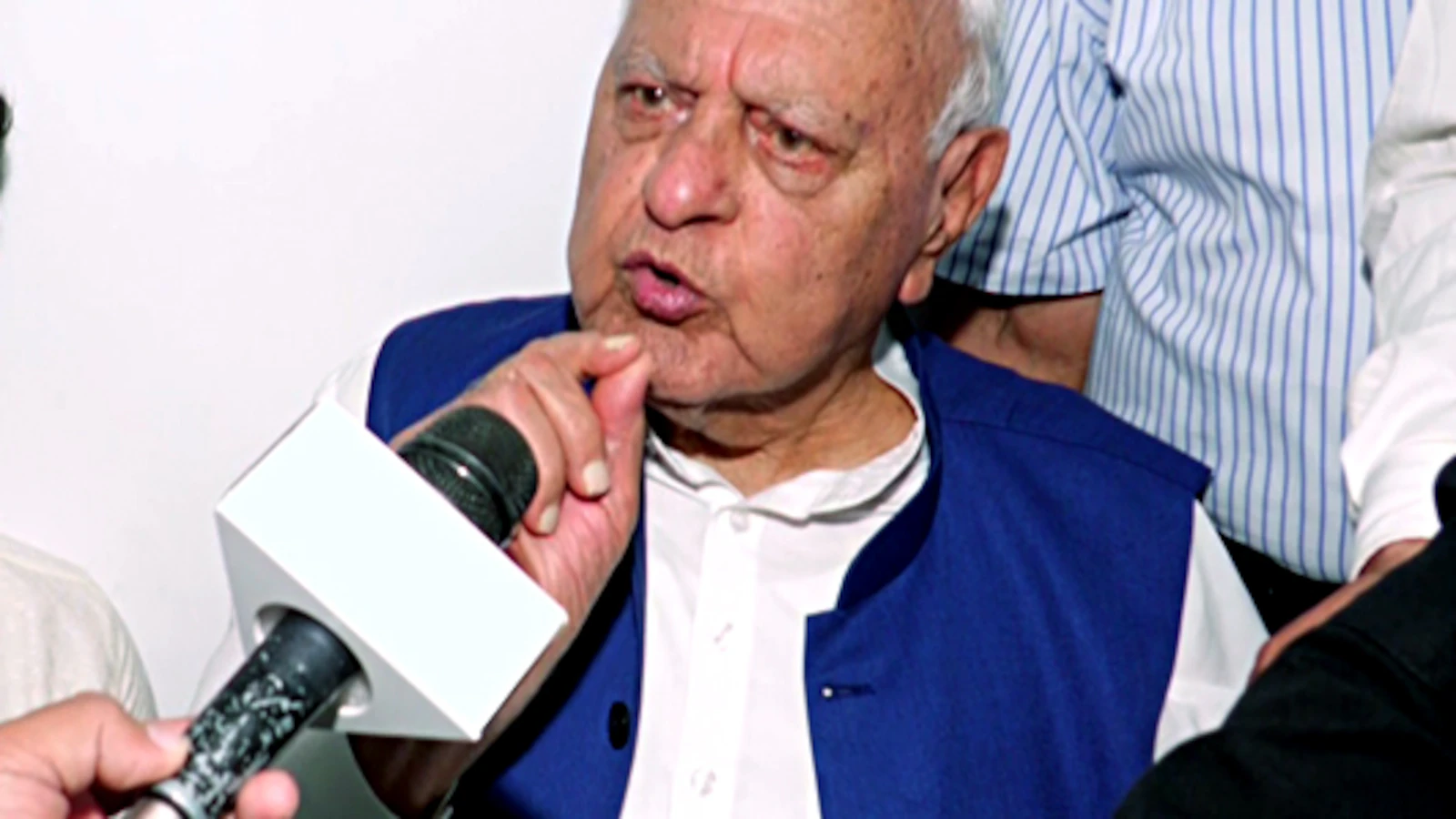
Farooq Abdullah has accused the LG-led administration of orchestrating threats against Kashmiri Pandit employees to delay statehood. The BJP has condemned the allegation. But behind the political clash lies a more difficult question: who is actually behind the threat letters?
By: Javid Amin | 03 September 2026
Farooq Abdullah’s explosive allegation puts Kashmiri Pandit security and J&K statehood in the same political frame
In Jammu and Kashmir, few political subjects are as sensitive as the safety of Kashmiri Pandits. Fewer still carry the historical weight of the community’s displacement from the Valley in the early years of militancy.
That is why Farooq Abdullah’s latest allegation has produced such a sharp political reaction.
The National Conference president and former Jammu and Kashmir chief minister has questioned why recent threats have specifically targeted Kashmiri Pandit employees while senior Hindu officers posted in the Valley have apparently not received similar warnings.
He went further.
Abdullah accused the administration headed by Lieutenant Governor Manoj Sinha of being responsible for the threats, arguing that they were part of a conspiracy to create fear and keep Jammu and Kashmir deprived of statehood.
The allegation is extraordinary.
But so is the political moment in which it has emerged.
For weeks, Kashmiri Pandit employees working under the Prime Minister’s Package have been raising security concerns after threat letters appeared online. The latest purported communication, dated August 23, reportedly contained names, addresses and vehicle details of some employees. The employees’ forum sought enhanced protection and a review of security arrangements. Importantly, the Indian Express reported that police and security agencies had not yet verified the authenticity of the poster.
That leaves the story suspended between two competing possibilities: a genuine militant intimidation campaign—or an allegation of political manipulation that itself remains unproven.
The facts available so far do not conclusively establish either proposition.
And that is precisely where the controversy begins.
What Farooq Abdullah actually alleged
Speaking to reporters in Anantnag on September 2, Abdullah questioned why Hindu officers serving in senior government and police positions were not apparently receiving similar threats.
He pointed to senior police and administrative officials and asked why, if Kashmiri Pandits were being targeted because they were Hindus, these officials were not facing comparable threats.
Abdullah then connected the issue directly to statehood.
He alleged that an atmosphere of fear was being deliberately created to ensure that Jammu and Kashmir remained a Union Territory rather than returning to statehood.
Most significantly, he placed responsibility at the door of the Lieutenant Governor’s administration.
According to multiple reports, Abdullah said he was accusing the administration of issuing the threats and demanded that the LG explain their source.
This was not merely another argument between the National Conference and the BJP.
It was an allegation against the credibility of the security apparatus itself.
Yet there is an important editorial distinction: Abdullah’s allegation is an allegation, not an established finding of an investigation.
No evidence has publicly emerged demonstrating that the LG administration created or circulated the threats.
That distinction should remain at the centre of any responsible account of the controversy.
The threat letters came first—and they were not invented by the political debate
The political storm did not begin with Abdullah.
It followed a series of purported threat communications targeting Kashmiri Pandit employees.
One letter surfaced in early August. According to reports, it named six Kashmiri Pandit employees, including people working in the Revenue Department, and contained contact information.
A second communication dated August 23 reportedly went further, listing personal details such as names, addresses and vehicle registration information.
The All PM Package Employees Forum subsequently approached J&K Chief Secretary Atal Dulloo seeking stronger protection for employees, including security reviews covering workplaces, homes and transit routes.
The detail that makes the latest episode particularly disturbing is the alleged availability of personal information.
Threats are one thing.
A threat accompanied by an individual’s address, vehicle details or telephone number has a different psychological impact.
It suggests that whoever prepared the communication either possessed, obtained or claimed to possess information about the intended targets.
But here again, caution is essential.
The authenticity of the August 23 poster had not been verified by police or security agencies when the employees’ forum raised the issue.
So the correct description is a purported or allegedly issued threat letter, not a conclusively authenticated militant document.
Who is behind the alleged threats?
This is perhaps the biggest unanswered question in the entire controversy.
The communications were attributed to an outfit calling itself the United Liberation Council (ULC).
Indian intelligence sources have described the group as a possible front or proxy linked to the Pakistan-based Lashkar-e-Taiba.
India Today reported that the August threat letter claimed access to information about the families, locations and workplaces of Kashmiri Pandit officials.
Another report said a later ULC communication dated August 27 was the fourth warning and targeted Kashmiri Pandits over efforts to reopen cases connected to killings and the community’s exodus.
But the attribution still requires care.
A group claiming responsibility for a communication does not, by itself, establish its organisational identity or operational capability.
Security agencies must determine:
- Who created the communications?
- Where were they produced?
- How was the personal information obtained?
- Are the threats linked to an operational militant network?
- Is ULC genuinely functioning as a separate organisation or as a proxy identity?
- Were the communications intended to intimidate, recruit, provoke or manipulate?
Those questions are more important than the political claims being exchanged around them.
Omar Abdullah’s position is an important part of the story
There is another political wrinkle that cannot be ignored.
Farooq Abdullah’s allegation sits uneasily beside the position taken earlier by his son, Chief Minister Omar Abdullah.
When the first threat emerged, Omar Abdullah urged police and security agencies to take it seriously.
The chief minister said the threats were highly concerning and called for action to protect the targeted employees. Reports also said government departments advised affected employees to remain away from offices temporarily and take precautions.
That creates an unusual contrast within the same political family.
The father is questioning whether the threats themselves are part of a political conspiracy.
The son, who heads the elected government, has treated the threat as a genuine security concern requiring an official response.
The difference does not necessarily mean the two have fundamentally opposing views.
Omar’s position is primarily about immediate security.
Farooq’s latest intervention is about the political circumstances surrounding the threats.
But the contrast is significant because it illustrates how complicated Kashmir’s security politics can become when questions of credibility, governance and statehood overlap.
Why Kashmiri Pandit employees remain particularly vulnerable
To understand the political sensitivity, one has to look beyond the latest letters.
The Prime Minister’s Package was designed to facilitate the return and employment of displaced Kashmiri Pandits in the Valley.
For many employees recruited under the package, the issue is therefore not simply employment.
It is tied to a much larger question: Can Kashmiri Pandits return and live and work in the Valley with confidence?
That is why security warnings carry an emotional weight that goes beyond the immediate threat.
The community’s experience during the insurgency of the late 1980s and 1990s remains central to this debate.
Fresh threats can revive memories of an earlier period when intimidation, targeted killings and militant violence contributed to the mass displacement of Kashmiri Pandits.
The latest employee reactions show this tension.
Despite the threats, some employees have publicly said they do not want to leave the Valley again. One employee quoted in reports said he would neither be scared nor run away.
That sentiment is politically significant.
For some Pandit employees, leaving again could feel like repeating the history they have spent decades trying to reverse.
The BJP’s counterattack: Abdullah is undermining genuine security concerns
The BJP has responded aggressively.
BJP leaders and supporters accused Abdullah of trivialising threats against Kashmiri Pandits and questioned his decision to cast doubt on the security narrative.
Political commentator and BJP spokesperson Pradeep Bhandari described Abdullah’s remarks as “soft support to terrorists”, while other BJP voices accused him of undermining the suffering of Kashmiri Hindus.
Other BJP figures have argued that Abdullah’s comparison between Kashmiri Pandit employees and senior Hindu officials is flawed.
The reasoning is straightforward.
A senior government officer posted in Kashmir operates as part of the state security structure.
A Kashmiri Pandit employee returning to the Valley under a rehabilitation programme occupies a different social and historical position.
The two cannot necessarily be assumed to face identical threats simply because both are Hindu.
That is the strongest argument against Abdullah’s comparison.
But there is also another side.
Questioning the authenticity or motive behind a threat does not necessarily mean denying that victims require protection.
In a functioning democracy, governments should be capable of doing both: protecting threatened citizens and investigating whether threats are genuine, fabricated, exaggerated or politically exploited.
The uncomfortable question Abdullah has raised
Despite the criticism, Abdullah has raised a question that security agencies should answer rather than simply dismiss.
If the threats contain detailed personal information, how did that information become available to whoever produced the communications?
The Kashmiri Pandit employees’ own forum has asked for an investigation into the alleged leakage of sensitive information.
The August 23 poster reportedly contained names, residential addresses and vehicle numbers. The Indian Express noted that security agencies had yet to establish its authenticity.
That creates two separate investigations.
First: Is the threat genuine?
Authorities must establish whether the communication originated from a functioning militant network.
Second: If genuine, how did the perpetrators obtain the information?
A threat can be serious even before an attack occurs.
If confidential personal information has been compromised, the security implications may extend beyond the employees named in the communication.
And if the threat turns out to be fabricated, authorities still need to determine who manufactured it and why.
Either way, the investigation matters.
Why statehood has entered the controversy
This is where the issue becomes distinctly political.
Restoration of statehood has been one of the central demands of the National Conference government and other political forces in Jammu and Kashmir.
The present political arrangement dates back to August 2019, when the former state was reorganised into the Union Territories of Jammu and Kashmir and Ladakh.
The Supreme Court subsequently upheld the constitutional changes while directing that elections be held and statehood restored “at the earliest” — with the caveat that statehood was to be restored for Jammu and Kashmir while Ladakh would remain a Union Territory.
Elections were eventually held in 2024, and an elected government under Omar Abdullah took office.
But statehood has remained unresolved.
That unresolved question has become a recurring political grievance for the National Conference.
Farooq Abdullah has now connected the Pandit threats to that unfinished political process.
His argument is essentially this:
If the administration can portray Kashmir as sufficiently insecure to justify continued central control, statehood could remain delayed.
The allegation is politically powerful.
But it remains unproven.
There is currently no publicly established evidence showing that the alleged threats were manufactured specifically to block statehood.
That should be stated plainly.
The bigger political calculation
For the National Conference, the controversy provides another opportunity to challenge the Centre and the Lieutenant Governor’s role in J&K’s governance.
For the BJP, it reinforces an entirely different narrative.
The party can argue that terrorism and the security of Kashmiri Pandits remain real problems and that political leaders should not cast doubt on threats before investigations are completed.
Both sides are therefore operating within familiar political frameworks.
NC’s argument
Security concerns should not become a permanent justification for denying democratic and constitutional restoration.
BJP’s argument
Statehood cannot be treated as more important than security, particularly when targeted threats against a historically displaced minority are involved.
The security establishment’s challenge
Determine what is actually happening rather than allowing competing political narratives to fill the evidentiary vacuum.
That last part is crucial.
Because once a security incident becomes politically weaponised, facts can quickly become secondary.
The history behind the political sensitivity
The Kashmiri Pandit question cannot be separated from the history of militancy.
The mass displacement of Kashmiri Pandits in the early 1990s remains one of the most contested and painful chapters in modern Kashmir.
There are continuing disagreements over the scale, causes and political interpretation of the exodus.
But there is no serious dispute that a large number of Kashmiri Pandits left the Valley amid militant violence, threats and an atmosphere of fear.
That history gives every fresh threat an additional dimension.
For the community, a threat letter is not simply a piece of paper circulating online.
It can carry the memory of what happened before.
This is also why political leaders across the spectrum need to be particularly careful with their language.
A careless statement can deepen an already profound sense of insecurity.
Are the threats genuine or manufactured? The evidence so far
At this stage, the most responsible answer is: the public evidence does not conclusively establish that they were manufactured by the LG administration. Nor does the available public reporting provide a complete independent authentication of every threat communication.
What is established from reporting is more limited:
- Threat communications targeting Kashmiri Pandit employees have circulated.
- At least one August 23 communication reportedly contained personal information.
- The All PM Package Employees Forum sought enhanced security.
- Authorities took precautionary measures after the threats.
- Security/intelligence sources have suspected a link between ULC and Lashkar-e-Taiba.
- Police and security agencies were still examining the authenticity of the latest poster when employees sought protection.
- Farooq Abdullah subsequently accused the LG-led administration of orchestrating the threats.
- BJP leaders strongly condemned Abdullah’s remarks.
That is the factual core.
Everything beyond it—particularly the claim that the administration deliberately manufactured the threats to block statehood—remains an allegation requiring evidence.
What happens next?
The political argument is likely to continue.
But the more important developments will happen away from television studios and political rallies.
Security agencies will need to establish the origin of the threat letters.
The administration will need to explain what protection is being provided to affected employees.
The government will also face pressure to address the larger question of whether employees recruited under the Prime Minister’s Package can work in the Valley without living under a permanent sense of vulnerability.
And eventually, New Delhi will have to confront the political question that has repeatedly returned since 2019:
When will Jammu and Kashmir regain statehood?
Until then, every security incident risks being interpreted through the larger statehood debate.
That is dangerous.
A genuine threat should not be dismissed because it is politically inconvenient.
But an unverified threat should not automatically become proof of a political conspiracy either.
Conclusion: Kashmir needs answers, not competing suspicions
Farooq Abdullah’s accusation has turned a security concern into another major political confrontation.
His central question—why are Kashmiri Pandit employees being singled out while other Hindu officials are not—deserves investigation.
But his conclusion that the LG administration is responsible for manufacturing the threats remains an allegation, not an established fact.
The BJP’s counterattack is equally political, but its underlying point is serious: Kashmiri Pandits have experienced targeted violence and displacement before, and threats against them cannot be casually dismissed.
There is a way through this impasse.
Investigate the threats.
Protect the employees.
Trace the source of the leaked personal information.
Establish whether the ULC communications are genuine and who stands behind them.
And if Abdullah’s allegation against the administration is to be taken seriously, it too should be tested against evidence rather than political rhetoric.
That is ultimately the larger lesson from this latest J&K controversy.
Security cannot become a political prop. Statehood cannot become a bargaining chip. And the fear of Kashmiri Pandits cannot be reduced to another talking point in the endless contest between Srinagar and New Delhi.
For the employees receiving these threats, the question is much simpler than the political debate around them:
Are they safe enough to stay?
That is the question the authorities now have to answer.


