NC vs BJP Protests in J&K: When Political Theatre Takes Over the Streets
By: News Desk | 02 September 2026
Srinagar: For a few hours on Wednesday, the streets of Srinagar became an extension of Jammu and Kashmir’s political battlefield.
The ruling National Conference (NC) moved towards the office of its principal political rival, the Bharatiya Janata Party (BJP), demanding answers over statehood and other unresolved political commitments.
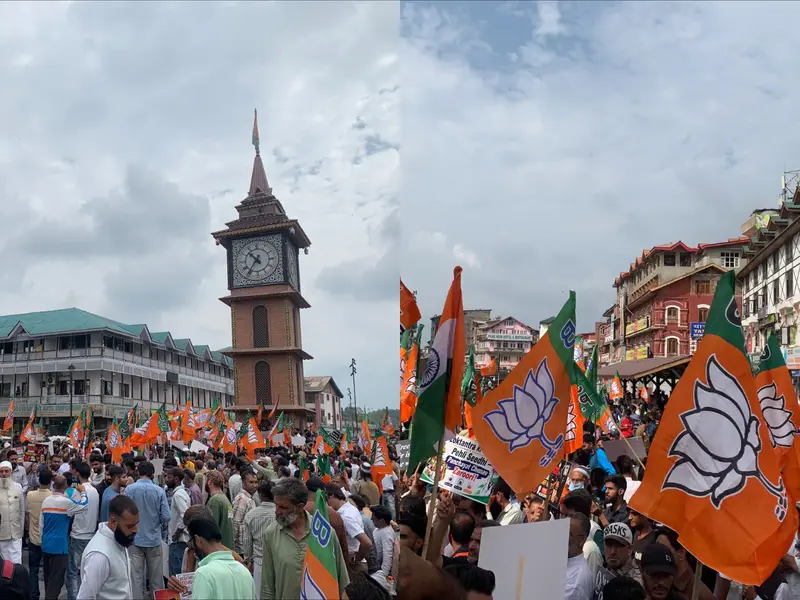
The BJP, meanwhile, mobilised in the heart of Srinagar and marched from Ghanta Ghar in Lal Chowk towards the Civil Secretariat, targeting the Omar Abdullah government over unemployment, recruitment, alleged corruption, electricity tariffs and other governance issues.
Police and security forces were deployed in large numbers around Lal Chowk, Jawahar Nagar, Rajbagh and adjoining areas. Roads leading towards the BJP office were restricted, while movement around the protest routes was affected as authorities attempted to prevent the two political mobilisations from turning into a direct confrontation.
The scene captured something deeper than a routine political protest.
The NC and BJP were not merely disagreeing. They were physically taking their political arguments to the doorstep of the other side.
And once again, ordinary residents found themselves caught in the middle.
Two Parties, Two Protests, Two Very Different Messages
The political confrontation was built around two sharply different narratives.
The BJP sought to make the Omar Abdullah government’s performance the central issue.
Its leaders accused the administration of failing Jammu and Kashmir’s youth, questioned recruitment and employment policies, raised allegations of corruption and backdoor appointments, and criticised the recent electricity tariff increase. The party also raised the delay in Panchayat and urban local body elections.
The National Conference chose a different battlefield.
Its protest was centred on statehood and accountability from the Union government, with the party demanding that commitments relating to Jammu and Kashmir’s political status be honoured. The NC also raised the issue of constitutional safeguards and other pending matters.
The result was an unusually clear political division:
The BJP asked: Why isn’t the Omar government delivering?
The NC asked: Why hasn’t the Union government restored statehood?
Both questions have political weight.
And neither side appears willing to concede the other’s argument.
Srinagar Becomes the Stage for a Larger Political Contest
The location of the protests is significant.
The BJP’s march began at Lal Chowk, one of Srinagar’s most recognisable political and commercial landmarks, before heading towards the Civil Secretariat.
The NC’s counter-mobilisation was directed towards the BJP headquarters in Jawahar Nagar.
Police subsequently restricted movement on roads around the BJP office and deployed personnel in adjoining areas.
This transformed the city into a series of political pressure points.
For residents, however, the political symbolism had a very practical consequence.
Roads were blocked.
Vehicles were stopped.
Traffic was diverted.
Security checkpoints appeared.
The political leadership could leave after delivering speeches. Commuters still had to find a way home.
That is the uncomfortable side of street politics that rarely features prominently in political speeches.
The Common Man Does Not Live Inside a Political Slogan
For political parties, a protest is an instrument.
For the public, it can become an interruption.
A shopkeeper near a protest route may worry about customers.
A daily wage worker may lose hours of work.
A student may struggle to reach college.
A patient may face delays getting to hospital.
A commuter travelling across Srinagar may have to take a longer route because a road has been sealed.
These are not abstract costs.
They are the immediate consequences of political mobilisation.
Reports from Srinagar indicated restrictions around Jawahar Nagar and Lal Chowk as security forces prepared for the rival programmes.
That does not mean political protest is illegitimate.
Quite the opposite.
Peaceful assembly is an important part of democratic politics.
But democratic protest also raises a broader question:
At what point does political mobilisation stop being a tool for accountability and become political theatre?
Wednesday’s events offered plenty of material for that debate.
The Interesting Contradiction: Who Is Actually Responsible for What?
The confrontation becomes more complicated when the respective responsibilities of the two sides are examined.
The National Conference is the ruling party in Jammu and Kashmir.
That means it is responsible for administering the Union Territory, running government departments, addressing recruitment and public-service concerns and delivering on its electoral promises.
The BJP, meanwhile, is the principal opposition party in the J&K Assembly, but it also heads the government at the Union level.
That creates a unique political arrangement.
When the BJP attacks Omar Abdullah over unemployment, recruitment or governance, it is acting as the state-level opposition.
When the NC attacks the BJP over statehood, however, it is targeting the political party that controls the Union government — because restoration of statehood ultimately involves a decision at the Centre.
This creates a political loop.
The NC can say the BJP controls New Delhi.
The BJP can say the NC controls the J&K administration.
And both can claim that the other is responsible for the problem being discussed.
That is precisely why the current confrontation is so politically useful to both sides.
Statehood: The NC’s Strongest Political Weapon
For the National Conference, statehood remains one of its strongest political issues.
Jammu and Kashmir was reorganised into two Union Territories in 2019 following the Centre’s constitutional changes.
In December 2023, the Supreme Court upheld the constitutional changes concerning Article 370 and said that statehood should be restored at the earliest and as soon as possible.
The NC has repeatedly invoked that position while pressing the Union government to restore statehood.
Wednesday’s protest was therefore not simply an attack on the BJP.
It was an attempt to keep the statehood question politically alive.
The party wants voters to see the issue not as a technical administrative matter but as an unfinished political commitment.
That is particularly important for the NC because its political identity has historically been closely connected with the question of Jammu and Kashmir’s autonomy and constitutional position.
BJP Tries to Change the Conversation
The BJP’s response is almost the mirror image.
Rather than allowing statehood to dominate the day’s political narrative, it is trying to move the conversation towards governance.
Jobs.
Recruitment.
Electricity bills.
Corruption allegations.
Local elections.
Administrative performance.
These are issues that can potentially reach voters beyond the traditional constitutional debate.
The BJP’s September 2 protest specifically highlighted unemployment, alleged recruitment irregularities, corruption and Panchayat elections, while its leadership also criticised the recent electricity tariff increase.
This is strategically important.
A constitutional debate can be highly ideological.
A jobless graduate, however, is likely to ask a much simpler question:
Where is my job?
A household facing a higher electricity bill may ask:
Why has my bill increased?
The BJP wants those questions to become more politically important than the older Article 370-versus-autonomy debate.
Electricity Tariff Hike Gives BJP a Tangible Issue
The electricity controversy has given the opposition a particularly accessible talking point.
The Joint Electricity Regulatory Commission approved an average tariff increase of 6.83 per cent for 2026-27, with the revised rates coming into effect from September 1.
The timing could hardly have been more politically convenient for the BJP.
The tariff revision became effective just as the party prepared to take its campaign against the Omar Abdullah government to the streets.
The BJP has presented the increase as evidence of anti-people governance.
But the issue is more complicated than the political slogans suggest.
Electricity tariffs are determined through a regulatory process involving the distribution companies’ revenue requirements and tariff calculations.
So the political question is not simply whether the NC government personally “increased” electricity prices.
The more relevant question is how the administration responds to the public impact of the increase — and whether it can protect vulnerable consumers while addressing the financial problems of the power sector.
That is the kind of distinction that often disappears during a street protest.
The Jobs Question Could Become More Important Than Statehood
There is another reason the BJP’s strategy deserves attention.
Jammu and Kashmir has a large population of educated young people competing for a limited number of government jobs.
Government recruitment has therefore always been politically sensitive.
The BJP has accused the NC government of failures involving recruitment, alleged backdoor appointments and outsourcing.
These remain political allegations, rather than established findings unless supported by official investigations or judicial conclusions.
But politically, the accusations are powerful.
The employment question can cut across regional and ideological identities.
A young person in Srinagar and another in Jammu may disagree profoundly about Article 370.
They may nevertheless share the same frustration about finding employment.
That is why the BJP’s attempt to shift the debate towards jobs could prove more consequential than a single day’s protest.
Is This Really Jammu vs Kashmir?
It would be tempting to describe Wednesday’s events as another manifestation of the Jammu-versus-Kashmir divide.
There is certainly a regional dimension to the politics.
The BJP has a much stronger electoral base in Jammu, while the National Conference’s strongest political base remains in the Kashmir Valley.
But the September 2 protests complicate the simple regional narrative.
The BJP itself marched through Srinagar.
The NC announced protests in both Srinagar and Jammu.
The political competition is therefore not geographically confined to one region.
Both parties are trying to speak to voters across Jammu and Kashmir.
The BJP wants to show that it can mobilise in Srinagar around issues such as employment and governance.
The NC wants to demonstrate that statehood is not simply a Valley demand but a broader political issue affecting the entire Union Territory.
The battle is regional in its history, but increasingly statewide in its electoral ambitions.
When Opposition and Government Both Take to the Streets
There is something inherently unusual about the present political arrangement.
The NC is the ruling party in J&K.
Yet it is protesting against the BJP.
The BJP is the opposition in the J&K Assembly.
Yet it is protesting against the elected government.
At the same time, the BJP controls the Union government, which is the authority the NC is pressuring over statehood.
This creates a political paradox.
The government protests against the government above it.
The opposition protests against the government below it.
And the two parties then organise counter-protests against each other.
This is not necessarily undemocratic.
Political parties routinely protest against governments at different levels.
But in Jammu and Kashmir, where the division of authority between the Union and the Union Territory remains politically sensitive, the arrangement produces a particularly complicated form of accountability.
Is Street Politics Replacing Institutional Politics?
There is another uncomfortable question.
Why take these battles to the streets when Jammu and Kashmir has an elected Legislative Assembly?
The Assembly exists precisely to debate laws, question ministers, demand accountability and scrutinise government policy.
Parliament exists to scrutinise the Union government.
Political parties also have access to courts, regulatory institutions, media platforms and public consultations.
Yet none of these mechanisms provides the visual impact of a street protest.
A hundred legislators arguing inside an Assembly chamber may receive less attention than a hundred workers facing barricades outside a government building.
Politics increasingly understands this.
The image is part of the message.
A march through Lal Chowk sends one message.
A gherao outside the Civil Secretariat sends another.
A police barricade between rival cadres creates another.
And social media amplifies all of it within minutes.
That is why modern political protests are often designed not merely to influence decision-makers but to produce political imagery.
The ‘Political Theatre’ Argument
PDP president Mehbooba Mufti went further, describing the confrontation between the NC and BJP as a “fixed match” and accusing both parties of engaging in political theatrics.
That is a political accusation, not an established fact.
But it captures a sentiment worth examining.
The NC can attack the BJP over statehood.
The BJP can attack the NC over governance.
Both can mobilise supporters.
Both can claim political victory.
And the underlying problems can remain unresolved.
That is the danger of performative politics.
A protest may create pressure, but pressure is not the same thing as policy.
A slogan may capture public anger, but it does not create a job.
A gherao may dominate television coverage, but it does not lower an electricity bill.
A political speech may demand statehood, but it does not itself restore it.
The real measure of political action is what happens after the cameras leave.
What Happens After the Barricades Come Down?
This is where Jammu and Kashmir’s political class faces its real test.
For the NC, the question is whether it can convert its campaign for statehood into meaningful political pressure on the Union government while simultaneously delivering on governance.
For the BJP, the challenge is whether its allegations about unemployment, recruitment and corruption can be converted into sustained legislative scrutiny and credible alternatives rather than remaining protest slogans.
For both parties, there is an even bigger question:
Can they compete politically without allowing competition itself to become a substitute for governance?
The electorate will eventually judge them not by the size of their rallies but by outcomes.
The Missing Voice in the Political Duel
There is one group largely absent from the rhetoric of both sides: the ordinary citizen.
The language of political parties is usually framed around mandates, betrayal, statehood, development, corruption, constitutional rights and national integration.
But daily life is more mundane.
People need functioning roads.
Reliable electricity.
Transparent recruitment.
Better public transport.
Healthcare.
Education.
Business opportunities.
Tourism.
Agricultural support.
And above all, economic security.
These concerns do not always produce dramatic headlines.
But they determine whether a government is remembered as successful.
The danger for both major parties is that citizens may eventually grow tired of being asked to choose between competing political narratives while seeing little change in their daily circumstances.
A New Political Battle Is Taking Shape in J&K
The September 2 protests suggest that Jammu and Kashmir’s political competition is entering a more confrontational phase.
The NC is attempting to consolidate the statehood question as a central political demand.
The BJP is attempting to make governance and employment the central test of the Omar Abdullah government’s credibility.
Neither party can afford to ignore the other’s issue.
The NC cannot simply talk about statehood while ignoring unemployment and public services.
The BJP cannot dismiss statehood as merely political theatre when its own leaders have repeatedly supported restoration of statehood in principle.
That is where the political contest becomes genuinely interesting.
The next phase may not be about choosing between statehood and development.
The public can reasonably demand both.
Conclusion: Beyond the Slogans, Who Will Answer the Common Man?
The rival NC-BJP protests in Srinagar have exposed the increasingly competitive nature of Jammu and Kashmir’s post-2019 politics.
The National Conference wants to keep statehood and political rights at the centre of the conversation.
The BJP wants the electorate to focus on jobs, recruitment, electricity prices and governance.
Both narratives have an audience.
Both have political value.
And both are likely to intensify as the next electoral battles approach.
But there is a risk in turning every unresolved issue into another street confrontation.
When politics becomes an endless cycle of protest, counter-protest, allegation and counter-allegation, the original problem can disappear behind the spectacle.
The ordinary citizen does not necessarily care which party produces the louder slogan.
The unemployed graduate wants employment.
The commuter wants an open road.
The shopkeeper wants customers.
The household wants an affordable electricity bill.
The farmer wants reliable infrastructure and markets.
And the voter ultimately wants a government that works.
That is why the most important question emerging from the NC-BJP street battle is not who had the larger crowd or whose slogans were louder.
It is much simpler:
After the barricades are removed and the political cameras move on, who will actually solve the problems for which these parties claim to be fighting?
For Jammu and Kashmir, that may prove to be the real test of politics — and the real test of power.