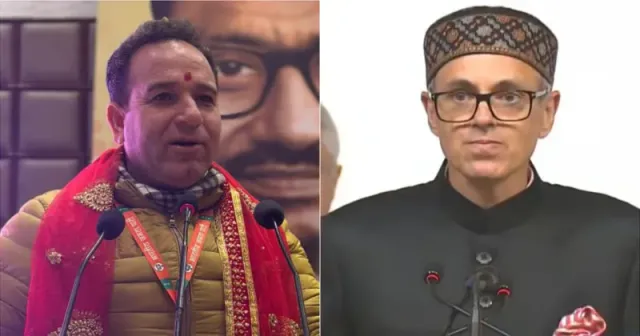
NC vs BJP in J&K: Rival Protests Bring Statehood, Jobs and Governance Battle to the Streets
By: Javid Amin | 01 September 2026
Srinagar: Jammu and Kashmir is witnessing one of its sharpest political street confrontations since the restoration of an elected government, with the ruling National Conference (NC) and opposition Bharatiya Janata Party (BJP) holding rival protest programmes on Wednesday over sharply different sets of grievances.
The BJP has taken its campaign against the Omar Abdullah-led government to Srinagar, with party leaders and workers assembling at Ghanta Ghar in Lal Chowk before marching towards the Civil Secretariat. The protest, led by J&K BJP president Sat Sharma and Leader of Opposition Sunil Sharma, centres on unemployment, recruitment, electricity tariffs, alleged corruption, outsourcing of government jobs and delays in Panchayat and urban local body elections.
The National Conference, responding to the BJP’s planned Secretariat gherao, has announced peaceful protests outside BJP headquarters in Srinagar and Jammu. Its demands are directed primarily at the Union government and include restoration of Jammu and Kashmir’s statehood, constitutional guarantees, clearance of the reservation-related file and what the party describes as justice for the people of J&K.
What began as two separate political campaigns has consequently developed into a direct street-level confrontation.
And the symbolism is difficult to miss.
One party is marching towards the Civil Secretariat, seeking to hold the elected government accountable.
The other is moving towards the BJP’s offices, seeking answers from the party that controls the Union government over promises concerning Jammu and Kashmir’s political status.
For the first time in this phase of J&K’s politics, the two principal political forces are preparing to test their strength on the streets at virtually the same time.
BJP Takes the Fight to the Civil Secretariat
The BJP’s September 2 programme was announced as a “Secretariat Gherao” against what the party describes as failures of the Omar Abdullah administration.
Party workers were asked to gather at Lal Chowk, from where the march would proceed towards the Civil Secretariat through M.A. Road. Sat Sharma and Sunil Sharma are leading the mobilisation.
The BJP’s campaign is built around issues that have a direct impact on households and young people.
Among them is the recent electricity tariff revision.
The Joint Electricity Regulatory Commission for Jammu and Kashmir and Ladakh approved an average 6.83 per cent increase in retail electricity tariffs for 2026-27, effective from September 1. The revised tariff applies to the two distribution companies, JPDCL and KPDCL, with domestic rates varying according to consumption slabs.
The BJP has seized on the increase as evidence of what it calls a disconnect between the NC government’s electoral promises and its present policies.
Employment is another major theme.
Sunil Sharma has accused the government of allowing recruitment and other work to move towards outsourcing and contractors, arguing that such arrangements could affect transparency and opportunities for educated youth. The BJP has also raised alleged backdoor appointments and recruitment irregularities. These are political allegations by the opposition and should not be treated as established findings without official investigation or evidence.
The party has additionally questioned the delay in Panchayat and urban local body elections, presenting grassroots democracy as another area where it believes the government needs to answer questions.
In effect, the BJP is attempting to move the political conversation away from constitutional questions and towards everyday governance.
Sunil Sharma Turns Statehood Into a Political Test for Omar Abdullah
The BJP’s street mobilisation has been accompanied by a more personal political challenge.
Leader of Opposition Sunil Sharma has asked Chief Minister Omar Abdullah to resign and seek a fresh mandate if statehood is the central issue on which the National Conference government wants public support.
Sharma’s argument is that Omar should contest an election specifically on the question of statehood and allow voters to decide whether they endorse his position.
It is a deliberately provocative demand.
The BJP leader has also accused the NC of using statehood to divert public attention from unemployment and other governance concerns.
But the challenge needs to be understood politically rather than constitutionally.
The Omar Abdullah government was elected in 2024 for a full Assembly term. Statehood was one of the National Conference’s political demands, but it was not the only issue on which voters were asked to choose.
Consequently, Sharma’s demand for an immediate fresh election is best understood as an opposition political strategy to question the government’s credibility, rather than a constitutional requirement.
Its purpose is to force Omar Abdullah to answer a difficult political question:
Is statehood the government’s principal mandate, or is it one component of a much wider electoral programme?
National Conference Responds With Its Own Gherao
The NC has chosen not to allow the BJP protest to dominate the political narrative.
On Tuesday, the party announced that it would peacefully gherao BJP headquarters in Srinagar and Jammu on September 2.
The party says its action is aimed at holding the Union government accountable for commitments concerning Jammu and Kashmir made in Parliament and before the Supreme Court.
Its list of demands includes:
- restoration of statehood;
- constitutional safeguards;
- clearance of the reservation file;
- justice for the people of Jammu and Kashmir.
The NC has also stressed that the electoral mandate given to it by the people is “not a blank cheque”, arguing that commitments concerning J&K should be honoured rather than indefinitely deferred.
In Srinagar, the NC has planned its mobilisation from the Gindun Park area near Rajbagh before moving towards the BJP office.
That puts the two parties’ programmes within the same broader political theatre.
The BJP says the NC government must answer for governance.
The NC says the BJP and Union government must answer for statehood and constitutional commitments.
A Crucial Distinction: This Is Not Simply a ‘Jammu vs Kashmir’ Protest
The politics of Jammu and Kashmir is often reduced to a regional binary — Jammu versus Kashmir.
The September 2 confrontation is more complicated.
The BJP’s main planned march is taking place in Srinagar, the political centre of Kashmir, while the NC has organised protests against BJP offices in both Srinagar and Jammu.
That matters.
The BJP is clearly attempting to establish a stronger political presence in Srinagar and demonstrate that it can mobilise around issues that directly concern people in the Valley, particularly employment, electricity and governance.
The party has been expanding its organisational activity in Kashmir, including holding its first state office-bearers’ meeting in Srinagar recently.
For the NC, meanwhile, taking its protest to Jammu as well as Srinagar allows it to frame statehood and constitutional issues as concerns affecting the entire Union Territory rather than only the Valley.
The competing programmes therefore have a regional dimension, but neither party is confining its political message to its traditional geographical base.
Why the Electricity Tariff Hike Has Become a Flashpoint
Among the BJP’s governance complaints, electricity has emerged as one of the most politically potent.
The revised tariff came into effect on September 1 — literally one day before the planned protest.
The JERC approved an average 6.83 per cent increase for the 2026-27 financial year. For metered domestic consumers, the energy charge is ₹2.45 per unit for monthly consumption up to 200 units, ₹4.20 for 201–400 units and ₹4.60 above 400 units. A fixed charge of ₹10 per kW per month has also been prescribed.
The BJP has linked the tariff increase to the NC’s election promises and has demanded that the government reconsider the hike.
For the opposition, the timing is politically useful.
For the government, however, the issue is more complicated than a simple political decision.
Electricity tariffs are determined through a regulatory process, and the JERC order cites the revenue requirements of the distribution companies and the gap between projected revenue at existing tariffs and assessed requirements.
That does not eliminate the political responsibility of an elected government to respond to public concerns.
But it does mean that the tariff controversy involves both regulatory economics and electoral politics.
The NC’s Statehood Argument Comes From a Different Political Direction
The National Conference is fighting on a fundamentally different battlefield.
For the party, the central question is not whether the Omar Abdullah government has performed perfectly.
It is whether the Union government has acted on its repeated assurances regarding restoration of statehood.
The demand carries particular weight because Jammu and Kashmir was reorganised as a Union Territory in 2019 following the Centre’s constitutional changes.
In December 2023, the Supreme Court upheld the constitutional changes relating to Article 370 and said statehood should be restored at the earliest and as soon as possible.
The NC has repeatedly used that judicial observation, along with statements made by the Union government, as part of its argument that statehood should now be restored.
The party’s September 2 protest is therefore designed to move the pressure point away from Srinagar’s Civil Secretariat and towards the BJP’s political organisation.
Its message is effectively:
If the BJP controls the Centre, then the BJP must answer for the Centre’s commitments.
That is why the NC is targeting BJP offices rather than the Secretariat.
Surinder Choudhary Calls BJP Protest ‘Political Hypocrisy’
The NC has also attacked the BJP’s decision to protest against the elected government in Srinagar.
Deputy Chief Minister Surinder Choudhary argued that if the BJP was genuinely concerned about restoration of statehood, its J&K unit should instead press its own national leadership in New Delhi.
He questioned why BJP leaders were targeting the Omar Abdullah government when the ultimate authority over restoration of statehood lies with the Union government.
The criticism highlights a fundamental contradiction in the political contest.
The BJP is the opposition party in the J&K Assembly, so it naturally seeks to hold the elected government accountable for matters within its sphere.
But the BJP is also the governing party at the Centre.
Statehood, meanwhile, is ultimately linked to decisions at the Union level.
That creates an unusually complicated political structure.
The NC can legitimately ask the BJP’s national leadership why statehood has not yet been restored.
The BJP can just as legitimately argue that the elected J&K government must answer for issues under its administrative responsibility.
Both arguments have political force.
And both are likely to remain central to the next phase of the confrontation.
Security Tightened as Both Parties Mobilise
Authorities have responded cautiously to the competing programmes.
Security forces and police were deployed in large numbers around sensitive areas of Srinagar, including Lal Chowk, Jawahar Nagar, Rajbagh and adjoining areas.
Traffic restrictions were also imposed around the BJP headquarters in Jawahar Nagar ahead of the NC protest. Vehicles approaching the office were stopped at several points as authorities attempted to prevent gatherings and possible confrontation.
The security arrangements underline the unusual nature of Wednesday’s political mobilisation.
This is not simply two parties holding separate press conferences or rallies miles apart.
Their programmes are designed as counter-mobilisations.
One begins at the heart of Srinagar and moves towards the government.
The other is aimed at the principal opposition party’s headquarters.
The possibility of workers from rival parties coming into close proximity has therefore made crowd control a significant concern.
From Assembly Politics to Street Politics
The September 2 protests also mark a change in the tone of Jammu and Kashmir politics.
After the 2024 Assembly election restored an elected legislature, much of the political contest initially played out inside the Assembly and through statements directed at the Union government.
The latest confrontation takes the battle onto the streets.
The BJP wants to demonstrate that the opposition can mobilise around issues affecting ordinary people.
The NC wants to demonstrate that its government and political cadre remain capable of campaigning around statehood and constitutional questions.
Both are, in effect, testing their organisational machinery.
And both know that images of crowds, marches, barricades and speeches can become as politically valuable as legislative speeches.
The Battle Over the ‘People’s Mandate’
Perhaps the most important phrase emerging from the confrontation is the “mandate of the people.”
The NC says its mandate should not be taken for granted.
Sunil Sharma argues that Omar Abdullah should seek a new mandate if statehood is the issue on which he wants public endorsement.
Both sides are therefore invoking the electorate.
But they are using the concept of mandate differently.
For the NC, the 2024 election gave it authority to pursue the promises contained in its political programme, including statehood.
For the BJP, the present government must demonstrate that its political campaign still reflects what voters actually prioritise.
This is more than semantics.
It reflects two competing understandings of representative democracy.
Does an election give a government a mandate to pursue an entire manifesto for its full term?
Or can a major political demand become a fresh test of public legitimacy during that term?
There is no constitutional requirement that Omar Abdullah resign simply because the BJP challenges his political position.
But Sharma’s demand can still be politically effective if it forces the NC to explain how it balances statehood with governance.
Jammu and Kashmir’s Political Debate Is Expanding
The most striking aspect of the current confrontation is that the political agenda is no longer dominated by a single issue.
For years, Article 370 defined much of the debate surrounding Jammu and Kashmir.
Now the political conversation is broader.
Statehood.
Jobs.
Recruitment.
Electricity prices.
Local elections.
Constitutional safeguards.
Governance.
Each issue appeals to a different section of the electorate.
The BJP wants the contest to move towards tangible governance and economic concerns.
The NC wants to retain statehood and constitutional rights at the centre of political debate.
That difference could shape the political narrative well beyond Wednesday’s protests.
What the Rival Protests Mean for Omar Abdullah
For Omar Abdullah, the political challenge is becoming increasingly two-dimensional.
On one side, he has to keep pressure on the Centre for restoration of statehood.
On the other, he must defend his government’s administrative record.
The BJP’s strategy is clearly designed to connect the two.
If the government talks about statehood, the BJP talks about jobs and electricity.
If the government criticises the Centre, the BJP points back to the responsibilities of the elected administration.
This creates a difficult political equation for the Chief Minister.
He cannot easily abandon the statehood issue because it is central to the National Conference’s political position.
But he also cannot allow governance concerns to be overshadowed indefinitely by the constitutional debate.
The coming months could therefore see the NC increasingly forced to fight on both fronts.
What the BJP Gains From the Srinagar Protest
For the BJP, the September 2 march is significant beyond the immediate criticism of Omar Abdullah.
The party is trying to demonstrate that its political presence in Srinagar and Kashmir is growing.
Holding a major organisational meeting in Srinagar and subsequently mobilising workers for a march towards the Civil Secretariat are part of that broader effort.
The BJP also has a clear electoral incentive.
It remains the dominant political force in Jammu, but its long-term challenge is to expand its appeal across the Valley.
A protest in Srinagar focused on unemployment, electricity and governance allows the party to speak directly to issues that are not inherently regional or ideological.
That is potentially more useful than a campaign built solely around constitutional integration.
What the NC Gains — and Risks
For the National Conference, the counter-protest provides an opportunity to reinforce its image as the political force pressing New Delhi on statehood.
But it also carries risks.
By responding directly to the BJP’s protest, the NC risks allowing the opposition to define the political conversation around governance failures.
The party must therefore keep its own message focused.
Its strongest argument is that statehood is not a diversion but a central political and constitutional issue, and that the Union government has repeatedly committed itself to restoring it.
The weaker its response appears on employment, recruitment and other everyday issues, however, the easier it becomes for the BJP to argue that the statehood campaign is being used to avoid scrutiny.
That is the political trap facing the NC.
A Contest That Goes Beyond One Day
Wednesday’s protests will eventually end.
The political confrontation will not.
The BJP has already signalled that it intends to raise employment, recruitment, electricity, local elections and governance issues inside and outside the Assembly.
The NC, meanwhile, is unlikely to abandon its campaign for statehood and constitutional safeguards.
The two sides are therefore likely to continue fighting on parallel tracks.
One track will concern who governs Jammu and Kashmir and how effectively.
The other will concern what political status Jammu and Kashmir should have within the Indian Union.
The two questions are increasingly colliding.
Conclusion: J&K’s Political Battle Moves From Parliament to the Streets
The rival protests on September 2 are more than another confrontation between the National Conference and BJP.
They represent a widening political contest over what Jammu and Kashmir’s post-2019 politics should be about.
The NC wants statehood, constitutional guarantees and accountability from the Union government to remain at the centre of the conversation.
The BJP wants the Omar Abdullah government to answer for jobs, recruitment, electricity tariffs, alleged corruption and delayed local elections.
Both parties claim to be speaking for the people.
Both are invoking the idea of accountability.
And both are trying to turn public dissatisfaction into political momentum.
The immediate concern for the administration is maintaining peace as competing cadres mobilise in Srinagar and Jammu. Police have already tightened security around sensitive locations in Srinagar.
But the larger political significance will be measured after the crowds disperse.
If the BJP succeeds in shifting public attention towards governance and employment, the NC could find its statehood campaign increasingly challenged by questions about its own performance.
If the NC succeeds in making the BJP answer for the delay in restoring statehood, the political pressure on the Union government could intensify.
Either way, September 2 marks a significant moment in the evolving politics of Jammu and Kashmir.
The battle is no longer being fought only over Article 370 or statehood. It is increasingly about jobs, electricity, governance, political credibility and who gets to define the next chapter of J&K’s politics.