Mecca Defence Pact Under Pressure: Pakistan’s New Clout Faces Its First Real Test in the Iran War
By: Javid Amin | 14 September 2026
Six months into the Iran war, the new Mecca Joint Defence Agreement is confronting the kind of crisis that can turn a diplomatic declaration into a real military alliance. Saudi Arabia is under sustained attack from Iran-backed Houthis, critical energy infrastructure has been hit and Riyadh has sought additional security support. Pakistan, one of the pact’s three members alongside Saudi Arabia and Türkiye, is suddenly at the centre of the calculation.
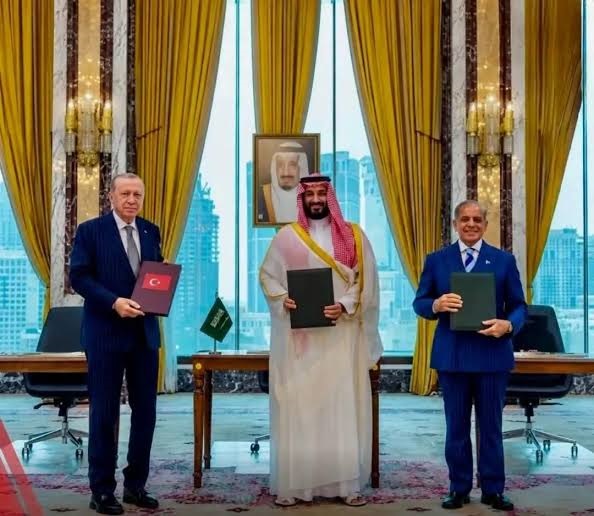
The photograph from Makkah on August 7 looked like the birth of a new security order.
Saudi Crown Prince Mohammed bin Salman, Turkish President Recep Tayyip Erdoğan and Pakistani Prime Minister Shehbaz Sharif stood together as the three countries signed the Makkah Joint Defence Agreement.
Its central promise was strikingly familiar to anyone who knows NATO’s Article 5: an armed attack against one member would be regarded as an attack against all.
Within weeks, however, the slogan has met reality.
Iran-backed Houthi forces have intensified their assault on Saudi Arabia. Missiles and drones have targeted military and energy facilities. The East-West oil pipeline has been disrupted. The Houthis have expanded their grip along Yemen’s Red Sea coast, threatening the Bab el-Mandeb, one of the world’s most important maritime chokepoints. Oil prices have climbed above $100 a barrel as the conflict threatens both Gulf and Red Sea energy routes.
And yet Pakistan has not announced that it is going to war.
On September 10, Pakistan’s Foreign Ministry explicitly said that no military response under the Mecca agreement had been discussed over the Houthi attacks. Islamabad reaffirmed its commitment to Saudi security while emphasising dialogue and diplomacy.
That is the first serious test of the pact.
It also raises a larger question:
Is Pakistan emerging as a genuine regional security power, or is its new diplomatic prominence running ahead of its ability and willingness to use force?
The pact is real, but “Islamic NATO” is still an exaggeration
The first thing to establish is what the agreement actually says.
The pact was signed in Makkah on August 7. Its official language says an armed attack against any of the three countries will be considered an attack against all three and commits the members to strengthen collective deterrence and defence cooperation.
That is a serious commitment.
But it is not NATO.
There is no evidence of a NATO-style standing military command, integrated nuclear planning structure or permanent multinational force comparable to the alliance’s established command system.
The three governments themselves have been careful about the comparison.
Pakistan’s Foreign Minister Ishaq Dar described the pact as defensive and said it was not directed against a particular country. Turkish officials have similarly stressed that the agreement is intended to strengthen regional security rather than establish an explicitly anti-Iran bloc.
Calling it “Islamic NATO” is therefore useful as shorthand, but potentially misleading as analysis.
It describes the political symbolism.
It does not yet describe the alliance’s operational capacity.
But the pact is moving faster than its critics expected
There is an important development that makes the agreement more substantial than a ceremonial declaration.
On August 31, the defence and foreign ministers and military chiefs of the three countries met in Istanbul for the first Strategic Political and Defence Committee meeting created under the agreement.
They agreed to establish a permanent secretariat in Saudi Arabia, with the first secretary-general coming from Pakistan for a three-year term.
They also agreed to develop defence-industry cooperation, joint technology development and production, and mechanisms for greater military coordination.
That gives Pakistan something more tangible than a seat at the table.
Islamabad will initially run the alliance’s administrative machinery.
It is an important diplomatic signal.
The country that is often portrayed as the junior economic partner of Saudi Arabia is now being given a central institutional role in a new regional security framework.
That is genuine clout.
The question is whether Islamabad can convert institutional influence into military credibility.
Saudi Arabia is now testing the promise in the most difficult way
The timing could hardly be worse for the pact.
Saudi Arabia is not facing a hypothetical security threat.
The Houthis have launched repeated missile and drone attacks against the kingdom, including strikes targeting military installations and energy infrastructure. On September 15, Saudi Civil Defence issued all-clear notices for several cities after earlier alerts linked to intensified Houthi attacks.
More seriously, Saudi Arabia’s East-West oil pipeline was recently disabled following an attack attributed to Iran-backed forces.
The pipeline is strategically important because it allows Saudi oil to reach the Red Sea without passing through the Strait of Hormuz.
That alternative route has now itself become vulnerable.
The Associated Press reported that the pipeline normally carries between roughly 2.6 million and 4 million barrels of oil a day, potentially representing around 4% of global oil supply. Its disruption has therefore become an international energy-security issue rather than simply a Saudi-Yemeni military incident.
The irony is difficult to miss.
The alliance was created partly to strengthen collective deterrence.
Its first major test is taking place against a force that is not conventionally comparable to any of its three members, but which can attack infrastructure, shipping and cities from multiple directions.
Iran does not need to attack Pakistan to test the pact
This is where the situation becomes particularly complicated.
The Mecca agreement is framed around an armed attack on a member state.
But the Saudi conflict is occurring through an Iranian-backed non-state actor.
The Houthis are not formally Iran’s military.
Tehran has repeatedly denied directing Houthi operations in the way a conventional military commander would direct an allied army.
That creates a potential grey zone.
If a Houthi missile hits a Saudi refinery, does the Mecca pact automatically require Pakistan and Türkiye to respond militarily?
The treaty’s public language does not spell out a detailed automatic-response mechanism.
And that ambiguity may have been deliberate.
It gives the three governments political flexibility.
It also prevents a single missile strike by a non-state actor from automatically forcing Pakistan or Türkiye into a war with Iran.
But it creates the precise credibility problem now confronting the pact.
If collective defence means everything, members could be dragged into wars they do not want.
If it means almost nothing in practice, adversaries may conclude that the alliance is largely symbolic.
Pakistan’s response reveals the balancing act
Islamabad is caught between two strategic realities.
On one side is Saudi Arabia.
Riyadh is a major economic partner, energy supplier and financial supporter of Pakistan. Saudi Arabia has also historically maintained deep military ties with Pakistan.
On the other side is Iran.
Pakistan shares a long border with Iran. The two countries have security interests along that frontier, extensive people-to-people connections and a complicated relationship shaped by sectarian sensitivities.
Pakistan therefore cannot treat the Iranian question as a distant Gulf dispute.
Any direct Pakistani military intervention against the Houthis or Iran could have consequences along its own western border.
That helps explain Islamabad’s current language.
Pakistan has condemned attacks on Saudi Arabia.
It has warned Iran about the consequences of Houthi attacks.
But it has simultaneously maintained contact with Tehran and emphasised diplomacy.
On August 11, Pakistan’s foreign minister even briefed Iranian Foreign Minister Abbas Araghchi about the contours of the Mecca pact. The two sides agreed to remain in close contact.
That is not the behaviour of a country preparing to become an automatic participant in an anti-Iran war.
It is the behaviour of a country trying to preserve strategic room for manoeuvre.
Pakistan’s diplomatic value may actually be greater than its military value
This is where the “hype versus heft” argument needs to be turned around.
Pakistan’s most useful contribution may not be sending troops into Yemen.
It may be its ability to communicate with actors that Saudi Arabia and Türkiye find difficult to reach directly.
Islamabad has channels to Tehran.
It has close relations with Riyadh.
It has a substantial military establishment familiar with Saudi security requirements.
And it now occupies an institutional position inside the Mecca framework.
Reuters reported on September 11 that Pakistan has been trying to balance its defence commitment to Saudi Arabia with its role as a mediator with Tehran. Islamabad has delivered messages urging Iran to restrain the Houthis and has maintained diplomatic contacts with Iranian officials.
That gives Pakistan a form of influence that cannot be measured simply in aircraft, missiles or troop numbers.
In a conflict where every additional military intervention risks widening the war, the ability to keep talking to the other side can itself be strategic capital.
But Pakistan has real military capacity in Saudi Arabia
It would also be wrong to portray Pakistan as merely a diplomatic middleman with no hard-power contribution.
Reuters reported in May that Pakistan had deployed around 8,000 troops, a fighter squadron, two drone squadrons and a Chinese HQ-9 air-defence system to Saudi Arabia during the Iran war.
The deployment reportedly included around 16 JF-17 fighter aircraft.
The forces were intended primarily to support Saudi defence and were funded by Riyadh.
This substantially changes the analysis.
Pakistan is not starting from zero.
Its military personnel are already embedded in Saudi security arrangements.
It has aircraft, air-defence capability and troops positioned inside the kingdom.
So the question is not whether Pakistan can contribute.
It clearly can.
The more difficult question is how far Islamabad is willing to go.
There is a difference between defending Saudi airspace and infrastructure and joining a Saudi-led offensive campaign in Yemen.
Pakistan appears far more comfortable with the former than the latter.
The 2015 Yemen precedent still matters
Pakistan’s reluctance to enter the Yemen war is not new.
When Saudi Arabia requested military assistance during the Yemen conflict in 2015, Pakistan’s parliament decided against joining the Saudi-led military intervention.
That history remains politically relevant.
Islamabad knows that a military campaign in Yemen could become open-ended.
It could also generate domestic sectarian tensions and expose Pakistani troops to asymmetric attacks.
The country’s military is already dealing with security pressures closer to home.
Sending forces into another regional war therefore carries a political cost that cannot be measured simply against the value of the Saudi relationship.
Türkiye adds another layer of military credibility
If Pakistan brings nuclear deterrence, manpower and long-standing Gulf military ties to the pact, Türkiye contributes something different.
It has a substantial conventional military, a growing defence industry and significant experience with drones, electronic warfare and autonomous systems.
The Turkish Defence Ministry has said the three countries plan joint exercises involving land, naval and air forces, air defence and unmanned systems.
The pact also envisages joint development and production of defence technology.
That could become one of the agreement’s most important long-term features.
The alliance may ultimately be less about creating a joint army and more about building an integrated defence ecosystem.
Türkiye can supply technology.
Pakistan can provide manpower, military expertise and potentially lower-cost platforms.
Saudi Arabia can provide money, infrastructure and a huge defence market.
That combination could eventually produce a meaningful regional security network.
But it will take years, not weeks.
The biggest weakness: there is no proven rapid-response mechanism
This is where the “Islamic NATO” label starts to break down.
NATO’s collective-defence credibility rests not merely on the words of Article 5.
It rests on decades of institutional integration, interoperability, joint planning, logistics, intelligence-sharing and military exercises.
The Mecca pact has only just begun building those mechanisms.
Its first strategic committee met on August 31.
Its secretariat is still being established.
Joint exercises and defence-industry cooperation remain plans rather than a mature integrated command.
That means an immediate crisis still requires national decisions in Riyadh, Ankara and Islamabad.
There is no public evidence of a standing force that can instantly respond to a Saudi attack.
And that is precisely what Iran and its partners will be watching.
The Houthi campaign exposes a different kind of warfare
The Saudi challenge is also not simply about ballistic missiles.
The Houthis have demonstrated an ability to combine missiles, drones, maritime threats and territorial manoeuvre.
Their advances along Yemen’s Red Sea coast have brought them closer to the Bab el-Mandeb Strait.
Recent reporting says the group has captured strategic locations including the port of Mocha and has expanded its control over sections of Yemen’s western coastline.
This matters because the Red Sea is the other half of the Gulf energy equation.
Saudi Arabia has been trying to preserve export options that bypass Hormuz.
If the Houthis can threaten those routes as well, Riyadh faces a strategic problem with no easy military solution.
A defence pact can protect an airbase.
It cannot automatically secure an entire maritime corridor.
That requires naval power, intelligence, surveillance, mine clearance, air defence, shipping escorts and political arrangements involving multiple countries.
Saudi Arabia is discovering the limits of military guarantees
There is another revealing development.
As the Houthi attacks intensified, Crown Prince Mohammed bin Salman sought additional American assistance.
U.S. Central Command chief Admiral Brad Cooper met the Saudi leadership in Jeddah on September 14. Washington offered intelligence and targeting support but President Donald Trump reportedly declined to authorise direct U.S. strikes against the Houthis.
This tells us something important about the current regional order.
Saudi Arabia has spent years building relationships with multiple security partners.
The United States remains the most important.
Türkiye offers military technology.
Pakistan offers manpower and defence cooperation.
But when a real crisis arrives, every partner has its own limits.
That is why Riyadh is experimenting with a more diversified security architecture.
The Mecca pact is part of that diversification.
Pakistan’s new clout is real, but it comes with a price
There is no question that Pakistan’s diplomatic profile has risen.
The country now sits at the centre of a trilateral defence arrangement involving two major regional powers.
Its representative is due to head the new pact’s secretariat for three years.
It has military forces in Saudi Arabia.
It maintains working relations with Tehran.
And it has positioned itself as a mediator in the wider Iran conflict.
That is a substantial diplomatic portfolio.
But influence creates obligations.
If Pakistan repeatedly invokes the language of collective defence but avoids any meaningful response when Saudi territory is attacked, the pact’s credibility could suffer.
If it intervenes militarily, however, it risks sacrificing the mediator role that currently gives Islamabad additional diplomatic value.
Pakistan therefore faces a strategic dilemma:
Does it become a security provider, or does it remain a diplomatic bridge?
Trying to do both may be possible, but only up to a point.
The Iranian calculation is more subtle than it appears
It would be easy to assume that Tehran sees the Mecca pact simply as an anti-Iran alliance.
The public evidence suggests a more complicated picture.
Iranian officials have not treated the pact as an immediate declaration of war.
Pakistan has communicated directly with Tehran about the agreement.
And the three pact members have repeatedly described the arrangement as defensive rather than directed against a particular country.
Iran’s strategic concern is therefore likely to be less about the existence of the pact than about what it eventually becomes.
If the alliance develops integrated air defence, joint intelligence and military interoperability, it could materially change Iran’s regional calculations.
If it remains a diplomatic forum with limited military integration, Tehran may view it as manageable.
The next two or three years will therefore matter more than the first six weeks.
The energy test is already here
The most immediate measure of the pact’s effectiveness is not whether Pakistani troops cross into Yemen.
It is whether Saudi Arabia can keep its energy system functioning.
The East-West pipeline attack has demonstrated the vulnerability of Saudi Arabia’s alternative export route.
Meanwhile, the Strait of Hormuz remains deeply disrupted and the Bab el-Mandeb is under increasing Houthi pressure.
Oil prices have consequently risen sharply. Reuters reported Brent above $107 a barrel on September 15 after fresh attacks on Saudi infrastructure.
For Riyadh, this is not simply a defence problem.
It is an economic-security crisis.
Every day of disrupted exports affects revenue.
Every increase in insurance costs affects shipping.
Every attack on energy infrastructure creates uncertainty for investors.
And every escalation threatens the economic transformation associated with Saudi Vision 2030.
This is where Pakistan’s economic dependence becomes relevant
Pakistan’s own economic constraints cannot be ignored.
Islamabad needs investment, energy supplies and financial support from Gulf partners.
That gives Saudi Arabia considerable economic leverage.
But Pakistan cannot afford to absorb the cost of a prolonged Middle Eastern war either.
A major regional conflict could raise oil prices dramatically, increase Pakistan’s import bill and put additional pressure on its already vulnerable external finances.
Pakistan therefore has an economic reason to prevent the Iran-Saudi confrontation from becoming a permanent war.
That strengthens the case for its mediation efforts.
In other words, Pakistan’s reluctance to fight may not indicate weakness.
It may reflect a rational calculation that preventing the war from expanding is more valuable to Islamabad than winning another battlefield commitment.
The real stress test has only just begun
The Mecca pact has survived its first weeks.
But survival is not the same as deterrence.
The critical question is whether Iran and the Houthis believe Saudi Arabia is now harder to attack because of the agreement.
So far, the answer is uncertain.
The attacks have continued.
Saudi energy infrastructure has been hit.
The Houthis have expanded their territorial and maritime position.
Pakistan has condemned the attacks and maintained diplomatic pressure, but has not announced a combat operation under the pact.
That is the gap between the pact’s political promise and its operational reality.
What would prove that the Mecca pact has real teeth?
Several developments would change the assessment.
An integrated air-defence operation involving Pakistan, Türkiye and Saudi Arabia would demonstrate practical military interoperability.
Joint patrols or maritime security missions around the Red Sea would show that the pact extends beyond political declarations.
A coordinated response to attacks on Saudi infrastructure would demonstrate that the collective-defence clause has operational meaning.
Permanent intelligence-sharing and early-warning systems would be another major step.
And perhaps most importantly, a clear doctrine for responding to attacks by non-state actors would remove the ambiguity currently surrounding the Houthis.
Without those mechanisms, the alliance will remain vulnerable to the accusation that it promises collective security without defining collective action.
The verdict: more than hype, less than NATO
The evidence does not support either extreme.
It is too simplistic to call the Mecca pact empty political theatre.
Pakistan’s military presence in Saudi Arabia is real.
The agreement’s collective-defence clause is real.
The new secretariat is real.
The planned joint exercises and defence-industry cooperation are real.
And Pakistan’s role in the alliance has clearly expanded.
But it is equally premature to describe the pact as an Islamic NATO.
It does not yet possess NATO’s integrated command, institutional maturity or demonstrated capacity for rapid collective military action.
The current Houthi campaign has exposed precisely that gap.
Pakistan has influence, but influence is not the same as command.
Saudi Arabia has money, but money cannot guarantee security.
Türkiye has military technology, but technology cannot substitute for a common strategic doctrine.
And the alliance has a collective-defence clause, but the first serious test has shown that the meaning of that clause still depends on political decisions in three separate capitals.
Pakistan’s biggest gain may be diplomatic, not military
For Islamabad, the most valuable outcome may ultimately be neither a deployment nor a battlefield victory.
It may be the emergence of Pakistan as a necessary intermediary between Saudi Arabia and Iran.
That is a role Pakistan has already begun cultivating.
Its conversations with Tehran, its security relationship with Riyadh and its position within the Mecca pact give Islamabad access that few other countries possess in quite the same combination.
But that influence will survive only if Pakistan can convince both sides that it is not simply speaking for the other.
That requires restraint.
It also requires credibility.
The alliance’s future will be decided in the grey zone
The most revealing test of the Mecca pact may therefore not be a direct Iranian missile strike on Saudi Arabia.
It may be something more ambiguous.
A Houthi attack.
A drone strike on an oil facility.
A missile launched from Yemen.
A militia attack from Iraq.
A maritime incident near Bab el-Mandeb.
Each creates the same question: does collective defence apply, and if it does, what exactly happens next?
That question remains unanswered.
And until it is answered through doctrine, exercises and actual coordinated operations, the Mecca pact will remain a work in progress.
Conclusion: Pakistan has gained a seat at the table, but now comes the bill
The Makkah Joint Defence Agreement has unquestionably raised Pakistan’s regional profile.
Islamabad helped shape the pact, has secured the first leadership of its secretariat and already maintains substantial military cooperation with Saudi Arabia.
That is real strategic capital.
But the current Iran war is exposing the cost of converting diplomatic influence into security commitments.
Pakistan does not want to abandon Saudi Arabia.
It does not want a confrontation with Iran.
It does not want to lose its mediator role.
And it cannot afford another expensive regional military commitment.
For now, Islamabad’s strategy is therefore clear: support Saudi Arabia, strengthen the alliance, keep talking to Tehran and avoid being pulled directly into the Yemen war.
Whether that strategy ultimately strengthens Pakistan’s influence or exposes the limits of its power will depend on what happens when the next missile flies.
The Mecca pact has survived its opening ceremony.
Now it has to survive the battlefield.