Central University of Kashmir Removes Chemistry HoD After Student Protests Over Harassment Allegations
By: News Desk | 03 October 2026
Srinagar: A student protest at the Central University of Kashmir has led to the removal of the Head of the Department of Chemistry from all departmental and official assignments, bringing renewed attention to student safety, faculty conduct and the mechanisms available to address harassment complaints on university campuses.
Dr Chinnappan Baskar, an Associate Professor and Head of the Department of Chemistry, has been attached to the Office of the Dean of Academic Affairs pending an inquiry into allegations raised by students. The university has also appointed Assistant Professor Dr Prashant Kumar Gupta as the interim coordinator of the Chemistry Department.
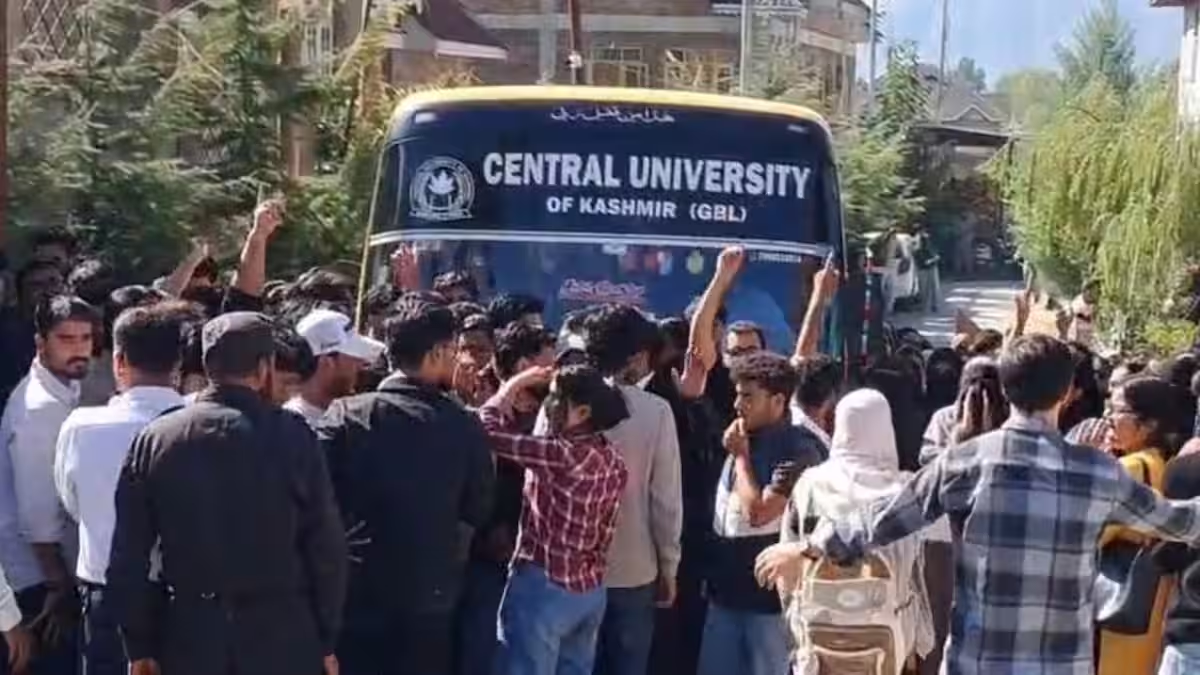
The action followed a protest by students at the university’s Nunar campus in Ganderbal district on October 1. Students alleged that the professor had made inappropriate and objectionable remarks towards female students and demanded action against him.
The allegations are serious, but they remain allegations at this stage. The university has ordered an inquiry, and no finding of guilt has been established.
What Triggered the Student Protest?
According to reports based on students’ allegations, the controversy intensified after a female student accused Baskar of making comments about her appearance and allegedly telling her that she was becoming “more beautiful” before asking her to be his “date.” Students also alleged that he used inappropriate or abusive language in the classroom.
Some students told media organisations that concerns about his conduct had existed for a period of time.
Kashmir Life reported that students alleged verbal abuse and harassment and that students boycotted classes and laboratory sessions during the October 1 protest. The university administration subsequently began steps towards a formal inquiry.
The allegations have not been adjudicated by the university inquiry at this point.
That distinction is important because an institutional response to a complaint is not the same thing as a finding that the complaint has been proved.
University Removes Him From Responsibilities, Not From the Institution
The university’s action is more accurately described as relieving the professor of his administrative and official responsibilities pending inquiry, rather than as a final dismissal.
According to the university order cited by multiple reports, Baskar has been attached to the Office of the Dean of Academic Affairs with immediate effect and relieved of his departmental and official assignments, including the headship of the Chemistry Department.
Dr Prashant Kumar Gupta has meanwhile been appointed as coordinator of the department until further orders.
This distinction matters.
An interim administrative arrangement can serve two purposes: allowing an institution to maintain academic functioning while also reducing the possibility of the person facing allegations continuing to exercise departmental authority during an inquiry.
It does not, by itself, determine the final outcome of the complaint.
Two Inquiry Tracks
The university has indicated that the allegations will be examined through institutional mechanisms.
Reports say an Internal Complaints Committee is involved in examining the harassment-related complaint, while a separate inquiry committee has also been constituted following directions from the Vice-Chancellor.
The involvement of such mechanisms is consistent with the broader regulatory framework governing sexual-harassment complaints in higher educational institutions.
The University Grants Commission lists the UGC Regulations on Prevention, Prohibition and Redressal of Sexual Harassment of Women Employees and Students in Higher Educational Institutions, 2015 among its regulations. UGC guidance states that higher educational institutions are required to constitute an Internal Complaints Committee and provide mechanisms for complaints, inquiries and interim redressal.
The university has also reiterated that students facing harassment should approach the appropriate institutional mechanism and that confidentiality will be maintained during the process, according to reports.
Why the Student Protest Matters
The immediate controversy concerns one department and one faculty member.
But the larger issue is how students respond when they believe an academic authority has crossed a boundary.
Universities operate on a significant power imbalance.
A professor may control classroom interaction, laboratory access, academic assessment, research opportunities and, in some circumstances, recommendations or professional references. A student who believes that a faculty member is behaving inappropriately may therefore hesitate to complain even when the conduct causes discomfort.
That is why an effective complaint mechanism cannot exist only on paper.
Students need to know:
- where they can complain;
- who receives the complaint;
- whether confidentiality will be protected;
- what happens after a complaint is submitted;
- whether they can continue their studies without intimidation;
- and how an inquiry protects both the complainant and the person accused.
These are institutional questions, not merely disciplinary ones.
A Safe Campus Is More Than Security at the Gate
Campus safety is often discussed in terms of physical security, surveillance, lighting, hostel arrangements and emergency response.
Those issues matter.
But safety also includes the academic and interpersonal environment inside classrooms, laboratories, offices and research spaces.
A student should be able to attend a class without feeling that personal appearance, gender or private life has become the subject of unwanted attention from someone exercising academic authority.
At the same time, institutions must ensure that allegations are examined fairly and through established procedures.
The objective should be neither automatic punishment nor dismissal of complaints.
It should be credible fact-finding.
The Boundary Between Informal Conduct and Professional Conduct
Universities are workplaces as well as educational spaces.
Faculty members naturally interact with students in many contexts. Friendly conversation, academic mentorship and informal interaction are not inherently problematic.
The difficulty begins when professional authority and personal conduct become blurred.
Comments about a student’s appearance, romantic advances, sexually suggestive remarks or language that makes a student uncomfortable can become particularly sensitive when they come from someone who holds academic authority over that student.
The context matters.
So does consent.
So does repetition.
And so does the power relationship between the people involved.
That is why complaints of this nature require investigation rather than assumptions based solely on either side’s version of events.
The University Says It Has a Zero-Tolerance Position
Registrar Nisar Ahmad Mir told media organisations that the university had spoken with protesting students and reiterated that inappropriate language or conduct should be reported to the administration. He also said appropriate action would follow if sexual harassment was established.
The administration’s stated position is important, but the more meaningful test will be what happens after the inquiry.
A zero-tolerance policy becomes credible through implementation.
Students will ultimately judge an institutional system not simply by the words used in a statement, but by whether complaints are received seriously, investigations are conducted independently and outcomes are communicated appropriately.
Due Process Is Equally Important
There is another side that universities must protect.
The professor facing allegations is entitled to a fair inquiry.
Student complaints should be taken seriously, but an allegation cannot automatically become a finding of guilt.
This is particularly important in an environment where social-media posts, campus discussions and rapidly circulated claims can create conclusions before an inquiry has examined the evidence.
The institution therefore has a difficult responsibility: protect students while maintaining procedural fairness.
That means examining testimony, available documentary or digital evidence, relevant classroom circumstances and other material that may help establish what actually happened.
What Should the Inquiry Establish?
A meaningful inquiry should go beyond asking whether a particular sentence was spoken.
It should establish the surrounding facts.
Among the relevant questions may be:
What exactly was said?
In what setting was it said?
Who was present?
Was there a pattern of similar complaints?
Were any previous complaints formally submitted?
Did the student feel pressured because of the professor’s academic position?
Were there subsequent communications or interactions relevant to the complaint?
Did any retaliation or threat occur after the alleged incident?
These questions should be answered through evidence rather than campus speculation.
Students Need a Complaint System They Can Actually Trust
The existence of an Internal Complaints Committee is necessary, but it is not sufficient.
Students must trust the system enough to use it.
That requires accessibility and awareness.
UGC’s framework recognises the need for institutional mechanisms dealing with sexual harassment and gender sensitisation in higher education.
Universities can strengthen those mechanisms through regular awareness sessions, clear contact information, confidential reporting channels, trained committee members and transparent procedures.
Students should not have to discover the complaint process only after a controversy erupts.
They should know it before they need it.
The Role of Classmates Is Also Important
The CUK episode also highlights the role of students themselves.
When a student believes a classmate is being harassed, peers can provide support without turning an allegation into a social-media trial.
They can encourage the student to approach the appropriate authority, accompany them where appropriate and preserve relevant evidence.
But they should also avoid publishing private details, identifying complainants unnecessarily or circulating unverified claims.
A complaint process is weakened when confidentiality disappears.
Universities Are Not Just Academic Factories
Higher education is often measured through examinations, research publications, rankings, placements and infrastructure.
Those are important indicators.
But a university is also a social environment in which young people spend some of the most formative years of their lives.
The quality of that environment matters.
A student who feels unsafe or humiliated may stop participating in class, avoid laboratories, withdraw from academic activities or lose confidence in approaching faculty.
That can have consequences extending well beyond one incident.
A healthy university therefore needs two things at the same time:
academic freedom and professional boundaries.
Neither should be sacrificed.
What Happens Next at Central University of Kashmir?
For now, the immediate administrative arrangement is clear.
Baskar has been relieved of his headship and other official responsibilities pending inquiry, while Dr Prashant Kumar Gupta is handling the Chemistry Department as coordinator. The allegations will be examined through the university’s formal mechanisms.
The next significant development will be the outcome of those inquiries.
If the allegations are established, the university will have to determine the appropriate action under the applicable rules.
If they are not established, the institution will still have to address the underlying concerns that prompted the student protest and ensure that students know how to raise future complaints safely.
Either way, the episode has exposed an issue that extends beyond one professor or one department.
The Larger Lesson for Kashmir’s Campuses
The CUK controversy is ultimately a test of institutional confidence.
Students should not have to choose between remaining silent and taking their concerns into the streets.
Protests can bring attention to an issue, but the sustainable solution is a complaint system that students trust enough to use before a situation reaches that stage.
For faculty members, the lesson is equally clear: academic authority carries professional responsibility.
For universities, the responsibility is broader still.
They must create an environment in which allegations are heard without prejudice, complainants are protected, accused persons receive due process, and findings are based on evidence.
The Central University of Kashmir has now begun that process.
The final judgment should come from the inquiry, not from the protest, social media or headlines.
For students, campus safety is not an optional facility. It is part of the academic environment itself. And for a university, a credible response to a complaint is ultimately measured not by how quickly it makes a statement, but by how fairly and transparently it establishes the facts.