‘What Was Taken Away From Us’: Statehood Debate Takes Centre Stage in J&K Assembly
By: News Desk | 28 September 2026
Srinagar: The demand for restoration of full statehood to Jammu and Kashmir dominated proceedings in the Legislative Assembly, with leaders across the political spectrum framing the issue in terms of democratic representation, constitutional commitments and the powers exercised by elected governments.
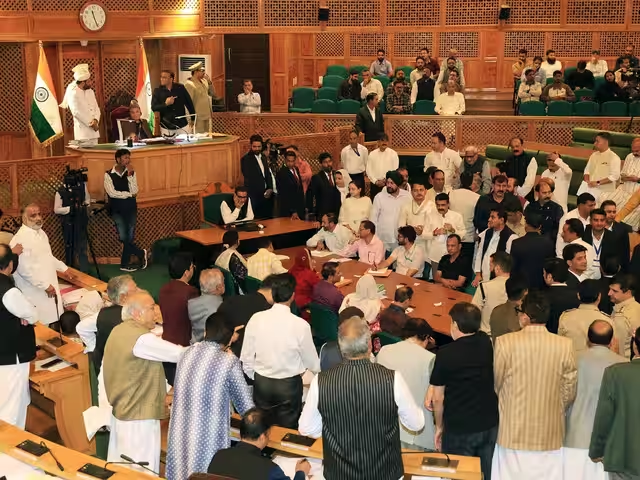
The debate came a day after the Assembly passed a resolution calling upon the Government of India to undertake the “immediate and urgent restoration” of full statehood to Jammu and Kashmir. The resolution was adopted by voice vote after BJP legislators, who had opposed its language and protested proceedings, walked out before the vote.
The resolution did not itself restore statehood. Instead, it formally called upon the Centre to restore the status and directed that the resolution be forwarded to the Government of India. Its wording also referred to resolutions adopted by the House in June 2000 and November 2024, a reference that became one of the central points of disagreement between the ruling benches and the BJP.
Statehood Framed as a Question of Rights
During the debate, CPI(M) leader and MLA M.Y. Tarigami argued that the demand was fundamentally about recovering a status that Jammu and Kashmir had previously possessed.
“We want what was taken away from us,” Tarigami said, according to a video report by Greater Kashmir, capturing the broader argument advanced by several members during the discussion.
The formulation reflected a recurring theme in the Assembly debate: that the restoration of statehood should be viewed not simply as an administrative decision but as a question concerning representative government and the powers available to an elected legislature.
Deputy Chief Minister Surinder Choudhary also defended the demand for statehood and criticised the BJP’s position during the Assembly confrontation. In remarks reported after the proceedings, Choudhary accused the BJP of opposing the restoration of statehood, while arguing that the Centre had previously committed to restoring the status of Jammu and Kashmir.
The BJP, however, has maintained that it supports restoration of statehood but objects to language that, in its view, connects that demand with the pre-2019 constitutional arrangement, Article 370, Article 35A or the pre-1953 position.
Sajad Lone Takes Debate Back to 1947
People’s Conference president and Handwara MLA Sajad Lone placed the debate in a much broader historical framework.
Lone argued that the political relationship between Jammu and Kashmir and India cannot be discussed solely through the events of 2019 or the subsequent Supreme Court proceedings. He said the reference point should instead be the commitments made to the people of Jammu and Kashmir in 1947.
“I have full respect for the Prime Minister of India and the Supreme Court of India. But if we are here today, it is not because of any promise made by the Prime Minister or the Supreme Court. We are here because of the promises made to the people of J&K in 1947,” Lone said in the Assembly, according to reports of his speech.
Lone subsequently argued that the Assembly should retain 1947 as its historical reference point rather than shifting the focus to 2019.
“The reference point in this Assembly should be 1947, not 2019,” he said, according to a report of his remarks.
His intervention broadened the statehood debate beyond the immediate question of whether Jammu and Kashmir should again become a state. Lone connected statehood with the constitutional and political arrangements that developed following accession and with the powers previously exercised by the elected government.
He also questioned the legal and constitutional basis of the 2019 reorganisation that converted the former state into two Union Territories, arguing that the reduction of Jammu and Kashmir from statehood to Union Territory status represented a fundamental change in the distribution of powers. These were Lone’s political and constitutional arguments rather than findings of the Assembly or a judicial determination.
Omar Abdullah’s Case: What Does “At the Earliest” Mean?
Chief Minister Omar Abdullah, who moved the statehood resolution, focused on the Centre’s commitment to restoring statehood and the Supreme Court’s December 2023 direction.
The Supreme Court, while deciding the constitutional challenges surrounding the 2019 changes, recorded the Union government’s submission that statehood would be restored to Jammu and Kashmir and directed that restoration should take place “at the earliest and as soon as possible.” The Court separately directed that Assembly elections be held by September 2024.
Omar argued in the Assembly that nearly two years had passed since the elected government returned to office and questioned what the phrase “at the earliest” meant if there was still no clarity on when statehood would be restored.
He also raised the question of whether statehood was being linked, explicitly or implicitly, to the security situation and militancy.
Omar argued that if restoration were made dependent on the complete end of militancy, the decision could effectively become contingent on developments outside the control of the elected government in Jammu and Kashmir. He said the decision should remain one for the Government of India rather than being determined by security developments.
The Chief Minister also insisted that the resolution before the House was specifically about statehood and did not constitute a fresh vote on Article 370, Article 35A, autonomy or special status.
Why the 2000 and 2024 References Became Controversial
The central political dispute over the resolution arose from its reference to two earlier Assembly resolutions.
The final text stated that, “in addition to” the resolutions passed by the House on June 26, 2000 and November 6, 2024, the Assembly called upon the Government of India for the immediate and urgent restoration of full statehood to Jammu and Kashmir.
The 2000 resolution had dealt with autonomy, while the November 2024 resolution concerned the restoration of Jammu and Kashmir’s special constitutional position.
BJP legislators argued that including those references changed the political character of what should otherwise have been a straightforward demand for statehood. Leader of Opposition Sunil Sharma said the BJP supported restoration of statehood but opposed references to the pre-2019 constitutional arrangement, including references associated with Article 370 and the pre-1953 position.
BJP members protested inside the House, raised slogans and entered the Well during the proceedings. The confrontation eventually resulted in their walkout before the resolution was put to a vote.
The BJP’s position, therefore, was not opposition to statehood in principle. Its stated objection was to the wording and historical references incorporated into the resolution.
Amendments Raised Over Article 370 and Special Status
The controversy intensified when several members proposed amendments to the statehood resolution.
At least 10 amendments were submitted, including proposals seeking references to Article 370 and Article 35A and other aspects of Jammu and Kashmir’s earlier constitutional position. Omar Abdullah urged members not to press such amendments, arguing that incorporating them would provide the BJP with grounds to oppose the statehood resolution itself. The amendments were subsequently withdrawn.
That decision allowed the final resolution to retain its central demand for restoration of statehood while preserving references to the earlier 2000 and 2024 resolutions.
The distinction was politically significant. The ruling side could argue that the House had adopted a direct demand for statehood, while the BJP continued to object to the historical and constitutional context in which that demand had been presented.
A Wider Argument Over Elected Power
For several members, however, the debate was about more than nomenclature.
Lone argued that converting Jammu and Kashmir from a state into a Union Territory had altered the powers available to elected representatives and placed greater authority in the hands of the Union administration. His argument reflected a broader concern among some political parties that statehood is closely connected to the ability of an elected government to exercise meaningful authority over governance.
The argument comes against the backdrop of Jammu and Kashmir’s present constitutional arrangement under the Jammu and Kashmir Reorganisation Act, 2019, under which Jammu and Kashmir functions as a Union Territory with a legislative Assembly while Ladakh is a separate Union Territory.
The Supreme Court’s 2023 judgment did not itself restore statehood. Instead, it recorded the Union government’s undertaking that statehood would be restored and directed that it should happen at the earliest and as soon as possible.
That distinction remains central to the current political debate: the Assembly can pass a resolution expressing its demand, but the resolution itself does not alter Jammu and Kashmir’s legal status.
BJP’s Objection and the Political Divide
The BJP’s opposition has centred on what it considers an attempt to connect the restoration of statehood with demands concerning the pre-2019 constitutional framework.
Sunil Sharma has said the BJP supports statehood but rejects references to the pre-1953 position, Articles 370 and 35A and other elements of the earlier arrangement. The party’s legislators therefore treated the wording of the resolution as a substantive political issue rather than merely a procedural disagreement.
The disagreement also produced wider disruptions in the Assembly, with ruling and opposition legislators exchanging slogans and proceedings being repeatedly interrupted. BJP members were among those marshalled out during the broader uproar surrounding the debate.
The BJP also moved a motion seeking the removal of Assembly Speaker Abdul Rahim Rather, alleging that the statehood resolution had been admitted in violation of Assembly rules.
Statehood Now Moves to the Centre
With the resolution passed, the immediate constitutional question has shifted from the Assembly floor to the Centre.
The resolution calls on the Government of India to restore full statehood and directs that the Assembly’s demand be formally forwarded to it. The vote therefore represents the elected Assembly’s institutional position, but it does not by itself change the Union Territory’s legal status.
The debate has also exposed different political approaches to the same demand.
For Omar Abdullah and members supporting the resolution, the immediate issue is the restoration of statehood promised by the Centre and contemplated in the Supreme Court’s 2023 judgment. For Sajad Lone, the discussion cannot be separated from the commitments associated with 1947 and the constitutional evolution that followed. For Tarigami and other members, the emphasis is on recovering the political status and powers that Jammu and Kashmir previously possessed.
The BJP, meanwhile, has drawn a distinction between supporting statehood and accepting references to the pre-2019 constitutional order.
Those competing interpretations are likely to remain part of Jammu and Kashmir’s political discourse as the Assembly’s resolution reaches the Government of India. What happens next will depend not on the Assembly vote alone, but on the Centre’s response and any subsequent legal or constitutional steps required for restoration of statehood.